How To Lead & Communicate With Clarity: Todd Cherches On Visual Leadership
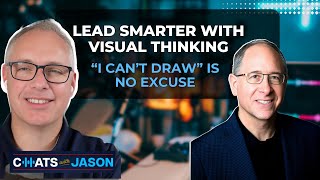
Todd Cherches explains visual leadership: using sketches, metaphors, and storytelling to make ideas stick. He shows how an iceberg metaphor or napkin sketch clarifies what leaders mean, and why our brains remember pictures far better than words alone.
Chapters
What if the reason your message isn't landing is because your audience can't see it? And what if the greatest leadership breakthrough wasn't about doing more, but drawing clearer? Hey, friends, welcome back to Chats with Jason. I'm your host, Jason S. Bradshaw, and today we're unpacking the power of pictures, metaphors and mental models with a leader who's helping the world see leadership in a whole new light. I'm joined by Todd Churches, TEDx speaker, award winning author of Visual Leadership, and the CEO and co founder of Big Blue Gumball, a cutting edge leadership development firm based in New York City. Now, Todd isn't just a trainer. He's a visual Translator. With over 25 years experience, experience in industries from television to theme parks to Fortune 500 boardrooms, Todd has coached and trained thousands, from Broadway stage managers to executives at American Express, the NBA, and even Homeland Security. He is also a three time award winning professor at nyu, a lecturer at Columbia, and a trusted consultant to some of the world's most recognizable brands. So in today's episode, we're going to dive into why visual thinking isn't just about creativity. It's about clarity and connection. How Todd's journey from Hollywood to Harvard classrooms shaped his leadership lens. And how to use pictures, metaphors and frameworks to make your message stick, your teams align, and your leadership shine. So if you've ever struggled to communicate your ideas in a way that inspires action, this episode is your visual toolbox. So let's get into it. Welcome to the show, Jason.
Thank you. That was one of the best introductions I've ever had. I want to bring you with me. They introduce me wherever I go from now on.
So I'm available. I might not be cheap, but I'm.
Available anytime you want to come to New York, I'll be happy to bring you around with me. So thank you.
Fantastic. Fantastic. You've worked in everything from TV to theme parks. As I mentioned at the top of the show, how did that journey shape the creation of visual leadership?
Yeah. If you have a chance to watch my TED Talk on the power of visual thinking, I start out by opening by saying, as a kid, people would say, what do you want to be when you grow up? And I would say, I want to be Superman. That was my first career aspiration. They said, if you can't be Superman, what's your backup plan? I said, Batman. So those are my only two aspirations. But I realized as I grew older, I needed to come up with something a little more mature. And that's When I decided I need to work in the entertainment and media industry in some capacity, I didn't really know what, but I love television. I was obsessed with television. And then my first job out of college was at Oglvia made their advertising in New York. And even though I wanted a creative job like an account exec position, I ended up in media buying which was a great foot in the door. But now what I wanted to do was very much a numbers job and I'm more of a words person than a numbers person. So I decided to move out to la. Having grown up in New York, that was a huge leap for me to move out to Hollywood to try to seek fame and fortune in some capacity. I had a series of part time jobs, temp jobs. I worked for Michael Nesmith of the Monkees. I worked for Aaron Spelling on this TV show Dynasty. I was in casting at Columbia Pictures, in comedy at Disney and drama program development at cbs. All of them at assistant level positions. It was great and amazing to be working at all these amazing world famous companies and going to wrap parties and pilot tapings and things like that. It was very exciting and glamorous. But one of the recurring themes was one horrible boss after another. Tyrannical, abusive. A lot of times as we know, people are promoted to management roles not because of that they're good at managing and leading, but they're good at what they do. And I had that pattern. So I said, something's off here. And when I dove into management leadership books and videos and things like that, I realized that management and leadership are an art and science. And I decided that's what I wanted to do. So my personal mission statement is making the world a better place, one leader at a time. And everyone is a leader in one way or another. So that's the my career background, that's what led me to doing what I do today.
Yeah, what a way to earn your stripes, right? It certainly would have been an interesting time if you were to describe visual leadership in just one sentence. What would that sentence be and why does it matter now more than ever?
Yeah. Visual leadership is the application of visual thinking to the practice of leadership. So that's my one sentence explanation and my motto is how do you get people to see what you're saying? Right. No matter what we do for a living, whether you're sending an email, speaking in front of a thousand people, having a one on one conversation with someone, our goal and objective is to get people to see what we're saying to how do you get an idea out of your head and into the heads of other people. And that's why visual leadership is needed more than ever, because we're not communicating as well as we could as efficiently as effectively. And visual leadership is a methodology and approach that I came up with over the years out of being an English literature major with a concentration in Shakespeare and poetry as an undergrad, leading through my years of working in the TV industry and eventually the theme park business. A big part of all the work I've done was around storytelling, was about the use of metaphor, was about using models and frameworks. So all of these methodologies, I've applied them to the practice of coaching and to managing into leading. And that's basically what I do, is I do that in my teaching and training and coaching, and I teach other people how to do it as well. Hmm.
So you mentioned metaphors. What's a metaphor that completely changed how you led or lived?
I love that question. The first one that popped into my head was an iceberg, right? When we say something like, oh, that's just the tip of the iceberg, it's become a phrase that we use just without even thinking about it. But if you picture. If you visualize. This is an example of visual leadership, Right. If you picture in your mind's eye an iceberg. Right. We know that only 10% of what we see is above the water level. The other 80 or 90% is below the water level. So we should always be asking ourselves, here's what we see and know. What don't we see and know? Let's say you're hiring someone. You say, here's their resume. That's just the tip of the iceberg, Right. In terms of who the person is, you interview them, the water level goes down a little bit. Now you see a little bit more, a little bit more, but there's still much more below the surface that we don't see. So just that one metaphor. If you remember the iceberg as a metaphor, it reminds us to always ask, what do I know? What do I see? But what else is out there? What am I missing? So that's just one big one that I use all the time, either consciously or even unconsciously.
Yeah, yeah. It makes so much sense. And you're right. As soon as you mentioned the tip of the iceberg, I was thinking about everything underneath it and all the guff that comes with that. You've been known to say that if they can't see it, they won't get it. Why do so many leaders struggle with Being understood. And is visual leadership the whole fix or just part of the fix?
It's not the whole of anything. It's one way of looking at the world. It's one lens. To use that metaphor, like, for example, real life example, I say when I teach the differences between managing and leading or management leadership, I say that managers, and this is not two people, these are two perspectives. Managers look through a microscope. Leaders look through a telescope. So if you just think about those two metaphors, right? So when we're managing, we're focusing on detail, we're focusing on execution. Our heads are down, we're trying to meet schedules and budgets. And right when you're leading, you're looking out into the stars, you're looking out into the future beyond what the eye can see. So leaders need to have a vision, right? Which is a visual metaphor. So you have to have a picture in your mind's eye of a future state that's different from and better than the current reality. You need to formulate that vision clearly in your own mind. But that's just part of the equation. The other is, how do you get that idea out of your head and into the heads of the people you're leading so that they see it as well? And that's where a lot of leaders miss. The boat metaphor is that we may be crystal clear. If you've ever delegated to someone and they bring something back and you say, that's not what I meant. That's not what I pictured. That's not what I expected. Whose fault is that? Right? I use one of the stories in my book. I'll hold it up, Little plug from my book, Visual Leadership. One of the stories I tell is called ice, rice or mice. I was once in a restaurant. I asked for some more ice, as in ice cubes. The waiter brought me a bowl of white rice. I said, more ice. He heard, more rice. Whose fault is that? It was my fault because I didn't clarify. I didn't close the loop to make sure it was clear. I could have held up a glass and said, I need more ice for my drink. If we communicate visually, we eliminate some of those miscommunications and misinterpretations and misunderstandings. So if you're delegating to someone, think about, am I communicating this visually? Is the person seeing what I'm saying? And if not, what can I do to improve that? So I end up with what I want, and we don't waste time and money and other things.
Makes so much sense. So I'M wondering, can you share with us a moment that visual thinking helped turn around a broken conversation, a team dynamic, or perhaps an executive pitch.
Yeah, so many examples. The first one that popped into my head was early in my coaching career, before I even came up with this methodology. I was coaching a senior executive based in Europe for a pharmaceutical company. And I won't mention the company or the country, but basically he had an eastern region and a western region and things just were not working out. He explained the situation to me and I thought this was such a stupid solution that I almost didn't even say it. But I said, instead of east and west, what if you divide your territories into north and south on a piece of paper, the little napkin sketch, I just drew the country as a circle, east and west. I said, what if instead of east and west, you made a north and south move? The east guy to the north, the west guy to the south, Would that help? He looked at me and like, oh my God, that's. It's not a hundred percent, but that's 90% of the solution to my problem. I didn't even know what he was talking about. But based on what he was explaining to me, because one region was more mature, one person was less experienced, and there were language issues and travel issues. So based on everything explained to me, it just seemed to me like a possible solution. But it wasn't until I drew it out and I sketched it on a little napkin sketch that he was able to see it in his mind's eye and envision again the word. That's all about visuals, right? Envision a possibility. He said, if I do that, that will be a big part of the solution to my problems. That always stays with me. That's one of those other chapters of my book is how 30 second napkin sketch solve the client's multimillion dollar problem. But just think about what does it take? Just pick up a pen or go up to a whiteboard and sketch something out. Because you could talk at each other, but if you write things on post its or you go up to a flip chart or a whiteboard, you sketch it out. People could see what you're saying more clearly. And then you can move things around, you can say, I didn't really understand what you were saying. This happens all the time. My coaching, I was working with a group of CEOs and they have a map out or draw out their biggest business challenge. And one guy was said to the other one, he said, I've known you for 15 years until you Sketched it out for me. I didn't really understand where your issue is. Now I see it really clearly. Let's talk. Right. So again, the success stories, there's millions of them, but those are just a few. I wrote an article for Inc. Magazine called can you draw what your company does? So I'm just going to throw that out there to your listeners and say, if you had to draw a picture of what your company does for a living, how are you similar to, different from, and better than the competition? What would you draw? Would you draw something literally, process diagram or a mind map or an org chart? Would you draw a metaphor? What would you draw? So that's an interesting challenge I pose to some of my clients.
Yeah. What a great question. And just for the listeners and viewers today, you're not saying that as a leader, you've got to be a great artist. It's not about being a great artist. It's just about putting your words into some different form, into a visual form to help unlock thinking, to help unlock understanding, and to create momentum for you.
Yeah, that's an important point. Even if you suffer from ICD syndrome, which is I can't draw syndrome, you could still use visual thinking. I always talk about two categories, visual imagery and visual language. You could use metaphors. You can tell stories. You can illustrate something through language or sound. You can hold up a picture. You could do an AI. Now, with AI, you can have AI create the visual for you. Right. So, yes, even if you can't draw, first of all, anyone can draw a stick figure. Anyone can draw a triangle, a circle, a square. So, yes, that's a great point. It's not about your artistic abilities. It's about your ability to think visually and get an idea out of your head so that someone else can say, I see what you're saying. Because sometimes people will say to me, what about someone who's blind or sight impaired? Or you're talking to someone on the phone rather than over video? Yeah. You need to use visual language to communicate your ideas.
Yeah. So beyond metaphors, we've talked about metaphors a bit, but beyond metaphors, what's some other ways that people can visually or create a vision for people but just using words?
One of the big challenges for people is getting other people to understand. Like for managers, you delegate to someone, Right. If I said to you, let's say, jason, great working with you, I just got promoted. You're taking my old job instead of just saying, here's what you should do and here's how you should do it. What if I said to you, let me tell you about the worst mistake I ever made when I had your job? And you pause. Don't you think that person's gonna be at the edge of their seat waiting to hear that story so that they don't replicate it? Eleanor Roosevelt said, learn from the mistakes of others. Life's too short to make them all ourselves. So storytelling is such a hot topic. Leadership, storytelling, the ability to tell a story, whether you're delivering a message on a town hall, whether you're trying to pitch your business to a client. Success stories, failure stories, cautionary tales, origin stories. Storytelling is a great methodology or skill to develop as a leader, to help get ideas, to bring them to life, to illustrate and add color to them. I always talk about three categories, three Fs. Facts, figures, and feelings. People are not motivated by facts and figures. They're motivated by feelings. Right. The facts and figures have to back it up. Right. So many leaders bore people to death with statistics and data and numbers, and we increased shareholder value by 3.7% last quarter. You just put people to sleep before. Right? What does that mean? What's the story you're trying to tell? Is that good? Is that bad? Is that better than expected? Worse than expected. So if you could translate your data into stories, it gives your numbers meaning, and then you can influence people and motivate and inspire people through your storytelling.
Fantastic. What would you say to someone, though, that says, the numbers matter, the facts matter, we don't need the fluff of a story?
Yeah, I'm not saying that they don't, but they may not resonate. Here's another chapter from my book. It's called How My Cardiologist Almost Gave Me a Heart Attack. That's the name of the chapter. So, long story short, I went for my routine cardiac exams, and. And the new cardiologist comes out and said. He's looking at the charts and the numbers on the screen. He said, based on your results, you have a 5% chance of having a heart attack within the next 10 years. And I almost fainted and hit my head and died on the table right then and there. But I realized, and I paused for a second, I said, wait a minute. Does that mean that there's a 95% chance that I won't have a heart attack for the next 10 years? He said, yeah, that's another way of looking at it. I'm like, yeah, you think? So basically, say, your results are perfect. So the numbers that he gave me were accurate, but Was that the meaning he wanted to convey? Was that the story he wanted to tell? Was that the understanding he wanted me to have? No. So he completely missed the mark. So that's a real life example of how, yes, the numbers matter and they're meaningful, but you always have to communicate in terms of who's my audience and what's my purpose, what do I want them to think, feel, know and do at the end of my sentence. And if your numbers, digits are just numbers on a spreadsheet, it's the story they're telling that matters. So, yes, you could say, yes, it's fluffy or it's touchy feely, but if you want to convey meaning, the meaning is in the story. The backup of that is in the data. Right.
So what hints do you have for a leader to be able to understand what's going to resonate with their audience?
Yeah, know your audience is one of the keys to any communication. If you're a CEO and you start your town hall with when I was at the golf club this weekend or at the yacht club with my billionaire friends, this is what happened. You just lost your whole audience. Who are you speaking to culturally, generationally, gender wise? I'm a big baseball fan, right? I use a lot of baseball analogies and I'm holding my Yankees thermos right now. But if I'm talking to someone in Australia, I might use rugby, or I might use tennis, which is universal around the world, or I might use cricket. If I'm talking to someone in India or Pakistan, right? So if. Or if I'm talking to someone in the uk, if I say football, I'm thinking American football, they're thinking soccer, right? So I've been corrected on that by calling it soccer rather than football. So that's what I'm saying. That's just one small example. We need to speak the language of our audience. Two reasons. One, they get you, and the other reason is they're thinking either consciously or unconsciously, you get me. So when you think speak someone else's language, that goes a long way to connecting, bonding, understanding. I keep this for those watching on video. I keep this dinosaur on my desk. For those listening, I'm holding up a Tyrannosaurus Rex toy that I keep on my desk. If you say, when I worked at IBM back in 1980, your younger people aren't thinking, oh, you're wise and brilliant, they're thinking, you're old and dinosaur, right? You're outdated. So that story may resonate, but you've just lost your Audience. Right. I once mentioned Simon Garfunkel in my class and my students thought that was a law firm or a management consulting firm. They had no recognition of the musical group. A lot of my students are from China. Right. So a 25 year old female from China is not going to get my Seinfeld references. She's not going to get my musical references of Frank Sinatra or Simon Garfunkel. So again, if you want to connect with your audience, speak their language, use metaphors and tell stories that they will say, okay, that really drew me in and they got my attention and your message really resonated.
And using the stories and the metaphors also doesn't date you.
Exactly. Yeah. It's perception. Yeah. If you want to be seen as young, hip, cutting edge and, you know, up to date, using stories from 40 years ago is not going to achieve that objective.
Yeah. Yeah. Wow. I was just thinking when you said the CEO talking about his days back in 1980, I was one. And while I wouldn't have tuned out to his message, I probably would have been thinking about other things and not got all of his message. You've talked about some of the tools that leaders can use, like charts and slides and whiteboards and sticky notes. Is there a tool or a go to tool that you use when you're traveling and wanting to lead with vision and be that creative soul to get your message across visually?
Yeah. Everyone you're talking to, including people listening to this conversation, has two thought bubbles over their heads. Why should I care? And what's in it for me? So every message we deliver should hit those thought bubbles. Why should I care is why should I be interested? What's in it for me is how will I benefit. Right. So before delivering any talk, presentation, speaking on a panel, teaching, of course, writing a blog post, I think about who is this for? Who is my audience and what is my purpose? If you start with that, then you can customize the like. For example, I did a workshop for the National Basketball Association a couple of years ago. I used a lot of basketball analogies and examples and. Right. I did something else for the US Tennis Association a year later. I used tennis metaphors and tennis examples. Right. Speaking the language, that's a deuce, that's an ace. Whose advantage? Right. So if you use that language again, they get you. They think you get me. Right. So that's the main thing. Some people pigeonhole themselves and say, I'm not creative or I can't draw. Then you can use AI just put into ChatGPT what's a good story I could tell? What's a good metaphor I could use? Talk to someone around you who is creative, could even be your kids. Right. I use a lot of props and toys and figures and so find out who, again, who your audience is, what's going to resonate with them, and then try to meet them where they live, not get them to have to meet you where you live. And I always talk about, in my TED talk, I talk about attention, comprehension, retention. When you use visual language or visual imagery, it gets people's attention and gets them to focus. It increases understanding, comprehension, and it helps them to remember retention. When people say, why visuals? There's a lot of science to back it up. There's the picture superiority effect. There is dual coding theory that says when you combine words and numbers with pictures, it's more effective than either the pictures or the words and numbers on their own. So the research, the science backs that up. But yeah, that's what I would say is again, start with who's my audience, what's my purpose, and, and what's going to help me achieve my objective, whatever that might be.
Yeah, so your work gets you into some interesting rooms. One of those rooms is as a teacher at universities, what do you see that the next generation of leaders are craving that the older generation often misses?
Yeah, that's interesting. First of all, attention spans are shorter than ever. Right. I used to give them 20 page articles, then 10 page. Now if you get them to read three pages, that's a lot, right? We're so used to scrolling on our devices, so a lot of the old ways of doing things don't resonate anymore. So we need to move quicker, we need to be more diverse in terms of, again, who our audience is. Younger people are more tech savvy, they're more proficient. One of my CEO executive coaching clients asked his assistant to do some research on something. He thought it would take him a week. The kid came back seven minutes later with 20 pages of AI generated content. Now the flip side of that is you're just getting raw content. What's lacking is critical thinking, analytical thinking, the ability to look at what you generate and say, is this accurate? Is it true? Is it relevant? Is it what we want, what we need? You know, it's saying that people are not being replaced by the robots, but people who know how to use the robots and replace those who don't. I think that we need to be more tech savvy. We need to be more discriminating in terms of processing information but from what I see from my students at NYU and at Columbia is we need to move faster than ever. They are more impatient. The analytical and critical thinking skills are not as strong as they were when they first started teaching 15 years ago. So we have to help them develop those skills and teach them what to look for. And the cautionary tales of handing in something to your boss that is not current, not accurate, can really get you and the company into a lot of trouble. So those are some things to think about.
Yeah, yeah. Interesting insights there. I once had. Not so long ago, someone applied for a job and it was signed off with regards ChatGPT. Needless to say, that individual did not get an interview. But it does show that people are looking for the fast way of completing something and not necessarily paying attention to detail all the time. I'm really fascinated by your career, Todd. As I've mentioned, you've taught Broadway stage managers, Homeland security officers, corporate execs at some of the world's most recognisable brands. I'm wondering what's one universal truth about leadership that you've discovered through your work that transcends industry?
Yeah, I think people are people wherever you go. There's a student at Purdue University, I'll give her a shout out, named Jenny Guan. Young woman, she's just a sophomore. She was interviewing people about the topic of servant leadership and she was interviewing professors and she reached out to me. I'm like, I'm mentoring enough people in among the students I teach, I don't need to take on one more. But I'm like, all right, I'll talk to her. She's had such an impact on me because servant leadership was always something I taught and referred to. And the idea of servant leadership, for those who may not know, it's literally just flipping the org chart on its head and saying, as a leader, it's not your job to serve me, it's my job to serve you. So just that little flip makes you more empathetic, makes you more compassionate, and reminds you to see things through the lens of other people. Right. So I think that's a key thing, that it doesn't matter what industry you're working in, what function you're working in. People need to want to be treated with respect. You need to build trust, you need to have authenticity. Google did that famous study called Project Aristotle in which they identified psychological safety as the single most important factor in a high performing team. If you don't create an environment where people feel they could be vulnerable, be authentic, Bring their true selves to work without fear of humiliation or punishment. You can have a dysfunctional culture and team and organization. I think that's the key unifier is that people want to be feel trusted. They want to work for leaders that they can trust and empathy and compassion. And I think having a servant leadership mindset can go a long way to creating a culture and climate that encourages success as opposed to the old fashioned command and control hierarchy that so many of us grew up on earlier in our career.
Yeah, yeah, makes a lot of sense to me. So what's one skill you wish every leader would master today?
Well, the easier answer is visual thinking is a skill. Right. Visual thinking and visual communication. But you know, I would say communication. Most of us are not working in factories. We're not manufacturing widgets. We are manufacturing ideas. Right. And those ideas need to be thought and those thoughts need to be expressed in communication. So communicating effectively, whether it's presenting, whether it's on a stage, whether it's one on one, the team meeting, even in the email, I think that's the key thing, is if you can improve your communication skills in all those different formats, that is the single biggest superpower that you could develop is the ability to communicate effectively.
Effectively, yeah, Communication. Everything starts and ends with it, really. So as we come to round out the show, before I ask you my last question today, I'll remind the audience that in the show notes there is links to all of Todd's work, where you can get copy of his book and of course, how you can follow his thought leadership. So I'm wondering if you could put up a billboard in Times Square today with a single leadership message. What would it say and why?
The closing line of my TED talk is a quote from Marcel Proust who said that the real voyage of discovery is not in seeking new lands, but in seeing with new eyes. So that's what I would put up on the billboard is that quote that I use in my workshops, the line that I end my TED Talk with. I think it says it all. It's like the world is right in front of us. We need to try to see it through a new lens and possibilities are endless.
Fantastic way to end out the show. Thanks so much for being on the show today.
Thanks, Jason. It was great talking to you.
So what if your next leadership breakthrough wasn't hidden in another spreadsheet, a strategy or a status meeting, but rather in a sketch, a symbol or a single metaphor that helps someone finally see what you mean? Today, Todd reminded us that leadership isn't just about telling people what to do, it's about showing them a vision they can believe in and helping them see themselves inside it. Because when people can see it, they can say yes to it. And when they can picture the future, they'll move toward it. And when your communication is clear, your leadership becomes contagious. If this episode sparks something in you, share it. Send it to a leader who's ready to be seen and to lead in a whole new way. And hey, don't forget to subscribe so that you never miss another episode of Chats with Jason, where real leaders share real strategies that elevate experiences and impact. I'm Jason S. Bradshaw, reminding you, transform the way you communicate and you'll transform the way you lead. Thanks for listening.
More from Jason

Bringing Wonder Back to Work | Leadership, Culture & Service with Peter Merritt







How to Lead With Empathy: Claude Silver on Emotional Bravery & People-First Culture


Inside Harley’s Cult-Like Loyalty | Ken Schmidt on Turning Customers Into Believers
