How to Leave Your 9-5 Job and Build a Thriving Business
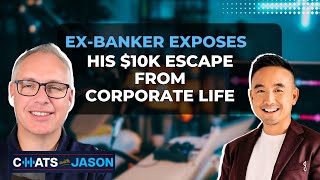
Maxwell Nee quit his corporate analyst job and spent 18 months learning entrepreneurship with almost no income. He shortens that curve by working with experienced founders, uses ScoreApp (a quiz platform between ClickFunnels and SurveyMonkey) for lead generation, and got 20,000 targeted listens from 20 podcast appearances.
Chapters
So I sold services in my first business and then I learned how to productize those services into courses. So looking back, I went through like an 18 month learning curve where I went from like making 100k a year and then I went to earning 0 for almost 18 months. Some people, it might trip their ego a little bit, but looking back at it, if I had just approach the most impressive entrepreneur I could find, that would have just cut my learning curve in half.
You're not actually trading your time for free, you're trading your time for the learnings that come from being around an entrepreneur. Welcome to Chats with Jason. This is going to be a fantastic episode and of course I'm your host, Jason Espratul and this is the show that helps you transform the experience to transform your business. Now today's guest is a multi award winning entrepreneur, a bodybuilder and a dancer. He's been featured on tv, radio and in business publications like Forbes, Singapore's Business Times and the Australian Business Review. Maxwell Nee is an investor and Chief revenue officer at ScoreApp Quiz marketing platform with over 7,000 paying clients. Maxwell, it's fantastic to have you on the show today.
Thank you so much for having me, Jason. I really appreciate it.
Now I know that Singapore is home today, but you grew up and went to university here in Queensland, Queensland University of Technology. A lot's happened for you since those university days. Can you share with us a bit of your background and how you got to being an investor in not one, but many successful businesses?
Yeah, so I used to work in corporate. I used to work at the Commonwealth bank as a corporate analyst. I love my job at the time. Got three promotions in five years, showed up, gave work 200% every day and then all of a sudden just realized it wasn't for me. Really hit a wall in my gut that I just couldn't walk into the office anymore. So I quit. And then I moved overseas because I needed a sea change and eventually founded a digital marketing agency. So I sold services, my first business and then I learned how to productize those services into courses. Then I started selling courses. Managed to get that business to about 2 million bucks a year with my business partners. It was a crazy, fun, wild ride. First time working remotely, working from a laptop on a beach, all that stuff that you think could never happen to you type of thing. And then at the same time I exited that business and an opportunity to invest in ScoreApp came along, which then I jumped in immediately and I've invested, follow up, invested three times.
Wow. We'll get to talk a little bit about ScoreApps soon and I think you've got a giveaway for our audience that we'll talk about right at the end. But I know that you're being a little bit humble, shall I say because you're the co founder of the Australian Family Office Association. You have a wine and whiskey investment body that you're involved with as well. You are sought after speaker on how to become a successful entrepreneur. How does that come about? Like I know that you mentioned just in your gut you just couldn't do this corporate job anymore. It takes a lot from getting, getting a regular paycheck every fortnight or every month to sitting on a beach building a multi million dollar business. So yeah, what you're thinking about that time, those early days, what would be the number one piece of advice you have for someone listening today that is in the same position? They know that what they're doing is not right. They want to be an entrepreneur. What's the key piece of advice you'd give them?
I quit abruptly. So most people would have had 50, 100k savings when they move overseas. I didn't, I had a 10 grand credit card because I wasn't planning for it. But I just, something was telling me I gotta get out of here, I've gotta reset my life. So looking back, I went through like an 18 month learning curve. Where I went from like making 100k a year on my corporate job. Super cushy, so many benefits. Big company like Commonwealth bank has a lot of benefits. And then I went to earnings zero for almost 18 months. And what that taught me is that it doesn't matter how smart you are, how driven you are, how motivated you are, if you're doing something new, if you're changing industry, job, products, position, role, country, there's going to be a learning curve. So a lot of entrepreneurs don't plan for the learning curve and they don't earn income for much longer than they expect. So what I learned is that there's three ways to go through a learning curve. I went through the hardest and most unintelligent way, which is the worst way is what I did, which is you self fund the learning curve, right? So you're not earning any money, you've got to self fund yourself and you got to self fund your learning. So I wasn't just earning zero, I was also investing from this 10 grand credit card into whatever I thought would help me. Then in the middle there is, you still gotta self fund yourself, but you might work with an entrepreneur for free. And anyone can do this. And I really recommend this. Some people, it might trip their ego a little bit. But looking back at it, if I had just approached, gone to a co working space, found the most impressive entrepreneur I could find and said, hey, look, Jason, I like what you're doing. I'm a new entrepreneur. Can I be your executive assistant for free? And that would have just cut my learning curve in half. And I would have. I'd be a lot further along now. And I do that now. I love asking friends, hey, look, can I just do this? Can I do this for free? And they say, why? And then I say, I want to learn this skill set. Can I just shadow you? I do that with my business partners now all the time. They must find it annoying. And then the last, the ideal scenario is you email someone like Jason and you say, hey, Jason, I would love to be your executive assistant. I saw a role that you're looking for. 1. I don't care how much money I earn, just to let you know, this is a means to an end. I wanted to do this for six to 12 months, but I will absorb everything and apply everything like a sponge.
Interesting you say that, and perhaps not surprising for me, because I know Daniel Priestley, just recently on Diary of a CEO Podcast, was asked for some advice around how to become an entrepreneur. And he was echoing what you said. To spend time with entrepreneurs, people that are at least three or four steps ahead of you so that you can learn. And even if it's for free, you're not actually trading your time for free. You're trading your time for the learnings that come from being around an entrepreneur. So really great advice there and I would think perhaps a bit of a reinforcement that just quitting and jumping on a plane, while obviously you were successful, there's different ways to go about it.
Yeah.
So you mentioned that you're a investor in ScoreApp and you've been involved in a number of investment rounds with ScoreApp. What is ScoreApp and what made you invest?
Yeah, good question. So ScoreApp is a quiz marketing platform that can help you with lead generation, collecting data from your audience, or even just transacting sales. So think of it as if you know what ClickFunnels is. You know what SurveyMonkey is. It's like a cross between ClickFunnels and SurveyMonkey, only it's probably one third of the price. Of those two put together, there's three ways you could use it. The first way is for lead generation. The really common example that people would know is you might have seen a gym, a fitness center, a personal trainer before, have a lead generation tool they're using, saying, fill in these 10 questions and I will tell you your exact body type and the exact food you need to be eating so that you can reach your summer fitness goals in half the time. Right. So that's obviously very compelling for a few reasons. It's personalized. There's two way feedback and the two way feedback is instantaneous. There's no book a call here, we'll call you back and let you know your results. Like it's immediate. ScoreApp uses that type of gamification to help businesses like coaches, consultants, authors, service providers, digital entrepreneurs generate leads.
I'm familiar with ScoreApp and some recent acquisition you did, I was familiar with your competitor as well. But a key that you talked about there was really about providing, as I take away from it at least was about scoreApp is about providing value through that lead generation process. So the client doesn't feel that they're just giving you their name and number and then someone's going to come and give them a nice salesy call. But rather there's a value exchange that of course, from a business point of view, it's designed to lead to a sale, hopefully, but the customer gets something in. And I think the key is it's a new way to attract and provide value to customers through that discovery phase of buying. I know that when we were preparing for today's recording of this show, your assistant gave me a whole list of things that we could talk about and we probably could go on for five or six hours, but I'm not quite there when it comes to long form video. But let's talk about just a couple. And I know that this is from a place of great personal experience. Having built your businesses, what are a couple of powerful strategies that businesses could use to increase the amount of leads they get? Because at the end of the day, without leads, the business is not going to grow, right?
Yeah, exactly right. One that I love to share that most people don't like to do is this. It's podcasting. So podcasting, being a guest on other people's podcasts in my mind is the cheapest, most high value way to get yourself out there and educate the market about yourself. Especially if you have a product that isn't like a physical good, like a T shirt or whatever consulting you're selling like a service. Most service entrepreneurs need a lot of education for their clients. So as an example, the average person on the Sensor podcast regularly listens to about an hour a day, which is seven hours a week. Right? So that's seven hours a week of quality time. And that's probably more time than they spend with their partners in terms of quality time. Right? And then not just that. The attention span is very different when you're listening to podcasts. The attention span is you're in learning self development mode. You're not in sit on the couch, numb your brain, watch Netflix mode. So that intent when you're reaching people through podcasts, and not just that, I did on average call it 20 podcasts towards the end of last year talking about Score app, and very conservatively, let's say each one generated a thousand listens that were the ideal client. 20,000 listens. That took me 20 hours, maybe 24 hours, including the time to book it and get all set up. Look, so that's 20,000 views of me and this and what we do and 20,000 clicks to our link. If you were to fill out Madison Square Garden in New York, the seating arrangement in there to be Justin Bieber, to be Kevin Hart, to be performing in there is only 19,000 people. You know what I mean? And what does it take to book that, to get that type of attention and spend that money to get people in there when you could be doing something like this at no cost? Extremely high leverage. No cost.
So why, like you started by saying that most people won't do it? Why do most people shy away from these sorts of activities?
Yeah, so I think that there's a few things, usually entrepreneurs, when they're really good at what they do, they're not good at talking about themselves and what they do. So they might see this as like self promotion. And no one likes that, especially culturally in Australia, no one likes that. But it's not that I'm not talking about me, I'm talking about Score. I'm talking about ideas. I'm talking about things that could help people. So there's just like a little pivot that a lot of people get stuck with that Happy will be shy. And I used to be scared of public speaking, like everyone. I think the numbers show that people are more scared of public speaking than they are dying. Right. So it does take a bit of training to get to the point where you could do 20 in a short period of time. But if you can get past that, you have a big opportunity.
And I would think too, certainly from my personal experience, I wonder if you agree that it's about Getting started, like, maybe even the first dozen interviews that you do on a podcast are less than great. But you have to start somewhere. And the more that you do, the better that you get at the art of being interviewed or interviewing. Right?
Yeah, exactly. And yeah, I get it. It's putting yourself out there, publishing something. The world can see it. You feel naked. I get it, I get it. I've been there. We've all been there. Right. I'll tell you something that's helped me. So I am writing a book right now. My first book. Want to get it out? All my friends are authors, and I've been stuck on it all the same reasons. And I'm aware that I'm in this bubble of excuses. So now I've really stapled myself down to the mindset of my goal isn't to put out bestselling book. My goal is to publish 10 books, and this is just one out of 10. It's about the quantum and the quality of work, but also the quantity of the quality of work.
Yeah, that makes a lot of sense. And I think it's easy for us to get in the way of ourselves. I've already published a book. I should have by now published my second book. In fact, if you spoke to my publisher, he would be telling you that he's been asking for my manuscript for a couple of years. So it's easy for us to put excuses in there. But I like how you reframe the goal. It's not about publishing one book in your case, it's publishing multiple books. So you have to get along because you can't get to 10 without doing your first one. Great insights for us there. I was thinking about going back to ScoreApp and how you were talking about it being a quiz marketing funnel. Does that allow you to give a more personalized client experience? Is that a key differentiator in the market these days?
Yes. There's so many benefits. Right. But yes, it allows you to collect really data rich leads from your client. That's really important because personalization, segmentation is everything. If I was to log on to Amazon.com and you were to log on to Amazon.com, we would both see completely different websites because Amazon's got 10 years of my purchase history, 10 years of yours, and it knows that to get the most out of me and to optimize my experience, I only want to see the things that I want to see. So you have the opportunity to do that. You also have the opportunity to allow your clients to tell you exactly what they want. So it's not just about you do a quiz, you get a score and then it's okay, you scored 72% out of 100. Let me help you get to 100 from a business coach, from a consultant or whatever. What would you love to see? Oh, I would love to see a bit more hand holding. I would love to see, you know, so you could actually just pull out of your clients heads exactly what they want. It's a bit like a focus group. You know how big advertising companies would do focus groups to put like a microwave in front of them in the 70s? And I'd say do you like this, do you like the color? They collect that data. You can do that using this app. And it's free. You know the base version is free. So you get started for free.
Yeah, and I think there's a couple of things there. It takes away the excuse. You can't say I'm not the big business, I'm not the big corporate, I don't have all the resources. Whether it's ScoreApp or apps similar to it, it is about enabling you to get started and get started for free. But it is also about giving that customer a differentiated experience. How can you give them almost a one to one experience while crowdsourcing data to improve your product offering and deliver a better experience? So you've mentioned coaches and consultants a couple of times in your examples but I would think that you could use this type of tool for almost any product that you're sell.
Yeah, I've seen it done really well in the E commerce space as well. So I signed up to this E commerce store in the uk. It was a health food store and they sold everything. They sold like gym bags to shakers, to supplements, to protein bars, to powder and I was only interested in the protein powder. So as soon as I made my first purchase it said what else would you like to see? What would you prefer? And then it only showed me what I wanted to see. So that encouraged me to open up more emails, less of their emails, go into spam and then you've got this compounding effects that might only be 1% a day or 1% a day forever. This compounding effect of iteration and improvement.
Yeah, it makes sense that it doesn't have to be like this massive big bang approach. It can be that 1% better every day. Not everyone's listening necessarily. Heard of ScoreApp? Can you share with us an example of a couple of the success stories that people have had with Score app?
Yes, it gives people Uncharted territory. If you have a product that's very intangible. For example, if you sell like personal branding, there's a testimonial on the website, woman called Hannah Power. She's a, she's a personal branding consultant and she provided a score to evaluate your personal branding based on questions. And it was a total game changer. She generated 800 leads of people that were very interested in what she had to offer that she had no idea. And you can't go around saying to people, your personal brand's crap, so you should work with me. But the scorecard can point out those gaps objectively. Right. And then we also had another one, also super intangible, which was emotional trauma healing. You can't walk around the street, people don't put stickers on their heads saying, hey, I need emotional trauma healing. They have to self identify themselves. Right. So it's about that self identifying your needs. The scorecard can help you pull that out of your audience.
Yeah. And surface up to your customers the real root of their problem or the real gap to what they're trying to achieve in a way that feels more organic than someone just perhaps hosting an event and saying, these are the three reasons you're failing.
Yeah, exactly. Some of our longest clients that have used it have 25 person sales teams and each one of their sales teams members use it and they use it as like a needs analysis tool. You can imagine whenever you go to doctor, you say, hey, Mr. Doctor, I'm sick. What's wrong? I don't know. Okay, let me help you diagnose that. Are you coughing? Do your eyes hurt? Have you been sleeping? Are you sneezing? Are you feeling tired? And then based on them ticking those boxes, they cut and slice, they filter the symptoms and laser into the problem and then the solution that solves a specific problem to you. Anyone can use it for that, to accelerate template and empower the sales process as well.
Yeah, that makes sense. And I love the use of the tool in perhaps the least obvious way, which is behind the scenes with the sales team to help guide them, make them more efficient and deliver a better experience ultimately for the customer. And I'm sure that leads to some phenomenal conversion rates. I know that because it's public diligence on your website, Score app has managed to secure itself some pretty big names when it comes to customers, especially in the online space. Ali Abdel and others who have these massive brands, personal brands that they've created and from that launch products and services. How did ScoreApp go about securing someone like that or were they with you from the early days of their business and you grew together?
It's a bit of both. So first of all, they had a need. If you go to a website, we just refreshed it. It says something like attract, convert and collect data from your audience. So anyone that has an audience, anyone that has a following, an email list, a YouTube following, Instagram, Facebook, podcast following, it turns those into leads of people with the contacts. So influencers in particular have a huge gap. They've got a lot of followers, but they don't know anything about them. They don't know if they're mostly male, mostly female. They don't know if they're actually interested or they just watch them for comedic purposes. They don't know. So we help them to know as well as a lot of it is just genuine old school relationship building. Jay Shetty used to be one of the examples on the website. Dan's known Jay Shetty for more than 10 years. I know that we're talking about digital world and sexy and fast and automated, but the analog world is still just as powerful, if not more powerful.
Yeah, yeah, absolutely. And it's important reminder that it's in business. The relationships that you form are important because you never know when you can serve them or they can serve you. Now, how do audience understand? Do I need to go off to Score App University to learn how to use it? Is it something that only the IT experts can use or is it something that a small business owner that's pretty humble when it comes to using technology could sign up and use easily and start getting, as you say on your website, start attracting, engaging and converting the audience.
Yeah. So I think like 80, 90% of our clients are solopreneurs, so they don't have a marketing team. So we've put a lot of money, effort and time into making it plug and play, copy and paste, that type of thing. But let me give you a head start. So we have copies of this book called Scorecard Marketing that goes into, first of all how it works so you understand what levers you're pulling in your audience to have it work and then how you can install it for yourself. So I can get some of those free copies out to people in your audience, Jason. They just need to go to scoreapp s c o r e app.com forward/book and we'll get them out of physical copy. If not, they'll get a PDF.
Fantastic. And certainly appreciate you and the team providing those. I know that you Also provide a whole pile of templates and other resources to help people launch and be successful on the platform. Before we wrap up, I've just got a couple of questions for you. The first one is perhaps a little bit controversial, but why would someone not use Score App to grow their business?
Yeah, that's a hard question to answer, but let me, let me think about an answer. So.
And it's perfectly okay and I am putting you on the spot. I didn't give you any warning on this question. I'm hoping, or at least I'm thinking and just for the audience sake. I'm not an affiliate of Score App. Other than being loosely aware of the platform and some of the deals that have happened, I have no insider knowled. But when I will go to the site and I've had a look at the app, I've tested how to play. I can think of times when I was in a corporate gig, C suite, corporate role, where I'd be challenging my marketing team to be using something like this in the business because it's not traditional, but it can deliver from a major corporate perspective. It's not traditional, but if a customer's looking to buy a car, they could go through the ScoreApp platform and get a recommendation for what's going to suit their lifestyle. If I'm a business coach, I can see how using this can help define the next logical step for a customer. So now a bit tongue in cheek, but I can't think of a reason where it wouldn't be worth exploring this.
Yeah, me neither, to be honest. Like, it covers a lot of ground. Like one other bit that it covers that we didn't mention is simply using it as a survey tool. So we've all been to a five star hotel where at the end of your stay they ask you to fill out a survey. Well, you could digitize that process using scoreApp. Right. So there's not a single company on the planet that wouldn't get value out of surveying its clients.
Yeah, and certainly my audience will know that. I'm a big believer that you don't have to ask your customers a whole pile of questions. Just three questions will really make a difference in terms of how you can serve and deliver value to your customers. And ScoreApp is a way that you can start. So my call to action is stop the excuses, start getting to know your customers. Score App is one of the tools available to help you do that. Now, Maxwell, we don't have time today to get into your life as a bodybuilder or a dancer, so we'll leave that for another time. But before we do let you go today, what's one thing you think the audience should do as soon as they finish watching today or listening to this podcast?
Yeah, look, if you're struggling, take action. Like, if you've heard a whole bunch of good things on this podcast or previous ones before on YouTube or whatever, and you're literally struggling to take action. And I've been there, and so is Jason. The easiest thing you could do is to change your environment, because I could promise you your house, your couch, your bed, the airflow, the air conditioning, something is just cluttering your brain. And if you can just declutter your brain, which you could do that physically by changing your location, you will at least give yourself that leg up to help you take the right actions to do whatever you want to do.
Fantastic advice. Change your environment to help declutter your mind and allow you to move forward, to break through whatever that challenge is. Maxwell, it's been absolutely great having you on the show. I'll be sure to leave details in the show notes on how people can get a copy of the book from scoreapp. Thank you again, and I look forward to keeping in touch.
Perfect. My pleasure. Thanks, Jason.
More from Jason

Bringing Wonder Back to Work | Leadership, Culture & Service with Peter Merritt







How to Lead With Empathy: Claude Silver on Emotional Bravery & People-First Culture


Inside Harley’s Cult-Like Loyalty | Ken Schmidt on Turning Customers Into Believers
