Lead with Vision, Not Just Strategy | Visionary Leadership with Dr. Oleg Konovalov
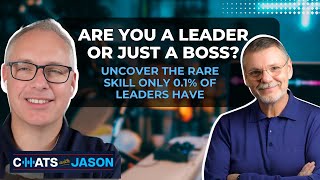
Dr. Oleg Konovalov argues that vision is a leadership responsibility, not just a statement. He describes vision as a space combining value and effort, and walks through a pragmatic process: clarity, scalability, ownership, and continual renewal.
Questions this video answers
Less than 0.1% (as stated by Dr. Oleg in the interview).
The Vision Code.
Beyond Chaos (expected to be published in the autumn, per the guest).
Chapters
What if your biggest leadership breakthrough wasn't about leading people, but about seeing a future so clearly that they chose to follow? Hey friends, welcome back to Chats with Jason. I'm your host, Jason S. Bradshaw and today's conversation is going to challenge everything you thought you knew about leadership.
Foreign.
We'Re joined by Dr. Oleg Konovalov, a global thought leader known as the Da Vinci of visionary leadership by Thinkers50. He's a best selling author, trusted advisor to Fortune 500 leaders and one of the world's most respected voices on turning vision into reality. So in this episode we go deep on why vision is not luxury. It's a leadership responsibility. How to build a culture where everyone sees the same mountain and climbs it together. And the real reason most leaders fail to inspire lasting change. This isn't about buzzwords or theory. This is about crafting a legacy on purpose. So get ready to rethink your role as a leader because as Dr. Oleg says, Vision is the noblest part of leadership and the rarest. So let's dive in. Dr. Oleg, welcome to the show.
Jason, thank you very much for inviting me into the conversation.
I absolutely agree our leaders play such an influential part on our employees experience. So I want to start with a story today. Can you take us back to a moment where you first realized that vision wasn't just important, it was absolutely everything.
First of all, it was my personal aim, like from within. I was brought up in a fairly tough environment and you know, just like communist environment in the old Soviet Union where the future was fairly blurry and it was like my craving what I'm doing, where I'm going, you know, it's all those things and they were ticking in my mind again and again and again and again. So it was some kind of my passion how to find that answer in business. I spent many years in the fishing industry in the uk so I was quite a shark was in fishing industry. And then so I have gone from being a second engineer to a CEO position and I realized that majority of shit is don't have any clue where they're leading people. They're very good at all sort of manifestation. You know, just like we're celebrating five years anniversary of our company or 10 years anniversary of our company. Come on, age deserves pension. What have you achieved? What have you done beyond the reports? And so the story remains the same as I see because I found that less than 0.1% of modern leaders actually have real vision. The majority or the vast majority of leaders, they have strong statements. You can't do much with a statement. You can't capitalize on it, you can't share it as a legacy. You can't share with anyone else. It's in the space is just your promise. So you must be real. Because leadership is about leading people into the future. It's exploring everything. You are starting from knowing nothing about the future and you're creating that future which will be beneficial for others. Another thing is it's about how to be better every day. Because leadership is not about how to do. You have managers for this. It's about how to be how I would lead people to make them better and greater for that future.
I love that differentiation that you make. A leader's job is how to be. A manager's job is how to do. I think we can quite often get caught up or leaders get caught up in the do bit because so often they get promoted into a so called leadership position because they were good at the doing as opposed to any necessary leadership traits. I'm wondering, what do you believe separates visionary leaders from everyone else?
I have a very strange approach. First of all, most or many people have difficulty sinking into a space. Vision is always a space. As I said, it's not a statement. Because when you're creating a space full of value, multidimensional space in the future, you must sink into that future. And there are two critical elements of that space of vision. First of all, value. What kind of a value you would offer people today? Leaders and executives are very good at putting a price tag, but you can't scale it. Price doesn't reflect the real value. And when I'm training companies, I'm always asking, okay, let's take a piece of paper and write down actual values that you offer people. Then based on this, you could create or define the price because you could scale the value. You can't scale the price. And the second element is effort. Because when you see something big and something important, you're committed, you're putting all your energy into it. It's about energy that people put together. Everyone who's involved, they are shouting about this phenomenal product or service or space. They're promoting that space in a simple way. I'll put it that way. It's like being married and having a happy family. Being married is a social exchange, doesn't have real value. Happy family is a space of husband and wife they created together and they're reshaping. They're finding a new meaning why they are together and even going through tough times because life is never smooth. But they're making that space greater, greater and greater. It's a space.
So in your book the Vision Code, you say the vision is the noblest part of leadership, yet the rarest. I'm wondering why is that so? And what do you think is holding leaders back from embracing vision fully? I know you've mentioned leaders are good at making statements, but not creating a space for the future and seeing into that. But I'm just wondering if we can go a little bit deeper. Why is it so rare? And what's holding people back? What's the fear behind the inaction?
This is. We could write a list. Why it's difficult for some people. And the first thing first recently completed a new research project, practical research. I hope this autumn this new book be out. It's called Beyond Chaos. Majority of people are not thinking deep into the future, they're sinking into the present. You can't create the future or define the future if you're thinking into the present or even into the past. One thing many people are thinking about their desires, not aspirations. Because desire is something that we want to have at any cost. Better house, better car, you know, just like some kind of a fancy status. And therefore they're feeling their ego. They are not creating that space of value for anyone where visionaries, they are feeling their aspirations. Aspirations is about something we want to create and this is where we're creating a space. So there are elements of it which must be there if you're thinking about feeding your ego. You wouldn't be a visionary.
Okay.
You'll be not a desperate guy.
Well, we don't want to create more desperate people. So give me an example of what you would consider aspirational versus something that's a desire that feeds an ego.
There are well known cases. For instance, we know this famous pre WD40 and they're just like 520 people. They're working for this company and their capitalization is about three and a half billion dollars these days. And you could find that spray in every garage, in every kitchen, every Formula One team. That's a well known example. Amazon, Tesla. How about a simple example that people are hardly noticing that in 1996 Pepsi created a space for simple drinking water. Today we're using these small bottles of drinking water which was considered nonsense until 1996. Now every time we go to a gym or we are on the road, we're just grabbing that little. So they created the space of counter packed drinking water. For instance, a phenomenal startup from Finland and I worked with Them, it's called selfly, they're producing vending machines. They started few years ago, now they are in 25 countries, they have more than 100 clients and they consider themselves as Google of vending machines. And they started with just an idea. Now I will tell you, last year it was an exhibition in Helsinki for startups and the queue just to their stand was about 1,000 people. Just wow. Because people think, hey, that's really something we want to get involved with. Could be whatever you're saying, it could be movement. There is a huge movement these days with approach because I do train people on visionary leadership and all those things. One of these phenomenal ladies, Dibola from Nigeria, few years ago she gone through my program. Now she created a movement of about 70,000 people visionaries in Nigeria. And they're growing. So it could be whatever the fool product, service, you could do whatever you want to.
Okay, that's great, that's great. So you've worked with organizations and leaders across the globe to help them see the future. What's the process? What's the core for helping leaders develop a vision that's both inspiring but importantly executable?
First of all, it must be executable, right? Otherwise it's just another illusion. And vision, as I mentioned, it allows 25, 30 times greater monetary value because it's pragmatic, it's functional, it's investable. So you must be very clear what you are creating and the challenge for many leaders, and this is where it's beginning of this stuff, work to help leaders with clarity. It's not about oh, we have an idea or we have a calling. It's about being very pragmatic, what we are creating, how it is valuable, how people would benefit from it. So it's about being really realistic, it's about growing. Because if you want to build something big, you must be big yourself. It's for giants, it's not for dwarfs. And of course you must make it pragmatic. It's a process called caviar. And your vision must be really viable, must be scalable, it must be simple. It must have all the elements of value who are responsible and must be simple. And it must be created on your passion, not just it sounds like a good idea. Those big things are helping me to grow. And it's of course about influence. You must make others the owners of that vision. And of course it's about execution, it's about strong leadership, it's not about consensus. And so you're creating a visionary culture, you're Maintaining focus and will you enabling decision making. You're moving hundreds following parts in one go. And of course it's about revitalizing your vision all the time because you can't create the same vision for 20 years. Vision is always live, it's dynamic, it's more or less. It's your ability to express how you love others in different way every day. Famous Chocolate Lindt, they're revising their vision every year. Famous charities called Junior Achievement, they're helping like 11, 12 million young people to gain their first profession. They're revising their vision every three years. So vision is always life. So it's a process and you think it's not just a process itself. It's about mindset, how to think into the future in a very productive way.
Yeah, just picking up on your point there around clarity. What's your best tip to help someone get clarity? Is it just asking additional questions like how can you get Super Cryst clear on an idea? Because I think a lot of people just go surface level. So how do we get that, that deeper clarity?
Okay, good question. First of all, think clarity is a shareable leadership resource, right? Because it's not about, oh, I have clarity, but people can't grasp. What kind of clarity do you have? We need clarity when the things are in chaos around us and chaos makes things messy and it pushes us. Therefore, the first thing first you must pose for intentional silence. Because the number of changes that we are facing daily, it's environment in which we are pushed every day, every moment, we are pushed forward and therefore we don't have even time to think. And if you want your thoughts to meet with solutions, you must pose intending to have intentional silence even for five minutes, for 10 minutes. And then you start seeing opportunities within that mess. Because every chaos has a pattern and you could see that gaps within that pattern. And then you must be very clear. Structured thoughts, structured thinking. Because chaos ruins that structure. Or have clarity about something that I can't explain that it's not a clarity. Your thoughts must be very well structured. This must be very simple. Because you can't pit the complexity of today's world by over complicating it. The only remedy in this sense is simplicity. And of course you must be true to yourself. Because if you wear a mask, that means it's wrong starting point. You must be true to yourself. What's your passion, what you want to create, who you are. And of course it's about, it's about ability to think forward because all the solutions are there ahead of us, not behind us. So it's a model I call Passad. You must be very clear about this because otherwise clarity would sound something very murky that you can't share with others. Yeah.
Okay, so let's shift gears just for a moment. If you were to explain leadership to a 10 year old, what would you say? How would you describe leadership to a child?
Leadership is a responsibility to make you and your life better. It's one thing. I have a little son, he's eight and a half years old and he's in Shotokan karate. I used to be in martial arts when I was young and I'm telling my son the way I've been taught all days. In karate. Leadership is defined in a simple sequence. If you have a problem, talk to me. If you create a problem, deal with me.
Makes a lot of sense. Makes a lot of sense.
Yeah, but reality is who you're going to be under my leadership tomorrow.
Yeah. I love that piece about responsibility for being a better self first, you know you can't be a better leader if you're not taking accountability for yourself to improve. So I'm sure you've heard the saying, Peter Drucker said that culture eats strategy for breakfast. How does having a clear vision influence culture? And how can leaders make sure that it's more than just a poster on a wall?
One of the most difficult things these days for vast majority of companies is shared vision. Because people are not united anyhow. Because it's not about having corporate events, just like, oh, we're having a party together, you know, and we will have a hangover tomorrow morning, all of us. No, it's not about this. It's what gets this energy, all of us, all our effort together. And therefore culture is not just a catalyzer of performance in terms of leadership. Culture is about controlling the soul of organization. Those who control the soul, they control the body of organization. If leaders don't control it, someone else will, but for their benefits, not for the company benefit. What happens? Culture is an inner energy of organization of all people and direct towards achieving one goal, company goal. It combines all the talents, all the efforts, all the competence so combined together. And what I always say, there are two counterparties in this sense. Leaders are paid for creating leadership resources such as trust, shared vision, professionalism, accountability, innovation. Because in the good common sense, leaders are highly paid, not because the building of a sudden became of a greater value overnight. It's all about market, but how they working with it to gain those resources and utilize those resources. I Must get engagement at that personal level. This is where I need to talk and get involved with people every day. I need to take care of them to gain that loyalty, involvement, respect, commitment, all those elements. Without people, every vision, every strategy is just a piece of paper. It's all about people.
So there's a lot of myths out there about leadership. If you could think of one myth that you would love the world to retire, what would it be?
The most common one is that leader must be born. First of all, it's a simple premise. It's a decision to be a leader. To make a decision at any point and learn. For instance.
Yeah, yeah, that makes sense. So if the entire business world could hear you say one sentence about visionary leadership, what would that sentence be?
Almost ancient. We would achieve much more with using far less resources. And we will be much more productive. And our kids and grandkids will be proud of our achievements.
So as we come to wrap up the episode, I'm wondering, what's one thing a leader listening today or watching this episode? Do you think that they should start doing as soon as they finish watching?
I would ask counterintuitive question. How much you're losing in your life, in business by not a strong vision? Because if you think how much you would lose, and it's phenomenal, the amounts are phenomenal. You're losing focus, you're losing resources, you're losing everything. More or less, you are preparing your business bank of the records.
What a great way to wrap us up. What if the greatest gift that you could give your team wasn't just a plan, a target, or yet another KPI, but a vision that they could see, feel, and importantly, believe in. Today, Dr. Oleg reminded us that leadership isn't about controlling the present, it's about illuminating the future. Because when people know where they're going, they don't just show up, they step up. They don't just follow orders, they follow purpose. So here's the challenge to you. Don't just lead projects, lead possibility. Don't just manage performance, inspire a mission. If today's conversation is something that has stirred in you, share it. Send it to a leader who is ready to trade control for clarity and compliance with commitment. And if you haven't already, hit that subscribe button. Because the world doesn't need more noise, it needs more leaders with vision. I'm Jason S. Bradshaw, reminding you better business begins with bold vision. Because when you transform the experience, you transform everything. Thanks for being with us on this episode of Chats with Jason.
More from Jason

Bringing Wonder Back to Work | Leadership, Culture & Service with Peter Merritt







How to Lead With Empathy: Claude Silver on Emotional Bravery & People-First Culture


Inside Harley’s Cult-Like Loyalty | Ken Schmidt on Turning Customers Into Believers
