Live
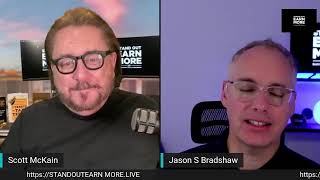
Scott McCain and Jason S Bradshaw preview the free Standout Earn More Live workshop and explain why narrowing your target customer matters: lower service costs, happier employees, stronger loyalty. They walk through how to find your ideal customer by asking buyers and non-buyers what problems they face.
Questions this video answers
December 15, 16 and 17 — 1:00pm to 4:00pm US Pacific Time.
December 16–18 — 8:00am to 11:00am Australian Eastern Daylight Savings Time (with some VIP bonus time).
$87 (VIP upgrade includes 90-day recordings and one-hour daily Q&A hot seats).
Chapters
Foreign. Welcome, everybody. Time for us to talk a little bit more about what it takes for you to stand out and earn more. I'm Scott McCain, as always, joined by Jason Bradshaw on the Gold coast of Australia. Good morning. Your time, Jason, how you doing?
Well, thank you. And good afternoon. Your time, Scott.
Thank you.
Good. Good to see you.
Thank you. Same here. You know, we, we have tended to wait until the end of our conversation to talk about it, but how about if today for those that are just, just joining us, we mentioned that coming up next week we have the standout Earn More live program. And so that is going to be very exciting. And Jason, if you will talk about it for a minute, getting a message that we're having trouble streaming to your restream.
Yes, you are indeed having troubles. It's not coming through on my end. But not to worry. Next week we won't be having the challenge. We'll be on a different platform. The Standout Erdmore workshop is delivered over three days, three hours each day, December 15, 16 and 17 US Pacific Time, 1:00pm to 4:00pm and in Australia, that's Australian Eastern Daylight Savings Time, December 16, 1718, 8:00am to 11:00am there's some bonus time if you're part of the VIP program. But US Pacific 15, 16 and 17 December, from 1:00am To 4:00pm the standout earn More workshop where you will learn how to create, or I should say, generate repeat and referral business without discounting. And if you were listening yesterday, you'll understand just how important that is in terms of growing your business. So learn how to generate repeat and referral business without discounting. You'll learn how to attract and retain great employees without increasing your overheads. And that also works for your contractors, your freelancers, those people that you trust with serving your customers. And then we'll wrap the whole program up with a nice bow to help you stand out from the competition without the gimmicks. And we all know how easy it is to stand out if you use gimmicks. But they don't last. They don't generate loyalty. And we're going to show you how to stand out from your competition so that you can truly build a distinctive business, so that you can earn more, earn more money, earn more credibility, Earn more can be many things. It doesn't have to be just money. But certainly that will be one of the byproducts of attending the Standout Earn More Live workshop. You can register right now, go to StandOutEarnMore LIVE. Registration is free, but you do have the option to upgrade for $87 to the VIP program, which gives you all of the recordings for 90 days and a bonus 1 hour Q& A session with hot seats at the end of each day, turning it into a phenomenal event and the guaranteed way to make sure you can move fast and get ready to have a great business, a bigger business in 2023.
You know, Jason, one of the things that strikes me is there's so many things in today's world that carry risk. You know that there's a football coach, Bruce Arians, here in the States, American football, who says no risk, it no biscuit. There's got to be some risk to get some reward. And that is not the case with this program. It is absolutely free to sign up. We'd love to have you there. And there's no obligation, as Jason mentioned, there is the opportunity to upgrade a VIP to get some extra bonuses, but the program itself and the content itself is absolutely free. So we'd love for you to join us next week. There's a lot of great information that's going to be coming your way, Jason. The website is crawling across the bottom of your screen right now. Standoutearnmore Live as Jason. Mention Jason. I think this is one of the really, really difficult, challenging and important issues. And I know we'll be covering this in greater depth when we're together for the program. But it's certainly an issue that is worth bringing up now and that is who's your ideal customer and how do you define that and what happens when you do define that? I think the other aspect that's really challenging is that many of us in small business want to appeal to everybody. We think that if we have a, if we cast a very broad net, then we have a greater opportunity to close a deal, to close a sale, to make something happen. And my experience has been that's, that's not true, but I'm really interested. Based on your vast corporate experience, is that an issue that small businesses and solopreneurs should be concerned about as well?
Well, I think it represents a great opportunity for small businesses, for solo entrepreneurs to, to differentiate themselves. You think about, you know, when I was the chief marketing officer for Volkswagen Group Australia, every single week there would be pressure on me to spend money to talk to everybody. Now the reality is not everyone that drives a car could afford to buy a car that the Volkswagen Group sold, and that's perfectly okay. Now there's also customers that could probably buy the entire fleet of cars, but never Would yet, because, you know, it's a global company. Massive brand recognition for good and not so good reasons. There was always pressure to do these general campaigns, and I mentioned earlier in the week that businesses, large corporates, really struggle with understanding their return on investment. Because a lot of the time you say, oh, yes, but it helps people know the brand. It's like people saying, no one knows who McDonald's is. Let's run a campaign so that we know who McDonald's is. It is not the way to successfully spend ad money and get a return on investment. So what would we do? We would, in every instance, talk about who is our ideal customer, who is most likely to buy from us. Now, from an advertising point of view, we would also consider who are on the fringe. Who are those fringe customers that may stretch up into the brand or may consider it as a second car, you know, and they have their Porsche as their primary car, for example. And so my position is that you can't even talk about your fringe customer until you know who your customer is.
Yeah, you can't talk about the fringe to get the core. Right. I mean, totally agree.
And if you know who the core is, this is where your marketing becomes super effective, because you can use their language, you can talk to them in ways that they understand, not in. Not in a way that's trying to offend nobody and hopefully make enough people happy that they'll do business with you. Now, I'm not saying you have to offend people just because you know who they are, but it makes it so much easier to talk to them if you know how they communicate. You know, it's no good talking to a customer about white glove service if they don't know what that term means.
Right.
So I. I believe that unlike large corporates, a small business, a solopreneur, has the ultimate capability to really focus on who their ideal customer is. The owner, the team members are much closer to the customers. They're also not burdened by shareholder pressure to be everywhere and everything to everyone.
Duane says here his ideal customer is the one that pays their bills on time. Bit of humor, bit of truth. I get that. I get that. You know, you make such an important point, Jason, because one of the things that is absolutely fascinated me in the. In the research I've. I've done on creating distinction is that we assume that by being distinctive, we will attract. And that would be a correct assumption. But along with that, it means that being distinctive means that you can't attract everybody. Our good friend Larry Winget says If you want to create raving fans, you have to also be willing to have raving enemies. Because if you are positioned in such a way that people are going to be crazy about what you do, it also means by its very nature that there are going to be people that don't like what you do. That's really hard for an entrepreneur. It's really hard for a small business to think, well, we're going to, we're going to turn these people away or we're not going to appeal to this kind of group. But it becomes a great conundrum, I think, because we get businesses that are studying their competition, imitating their competition and trying to be as vanilla as possible so that they don't turn away anybody. And in the end, they just become adrift in that sea of sameness. They are a commodity. They are, you know, not indistinguishable from the competition. Joe Calloway, our friend, just chimed in. Your advice to know your ideal customer is spot on. The wrong customer could drain you in many ways. You know, we, we, we need to talk about that. Jason, Joe makes a excellent, excellent point. Is just the energy that it takes to serve the wrong customer. The ideal customer is likely to become a lifetime customer and will send others your way. Joe, that is, that is, as always, so, so spot on. Jason, could you give us from, from your experience, some, maybe an example, maybe with your organizations in the past, maybe not organizations that you've seen that have spent a lot of energy, other resources going after the wrong customer?
Well, it is. Where do you start? Think about a Motel 6. There's a reason Motel 6 doesn't advertise in the First Class Lounge, in the Admiral's Lounge, at the Delta First Lounge. Because those customers, when they turn up, do they get a bed? Yes. Every hotel room hopefully gives you that. Do you get a bathroom? Yes. Like, it ticks the foundations of what a hotel stay will have. But if you're flying first class, you're probably more used to an experience that is a Marriott or a JW Marriott.
Or.
Another brand that's not a Motel 6. So if Motel 6 went and spent some money to acquire you, and especially in these tough economic times, it becomes a conversation. If I can get my hotel room cheaper, I'm going to consider it. But then you turn up and the staff comes, just constantly keep getting calls. Where is this? Where is this? Where is this? You know what? Why don't you have 24 hours room service? Why don't you have these things? And that, my point Is that when you attract the wrong customer, you actually spend more time serving them, trying to make them happy. I know. You know, so many times I would have people, when I was at Target, we would have people call into our contact center going, my $5 t shirt that's three years old has fallen to bits. Yep, that's right. It cost you $5, and you've just cost me more money to answer the call than it did to sell you the $5 T shirt. Now, it's a bit of an extreme point, but if, if Target was marketing to the, to, to the luxury goods shopper, then the number of people that are calling in saying, my $5 t shirt doesn't stand up like my $5,000 t shirt, it seems. It seems insane. But it happens every single day in contact centers around the world where they get call after call, complaint after complaint, because the product doesn't perform to the expectations that that shopper has based on where they normally shop. And so if you're a Target, talk to people that shop at Target or that, you know, are on the fringe of that. Not the, not the person that's going to buy the $5,000 handbag.
Yeah, yeah, absolutely. And vice versa. If you're selling the $5,000 handbag, you don't want to be advertising to the crowd that's going to shop Walmart. Right. I mean, nothing wrong with shopping at Walmart. Nothing wrong with it. If you can buy a $5,000 handbag, you know, good for you. But, but it's so true that, you know, the marketing messages are different and the level. And that's. That's become a particular challenge, I think, for a lot of businesses is the expectation level of customers continues to go up. It's almost. It's the old line about no good deed goes unpunished. Right. We serve our customers. My great friend Dr. Michael LaBeouf wrote a book called Greatest Management Principle. GMP Greatest Management Principle. It was since retitled Getting Results. But I like the previous title better. And here's the greatest management principle in the world according to my friend. I agree. Behavior rewarded is behavior repeated. The problem is we don't examine the behaviors that we are rewarding. Therefore, we get behavior that we don't anticipate. For example, to use your example, Jason, part of what happens is that we do a great job for our customers. We serve them. They're buying a $5 t shirt, but we give them $100 service. Well, what happens is that's where we start the next service with them. They have now come to expect that they will elevate their expectations. And. And we're going, wait a minute. We treated you great that time. Don't you understand? No, they don't understand. They don't care. They got this great level of service and now they expect it to continue. And it really creates challenges. So part of what we have to do, I think it's part of why identifying our ideal customer is so significant, because we will know how to reward them to get more of the behavior that we desire. Whereas if we give these kinds of rewards, you know, it's funny, I, for, I don't know, 13 years in a row was a diamond level medallion flyer on Delta. And it got to where at the last quarter of the year, I would fly from Indianapolis to Chicago to go to Atlanta to connect to Orlando so I could get the number of segments so I could keep that level of service. So customers will respond when we set the bar and reward them for attaining that. But we've got to think about that. Scott has an interesting point here. This conversation is very much appreciated. I'm at the point of pivoting by adding another service with the hopes my company will change direction. Yeah. And that's. Scott, I love that you use the word pivot, because that is. That is something that we often need to do. If we identify an ideal customer, it means we need to pivot towards them. And by the way, when you pivot, it also means you kind of turn your back to something and not in an offensive way. But I think there are some customers out there that our businesses would all be stronger if we turned our backs on them, if we stopped serving them. Agree? Jason? Disagree.
Absolutely. You can't possibly be all things to all people in your personal life or in your professional life. And when you try to do so, there's another cost. It's not. You know, I mentioned the cost of the call center spending money serving the customer. That expectation doesn't match the reality. And that's because the marketing message got them in. But the other cost is the cost on the employee who has to sit there day in, day out and take the negativity, take the abuse to the contact center manager that is like, oh, no matter what, I've got to hit this KPI and this KPI and this KPI. We create these challenges for our employees. And the more challenges that we create for our employees, the harder it is for them to stay on purpose and to deliver the experience that we actually want to be famous for. You know, Southwest Airlines is, well A, they don't operate in Australia. And I know who they are and I knew who they were before I had ever gone to America because they are interesting everywhere. Used as an example of how to do business differently with the customer at the heart of what they do. Yet Southwest Airline is 100% double down on ensuring that they only market to their ideal customer. And by doing so, their employees are focused on delivering an experience that matches their marketing and one that uplifts everybody, as opposed to bring stress and new challenges. And, you know, I often joke that the problem with Southwest being so good at what they've done, you know, the only airline in American history to be profitable every single single year. Okay, yes, the profit number varies greatly, but a black ink on your balance sheet is much better than the red ink that most airlines have had over the years. One of the challenges of being so good is that they're always held up as these case studies. And so you have people like me, you know, land into la, you know, fortunate enough to be in a lay flat bed, get off of my flight in la, go through customs, go, I would need to try this Southwest thing and go, what do you mean you don't have an assigned seat? They're like, but we didn't market to you. We weren't trying to get you as a customer. We were trying to get the people that love us to come back to us. And there are very loyal Southwest customers. I don't think anyone in Southwest marketing team in their customer teams going, who's our customer? How do I get more customers to talk about us? They do it in droves, and they do it in droves because they know who they're serving, they deliver on their promises, and they make an experience that is worthy of remark.
I think Andy saw my last boarding pass on Southwest C40. You nailed it. That's so true. Yes, that tends to be, that's one of the problems I have when I fly Southwest is I keep forgetting that the sooner I check in, the better number that I get the number seat, you know, that I get. And so, yeah, I've ended up C40, where you're, you're in the middle seat in the back row. But, you know, it's interesting. One of the challenges that Southwest is experiencing now that I'm reading about and have experienced personally is as they have grown so dramatically and grown. You know, when Herb Kelleher was running, it was very, dragged his feet quite a bit about expanding in new markets. It was very, it was a big deal. When Southwest came into a market. They've expanded so much that. How do you maintain the organizational culture when you've so rapidly expanded your operations and. And your number of employees and everything else that goes along with that? It's a very interesting challenge for Southwest. And as you continue to promote from within, you know, who are you promoting? There was an article recently about how one of the things that Southwest had done is promote operations. People who are concerned about getting the plane from point A to point B, who might be overlooking some of the important aspects of that customer experience that's so different, so unique, and so what they're known for. So this whole process we're talking about today never, never stops it. It's not something that you've done. It's something you continue to work on, something you continue to do. Yeah, Andy, that. That has been the get to know you seat has been the one, as I wrote in a book, trap between the most recent penitentiary parolee and evidently a retired sumo wrestler is typically my. My seat mates when I'm in the middle seat. Ted says it exactly right. Ted summarizes it perfectly. Trying to please everyone makes you distinctive to no one. And it's so true. You know, it's really interesting because when we talk about some of the distinctive performers out there, whether it's an actor, a musical group, whatever it might be, the ones, you know, I know people that are just tired of Tom Hanks. That is. That is absolutely. I can't wrap my head around that because I think he's extraordinary. But even people that we think, oh, everybody likes them. No, it's not true. I know someone very well who thinks the Beatles were just terrible. I don't get that. But to Ted's point, the more people you try to please, the less distinctive that you are in the marketplace, which means the less attractive that you are in the marketplace. Dwayne is interested in questions you can ask to help peel back the layers to determine if a customer is right for you.
That's.
That's a great question, Jason. What I've got a couple. What would you suggest that people, entrepreneurs and small businesses be asking to see if. If a particular customer is. Is right for you?
Well, one of the questions to ask is what is their primary challenge? What are the problems that they face the most often, you know, and I say that because your product, whether it be a physical good or a service, should be trying to solve problems to add value, to enrich someone's life. And so what is the common every single day challenges lifestyle that this individual has, you know, think about if I go back to my Target days when we, when we bought out the Everyday Essentials line, it had a different name in the US But Everyday Essentials line. The whole reason that that came out is around affordability because the ideal customer at that stage in Target was really focused on affordability. And they didn't need a T shirt to last a decade. They needed a T shirt to last the child's growth spurt that six months, that three months, that, that year. And you know, they were talking to the university student that was going off to college for the first time and setting up their, you know, dorm room and wanted a toaster or you know, it's their, you know, they're probably on their first part time job. They're not going to spend $500 on that nice stainless steel model. They want the $5, $10 one that's going to do the job and you know, will doesn't matter if it breaks down in three years time because they're probably going to throw it away anyway. And so what, what is the average day of your ideal of your customer doing? And then see if there's a community you can serve that you know, that is what is their average day and what is their challenges? They're the two questions I would start with.
I love that, I love that. That's, that was going to be my point as well. We're on the same track about, you know, what are the problems that they need, that they need to get solved. A reminder as well, not exactly on this point, but a reminder as well that if they identify a problem that is not in your wheelhouse, if your customers, as you talk with them identify a problem that is not really specifically what you solve, you're better off to refer them elsewhere than to move heaven and earth to try to solve that problem, hoping they will buy something else from you. Because first of all, if it's not in your wheelhouse of what you are all about, within your clarity, then the fact is there's probably somebody that could deliver better than you. And you run the risk of discouraging that customer from future purchases because you haven't delivered at the standard that they would like to. But the second thing is when you refer someone else, when you say that isn't exactly what we do, so let me refer you to someone that this is right, perfectly perfect fit for their skills and their abilities. The trust that you gain from that means that when that customer is looking for what you do, they think of you first because you have gained such a reservoir of goodwill with that customer that. That you've proven that you're trustworthy. You know, if you'll say no to what you don't do, then when you say yes to what you will, the customer has a deep and abiding faith that you're going to be able to perform because you know what you do and you were willing to send them elsewhere for what you don't do.
And, Scott, you know, there's some really easy examples to go to where that has led to companies being famous, you know, for sending customers away, but for the right reasons. And Zappos, which Tony Hsieh. Rest in peace, Tony. But Tony founded that, was an early investor in that business and ultimately its leader. He focused his team members on doing what it takes to serve your customers because that will build loyalty. I remember sending a tweet to the Zappos team saying, I'm coming to Las Vegas. Where should I stay Day now. If you don't know who Zappos is, I'd be shocked. But they're a shoe retailer originally, and here I am asking them about where to stay now that not only did they respond, they gave me multiple suggestions and offered a whole range of choice. But in their wheelhouse, which is selling shoes, I reached out to them and said, I want to buy a particular shoe. I'm going to get it shipped to my hotel room. And their response was, we don't have it in stock, but we have found it on this website and they'll be able to ship it to you in time for you to, you know, to get the shoes. Not only are they recommending people for things that they don't sell, they're recommending to people, their competitors, when they can't deliver on their promise. Now that's going to the next level. And it's a very, you know, it's more advanced than it sounds. But, you know, the. The reality is when I'm hungry and thirsty, Coca Cola doesn't try to make me the food as well. They leave that to someone else because they want to be famous for having the most refreshing drinks out there. You, in your business can be the Coca Cola of your industry, the Zappos of your industry. By focusing on delivering immense value in what you do best and helping people find their way to those auxiliary services that. That they may also need.
Samuel has it right. Service is actually caring about people, caring about customers, caring about their results, caring about what they. What they can achieve and attain because of your products or services. Sam is spot on it's exactly right. And, and that comes from caring employees. And caring employees are created by entrepreneurs and business leaders that care about their team. So all of that, you know, fits in well. Jason, we're about out of time. The question I would ask, and it's similar to the one that Dwayne asked just a little bit ago. If there were, let's say I'm in the position where I'm trying to, you know, trying to sell to the world and I've heard the conversation that you and I have had and so now I'm, I'm going to determine my ideal customer. Could, could you give me some steps, some ideas of how I get started to narrow it down to my ideal customer? You mentioned about problems earlier. Maybe that's, maybe that's the first step.
Well, you know, I would say the very first step would be to register for standout Earn more the online workshop. But I somewhat trying to make a joke and you should register if you haven't already. But the, the reality is that if you want to know who your ideal customer is, get 50 people that buy your competitors products in a room and ask them questions. And, and you know, if you want, want to really double down on getting clarity around who buys your product or who might buy your product, get 50 random people that have never bought your product and if possible your competitor's product and ask them why they don't buy it. Because sometimes getting clarity around why people won't buy your product unlocks who your ideal customer is.
That's a great point. You know, it's really interesting how many organizations I've worked for and I'll ask them some kind of question about what's the goal of the organization, what is the overriding purpose? And more times than I can count, the response has been we want to exceed customer expectations. So then I ask, okay, so what do your customers expect? And they will say, well, we believe our customer. And my response is always no. What's the data? You know, how many customers have you asked this of how many have, of your competitors customers have you asked that question? You can't, you can't exceed an expectation of which you are unaware. And what we have to do is exactly what you said, Jason. We've got to be talking to our customers. We've, we've got to be talking to those who've chosen to buy elsewhere. We've got to have these ongoing communications because it's the only way that we're going to be able to determine how, how we target our Ideal customer in a way that's cost effective and gives us the return on investment that we desire. And I want us to close. I'm going to ask you for a last thought in just a second, but I want to echo what you were saying about our free program next week. We are going to be conducting a workshop on next Thursday, Friday and Saturday. It'll be different days for the folks in Australia because of the different time. But just go to StandoutEarnMore live. StandoutEarnMore live. We're going to be talking about how you earn more freedom in your business, how you earn more respect, how you earn more profit, of course, but how you earn more of the type of customers, the target customer that you desire, hey, maybe even the target employee. Because in today's world, where we are hearing so much about challenges in staffing, we have some ideas and some very specific approaches to help you get on board the kind of people that you. You desire. High performers. So all of that is going to be covered over the three sessions that we'll be conducting next week. It's absolutely free to sign up. If you'd like more like the ability to download the sessions and you'd like the ability to have hot seats and longer conversations with Jason, myself, you can upgrade for a very, very minimal price to a VIP seat. So the session itself is absolutely free. We would love for you to be a part of it. Just go to standoutearnmore.live and it will give you all the information about the dates, times, everything else for our program next week. So last thoughts.
Jason, once you know who your ideal customer is, it gives you the opportunity to. To maximize the impact of every dollar you spend to attract a new customer. Because you get to hang out with your ideal customer where they are and join the conversations they're having so that they decide to do business with you.
Spot on. I wrote in one of my books that you better know who your target customer is. You know, you can't imagine Barney the dinosaur performing at a penitentiary. You can't imagine a very erotic play in a convent. Those are very outlandish examples. But the fact of the matter is, Barney's done pretty well without appealing to that demographic group, right? I mean, they know who their target market is. So that's what we have to do as well. Know your ideal customer, and that's who you want to be distinctive with. That's who you want to stand out for. Because when you do that, you'll earn more. Hey, Jason, we'll be back here tomorrow with a new topic at the same time. So I look forward to seeing you tomorrow. And thanks to everybody asking questions and really, really appreciate your participation. Thanks, Jason. We'll see you tomorrow.
Thanks, Scott. Thanks, everyone.
More from Jason

Bringing Wonder Back to Work | Leadership, Culture & Service with Peter Merritt







How to Lead With Empathy: Claude Silver on Emotional Bravery & People-First Culture


Inside Harley’s Cult-Like Loyalty | Ken Schmidt on Turning Customers Into Believers
