Mastering Change: Unveiling the Key Questions for Success
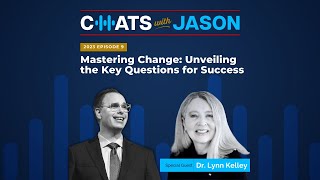
Jason S. Bradshaw interviews Lynn Kelley about her book Change Questions. Most organizational changes fail because of weak leadership visibility and poor communication. Kelley's core advice: define the value-driven purpose upfront, support middle managers with clear messaging, and run pilots before full rollout.
Chapters
Well, Lyn, it's so great to have you on the show today. And congratulations on the release of your new book, Change Questions. Pleasure to have you here today.
Thanks, Jason. So good to be here.
So, Lyn, an impressive career across many different industries. You must have faced the reality of big organizations trying to manage and navigate change almost on a daily basis. Is that what led to this great book or what motivated you to write the book?
All my failures. Because seriously, I mean, every single time I failed, I researched what I could have done differently and I just really went, I went to the research like the peer reviewed stuff, the university stuff. I wanted to dig deep. I've probably read every change methodology out there. There's so many good ones. And I kept trying things and then just in terms of how that led to the book, is that I, you know, people started asking me as, as I gave them, I just gave away my method and told people and they said, oh, do you have a book? Do you have a book? And I'm like, no, I'm not writing a book. And then Covid hit. So between Covid and my failures, two really bad things, that's where the book came.
Well, that's definitely a way to find the silver lining in any situation. And good to see that your Covid time was spent creating this masterpiece that, that will help people going forward. Now a question that I think we need to ask right up front is why is organizational change so difficult? Why does it fail so often?
Oh, I know, I know. And there are a lot of reasons. So I mean, again, let's talk about research. The two number one areas is lack visible leadership support. So not just leadership support, but making it overt and visible and letting leaders know that they need to show people that they support it, not just say they do. That's the one thing the top two things tie, it's that one and communication. So just poor communication around the change. And then after those two biggies, there are just lots of other ones. And the reason for the book having 11 change questions, which is really too big for a set methodology, is because some of those, when I said every time I failed, sometimes when I looked up what I did wrong, that only happens within 5% of the time. So it's too little to make it in a six step methodology. But for me, I was just working, trying to, trying to make things stick. And one more thing is every single time I added a question, it seemed like my probability of sustainment just increased from that 30% that everyone says is average. And a lot of Studies say between 30 and 40% sustainment success rate of any change initiatives about what you can expect. But I could see it going up.
Well, it makes a lot of sense that change isn't a cookie cutter business. No two businesses. Whether you're, I would argue even if you're a solopreneur, you go through change. Right. The change in yourself, change in market conditions.
Right.
And of course, if you're a Fortune 500 company, well, change is, is a constant. But not one organization is the same. Not, not two pieces. You could be implementing two pieces of software that do the same thing ultimately, but have a very different way of making that work and impact on individuals. Right. So it's not surprising that you've got 11 questions. The question, chapter one in your book Intentional Change is not for the faint of heart. This point on intentionality in change, does that mean you think some businesses change just for the sake of it?
Actually that's. No, that's not what I meant by that, but I do think that happens. What I meant is that when you go to all of your work to create your solution, that thing you're going to implement either. And I talk a lot about sweeping organizational change because I was in two Fortune 200 companies and we're talking really, really, but also within those companies. In fact, we had a factory in Wollongong, Australia where I would come once a month and loved, loved, loved being there. Even when we implemented things at a factory, at one 100 person factory, it is still really difficult. And it's not for the faint of heart. And the word intentional is there because what I believe is knowing that the failure rate is so high that we have to be intentional. After we define our solution, what are we going to implement? We have to say, well, we're not done. We can't just announce it and roll it out tomorrow. We have to put a little bit more work in it and we have to make sure that we're mitigating the risk of failure. And that's what I mean by that is just put the extra work into it. It's not that hard and it's worth it because it's, if it fails, you know, you, not only do you leave poor morale and a flavor of the month, you make it, you just make it harder the next time to do another needed change, you know, so you have to be really intentional about it.
Yeah, let's, let's unpack that. The, the, my, my. I was specifically being provocative in that I wanted to understand if it was about the Intention. I love, I love Provocative change program.
Yeah, we're good.
Or was it just. Some companies just change because they want to. So let's just assume that the change is not. Because it's, well, easy to say we'll just make everything better by changing and they're not actually changing anything but having really visible leadership support that intentionally is focused on, if I hear you correctly, implementing the change, but sustaining the change. So not, not just ticking the box and saying, okay, we've updated everything and then move on. It's, we've updated everything and continuing to show that visible leadership and support for that new way of doing things. Right?
That's, that's correct. It's, it's necessary all the way through as well as the ownership to say and part of the change questions. What we think about doing is we think about saying what is the value that we expect to get from this change? Because a lot of times, you know, we're marching forward for an implementation plan that's time based. By this date, everybody will be trained. By this date, you'll start doing it. And is the value that we want to get from that trained employees? Well, maybe, but you train them for a reason, right? So within that whole process, you really, you want to think about what's the value. And then we measure the value. And that's part of what we expect from leadership or someone in the organization to say, are we continuing to get the value? Did we ever get it in the first place? Just because we trained them, we said go, go forth and do. Did we really get it? And then if we got it, then let's measure for a while. But also if we didn't get it, how can we tweak it and not call it a failure yet? Because it could be. We're like almost there. And maybe one of the studies I found that like 16% of the people in organizations that are asking them to do and they've been trained and all this other stuff. So employees want to do it, 16% of them want to do it. But there's something in the system that prevents them from doing it. It might be the way their success is measured. It could be that they don't have a tool that's working exactly right. And if we give up or just say, okay, we're done, we implemented, everybody got trained, everybody did it, and just assume that we got it, then we're missing a great opportunity to tweak and get better. And so leaders. But we just have to own all of that. You know, we really do.
It'S an alarming stat. 16% of people want to make the change work, do the work, but they're missing a piece of the puzzle that's preventing them. And I think it comes back to that visible leadership showing, not just saying that you support it, but actively being visible in supporting it, because that would lead to conversations that potentially unlock that missing Jigsaw piece. So very, very interesting there.
Well, and just one more point on that is that, you know, nobody, nobody wants to be told what to do. And I think especially not leadership. So. Well, what I really recommend is when you go to leadership and you know you're going to roll out an organizational change, and in many cases I was reporting to the CEO, so I would be like part of that leadership. But instead of kind of losing my authority to say, you're going to do this, what I would share with them is, this is what we're going to be. We need your support. So tell us, give us ideas of how you think you can support this. And some people would say, I can walk the floor where it's taking place. I can ask them, can I remove any roadblocks for them? Some people said, I'd like to train my own people. I want to understand this. So we get all kinds of answers and then we take that and then we synthesize it and then we go back to leadership in this catch ball kind of process. So think about already you've asked them, how can you support it? You've already overcome a big psychological hurdle because in their head, they're visualizing themselves doing the change, supporting it, and now you've got them a lot closer than they were initially when you told them what to do, which no one likes that. And they often, they do the opposite or just give lip service. And then we go back to them and say, okay, this is what you and your peers said. Choose a couple of these things and tell us what you're going to choose so we understand what's the most helpful and meaningful and then sign up for, can you do this? Can you do these support visible support activities with your employees? And you know, now you've got a double loop of them seeing themselves doing it. And you know, a lot of what I tried to do, well, actually, I didn't even try to do it every time I failed. A lot of times what I found out is that it came down to human psychology. You know, what, how do you motivate people? How do you get buy in? And can we do all this up front before we already burned our Bridges and have a failure behind us.
Well, it's interesting that you mentioned the whole executive team because we've both sat on executive teams and I'm sure we've both been faced with the situation where we are charged with leading a piece of work which could potentially just be primarily related to our business unit, our division. Yet the individuals want to see and hear that the whole leadership team, the whole executive team is behind something. And yet so often organizations forget that it's not just about the person whose division, who's the head of the division, but it's about that executive team. You had some clues in there for us in terms of how to get that buy in and that support. And I just want to highlight that it was how can you help the change? How can you show your support vs will you or you will. You're not giving them, you're not giving them the option really. You're just saying how can you find a way to support this? So that's great. Now thinking about, thinking about middle management in organizations generally, they're the ones that have to do for what of a better term, the grunt work.
Exactly.
The change.
Right.
How, how do we, how do we support them as leaders? How do we support them in the change? But more importantly, how, how do we have to communicate differently to them to help them be successful?
Yeah, so some. Well, we've, you know, one of the things that we found really worked well at Union Pacific Railroad is we cascaded the change through the leadership ranks so that everybody experienced, you know, we started at the top. This was a major organizational change that involved culture and everything else. And instead of, you know, implementing across the board to everybody, we started at the top with that visual leadership behavior. And then we, we cascaded all the way through the organization so that by the time you got, you know, middle managers, they can look up and say oh yeah, everybody's doing that. The other thing that I always talk about and I learned this so such the hard way and I'm so thrilled because it was one of the best lessons I ever learned about change is I had a change that I thought was really, really easy. And by, by then I had the change questions were really delivering strong results. I was up to like 70% sustainment rate of every, hundreds of changes across, across globally 32 different countries. And, and then I, I threw out a change that I, I perceived as really easy. I mean it was only 10 different countries, maybe 250 people. They all knew me, we had had relationship. I knew I had, I knew every one of them by name. Um, I mean, I just was like, this is easy. So I, I said, in a meeting, look, this is what we're thinking about. I just want to, you know, let you know it's probably coming. Whatever, whatever, whatever. Let's get some feedback. We did a little bit of discussion. So then like two weeks later, I just said, okay. And I sent the email, okay, hey, we're doing it. And oh my gosh, the pushback, like, you know, I was like, are you kidding me? But it's not even a big deal. Change. Are you kidding me? And, and I, and I really dug deep on that one because I had had like, by that time, seven change questions. And I thought, how in the heck did this happen? That caught me out of the blue. And I found something early on written, I think in the 1990s by Michael Hammer. And he talked about the change curve. 20% of people accept change, 60% are neutral, and 20% pretty actively or at least passively resist the change. And then I also read another article about something called in a Harvard Business Review about operational speed and strategic speed in the sense that you want to really, when you're implementing, you want to keep checking and making sure it's working and you want to start small and let it spread. And so I thought, huh, well, then I would think with that middle part. And then of course, Malcolm Gladwell's the Tipping Point, you have to get critical mass. So if you implement to everybody, the people with the loudest voice are the resistors, and they pull that neutral group, which you can't afford to have them pulled in the other way and start the momentum going in the wrong direction. So, so basically I, I would all. I really have always tried now to do a pilot. A lot of times you can't do a full blown pilot, but you might be able to do a little simulation. You get a group and you say, okay, if we were to do this, let's walk through it. How would, what would this be like? What would be your reaction and get the real reactions? And then to help support their leadership and the middle managers through the rest of the company, when that's going to happen, when we finally roll out, then every time we got a little success in the pilot and the learning trial and the model line and the simulation, whatever it was, we had leadership talk about it. Oh, this great cool thing is happening. We got this success or we got great feedback on it, or we, you know, do a podcast, or we do, you know, a real live kind of thing, interview or article and suddenly, you know, fear of missing out, you've got that middle group going up. But how come. How come they have that? How come I don't. Again, human psychology. But that also created that momentum that we're middle managers who might be neutral, start to look and go, oh, I want that. And then, and then eventually, you know, people that naturally resist and look, I, I don't, I don't. I get it. I get it. If you've been through a ton of changes, resistance may be just, you know, you may want to just say, you know, I've seen enough of this with this organization. I'm. I'm not doing anything new. I. Look, I get it. So I'm not labeling them in a negative sense. What I'm. What I mean to be saying is, let's let them be. Let's let them be. Wait till, wait till we've got the tipping point, and then it's going to come to them. And then at that point, they will find, even for themselves, so much easier to accept. So I think a lot of that is also really helpful.
I'm just sitting here thinking how important it is that no matter the size, type of change that you're dealing with, no matter how much, you know the people that are involved in the change, that the value of doing those. What seems insignificant sometimes, especially when, you know, everyone involved, those little, those little proof point exercises, whether it's a pilot or a simulation or something else, what I would call the proof point exercises are really key to delivering that change because it in itself is part of that communication journey of reinforcing that the intention behind the change is actually deliverable, is achievable. So I think that, I think that's a great lesson. I was thinking, as you're talking, I was thinking through some of the changes that I've been involved in, and I'm definitely guilty of going, well, they all know me. They know that it's going to be fine.
It's all good.
That's it. The corner on the plate going, what on earth is going wrong?
Exactly. You know, Jason, one other thing that we give to managers, because I want to finish that question thoroughly because I love this next one is one of the change questions is what we ask ourselves as a team implementing the changes. We try to gather all the frequently asked questions, even the really, really hard ones, because. And then we get the answers, the right answers. Sometimes, if it's union, you have to go to union, you have to go to legal, you have to go to hr, you get the Right answers. But then you give that all those questions and answers to managers and if the company lets you, you put on the website, because otherwise managers have to make it up. You know, people there, people come to this. Will this mean my hours will change? Will this mean I'll. That I may lose my job? Does this mean we're going to cut employees? You know, I mean, why let, why put managers who have middle managers especially who have such a difficult job in the middle of all, you know, both, both people pulling them in all directions. Let's give them all the tools they need to make sure that the change is successful and it doesn't take that long, you know, and it's such a beautiful thing to that, that thing to help managers out.
I think also it helps cement the change because quite often when you go down the path of individuals, let's say making up the response on the spot, you know, they're not doing it with any negative intentions.
Right.
But the problem with that is the consistency. A manager rate will say X, manager B will say X minus one. And you know, eventually you're not even at X anymore. People, people are starting right back at the little first letter of the Alphabet and people then start to have a mistrust.
Absolutely right. And you know, the other aspect of leadership that I didn't mention, because there's a lot of stuff bundled in that lack of visible leadership support. One of the elements that also brings that to the very top of the reasons why some change fails is lack of a consistent message. So, you know, you give people these frequently asked questions. We also in, we have a pretty, I recommend a pretty much robust communication plan that does include the key messages. And then we really try to hammer in on if it's three key messages or five, then every article, every speech, every anything, we give those key messages to managers and we say when you talk about this change, these are the things that we want you to hit on just to give the consistent message. So it's. Yeah, there's a lot of little. That's the thing is that there's so many little reasons too, that why change fails. And if you can hit as many of those and mitigate as much risk as you can, then you can see really good. I think like when I left Textron, we had a 90% sustainment rate of hundreds of initiatives every year across the organization. And because, you know you've mitigated all the risk. Right. You just, and it doesn't take that much longer. And how, what a waste of time it is to Put in a change and have it not sustained. That's a, that's a bigger waste of time than putting in the time in the beginning.
Yeah, yeah, absolutely, absolutely. So out of all the questions in the book that you ask, is there one that is your golden question? The one that no matter what you.
Always ask, I always ask purpose and the way. And if you already know it, you have it done in a minute. Right. But if you don't really know it the way, that is what is the value driven purpose of the change? And there's two elements of that value, and I mentioned it. We want to know what value we're going to get from this because people have a fundamental need. I don't know if you have kids. My kids are grown and now I'm onto my grandkids. But you know, terrible, like toddlers are the terrible twos, the threes are why. And get this, every, every three year old asks why an average or most of, of eight times a day, like every day, like all the time. And, and, and that fundamental need doesn't go away. Studies have shown that even millennials have a stronger need to know why they're being asked to change than any other group in the workplace right now. So, so we owe it to employees and to be able to tell them what is the purpose and what's the value we're going to get. And then that all feeds into the key messages and, and we get alignment with leadership because it could be that leadership isn't aligned. So, you know, I always ask what is your value driven purpose for this change? And, and it doesn't take that much time unless you don't know it. And then you, then you needed it to ask it. So, so it's not a, you know, it's just a really efficient question. You write it, you're done in three minutes. If you don't know it, you need to know it.
Yeah. And I'm thinking also in the process of asking that question, and I hope that when you're asking it, you're not just asking yourself, because sometimes we have blinkers on and we'll think our answer is the great one, but when we're answering that, I think in the process you might even find a way that changes the change program. You might realize that actually Project A needs to be project A with a little bit of polish on the side because you didn't really understand what it was going to deliver at a meaningful level. And by meaningful, I'm not just meaning from A. Let's all feel good and hug each other perspective. I mean, meaningful, culturally meaningful from a shareholder return. Meaningful in every possible way that an organization should be measuring. So really, really, really glad that I didn't lead you to, to that purpose question that that was the one that you chose because.
And I'm glad you understood it so well. I mean, you're, you know, you hit the nail on the head when you described it. Absolutely.
Yeah. Yeah. I'm. As you were talking about consistent communication and making sure that you continually reinforce the message, I was at an organization once and relaunched a completely new division, a new program, programs as part of that. And every, every single time I was in front of people for probably 18 months, I would talk relentlessly and at times nothing about nothing else. Then the five core elements of the program.
Good.
And even if I didn't talk about all five, I'd talk about one of them at least. Right?
Exactly.
And so people were like, you're like a broken record. I'm like, yeah, but everybody knows what I'm talking about. Everybody in the organization remembers it. And then a few years later, we had to make a tweak to a couple of those pillars. And I'm like, it's rinse and repeat people. We need to make sure it's top of mind and that people understand why we're doing it because otherwise we're going to lose the battle. And they'll talk about stuff from five years ago. Look, it's been absolutely great talking to you today. And I know that we could talk for hours around the lessons that we've both learned through change management and, and everyday business leadership, because every day we are making changes in some way to our organizations. But I'm wondering for the listener today, after they finish watching or listening to this show, what's one thing that you would recommend that they do other than buying your book? Because that's a given to really help them on whatever change projects that they're either part of or leading.
Okay. And I'm going to answer it two ways, if you don't mind. So the first thing I want to tell you is, other than buying the book, what we really did when we wrote the book is we said we want to get the word out as much as possible. So the change questions are free in a digital workbook. And you'll. I know you're going to talk about that in a minute, but they don't have to buy the book if they want to start using it. And then the book is there to supplement. So I'm not here to Sell books. I'm. I just don't want this to meth this way to approach change to die with me. That's my goal. Okay, now I'm going to answer your question. What's the. The one thing I want the one thing to be is that people acknowledge that probability is your change will fail. I mean, with 30 to 40, I've seen success rates as high as 40% in the literature, but. But nothing higher than 40%. So less than 50% chance that you're, you know, greater than 60%, 50% chance that your change will fail. And we feel like if we say that, we'll jinx it, but you won't. You will only jinx it if you don't recognize it. So do the upfront work. That's my one thing. And I don'. Care whose methodology you choose, and I don't care. Like I say, for the change questions, only choose two if that's all that are applicable to you. Like just, you know, the whole idea. Don't do too much work. Just do what do. Do just. Right. Just enough work. So that would be my one thing. Just, Just mitigate the risk.
Yeah. Yeah. What an. What an excellent way to. To wrap up the show. In the show notes, we have a link to that, to the change questions that you talk about, that, that free download, and of course a link to your book, which is. I think anyone that's leading change should definitely look at your questions and understand from your experience how to lead a change successfully. And as you said, it starts by acknowledging that the odds are against you. So let's do the right work to start with to maximize your ability to succeed. Lynn, it has been an absolute pleasure having you on the show today. I hope we get to stay in touch and I get to continue to see your great work.
Definitely. Thank you, Jason. I really enjoyed it.
More from Jason

Bringing Wonder Back to Work | Leadership, Culture & Service with Peter Merritt







How to Lead With Empathy: Claude Silver on Emotional Bravery & People-First Culture


Inside Harley’s Cult-Like Loyalty | Ken Schmidt on Turning Customers Into Believers
