Navigating Leadership: Lessons from a Maverick Navy Captain
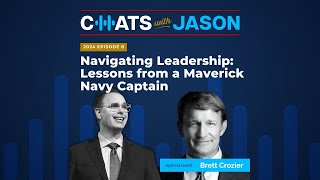
Retired Navy Captain Brett Crozier discusses his 30-year career, the COVID outbreak aboard USS Theodore Roosevelt, and what he learned about leadership. He talks about trust, protecting your people, and why leaders need to recharge.
Chapters
Brett, I'm so excited to have you with us today. Welcome to the show.
Thanks Jason. Great to be here. I appreciate the opportunity to chat with you.
Now. Congratulations on your book Surf when you Lessons in Life, Loyalty and leadership from a maverick Navy Captain. Bestselling book. Congratulations.
Yeah, it's been fun. It's been another fun adventure since I retired from the Navy after 30 years that now find myself on a book tour occasionally. You're talking about a book and you know, as I say, it took me, it only took me 34 years to write, but I've been enjoying the couple months since it's come out at least and a chance to talk about not just leadership, but the Navy and all the amazing things I learned over the last 30 years in service.
Now I was looking at Goodreads and there's this five star review, one of many five star reviews of the book. And Captain might actually be the actual real life, most interesting man in the world. I'm not sure you can get a better review than that. It goes on to talk about the book, but what a review. And all across every, every site where great books are sold, everyone's giving you rave reviews on this book now. 30 years of service in the U.S. navy. Thank you for your service. I think you would have seen quite a lot in that time. But before we dive into some of the lessons you share with us in the book, a maverick Navy captain. Now that's quite a bold, bold statement. What makes you a maverick?
Well, I think it's how you interpret that word, I guess. Obviously the book came out still in the popularity of the most recent Top Gun movie, which, which in all fairness, you know, we can back up to when I was 16 year old Brett Kroger looking to figure out what I wanted to do in life. And that's when the first Top Gun came out. And without a doubt, that is why I joined the Navy. I wanted to, I'd always wanted to be a pilot. That movie came out when I was 16, just learning to drive a car and it kind of just gave me a very clear path. And so that set me on this, you know, the 30 years of adventure. So it was fun in some way to, to reflect on the current movie in the title of the book. But yeah, I think in some ways too it's, you know, the, my claim to fame, so to speak, in the Navy is all in the last couple years of my career. And it came when, you know, we were on board the Theodore Roosevelt. I was captain of the aircraft carrier, best job in the Navy, we can certainly talk more about it and just I was running into resistance from leadership and just, just some red tape, as you can imagine, the military, as I was trying to protect the crew from a Covid outbreak that, that we had that was starting to run rampant on the ship. And I just wasn't. Not that people weren't trying to help, they just weren't trying to help quick enough. And I knew at the end of the day that, you know, as a leader and a captain of the ship, I'm ultimately responsible. And so I kind of bucked the system. I kind of, I'm gonna say I don't think I jumped the chain of command, but I became very direct to my superiors in terms of what was going on and the help I needed and why I needed it now. And I think rocked the boat, so to speak, and the Navy. The Navy term ultimately got me the help I needed. But along with that came a lot of media attention and eventually led to my firing. I was fired, relieved. The command of the Roosevelt term still went on to serve another two years and I kept flying jet. So it was a soft landing there, they say. But I think for many, they remember that moment even though it was just, you know, you know, one moment in my 30 year career, but one certainly that stands out and national or if not international attention, just because like the rest of the world, we're all trying to figure out Covid and how to deal with it and what to do. And I just, you know, sometimes when you're a leader, you can't be distracted by that. You just have to remind yourself what your priorities are. And in that case it was take care of my crew and my, you know, the 5,000 sailors that I had on board. My.
It's an interesting situation that I think you found yourself in. When people think of the armed forces, Navy, army, whatever service, but when you think of the armed forces, you instantly, or at least I instantly think of rank and file, command and follow. And as you put it, as the leader of 5,000 people with an outbreak of a, face it, of a, of a flu or whatever you want to call it, that to this day I think we're still trying to understand it completely. And you, you had to make a decision. Do you just tick the box and say, well, my orders are X and I will be damned, the 5,000 people, or do you find a respectful way to push back? And what I'm hearing is you found a respectful way to push back, even if it doesn't necessarily taken with the same way. So how did you. How did you have the courage? Like, as you said, ultimately, it changed the last two years of your career. How did you have the courage to go against what some of your training would have been, which is you just follow the rules. Yeah.
You know, after. After that many years in the military, I felt like I got pretty good at managing risk. As a pilot. I Flew helicopters for 10 years and fighters for 20 years. I led squadrons and other ships. So you know how to deal with risk management. Right. And you deal with those all the time, whether it's weather, operational requirements, whether it's the enemy, or folks that you're worried about doing harm to your team. So that's how the world you live in. Nothing, of course, is black and white. And I know that we all love movies and books where everything's very clear and okay. It becomes very obvious the decision. That's not how life works as we know it. It doesn't matter if you're in the military or in the corporate side or nonprofit world. Nothing is really that. I mean, it's rarely that black and white. So in those shades of gray, as we call it, and faced with, at that point, indecision from leadership because they were trying to figure out the threat and the risk, I. I knew, you know, it became pretty clear to me that. And we were not at war, you know, and if you're in war and you're in a combat scenario and you're a combat leader, you are going to take and you're going to accept risk to your crew. That's the reality. You don't care as much about money in that regard. You're going to spend and all you have to, to. To achieve your mission, you're going to accept risk to the crew. You're going to try to minimize the risk to time, because that's another factor in risk management. Because you're trying to move forward operationally when you're at peacetime or you're on the corporate side, well, now, you know, you are going to probably pay more attention to money. You're not as worried about time, but you also probably want zero risk to your crew. So on that spectrum of peacetime to wartime, those three factors when it comes to operational risk will change between time, people and money. And when you're in the. When you're in combat, you will accept risk to your crew. That's just the reality, the nature of warfare. But when you're in peacetime, which we are, you know, despite what everyone wants to say and threats around the world. We're at peace right now in most of the world, at least not everywhere, but certainly for the U.S. navy. Then the question becomes why accept any risk of the crew? And we go through herculean efforts to minimize risk to people all the time. You know, whether in cranials, making sure that, you know, you have sound protection, hearing protection, eye protection, those are just part of our daily lives. So you're faced with a pandemic potentially is lethal, at least at that point. You know, it had been the. If we were seeing this high percentage of fatality rates for a normal flu at least, and applying that to the crew of 5,000, well, I mean 1% of 5,000 is a lot of people that's you're not going to, and you shouldn't accept any risk of the crew when it comes to that. So I'm answering it in a really long way. But bottom line, you know, I, I, in the shades of gray as they say, for operational risk decision making. I decided that we were in a peacetime environment, we were safely purified and I wanted to minimize the risk to the crew. And I knew that again it wasn't going to be a clean path in black and white. I knew there's going to be risk to my career as a result because I'm trying to accelerate it. But it became so obvious to me that as a leader, if you're there to take care of your team and that's one of the leaders primary responsibility, then why accept any risk to your career? Why be afraid to push, guys? And so it kind of became a, you know, a conscience versus career moment. And I certainly didn't. I knew there was risk to my, my career. I knew I could be fired for it, but I didn't think that was going to happen, to be honest. I thought that, all right, I'll get slapped around a little bit, people will muddle under their breath and I'll never make admiral. I was, I was okay with it because I, in the end, in the end, of course, you know, there's a job and you know, I'd rather, I guess in my career at 30 years keep my head held high that I made all the decisions I could to protect my crew, then accept risk where I didn't have to, potentially fatalities to accrue when I didn't have to and have to live with that for the rest of my life. It still wasn't black and white, to be honest. Right. There was still a lot of gray. But I think that how I had been trained and how I tried to lead up to that point, I couldn't then back away from taking care of my crew, which I think is leaders.
Number one responsibility being true and congruent. What got you there in the first place? I love how you brought it back to the corporate world where you talked to or shared with us the different ways you measure risk. And that risk is situational. Okay, most people in most corporate jobs aren't dealing with warfare in the sense of a military warfare, but certainly nonetheless the risks that you are managing and mitigating do change from time to time.
And.
You have to be true to your role as a leader while managing those risks. So I think that's a great example for us to live by and importantly a reminder that as a leader we have a duty to our people. And sometimes that duty is at our own sacrifice or peril or certainly challenge at least. I have definitely been in some conversations where, where people wanted the number before they wanted to know what the people were. So look, in the book you cover a whole range of topics and share your wisdom around leadership and through your experience and that really interesting lens of combat versus non combat time. But chapter one, never turn down espresso.
Never.
Now there's going to be a story or two behind that title.
Yeah, and in all fairness, I literally just had a shot of espresso before I came on with it, just because now it's become part of my daily life. But yeah, I think, you know, in the end it's, I'll. Yeah, I'll tell a story about it. I think it's a good reminder for people the importance of teamwork and networking and however you want to describe it. But you know, I'd, I'd come off a squadron command tour where I had a command of about squadron about 250 people. We had 12 F18s. We deployed all over the world. It was a phenomenal job. I got to fly, I got to leave. We traveled to the Philippines. We were actually down in Australia for a month. We'd go to Korea and Japan. It was a phenomenal tour. And as soon as I was done with that tour, I had promised my family and my wife that explore the world a little bit more than we had at that point. So I had got orders to Naples, Italy. And if you've ever been to Naples, Italy, you know, they called a pretty lady with dirty feet. And it's probably the perfect description. And when you first get there, you're overwhelmed by everything, but by the time you leave, you're crying. Because it's just such a lovely place to live and the people are so friendly. But I was assigned to a NATO staff and we were in charge of maritime office around the Mediterranean, all the way from North Africa to Italy to Turkey, all the way out to Portugal, anywhere in the Med, really for air operations. I had a team of about 12 people, but come off this command tour of 250 and man, I was like, you know, it was on fire. You know, everything I did, I wanted to do fast. That was, you know, I was ready to work 12 hour days, seven days a week. And things were a little bit slower in Naples. You know, on my team of about 12 to 15, they were had Germans, I had a Turk, I had a couple Italians, I had folks from Portugal and some Brits as well. And, and it was just a slower pace, frustratingly slow, to be honest. Like, I was just ready to go. And, and I had a guy that worked for me named Luigi, Luigi Fazio. And Luigi was an Italian lieutenant colonel in the Italian army. And every day he would just say chopper, which is my call sign because I was a helicopter pilot in it. Chopper. Let's go get some espresso. So if you've ever been to Naples, Italy, you know, there, there, there's many things they're famous for, but certainly espresso and pizza are the top of those list. And so I knew that espresso is an important part of the culture and I knew it was pretty good. But man, I was ready to work. You know, I was ready to drink crappy coffee in the office and forgo the Italian espresso because I wanted to get stuff done. In my mind, the PowerPoint briefs and these white papers and these reports were extremely important. And after a couple of weeks, Luigi come up to me and he said, hey, Cupper, you know, we invite you to get espresso not because it's phenomenal copy, which it is, but so you can come down and we can hang out and we can, we can talk, we can get away from work and we can get to know each other. And if we get to know each other, then we can kind of trust each other. Extremely important in an international environment like that, where we had people all over. And here I am, the American with all the firepower you would ever want in a situation with NATO. And I was ready to work really hard. But Luigi kind of reminded me that, hey, there's more to relationships and alliances than just working hard. So I did, I went down and I, I had espresso with them. At 9 and, and then of course they have espresso at 11 and then again at 2 and all day long you're drinking espresso. And to this day I drink espresso now all day long. But. But what? From that I got to really meet these guys and it, it forced me to slow down a little bit. It forced me to get to know these guys that I was working with. And we developed, you know, some trust amongst each other was not there in Italy. So then fast forward about six, eight months later when Arab Spring kicks off in Northern Africa and it started Tunisia or encompassed Egypt and Libya and a lot of the countries there. And NATO got called in to keep an eye on Libya, Gaddafi specifically, who was moving towards Benghazi from Tripoli and he had committed atrocities. And so NATO got called in to back up the US and we went from this very sleepy hollow staff, NATO staff, that we were working three or four days a week, it felt like to Suddenly we're working seven days a week, 24 hours a day monitoring and managing and handling the stuff that was going on in Libya. And this team that I initially had kind of not given credit to, they were with me 24 hours a day, seven days a week. We had shifts out to say and they were there working side by side and we, you know, I realized then looking back the time we'd spent up front to develop the camaraderie of teamwork, got to trust each other, you know, carried forward to when we really needed it. And we did some phenomenal work. And I call them great friends to this day and still keep in touch with them. But it was a reminder for me the importance of teamwork, even at a international staff and developing trust. Trust is a commodity of leadership. The more trust not just you have in your employees or your workers, but the trust they have in you. The quicker you're going to work, the quicker you can communicate and the more effective you'll be. And it's the essence of any real teamwork. Have trust. You can look at sports, you can look at the corporate level, but you know, you have to work hard. Trust isn't a given either. You're. No one's just going to give you trust if you show up and you have a title or you have a fancy parking lot or a nice car. That doesn't endear you any trust. People trust you because they get to know you, they get to see you make decision and they know that they you have their best interest at heart. And when you build that trust, I'll tell You, that's, that's the essence of teamwork. And there's nothing you can't do at that point.
What a great reminder for every leader to actually just spend some time with the people that you have the honor to lead and to serve. Certainly from my experience, I would agree that those individuals that I took the time to connect with on a human level, we were certainly much, our connection was much deeper. And I think leading them became easier as well. And I wonder if you agree it became easy to lead them because they understood where you were coming from. Even if they didn't necessarily know the nuances of your decision, they understood you fundamentally were on their side, that you were with them, one of them, right.
If you develop that trust and they trust you even when you don't have the luxury of time to explain all the reason, you know the rationale behind your decision, they know you well enough to know that you're, you're doing what makes sense for, for them, for the company. But it takes, you have to invest in it. Again, trust isn't a given, but it's worth that time. And that allows you then to have that speed of trust and you know, and make quick, quick decisions down there. In fact, if you trust the people to work for you, then you can delegate more because now you trust them, you get to know them, you know them on a personal level, you know how to inspire them and that allows you as a leader, the more you can delegate, then the quicker you can more work you're going to get done. Man, if you don't trust in an organization, you know, there's, you're not. You as a leader won't be effective. And if you're an employee working for somebody doesn't trust you then have to be effective as a worker. So I think any, anyone in any kind of leadership position needs to think about the trust they have. They have now, what they've done to get that trust and then how to go and how to improve that even more. And that's to your point. Sometimes they're stepping away from the office. Sometimes they just go on to, to have a beer after work or you know, go to the go hike together or find opportunities outside of work. And I, I always, I, anytime I was in a command where it would do that, I knew that it paid huge dividends in terms of building that teamwork.
Great reminder for us, for us all now, when, when you're not flying jets and leading thousands of people on a ship, how do you like to spend your time? How do you, how do you relax and re energize yourself?
For me, it's been family in many regards, meaning that of all the things I want to do when I have free time, I always try to prioritize the family, and that's through my 30 years in the Navy. We moved 20 times and we were constantly in transition. So I always tried to first and foremost prioritize time with my family. That was my base once, you know, once the kids got older and once I felt like we had more stable location. I very much believe in the outdoors and finding time outside. And if I was lucky enough to be near the ocean, which the Navy often tends to send you near the ocean, if there was good surf, I'd grab a surfboard and head out and get myself out on the water. And if it was a really good day, my family would be there in total. My wife would be on the beach or surfing and my three younger boys, and they'd be out there somewhere on the break with me. We'd be hanging out. So. But I do, I like to get away. I like to get away, especially when you can get away from your iPhone and your Apple watch and the TV and stuff. Because I think that today's society, we're so overwhelmed with information, it's around you all the time. I read a study recently that said that the average leader has less than 28 minutes of uninterrupted time in the course of one day. So the most you'll ever have as a leader before someone wants to talk to you or ask you a question is about 28 minutes. And that assumes you're not sitting at your computer answering emails. And because if you're using your 28 minutes, then you're constantly at. Or you don't have even a minute. And I think as leaders, it's important to find that critical, that time to think critically and time that you can actually think. In the military, we say strategically, but how do you think downrange for what your company or your ship or your squatter needs to be doing? And if, if all you get is one minute intervals, there's no way, you know, you're just, you can't physically think critically in that amount of time. And so, you know, get, get yourself on the water for me or go on a hike or get yourself in nature and don't bring your phone. And if you're silly enough to bring your phone out on the surf, you know, on the lineup, they're going to be laughing at you and probably cutting you out. So Kind of force you to leave your own beach at least. But I always found that, you know, get myself on the water is that, you know, it's, it's exercise. I love being on the ocean. I'm a sailor at heart. And. But I found what I did realize probably initially when I was surfing while I was younger, but certainly appreciated it more as I got more senior, was that was some critical time for me. Not let me spend time away from all this, you know, all this distraction and think critically and strategically about personally my life, what my command was doing, what the ship's doing in between waves, of course, but, but I found that, you know, I think everybody, every meter would, would behoove them to spend a little bit of time and create that white space, as I call it my Navy career, to think critically. Because that's really the leader, what you're getting paid to do. A good leader is not getting paid to make minute by minute or hourly decisions. They're getting paid to make decisions that are going to affect the company one month, six months, in some cases five or six years out. And if you as a leader aren't doing that, no one else is. You know, you as like a CEO, as a ship, I would just say, hey, you know, you guys worry about day to day. My mid level managers can worry about mid, you know, week to week. The more senior folk can worry about month to month and then the, you know, the executive staff, we better be thinking like six months to six years because no one else on the ship was. And that's pretty true of probably in any organization. So find that time to think critically. And I found a way to use that free time, as you said, get myself to surf a little bit and then think critically and then kind of help think strategically downrange.
Yeah, I definitely agree that it's important as a leader that we, we find space, quiet space. And, and by that I don't mean crossing your legs, sitting in a dark room humming. I, I mean that, that space where you can think about whatever, whether that be, you know, catching that next wave, which I can assure you I would be falling in the ocean, not catching anything, or whether it's that strategic game plan for the next six months, 12 months of the business. But if you're constantly getting interrupted, if you're not giving yourself permission to not be interrupted. I think that's the key.
Yeah.
As a leader, so many leaders are taught be busy, look busy, be doing something, visibly be doing something, as opposed to giving yourself permission to be not available to having Some time out so that you can have that time to think, but also to recharge. Because if you are making 100 decisions an hour a day, it becomes really hard for you to stay focused on whatever the goal is that you set. So a great lesson there and a good reminder for us all that it's important to find that time. Now I know that we could chat for four hours and I'm sure there's some things that you're not even that I would love to ask that you definitely probably shouldn't answer. So we won't go down that path. But reflecting on your 30 years in service, dealing with, coming up through the ranks with undoubtedly changes in the government's view of, of the military's role and, and even what, what the purpose of military has been over the years, and certainly the US Military taking the global leadership role that it does in for most Western nations, what's the one thing out of that 30 year career that you think will live with you forever from a, from a leadership point of view of what made you a great leader?
You know, I found as you, you know, as you progress through the ranks in the military, it's probably, you know, again, true in the corporate side with that comes a lot of perks and benefits. And some people would say even kind of in power in a different. Only if you describe power means you're going to get increased responsibility, probably higher pay, better benefit. And I see, I saw time and time again in the military, and I see it now on the outside as well, that folks tend to forget that when you get this power, or that's the right way to describe it, what you really have is a huge responsibility. And I think it's responsibility to leader, to take care of people, to inspire them, to motivate them, to build that teamwork that we talked about. And I find that sometimes people get in that position of power that they tend to lose just some common decency and how to treat people. And I used to say that when in doubt, be kind. And I found that the more senior you get, the more important it probably is because you already have, you're already speaking from a position of authority. You know, on a Navy ship, when the Captain says something, 99.9% are going to do exactly what you say. If you want to paint the ship pink, they're going to paint the ship pink. So you already have this incredible amount of authority and power, as it were, to inspire and get things done with that. I found though, an equal responsibility then to be kind, to find A way then to connect on a human to human level. And it was. And it never. I never regretted it. I never Even when some, even on a young sailor was doing something silly that he shouldn't have been doing, or drinking more important when he shouldn't have been or, or not following procedure, it'd be very easy to discount him and just say, you know, you're one of 5,000. I'm gonna, I'm gonna discount you and just. I'm gonna hammer you, give you all the discipline possible, or put you in the brig or whatever the case may be. I never, I tried to never do that. I always tried to look at it from their perspective and try to be. Because they're already. They'll come before you in that kind of case. And they're already. They already know they've made a mistake. And by being kind, what you've done is you've kind of. You've opened yourself up a little bit. You may be a little vulnerable as a leader when you do that, but from a position of power, when you're kind to somebody, what it does, it creates a culture on the ship that we're all, you know, that it kind of goes back to that teamwork and that trust that the end of the day, there might be hierarchy built into the system, just like there is in the corporate side, but we're all still people. And the captain of the ship or the CEO of a company is willing to be kind, forgiving at times. They have to. It goes a long way. And I think that's true even outside of leadership. I mean, just sometimes you're driving around in traffic, right? It's really easy to get angry with somebody who cuts you off. And then it's always my wife, right? It's always who reminds me that, you know, maybe that person's in a hurry or maybe that person is trying to get to the hospital or, or maybe not, but it almost doesn't matter. And every time I just said, you know what? I'll let that person in, or I'm gonna. I'm gonna, you know, give the sailor the benefit of the doubt or I'm gonna, you know, or in a foreign nation with a foreign country and you're talking about even. It just went a long way. And I never regretted it. I. I would often regret when I was. I would be angry or respond and angry mattered, but when I was kind, I never regretted it. And I think it's. It speaks true just to leadership. I think it's true to just day to day Living. It doesn't, it's different. It doesn't mean you're soft. Right. It doesn't mean that you are, you have, you don't have standards. That's, that's a, you know, that's not what I'm saying. I'm saying find a way to be kind to people that you interact with day to day. Find way to be kind to people you lead. I guarantee you'll, you'll build that trust we talked about. That'll relate, you know, relates to the teamwork. It's important for success. I guarantee that, you know, you'll have a better organization as a result.
Yeah, I absolutely love that. And to your point, being kind doesn't mean you're not maintaining or enforcing, if you will, a standard, but it's the way you go about it. And quite often in the corporate world, you'll see leaders, unfortunately, that will publicly berate underperformance either collectively or individually. And then you'll, of course, you'll see leaders that praise publicly but have more delicate conversations in a private setting. And I think that's an example of being kind. No one likes to be called out for their mistakes. They like it even less if it becomes a public display. But if you can find a way to coach someone through that and remember that the vast majority of employees, I think this is the same whether you're in the Navy or whether you're in the corporate world. People turn up wanting to do their job. It is the extreme minority that turn up wanting to do something bad. And yet our default position quite often is, oh, well, you clearly turned up to do this. Wrong. No, just be kind. Help them learn through the situation and through that you'll build trust and so much more. Now I know, Brett, that people will want to connect with you and to follow your work. What's the easiest way for people to stay in connection with you and to continue to learn from you?
So I have that book that we talked about, Surf when you can. And I've got a website at surf when you can.com that I try to populate specifically with like nonprofits that I am engaged with and you know, for folks that are looking for causes and things to be involved where outside of work particularly, I think I found it very rewarding. I've been doing it now full time since I retired, and it's been, was a good decision because I enjoy it. There's leadership is so required out there. Even in the nonprofit world. We try to make a difference. I'm inspired by what these Folks do. And yes, if you go to my website, surfinyoucan.com, they've got links to Instagram and other things that I post on. And to be fair, I have a sister that actually does all that for me because I'm not a savvy like Instagram and Twitter and stuff. So she helps me out a little bit. But the website, we try to keep current and there's the section called the Cause, and it's just some of the nonprofit, like Surfrider or a couple others I'm involved with that I think are worth people's time to pay attention to.
And even after 30 years of service, you're still serving phenomenal. Before we let you go, Brett, I have one last question for you. What's one thing someone listening or watching the show today can do or start doing to be a better leader?
Well, we touched on a little bit. I would encourage anybody to find a local nonprofit they could get involved with. You know, there's so many parallels to the corporate side and executive side of the military in the nonprofit world. But, you know, there's a lot of people out there just trying to make a positive difference. And they don't do it to get rich. They do it because they're inspired by the mission. Leadership is still required in the nonprofit world. So for those that are at the executive level, I think there's opportunities for them to get involved and help guide and think strategically for them. But even if you only do one day a month or a couple days a year, I've been trying to do it throughout my career and I do it now more as a full time job. But I find it very rewarding and I think that it helps you get familiar with the community. And again, it kind of just gets you to know people that you live with that live around all the time. And I think that's important. And, you know, I focused on the homeless stuff here now in San Diego, and now I feel like for the first time I can help get involved with local causes. Because up to this point I've been focused globally. So anyways, I would encourage people to find a nonprofit they're inspired by. Don't just give money. You can, they need money. But I would argue just give a little bit of your time, probably your most precious commodity, and I guarantee you'll better be a better leader as a result of that.
I could not endorse that more strongly. I think my time serving in various nonprofits taught me more about business and leadership and the importance of so many topics than a four year MBA could have taught me. And beyond that, as you said, it's a great way to get to know the community and to give back to the community in which you live, work and play. Brett, it's been an absolute pleasure having you on the show. Thank you again for taking the time to share your thoughts with us today.
Thanks, Jason. Yeah, it was great, great conversation and again, look forward to the next time. But I appreciate a chance to chat with you there.
More from Jason

Bringing Wonder Back to Work | Leadership, Culture & Service with Peter Merritt







How to Lead With Empathy: Claude Silver on Emotional Bravery & People-First Culture


Inside Harley’s Cult-Like Loyalty | Ken Schmidt on Turning Customers Into Believers
