Practical Guide To Rethinking Your CRM Approach
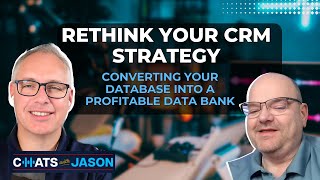
Jason S. Bradshaw and Tommy Clifford discuss how to use CRM systems effectively, including segmentation strategies and multi-channel communication. Clifford shares insights from his book on CRM strategies for driving business growth.
Chapters
Hi and welcome to another edition of Chats with Jason. Of course. I'm your host, Jason S. Bradshaw and you're watching or listening to the show that helps you transform the experience to transform your business. I'm absolutely delighted by our guest that we have with us today. We're mixing things up a little bit and we're going to get you to start to rethink everything you know about CRM. That's the title of the book by the newly best selling author Tommy Clifford. Tommy, it's great to have you with us today.
Jason, thank you so much for bridging the miles and bringing this all together. This is awesome to be with you. Thank you, sir.
Oh, I appreciate your time as well. And you know when this comes out, you'll have been a best selling author for five or six weeks by that stage. But what's it feel to have published your book and in just a number of days for it to go to number one?
It's crazy. It's totally crazy. Someone needs to pinch me. I was on the phone with my mom yesterday. I sent her a copy of the book and I knew that when Amazon delivered it so she went to the door and she just squealed. And it's kind of crazy, to be honest with you. I don't know what to expect. I still don't know what to expect, but it's kind of crazy and it's, it's so exciting.
So thank you, that's fantastic to hear. Now I have to ask a really hard question out of the gate, why on earth did you write a book about CRM?
Well, okay, so everybody has a CRM. And my line of work, my company, so Easy Solutions, we've kind of focused. The hub of our communication strategy is the CRM. And whether you're using one or need to be using one and whether you're, you know, an Excel spreadsheet, that's your CRM. You know, three by five cards, that's your CRM. You know, some people have it on post it notes, that's your CRM. That's your reminding mechanism. That's your tool to say, hey, I need to talk to Jimmy, Billy or Bobby. When I thought about this and when I looked in the industry, there's no real good books that there's books that teach you how to use a specific CRM. I didn't want to teach people how to use their CRM. I wanted to get them excited to dive into the tools that they had.
So let's just play devil's advocate, get everyone on the same page, when we say CRM, what do we mean?
We mean customer relationship management system. Again, it could be your Excel spreadsheet, it could be Zoho, it could be Salesforce, it could be something free. It all depends. Everything's different. But it's a tools that you use to keep your clients top of mind and to communicate them made through text message or emails, whatever happens to be some jot down some notes task. Hey Susie, somebody needs something. I can put a task for myself, a reminder, that type of thing.
Yeah, well, I can certainly remember the days when Salesforce first launched. You know, they were anti software pro small business at that stage. Although I think there's more business offerings, probably not what it used to be. And of course now there's, I don't know, you'd know better than me. Hundreds of different CRM out there. But the thing that I've always found, I'd love to hear your thoughts on it is a lot of businesses, certainly the bigger they get go, we need a CRM. So they go and buy one and in some cases spend lots and lots of money. Oh man, lots. And then it sort of like just sits there on the shelf and becomes a filing cabinet for information that doesn't get used properly.
Isn't that the truth? You're 100% right, Jason. A lot of people spend ridiculous amounts of money. I have some clients, we're spending figures a year on their CRM and it became a boat anchor. People get scared of it. It's almost you really need to have a data person on staff to be your Sherpa or have somebody that you have on retainer that can really help you learn that tool and have it become part of your hustle. You know, your CRM might be your phone, it might be on your laptop, it might be in the cloud, wherever it happens to be. But you're only as good is how much you use it. And if it makes you scared, then you're basically just wasting money. You know, hey, write me a check, I'll take it for free and you'll get the same output. I mean, if you can. It's kind of like my dad says, you know, I'm going to buy a boat when I can afford to flush that amount of money. So people do spend a lot of money on their serum, but I don't think they understand what can happen and the power of that tool when it's done properly.
Okay, so you've got me interested. What is the power of the tool when it's done properly.
A lot of people say, well, I need hundreds and thousands of people in my database to be able to make money. I want to help them. And through the book here, this is going to help you take your database and turn it into a data bank. If you're not communicating with your audience, they don't know what you can offer. They don't know the knowledge you have. Now, I'm not going to tell you, Jason, that you need to start just riveting these people with holding your hand out, say, hey, buy my stuff. No way. You're never going to want to do that. What you're going to want to do is you're going to want to enrich them, edify them. You don't want to say you're the smartest person in the room. You want to prove to people you're the smartest person in the room. You want to edify them, educate them, make them laugh, make them want to open that email, respond to that text message. Then when they're thinking, hey, I need that. Oh, yeah, I got that email from Tommy. He's got that. I can buy my widget from him. And there you go. And then you can now look at all the people who've purchased your widget and say, hey, wait a minute, have you used this feature? You're edifying them. Don't you wish that when you bought that car from Honda or Toyota that you get an email that said, hey, you know that little thing at the end of the steering wheel if you turn it, that turns your wipers on? Oh, wait a minute, I didn't know that. Or whatever it happens to be. And so CRM helps you be better in your client's eyes.
Yeah. What I'm hearing is that CRM leveraged properly and don't want to get into corporate speak, as I say that word, leverage. But CRM deployed correctly, utilized correctly, can help you pre transaction. So in educating, enticing, informing your potential customers around the benefits and other aspects of whatever you sell, whether it be a physical good or a service, but importantly, it allows you to continue the conversation, post the transaction, so that they can have a better experience, a better ownership experience, if you will, with whatever they've purchased and potentially even, if I heard you correctly, create a closer relationship with you, the brand.
Absolutely. One of our clients is in the healthcare industry and they send out messages on a regular cadence once a week so that these people know, hey, you have our service. Here's how you use it. If you need help, call this person and that Helps with retention. They brought that tool on board for retention. If you ever go to Facebook and you say, hey, I want to know more about this product and it's 2 o' clock in the morning and you go, hey, wait a minute, I just got an email from that company telling me more about that product. I promise you, there's Susie, Billy and Sally are not up at 2 o' clock in the morning sending this email. There's a drip campaign and so it's all automated. But that automation helps build retention.
Yeah, absolutely. So in the book, there's eight wonderful chapters, you really kick us off with some intrigue. From Rolodex to Digital Dynamo, the roots of CRM. So I guess something that's plaguing me is I think many business owners, even solopreneurs, very quickly realize they need to organize their data in some shape or form and they'll choose some CRM. Sometimes driven by costs, sometimes driven by features, but nonetheless they choose something. Whether it's the perfect fit or not doesn't really matter. They choose something and they start to fill the Rolodex up with information. What do you see is the common roadblock that businesses have from using it as a Rolodex to turning it into that digital dynamo, to actually leveraging the CRM for their benefit and their clients benefits.
Great question. I think one of the big things is they don't segment their database. They speak to every person as if they're going to purchase or sell the same product. Amazon doesn't send a gardener things that a gardener is not going to need. They're not going to send Tommy text messages and emails for, you know, ladies dresses. Not my hustle. They know the target audience. And so segmenting. You want to segment the buyers from the sellers. You want to segment the, you know, people. I did in 2023, 2022, 2024. So you can customize and personalize your messaging to those specific target audiences. The more personalized you do your messaging, the less likely it's going to hit the spam folder because all the spam people up in spam space know that you didn't just send that to 10,000 people, that was a personal message to one person instead of the same thing you're puking out.
So segmentation was one of the key hints there. And then in your book, you also talk about the essential blueprint to a CRM. Does that include things like segmentation or what do you include in your blueprint? And I'm guessing that's where you suggest People should start.
Well, in your blueprint, first, you want to start talking bulk emailing. You want to set. Set up a bulk sending domain. But in the blueprint, you want to make sure there's lots of avenues to a crl. There's your Google business reviews, there's your Facebook business page. And being able to communicate in one spot, I think, is a big deal. There's humongous digital sprawl. Jason, if you think you're spending a lot of money on Netflix and Paramount and AMC and all these different cable channels now, think about all the digital tools you have. You got a calendar tool, you got a form tool, you got a survey tool, you got an email tool, then you got a tool to keep track of your names, and you got web hosting and domains and all these different things. It can go on and on and on. And really being able to look at your digital sprawl and say, hey, can I bring these under one umbrella? Is there one throat to choke? Can I make my life easier? Because many people say, well, I got a database, and then I got my stuff over in, you know, in an email software. Okay, that's great. But as soon as one person opts out, now you've got your database wrong in two different places because chances are they're not even talking. And so people don't realize the speed bumps that they're under. I like to say, are you working harder or are you working smarter? And I think there's a lot of people who are really working harder when it comes to wrangling their database.
So I hear it all the time. I'm guilty of it as well myself. I'll have my CRM, which happens in my case to be Salesforce, but then I'll see some nice new shiny object, and I'll go and buy that piece of software, and then I'll find some new one, and they're all going to solve problems. And ultimately I just keep going back to my core system because it's easier but. Or more familiar, in my case, I should say. I'm wondering, what's your medicine to stop, especially small business owners, instead of focusing on building out and leveraging a CRM system, they have that shiny object syndrome and just keep buying more and more software.
People need to simmer down. They need to get really, really super good. You need to explain to me why you need this tool, why the tool you currently have isn't working and every step and everything you did to try to make it work. We have Angry Bird syndrome when it comes to Technology. Everybody will get it. This doesn't work. Throw it down. Want to switch gears? No. Hold your horses. Do some research. Everybody really needs to have, like, a digital Sherpa in their life. Somebody who, whether they're on staff or somebody they can have come over and say, okay, hold on. This isn't working. This is what it's supposed to do. Can you help me make it do what it's supposed to do and get another look at it? Because sometimes we get too close to the fire. You don't see this kind of like your writing project. You may have somebody else edit it because you can't see the spelling errors in the project. Pull yourself back, take a deep breath, and realize, no. Just say, no, you don't need that other project. You don't need that other tool. You don't need to add more complexity until you've exhausted everything in place. It's hard, Jason. It really is. Even for me. Oh, I need to spend money on that. Well, no, I don't. I need to spend money on that. No, I don't. Take a step back, take a deep breath. Take a couple days. Look at it. A lot of people are too quick to just run for their credit card and say, hey, I do need this. And the answer is, no, you really don't. You don't need that for a second. Take a step back and just think about it.
Yeah, that makes sense. Now we don't have time, unfortunately, to go through every chapter of the book. There's gold throughout it. There's a chapter that supercharge your CRM, Unlocking hidden powers. I think the audience would love if you could share some of these hidden powers with them today.
Hidden powers AI is more than a buzzword. AI is something that's built into many CRMs, and this is one of my favorite. Hidden powers is your CRM can tell you who's raising their hand, who's opened their emails the most, who's clicked on links the most, who's visited your website the most, who's clicked those little triggers you put in place. So now you can say, hey, I've got a list of 400 people, but I got 20 people who are really raising their hand a lot higher than other people. And you can go, here's an offer, here's a coupon. If you raise your hand higher, I'll give you this coupon. So being able to leverage that intelligence that's in there, that being able to have somebody in the cloud call that data and then give them something different that goes Back to that segmentation. You know who different people are. You know, back to our real estate example. We got our buyers and sellers, but you know that this buyer went to see 1313 Mockingbird Lane and 1200 Pennsylvania Avenue and all these different addresses. Wait a minute, they're visiting houses that are three bedroom, two bath. Hey, I should give them a call, say hey, I just got a three bedroom, two bathroom that's going to come on the market tomorrow. You can work smarter, not harder. And that's really what the CRM. Some of those hidden talents are giving you some intelligence and giving you some cues so that you can delight your clients in a better fashion and hopefully turning that into your database, into your data bank.
Yeah, I love that term data bank bank as it make you think of it more in terms of how you can leverage your success commercially. Tommy, the audience is intrigued and I didn't do this up front because I wanted to get them hooked on the great content in your book. But can you share with us a little bit about your background? Because I was reading your bio earlier and it's extensive and it's no wonder you have such deep in thoughts on CRM.
Thank you. So I have been in the printing and pre press industries for the last 30 years. When Covid happened, I got my real estate license and I started getting involved in the real estate space and I decided that I didn't like actually selling homes, but I like supporting real estate agents. And of course a CRM was kind of a logical thing. So me and my business partner formed a company. We kind of cut our teeth on real estate agents and then we started getting more involved in other ways of communicating with our audience. I'm the chairman of the board of directors of a credit union. I have a passion for giving back to the community. And this year my business partner challenged me to write a book and I said, I don't know anything about writing a book. It turned out that one of my clients wrote a book. Rethink everything you know about social media and kind of started building a little family of it. And then he said, hey, I want to build very much like what the dummies books are. Let's continue this discussion. So that's where this came out of. So I just love technology. I have a thirst for learning.
Yeah, fantastic. And if I'm not incorrect, you've done some successful work for companies like Motorola and Microsoft and some some really big names out there.
I've done some influencer work where I worked with Ford, Motorola, Microsoft, and this is Back when Twitter was formed back in 2007, 2008 and actually little known story in 2009, my son Drew, I actually live tweeted his birth and it got picked up and they did a news story about me and it ran and I started public speaking. And so that's where I kind of got into the social media influencing space, working with some of those other companies.
Well, what an impressive and diversified background there. Jumping back into the book, what is the easiest way for someone to get a copy of the book?
Easiest way is to go on Amazon and do a little search, rethink everything. CRM. It'll come right up. Or just search for Tommy Clifford and my author bio will come right up. I published it through Amazon. Kdp. We've got the softbound and the hardbound and I'm working on the Kindle and the audio version will be out in first quarter of 2025.
Oh, fantastic. I think it's great when books come out in multiple formats. It makes it more accessible to.
Absolutely. When every. Everybody needs a little CRM in their life. Even when I opened up with my mom, she was so cute. She was, oh, I need to read this. I need to learn all about this. Okay, mom, you're 82 years old. You need to simmer down. When I'm thankful you're going to read it. That's awesome.
You never know, she might be about to start her side hustle.
Never know, she might. She might want to work on Salesforce with you.
Well, there's always work to do on Salesforce. Like any tool, though, it's only as powerful as you implement it and design it and use it. And every tool. We can joke, but reality is every tool is like that. Right? It doesn't matter whether you're buying the $97,000 tool or the $9 tool, if you don't implement it correctly, if you don't structure your data correctly, if you don't evolve it as your business evolves, then it can become an anchor.
100%. It's only going to be as good as you are. And a CRM is totally an action word. It's not going to do it for you. You know, the only person that's gonna do it, it's got, you know, four fingers and a thumb, this guy.
So thinking about the evolution of CRM, you've convinced someone they need to get a CRM system. They get it, but their business evolves over time. How do you make sure that the CRM keeps pace with the actual needs of the business?
That's a great question. And that has to go to a lot of the homework that you do up front. You need to talk to people, find people who are in your like space and say, hey, what tools do you use? Ask some probing questions. Maybe you need a Sherpa to come on board and say, hey, can you help me? Here's our current state, here's our future state, here's where we want to be. But you have to educate yourself. This kind of stuff is always evolving. There's always new tools, everything's in the cloud, there's going to be updates, there's going to be new features, things are going to break. They just had a new revision come out. That type of stuff is part of life. But I would really work your network and find out who is doing what you're doing, who's happy with their tool, why are they happy? And then start digging in, start taking some good notes and then going to somebody say, you're really smart in this space. I'm a plumber, electrician or a concrete company and I've got this information. I want to talk to people like this, is this the right tool? And so you have to, you have to educate. You cannot just sit back and think that this is going to solve its problem. Okay, I'm just going to pour water on the secret pill and it's going to go, no. You got to do a lot of homework. You got to roll up your sleeves and dig in. But once you do, that's when you get the satisfaction.
That makes sense. Now, throughout the conversation today, you've mentioned email and text messages and social media and Google business reviews and plethora of platforms. In your book there's a chapter on multi channel CRM communication. How important really is it that your CRM can do multi channel?
I think it's really paramount. Here's why. Not every person is going to listen full force on every channel. I mean in the States we have Sirius XM, Sally radio has like 300 different channels. You know, somebody's listening to country music, somebody's listening to rock and roll, someone's listening to new age country. Whatever happens to be, you need to be where your customers are because if you're not there, they're not going to find you. You got to go to them and you need to communicate the way they want to be communicated too. So I think multi channel communication is really paramount. I mean if you're only doing direct mail, that's a great channel. But you're missing out on the people who aren't direct mail people. And if you're only advertising on Facebook, you're missing out on all the people who aren't Facebook people. So I think it's important that you build a strategy. Not all at once, but just have a strategy that over a period of time, you're going to add more and more channels and start communicating with people where they are as opposed to trying to get them to come to where you are.
Yeah, makes absolute sense. So, as we wrap up today, thank you very much, Tommy, for your time. But before I do let you go, what's the one thing that someone listening today or watching the show on YouTube should start doing or perhaps stop doing when it comes to their CRM?
Stop sitting on your hands and start acting. It's going to be a slow process. Remember, TV network started with one viewer. YouTube started with one video. All you need is one name to really have a CRM. You just need to make some little incremental changes and some action words. So you're going to see a big train moving down the road. Before you know it, you're going to have 5, 10, 15,000 people in your database, and they're going to be clamoring for more of you. And you're going to offer this course or this product or this trinket, whatever happens to be. You're going to wake up in the morning and go, wow, I just had sales from that. I sent out this email and I had this. Now I want more of that in my life. You just got to do it. Just do it.
Well, what a great way to end. Tommy, thanks very much for your time today. And again, congratulations on the book.
Thank you, Jason, for having me. It was a pleasure to be a part of this operation. Thank you so much.
More from Jason

Bringing Wonder Back to Work | Leadership, Culture & Service with Peter Merritt







How to Lead With Empathy: Claude Silver on Emotional Bravery & People-First Culture


Inside Harley’s Cult-Like Loyalty | Ken Schmidt on Turning Customers Into Believers
