Social Media Changing the Way We Do Business
Jason S Bradshaw explains how social media is reshaping business communication and customer engagement. He covers rapid adoption across industries and shows how companies now interact with customers in real time.
Here, right there. Right here, right there. Right here, right there. Right here, right there. Right here, right there. Right here, right there. Right here, right there.
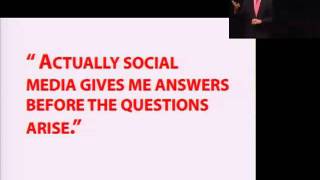
It took 13 years for 50 million people to use the TV. It took just four years for the same number of people to use the Internet, three years for the ipod. And I suppose Facebook did okay. 200 million users in 12 months. Social media is happening right now. Whether we like it or not, it's here to stay. Today I hope to explore with you how social media is changing the way that we do business, perhaps even the way it's changing our lives. So I've been following the Twitter feed around here, and I've been noticing some comments that people would like to be able to ask questions via Twitter. So at the end of the presentation today, I'm going to check the Twitter feed and before we wrap up, I'll ask any questions. So you can just send your questions to my Twitter feed, which is Bradshaw. Or if you haven't joined the conversation yet, the lovely Sarah is going to be walking around with a card like this. And if you've got a question, just write it down on a piece of paper, hand it to her, and we'll try to get to those a little bit later. So we really don't have a choice if we use social media or not. It's happening every day. Thousands of more people join another social networking site. The author of the international bestseller socialnomics says that we simply need to work out how we're going to do it the best way we possibly can. So what is this social media social networking thing that I'm banging on about up here? Well, quite simply, it's about conversations, but we'll get to that in a moment. A little bit more sophisticated understanding of social media is that it's an interactive process, process of delivering and contributing to content with our friends, associates, and our strangers that are soon to become our friends. And I tend to break social media into three key networks, so places like Facebook and LinkedIn and MySpace that help create communities that network you with friends, colleagues, and people with similar interests. Conversation sites like Twitter and Yammer that help create, start and continue an interactive dialogue around anything that you can do in 140 characters or less. And there's quite a lot you can say in 140 characters or less, believe it or not. And the third category that I use to define social media as content. And by a content social media site, I'm referring to sites like YouTube, WordPress, Blogger, etc. Where people create content and publish it for the world to view. The key to social media is that it's available to Everybody. In Australia, 84% of Australians have access to the Internet. So not quite everybody, but certainly the majority of Australians. And that trend is certainly mimicked across the world. Interestingly, the usage of social media is growing and we're going to talk about that and how that's impacting the conversation. We'll also talk about how the conversation control has changed and that's really what social media is doing, taking the conversation control and putting it in the hands of each one of us. Today, if I'm not happy with the service that I'm provided, I can blog about it, I can tweet about it, I can post it on Facebook, I can put it on MySpace, I can upload a YouTube video. The list goes on and on and on. Ten years ago, I could tell my circle of friends that I didn't like something and that's all that would ever see it. Today, with over 500 million users on Facebook, the potential for your message reaching the masses is real and it's happening. But what's happening if you're not part of the conversation? Why does it matter? We'll hope to answer some of those questions as we go through today, but I thought I'd share a personal story about some usage of social media that I've had recently. So, one night I was sitting at home and I decided that I needed to rejig some of my finances and I wanted a new non fixed term savings account. Now, I could have just rang up my bank, my normal bank, and said, I want to move this chunk of money into an account, but I want to be able to access at any time. But instead what I did is I posted a message on Twitter saying, what is Australia's best savings non fixed term account? Pretty simple question. So I had people that follow me respond, not too impressed. So what, they're already following me. But Eubank, accompanied by Nab, responded to me the very next morning in around business hours time and said to me, oh, hi, we know you're looking for a savings account. We think we've got the best product. It's easy to do business with us. You just go to the web. If you've got a passport or a couple of forms of id, you can do it all on the web. If you give us your number, we'll ring you. Don't go into a branch, we don't have branches by the way, so we'll ring you, we'll help you. Don't look at anyone else, they engaged in the conversation. Now, the reality is that they could have used a completely automated process to engage in that conversation. There's software out there today that you will have heard about through other sessions where they can do mining of Twitter and social media sites to see what's happening there in the conversation. Interestingly enough though, when do you actually want to talk to a customer when they're about to make a purchase? Why would you talk to them if all they're doing is checking out whether they like your brand or not? But the moment I said I'm looking for the best savings account, that was a trigger in the Eubank system to say he might be about to make a purchase, we better engage. I'd like to think that other banks were switched on and that I'd been contacted via social media by all of the banks. The reality is only one Eubank contacted me. Now, I did some other research. I'm not completely blind and trusting of social media, but they ended up winning my business and since then I've had a couple of inquiries. So what did I do? I just sent them a tweet and they responded to me. Much faster, mind you, than ringing my normal bank and sitting on their phone queue while I get routed through voice recognition program saying, no, I want an operator as opposed to the automated response. So that's just one way social media is changing business in real terms right now. But let's cast our mind back a little while to 1994. Can I just see who in the room was working either self employed or for someone in 1994, just by a quick show of hands. Right, And I'm assuming everyone else is generation Y or generation Z like me. You're at School in 1994. Well, in 1994, apart from going to school, which was what I called my day job at the time, I also launched my own company selling and retailing a range of computer and telecommunication products and services in the area that I live. And the article that you can see up there was from when I was interviewed by Australian Small Business and investing in 1994. My mode of transport was this gorgeous two wheeler which I've thankfully upgraded. And my mode of communication was a lovely analog NEC Sports Mobile. It was great. It could make a phone call if I was in a coverage area. It wasn't like the device that I have here today, which is an expensive remote control, a mobile phone, a social media connector, a web browser, a whole range of things. But when I was interviewed, I was asked why Am I doing this? And I said that I'm building a business giving levels of customer service that no one else is prepared to do. Well, I don't know if you've been to any vendor meetings lately or if you've turned on the TV, but almost everyone, every business will tell you in 2010 that they're trying to make your life easier. Their product is better, faster, simpler. Their customer service is easier. You're going to have a dedicated account team. Everyone was saying this in 1994, and everyone's saying it in 2010. So people's language isn't changing. So what has changed since 1994? Why does social media change the playing field? Well, let's look at technology. In 1994, how many websites were in existence? Does anyone have an idea? Well, I went to Wikipedia because we all know that that's the source of all truth, right? It wasn't around in 1994, but they've got lots of information about 1994. And according to Wikipedia, around June, July of 1994, there was 3,000 websites. And most of those websites were either government websites or large corporations. You'd go to them and you'd get some static information. Not really impressive when you consider that there's over 100 million websites and growing today. So the amount of information has changed, right? And the way that we access it, information has changed. Has anyone heard of the company called Yahoo? Anyone? Yep. Not too many Gen Ys in here. Yahoo was the pioneer, many would say, of search engines. Who uses Yahoo today for searching? And that's a nobody? No, I've got one right up the back. Google, of course, wasn't around in 1994, and now they're a household name. Google has put accessing information into the palm of your hand, literally into the palm of your smart device. And of course, people's ability to have their own websites to talk about what's going on in the world. To tell you that today, I had for breakfast the toasted sandwich, and it was great. The service was amazing. Didn't exist because the cost to do so was just prohibitive. The technology didn't exist, the conversations couldn't be had. I'm sure people wanted to talk to people and connect. That's why we had pen pals, right, so you could get to know other people. So people really did crave communication. But the tools weren't there in 1994. Of course, the other technology platforms just weren't as sophisticated as they are today. That analog mobile phone, text message, what's A text message. I had a pager for that. Can you tell that I was using technology from a young age? So I had a pager for Texting or to GetText, which is actually where my mobile phone would go if I didn't answer it because they didn't have voicemail. My laptop. Would you like a color screen, sir? Yep. That was an optional extra for most suppliers at the time. And of course the desktop computer had those wonderful things called floppy drives or floppy disks. I remember installing the then Office suite of WordPerfect 36 disks. Fantastic modern age that we lived in. My first modem was a 9.6K. You could do a lot of chatting with that. I might be able to tell one person of a day that I had a lovely meal for dinner. So technology was a bit different, but I think it was more than technology that's changed since then. So in preparing for this presentation today, I thought, what better thing to do than do a survey? Everybody does surveys. Who's ever engaged a survey company? A few. Did it cost you more than $2? Everybody again. Why? Because they're a company, they've got overheads, they've got to make money. But I used social media to do this survey. I used a free site which was supported by ads, so you can argue whether it's free or not. But I used a free survey tool. I posted the link to that survey on my Twitter and my LinkedIn account. In two hours I had 500 responses. And I asked a series of questions and I've decided only to pull out a couple of those today. But the first question I asked was how did you answer questions in 2000? So how did you source information to help you make informed decisions to answer questions? And interestingly, they said ask people. So although in 1994 there was only 3000 websites, six years later there was a lot more websites. We had Google mining away the data there so you could link with people. People still said in 2000 their number. One way to get a question answered was to ask someone else. The answer, read a book or a magazine, go to the library. Who's been to the library in the last three people out of a room of about 100. Don't think the libraries are going to be building too many more who used AltaVista, another search engine that's gone. And a couple of people mentioned that they used bulletin board services. And bulletin board services were in their day quite revolutionary. You could chat to someone through a text based screen and it slowly got better. So in 2000, only 10 years ago, people were still very reliant on pulling information to them, not having it pushed to them, pulling it to them, going to other sources, other people to pull information to solve problems. So I started to ask the same reference group, the same question, but how did you do it? In 2010, the era of social media, the first response was I asked my tweets. My tweeps are my Twitter followers for those that don't know the language. And quite often in my everyday life, I will have a problem at work myself and I'll just go and post it on Twitter. I won't say all the full details and reveal company confidentialities, of course, but I'll ask some questions to get some information. So did 99% of the respondees to the survey. Many of them use social media. In fact, every response said that they use some form of social media. They use Google, Wikipedia, Facebook and so on and so on and so on. Not one of them said that they went to the library. Not one of them said they picked up the phone, hopped in the car and went and visited someone to ask the question and get another perspective. They used social media to tools. They started the conversation using social media tools because it's fast, it's real time, it's now. But this has to be one of my best responses. I think I got, I googled the crap out of things, read many more blogs and cross reference the information. I can google the crap out of everything myself and I'll get millions of responses. I can get it in images and videos and blogs and. And he'll link to papers, real time information there. And just when I thought this was my best response, I came across this one. Actually, social media gives me the answers before the question arises. So we now start to get into information being pushed to us. And if you were at the keynote yesterday, and if you've attended some of the other sessions around social media and communication, the concept of the context Aware device was discussed. The example that you'll be wearing clothes that will, you know, remotely tell the hospital that you're about to have a heart attack. The ambulance will come by, pick you up and say, come on, off you go, we want to look after you before you get sick was provided. It's about solving problems, pushing information out to you before you even realize necessarily that you needed that answer. It's real time. It happens as and when you need it. In social media terms, an everyday user expects nothing less. But in your business, if something happened in real time, how do you respond to that today, you know There was this big major plane incident recently. I won't mention the brand, but if you've read any media in the last couple of weeks, you'll know that that brains had a few problems. And on Twitter I had learned that this plane had crashed and all these people had died. I was devastated, literally. I picked up the phone and started to ring a friend that flies a lot to see if he was answering his phone. Gladly, he did. I don't know what I was going to do if he didn't. And then as more information came to surface, social media corrected itself and the real story came out that there was a major engine failure, the plane had returned back to the airport and landed. Safety, no injuries of anyone on board. Fantastic. Before the media outlets could go to the editor, get the story approved, print it in the papers and get it to the shops, I knew it all. Before that airline could get their media team responding to the situation, the social media world was already abuzz of everything that had happened. There were photos, there was speculation about how it happened, they were laying blame, and of course there were some well wishes. And we've seen this happen all across the world with all sorts of different things. Social media is real time and it's impacting your business. If you're not listening to those conversations and you're that airline and your airline's being accused of killing hundreds of people, you'd want to respond. I think you'd want to get involved. Social media impacts your business every day. But the fundamental difference with social media isn't that the information is there and lots of people can share information, but that it is real time and that today everyone controls, creates, distributes, questions, improves, etc, etc, etc, information in real time. As I said. When was the last time that you wanted to know something straight away and couldn't get an answer? Probably recently with social media that happens all the time and people just post a question and get an answer back in real time. Today on the Twitter stream for Gartner here, there was somebody suggesting that why can't we ask a question via Twitter? So what did I do? I added it to the presentation. Real time engagement with my customers, which are you guys today making a difference, hopefully to the quality of the presentation and your engagement. It's real time. And anyone can be famous. Let's have a look.
And I tell the punchline wrong I know you get me so I let my walls come down, down let's fall into each other's arms. No regrets, just love. We can dance until we die. You and I we'll be young forever. You make me feel like a living up my teenage dream and when you turn it on I can't sleep Just run away and don't ever look back don't ever look back My heart stops when you look at me Just one touch now baby I believe this is real so take a chance and don't ever look back don't ever look back. It's your heart racing in my skin Diabetes dream tonight Let you put your hands on me in my skin DY When I see your face there's not a thing that I would change Cuz you're amazing just the way you are and when you smile the whole world stops and stares for a while. Wow. Cause you're amazing just the way you are.
Sat Forget Australian Idol X Factor, we don't need it. Anybody can show off to their world whatever they think their talents might be. This young gentleman here generated in just two months over 2 million views. He didn't have a sophisticated marketing team to do it. He didn't have a distribution deal with any of the record labels. He simply created a YouTube video and uploaded it. So what you might think, well, this guy's pretty smart and so is YouTube actually, because YouTube gave him and anyone that uses YouTube that creates original content the option to have ads displayed to every visitor to that site. So not only did he get to have a bit of fame and he's released a number of videos and had 10 million odd hits across all of them. But every time someone goes to watch one of his video, he earns a couple of cents. Not a big deal. But when that's pure profit, no distribution arm, no marketing arm, no sales team, no let's try and get on X Factor or Australian Idol and what have you, American Idol in his case, he simply created a YouTube video that delivered, as I said, 2 million visits. And the reports around this particular individual is that he's earning a reasonably large six figure salary. Social media changes not only the way we work, but who we work for. If you've got talents, you don't necessarily have to be tied to the desk or to the boss anymore. Interesting enough, 21,000 people liked this particular video and over 6,000 people went to the effort of making a comment. So that's a bit of a fun way. People are using YouTube and let's face it, earning $100,000 putting a YouTube video together, it's not worth a few hours a day to give it a try. But other people are using YouTube in other ways and as I said, today everyone controls information. They create information, they share information, they create the conversation. If you're not part of the conversation, what's happening? What's happening? Maybe your brand is getting heralded as the best company in the world. Maybe the opposite. Well, YouTube again. I thought I'd do a search to see how many bad customer experiences people had had and went to the effort of putting it up on YouTube. I could have googled it and found hundreds of thousands of blogs, but I thought, who would go to the effort of a YouTube video? Well, apparently 5,130 people did, which had millions of views across each of those videos talking about how good or bad, well, in this case how bad the service was. So I thought I better go and check. Just to be fair, how many videos on YouTube were there around good customer experiences? Anyone would like to take a guess? Zero. Every page of the search results that I looked at were Companies having their TV commercials on YouTube with every company saying they give great customer service. Because no one's going to get up there and say, come and buy from us, we give bad service. In 1994, when you made a complaint about a product, you might talk over dinner with some of your friends. You may even ring the complaints department and at most you might write to the local editor who may or may not run it in the local paper. Today you just upload a YouTube video. Millions of people see it and companies change. Or do they? Well, an author and blogger in the US had a problem with his Dell computer. And I happy to mention Dell because although this blogger was not happy with Dell at the time, he is now an advocate for what they've done. He spoke about his experiences with Dell and tried to engage with Dell and it didn't work. And it was only after a groundswell of conversation around his experience that Dell said, here's a new computer, we'll take back the old one. Sorry for the inconvenience. But more importantly, it gave Dell the wake up call to get involved in the conversation. And now Dell actually has customer engagement sites where you can tell Dell what products they should develop, what ideas are good, what ideas are bad. And funny enough, Dell's listening and creating products people want to buy that have been created by their community and they're having two way dialogue. So this isn't something about Gen Y as just going out there and saying, oh, I'm not happy in the world and listen to me, I'm Gen Y. It's actually creating change in the workplace and it's happening with More people than we think. Last year, independent research showed that the largest growth area of social media was in people over the age of 40. 26% increase from the previous year in the number of people in Australia using social media aged over 40. And the previous year they had double digit growth as well. The numbers aren't as impressive as Gen Y, but you wouldn't expect them to because they created the technology, they were the first on it. But it's not just about YouTube and it's not just about complaints, it's about engaging with the community. When you have a meeting face to face, that's a level of engagement and social media takes that engagement to another level. Let's have a look quickly at another way that people are engaging via social media. We went to the plant about two weeks ago where the prototypes are running down Chicago assembly line and just to see it, to see it finally coming off the line. It's all about details. Nothing's unturned, you know, everything's been thought out to get the opportunity. Wow, you get to reinvent this, you get to take the all new one ground up. There's almost a special trepidation, almost a fear when you're working on a program that's iconic. This is the Explorer and we really want to surprise people. They really wanted to excite people, get people engaged, but they didn't want to spend millions of dollars on marketing. So they did it on Facebook. They created a video and put it on Facebook and said if you're on Facebook, if you're a friend of the Ford Motor Company on Facebook, we'll unveil our new car that's been built from the ground up to you first, not at a motor show, not at a press conference, to you, our friends, our followers on Facebook. And the number of subscribers to their Facebook page grew significantly. And now they have all those people that they can engage with every time they launch a new product, every time they want some real time user feedback. Generating conversations around your brand that are positive is just as important and is just as enabling on social media as ever. And you can do it for next to nothing, changing the way we do business. You don't have to spend hundreds of thousands of dollars to engage with people. Social media is a free tool that lets you do it. And of course there are paid models. Another company, McDonald's, used foursquare. Foursquare is a locations based application that works on any smartphone device that is about checking into places. So when I got here today, I checked into the gut symposium when I Go to coffee. I sometimes remember to check in because if I do, I get a free coffee every Friday because I'm the mayor of that location. And they spent $1,000 on this stupid social media idea. That thousand dollars created a 33% increase in traffic to their stores. Talk about return on investment. $1,000 for a 33% increase in traffic to your store, which they translated into sales. That's pretty impressive. Now, even if everyone only bought a $1 Happy Meal and I'm sure they're more expensive than that. I haven't been to McDonald's in a long time. They've got $33,000 for a $1,000 investment. If you don't believe social media is changing the way we do business, how can you respond to a return on investment of that type of. And I've mentioned that it's not just a Gen Y thing and I really do hope that at the end of today you understand that more than anything because it's about engaging, engaging with communities. And whoever your customers are, they're going to be able to be engaged with much more quickly and simply through social media. I believe that social media is the biggest life changing event of the last decade. The GFC's impact will not be remembered for as long as the impact of the social media revolution. Everyone in this room now has a voice that extends beyond their immediate networks. That's powerful stuff. And with opportunity and risk and new technologies, there's many things that can be said and of course it's not all good. But I think the number one opportunity is that real time engagement with customers. The Eubank analogy where they automated engagement with me at that time of purchase. They didn't have to invest in the sales team to get me to like their product. In fact, I'd seen Eubank advertisements on television ever since they've been running them. Never once picked up the phone and rang them, never once went to their website. They engaged with me at the time of purchase, when I was ready to purchase and I made a purchasing decision within an hour of that engagement. Powerful stuff. But I've also listed up there, staff, staff are using social media. Staff can be your brand advocate, they can protect your brand. When they see stuff about your brand, they can tell it how it is, they can tell the truth, but they can also damage your brand. And it's important to understand that they're using social media. But I need you to realize that blocking social media means nothing. Putting in that fancy software on your servers so that every time someone types in twitter.com or facebook.com or LinkedIn.com comes up with Page not available or blocked by the proxy server means nothing. 44% of Australian mobile users have a smartphone or an Internet enabled device and 42% of those people admit to using it multiple times a day at work for social media. So every time you get blocked or can't go to facebook.com, talk about productivity going down. Oh, where's my mobile phone? I'll go and get my mobile phone and then I'll go and whinge on Facebook about the fact that every time I want to check what's happening, I can't. Indeed, Facebook just this week announced a new messaging platform where they're hoping to integrate even further Facebook with our lives by bringing inbox, email if you like, and instant messaging and the Facebook platform together. So it's going to become more and more a part of everyday life for so many people. So the more times you block it, the more way people will try and use another way to access it. And hey, everyone's getting smartphones. It's the double digit growth again. Why? Because people want real time information. St. George banking application does more transactions in a day than some phenomenal amount of branches could ever do. I think it's 13 branches worth of transactions are done on the St. George banking application for the iPhone and similar devices every single day. Why? Because we want to do it now, we want to do it when we're ready and where we're ready. Equally, people want to communicate when they're ready or find information when they're ready. But the real opportunity is relationships. Sales and long term customer loyalty is built through relationships. Sometimes those relationships are best served via social media, sometimes those relationships start by social media. But it becomes a part of the fabric of building those relationships. And managing relationships in real time saves you money. Managing relationships on social media sites saves you money because you can automate a lot of it without people realising that it's that's being automated. And you can create new relationships at the time when someone is ready for that relationship. When you're watching tv, how often does the TV ad that comes up on your screen relate to exactly what you're wanting at that point in time ever. If it does, it's a fluke. But through social media and mining social media data, organizations like yours can engage at that crucial point of making a purchasing decision or at that crucial point of dissatisfaction. It costs six times what it costs to retain a customer to get a new one. So let's look at easier and cheaper ways to do it. Let's bring down that cost. So the return on investment on every new customer acquisition is much better. So the social media journey. I'm not one for large documents of processes, but I do think it's essential that if you're in the social media world in a corporation sense, that you have a framework so that staff understand what they can and can't say in social media, so that as an organisation, you know how you're going to engage with social media media. There are so many different social media sites, you can't possibly be across them all. So which ones are going to be your strategic sites, where you're going to be actively engaged? Is it going to be Facebook? Is it going to be Twitter? Is it going to be LinkedIn to attract and retain talent? Is it going to be using YouTube or Yammer or MySpace? If you're in the music business, you're probably going to be on MySpace because that's becoming the music social media network. But you need a framework so staff know their bounds, so that you know what risks that there are and that you can manage those risks. You need to join the conversation. I'll touch on that in a moment. And you need to build engagement, and joining the conversation and building engagement go hand in hand. Who here likes being told what to do every single day? And every time you respond, you get blank stars, nothing back. None of us. I'm going to assume none of us. So without engagement, social media doesn't work. If I wanted to know your press release, I'd subscribe to your RSS feed. And if you don't have an RSS feed, I probably wouldn't be on your website. If I was in the media, I might go to your press conference conferences. But when your competitors are already on social media and they're engaging in conversations, what are you missing out on? And if you're not engaging, if all you're doing is saying, go read my press release, go read my press release. What's that? No, I don't listen to complaints. Go read my press release. People will switch off. They'll go to your competitor that is listening. They do go to your competitor that is listening. We heard yesterday how Blackmores is using sophisticated Web 2.0 technologies to make an interactive, real time conversation happen with visitors to their website. That is an extension of social media. Social media isn't just Twitter, it isn't just Facebook. It's all the supporting technologies that engage with customers in real time. If you're a customer and you can go to a website where they go, oh, okay, you've got this and this. So we'll direct you to the information that is relevant to you and not fill you with a hundred pages of useless information. That becomes a much more positive experience than if you simply go, which one of these hundred menus do I need? Equally, when you engage with me on social media about what I want, I stay engaged with you and I stay loyal to you. And the second point or warning around social media is that it doesn't replace face to face communications. The letter didn't get superseded by video conferencing or email. People still send letters. Meetings didn't disappear. Face to face meetings didn't appear with video conferencing either. And social media won't replace the need for face to face interaction, because as humans, we need to have various levels of interaction so that we stay engaged, so that we can read our body language. I can't tweet and express the same things as a death stare can, with the same meaning and the same intensity. I can use some words, but you're not going to get it the same way. I equally can't see in your eyes the remorse that you're feeling about something or hear it in your voice if I'm just reading it on a screen. So while social media, I believe, is changing the way that we do business, and it's absolutely essential that your business is involved in the conversation, don't use it as your only platform of engagement. Going back to my Eubank example, can we call you if you don't understand what we've sent to you? I understood, so I didn't get them to call me. But that could have been the difference between the sale or not the sale. They weren't fixed to one form of engagement. Social media isn't about fixing people into 140 characters or into a blog. It's about engaging with a community that people want to engage with. And so if everyone already knows how to use it, how can we leverage it? So when Apple launched this revolutionary, magical device, they said, everybody already knows how to use it before we got it. Twitter, social media, Facebook is exactly like that. In the organization that you work in, the majority of your staff will have a level of exposure to it. So why not bring those tools into the organization so that you can collaborate in real time, so that you can share information in real time? In the organization that I contract to, they have offices all across the state. In the organisation that I'm on the board of, we have Offices all across the state. How do we communicate? Well, in one organisation, we use social media, we use blobs, we use wikis, we use Twitter, we use Facebook like products for the corporation, we do it cheaply, we use some free tools that are out there because that organization that I sit on is a not for profit organization. So you can't be spending too much of your grant money on corporate facilities. And the other organization that I contract to is still testing the waters on social media. They push a bit of information out, but they haven't leveraged it internally. Why go and buy expensive platforms and try and teach people how to use them when you can give them a social media platform that is intuitive, that people know how to use? CIOs always are saying, I don't have money these days. And that's probably true. And customers, your internal customers as CIOs are asking you to do more and more and more. If you can spend $1,000 on a social media tool and get a 33% return like McDonald's did, imagine what you could do with that free cash that you're now not spending on collaboration tools that you can put into customer relationship management tools that by the way now back into end into your website that mine data, social media data. So leverage consumer tools. We heard earlier today in the Unified Communications discussion that consumerism consumer tools are miles ahead of corporate tools. They don't need to be. Those decisions are made in the room of many like these with people like you every day going, we've got to do it the way we've always done it. You don't, your staff aren't your staff and your customers aren't. So why are you? And clearly I didn't forget because it's a slide, but I did forget when I was putting my slide pack together originally to talk about a fairly topical issue when it comes to social media. And that's the topic of privacy. This is one that as a Gen Y, er, I'm a little bit complex by, because if I don't want you to know something, I don't tell you, right? So there's no privacy issue if I want you to know, and I don't care if you know. I tell you, if I don't like a website because of their privacy settings or because of the people that use it, I don't use it. So with social media, it's that simple. If you don't want someone to know something, don't put it out there. It doesn't have to be any harder than That I think we do over complicate it quite a lot. Now, I've noticed on the Twitter feed that there has been at least one question come through. Did anyone have any paper based questions? No paper based questions right now. This is the first time I've taken. Oh, I've got one. Good. If only I could put this into here and I'd be fine. So we'll start with the Twitter questions and we'll see if we've got time left for the old method of writing stuff down. See, I did everything by typing. So if I write something, you would either confuse me for someone that's never spoken English or a doctor. Both would be completely wrong. So one of the questions is how do you verify validate information from social media and how can you cut through the clutter? Very good question. And it's not a simple answer. There are tools thankfully that do it for you. You can engage consultants to do it, which obviously does come at a cost. But it does come down to refining and developing an intelligent around how you use social media. So for example, if I follow somebody on Twitter because they're an IT professional and they start talking about stuff that I'm not interested in, then I move them to a list to manage that. So I don't see it unless I want to see it. In organizations I can go and even as an individual I can go to free advertised, supported sites. You can actually filter out things that are talking about me as an individual. So there are tools out there to help you do it. And if you're going to do social media in your organization on a large scale, I definitely would recommend that you use them because you can't be across every social media site and these tools will help you do that. And what does it have to do with business? Well, quite frankly, do you want sales to happen or not? Do you want to be able to control what customers are saying about you? Do you want to keep a customer? Do you want to spend six times the money to get a customer to replace the one that's left, or do you want to keep it, keep that customer? Customers don't mind when something goes wrong. If you fix it quickly, if you engage with them quickly and this is the way that you can do it. So when I earlier last year put on Twitter that I absolutely hated my network coverage from my mobile phone provider, I started a conversation and many of my friends started going, yeah, yeah, I'm with the same company and they're providing problems. I ended up turning away from that company because they Refused to engage with me. Not only did they refuse to engage with me on social media, but they refused on other methods as well. I ultimately didn't pay that company a cent because they rebated me. Have you ever had a social media strategy? How did you build one? I actually have published a book on social media and it's available from my website. I'd suggest that you go to the website, download it for free. It is available in printed copy at a cost, but you can download it or view it online for free. That talks about some strategies on how to build a social media strategy. But it also provides a link to over 140 organizations that have already developed social media strategies, from defence organisations through to people like McDonald's and Unilever. So the website's simple, it's been up there all the time. Jasonbradshaw.com There's a link on the front page through to that. How can you help social media in business to business and how can it help with sales opportunities? So the first one, business to business. So I predominantly work in the corporate sector, business to business. I use social media streams to constantly monitor what's happening with my top five suppliers. Why? Because social media is going to tell me before they are and I want to know if an exchange that I'm relying on for my data center goes offline. I want to know if company X is launching a new product because that product might help me. I'll know through social media before my account manager's got to me because undoubtedly there's going to be someone bigger than me that the account manager rings first with that exciting new product launch. And a lot of businesses are using social media to engage business to business. It's about sharing of information, collaboration. Certainly some of the Web 2.0 designers out there use it to work with their partners so they can collaborate in real time. Remembering that social media isn't just Twitter, it isn't just Facebook, it's real time live streams of blogging and what have you. Interestingly, the US government, for example, their federal offers for procurement or for purchasing and supply created a Web 2.0 social media strategy called Better Buying. And through that they connected every federal or through the federal and the state based procurement organization. So when any of those state organizations were doing a procurement exercise, they just posted it as a message, a real time update. Hey guys, I'm looking to buy X. Has anyone ever done that before? Does anyone have a contract that I can use and go and and piggyback off? So I don't have to spend months and months trying to procure that with vendors. So that's the way that they're doing it within agencies, within government. So that's really great. The Canadian government, one of the Ontario, in Ontario, they're using web 2.0 and social media to actually ask people to tell them what they should buy. What is the best product. We need to build a data center. What's the best data center look like? And they've got suppliers so that business to business and consumers, feeding them with information. And from that they go and create a tender, release it to the market to get a better result. The US Government say that they've saved tens of millions of dollars through using a B2B social media approach. And of course the Obama campaign has been heralded in every major paper around social media and how they built a campaign out there of social media so businesses are using it. And in terms of sales opportunities, it's about mining the data, it's about looking for people wanting to make a decision about your product. And you do need to engage someone, a tool to help you do that, to do it sophisticatedly, to do it remotely and automated. Spend a couple of thousand up front. Get a tool that just constantly mines the millions and millions of posts that happen every week and it just pops out the ones that relate to your product and sends a tweet. And once that engagement starts to happen, it sends it to an operator and that operator can take over or make a call. So there's many ways that you can use it. I hope that you found today's session interesting. Now, some people ask me for my business card. Usually I don't carry business cards for a number of reasons. It's good for the environment, it's good on the hip pocket. So if you do want my contact details, visit Google or any other web search engine that you might use and it will take you to my website. I'm at the top of the page, very easy to find. I'm not the real estate broker, I'm not the local counsellor. I'm the number one hit. Go to it. You'll be able to contact me on any of my social media streams. Thanks for your time today.
More from Jason

Bringing Wonder Back to Work | Leadership, Culture & Service with Peter Merritt







How to Lead With Empathy: Claude Silver on Emotional Bravery & People-First Culture


Inside Harley’s Cult-Like Loyalty | Ken Schmidt on Turning Customers Into Believers
