The Secret Link Between Purpose, Profit & Performance
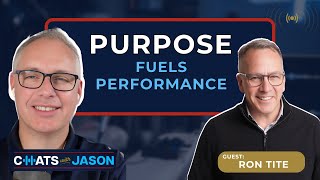
Ron Tite explains how to turn purpose from a poster into a growth engine by connecting it to how you make money and what every employee does daily. Purpose works when it's tied to business metrics like revenue and loyalty, not just borrowed from what competitors claim.
Chapters
If purpose is just a poster, AI will shred it. But when purpose is fueled, teams move, customers stay, and competitors sweat. Welcome back to Chats with Jason. I'm your host, Jason S. Bradshaw. And today we're joined by someone who turns lofty ideals into measurable momentum. Ron Tite is a globally in demand keynote speaker, best selling author of Think, do say and founder of Church and State. He's that rare blend of strategist and showrunner. An award winning creative director who shaped work for brands like Google, Microsoft, Walmart and Volvo, and a former stand up who knows how to keep it real while keeping you riveted. I'm really looking forward to this conversation. His newest book, the Purpose of Purpose, makes a bold promise. Align what you think, what you do and what you say and growth follows. In this conversation, we're going to unpack how to turn FOBO into forward motion, lead the AI revolution without losing your people and use story as the spark that connects purpose to performance. After all, organizations don't change, people do. And after today, you'll know exactly how to lead that change. So let's dive in with Ron Tite. Ron, welcome to the show.
Thank you, Jason. Right out of the gate, I think I'm gonna steal your line now. When people ask me to introduce myself, I'm gonna say, I keep it real. We'll keep you riveted. That's a gold line. I'm gonna use it, I'm gonna, I will, I will attribute it to you.
But I'm gonna use it, use it away. More than happy for you to do that. So let's dive in. When does purpose stop? Just a poster. And I'm sure, you know, everyone listening, that works in a corporate environment and even perhaps some solopreneurs, they have a poster up on the wall with this great purpose. When does it stop being a poster and actually start being a profit engine?
I think the first thing that is really required is that they articulate the purpose, right? Some of the purpose statements that have been written over the past little while, they deserve to be on a poster. That's the best they're ever going to be. And you know, leaders responded to, you know, the market and consumers saying how evil they were by responding like, but, no but. And the poster was something they could point to, right? It was like, but no. We, we wrote this purpose statement. We went to a city north of where we. Or we went to a resort north of the city and we huddled around a flip chat. We wrote that. So it was really easy for A leader to point to a poster and say, that's what we have. So they could check the box and move on. Because of that, what they wanted to do was they wanted to write purpose statements that made them sound like they were petting kittens and, you know, working in dream catchers and just saving the world. And they go, we believe in sustainability. You make a cracker. What are you talking about? So they chose purpose statements that address social cause and issue absolutely nothing to do with where they made their money. So that was the first thing where they got wrong, which is that thing belongs in a poster because there's no way it can be. You can bring it inside the organization because it's not connected to where they make their money. Now, the second reason, kind of a step of that, when the purpose actually becomes a part of growth, is when it's connected to what you do and when every single person in the organization fundamentally understands what it means. Oh, this is what this place believes in. And they know that they have a clear and valued role in bringing that thing to life. We believe in that care brings community. And so therefore I know that I have a role in bringing care to life. That's when everything fires together and that's when you drive growth.
So that all makes sense to me. I'm just wondering, though, why do we keep seeing organizations have these purpose statements that are so misaligned? I can think of a couple of airlines as an example where they talk about sustainable aviation. If you cared about sustainability, you wouldn't be flying a plane. Like, they just chew through so much AV gas, right? Why do organizations continue to go down this route even though there's people like yourself that have debunked? The purpose statement should be this lofty, misaligned thing to something that is actually aligned to drive profit. And why does it continue?
They face social pressure to be something that they're not. And it's really easy. Instead of completely overhauling the entire foundation of an airline, it's just way easier to just write a statement to say that you do it. I think also, though, they feel pressure within categories where if you look at all financial institutions, you look at FIS and go ahead, in any country, wherever you are, list the top 10 financial services companies and look at their purpose statements. They all sound alike. They just all sound alike. So it's not unlike other parts of the business where they benchmark the competition, they see what the competition is doing and they Change it by 2% to, to. To show that they belong in that category. It's either out of laziness or it's out of fear or both.
Yeah. And I'm not saying, just to be clear to our listeners, I'm not saying airlines shouldn't care about sustainability. I just don't think that's their purpose on life. Yes, they should be. That everyone should have steps in that they take to be more sustainable.
Well, they just lost the plot in there. Right. And that's where. Where if I had a theme for 2025, it was, let's get back to work. Let's get back to work. If your purpose and you're an airline is about sustainability, then you know what? Then why would I fly with you other than if I want to check that box? But your purpose should really be about getting me from point A to point B with an amazing experience through you, make your money. That's why I buy the ticket and all those other things from human rights and equality and sustainability of how you provide that service that I buy. Those are all expectations. Now, if somebody says, we believe in sustainability, most consumers are like, man, I hope so. Like, that's like saying, we believe in not murdering people. I hope you believe in that. But I came here to buy a plane ticket so I could get to Florida. Like, that's how it's got to come back.
Yeah, I love that distinction that you make. Purpose isn't about every action that your business will take or every action that your business feels delivers value overall. It's about, what are you there to do? It would be like a car company saying they create the best travel experience in the world. No, they're a mobility service. Some of the big groups obviously have buses and stuff. They're not an airline. Was there a shift in your mind or a moment in time where you started to see organizations go, actually, we've got this wrong about purpose, and we need to start again and refocus.
I've done a lot of work with frontline employees. I'm talking grocery store cashiers, deli clerks, people who are frontlines who are facing customers. And it started there when those people were like, calling BS on stuff. They live it every day. And they either go, you know what? I don't even know what it means, or they couldn't tell you what the purpose was, or they could state it because it was beat into their brain during some weird onboarding process, but they didn't know what it meant, and they didn't know what role they played. And so it was those people who first was like, oh, yeah, maybe we're Getting this wrong. And then when we were working with larger enterprise clients, we boiled it down to this, what we called an essential do. This is the cheat sheet to, to tell whether or not your purpose is actually grounded in reality. And it's just finished the statement we believe this, so we do this by doing this. And the key word in all of that is so we believe this, so we do this. So if you say we believe in sustainability so we make crackers, you can see how that does not connect. So that was when we started writing those and we're like, this does not connect. I just found myself angrily responding to LinkedIn posts going, this is not purpose. And I just slowly but surely was moved from being angry to inspired as I started to see organizations who embraced what we believed and what we advised them to do and other organizations on a global stage that you started to see, oh, people are actually believing in something that's connected to where they make their cash.
So walk us through a client and I'm not asking you to breach any non disclosure agreements or anything like that, but where misalignment was costing growth, what changed and what moved the needle?
I think one, a change is always going to come within a business environment with business results. I used to be the creative director on Dell. Our data team would pull, this was back when I was at Havas, when I was ECD at Havas and the data team would pull the data and somebody said, I don't think we should have a, a desktop. And in an ad it should be a laptop. Our data team would go, we've got the numbers, we know what is performing best. So business results will always be the thing that carries through. And so it has to start there. So when we started to see decrease in margins, we started to see decrease in top line revenue, we started to see a decrease in loyalty, we started to see a decrease in social engagement. Like all these really key metrics and all the way down into employee engagement and when employees certainly coming out of the back half of the pandemic right, when employees start to go, I don't know, is this place for me? And they start to question how their organizations were delivering against their purpose. And so all those metrics were the key thing to go. I think we need to revisit some of this. And we start when you bring it back instead of saying you're wrong with that. It's just, let's just start from the beginning. Let's just start with a fundamental belief that's tied to where you make your money. Okay. Let's start there. This is what we think you fundamentally believe in. So it's really. It's not throwing everything out at once. It's asking for the approval to question and to explore. And through that process, looking for tiny victories along the way so that you can incrementally take a client and by the time you get to the end result, you've completely overhauled it.
Yeah. Talking of how workplaces are changing, AI is definitely one of those tools that is on everyone's buzz list at the moment, and it's disrupting the way we work in so many ways. I'd say culture is definitely being impacted by. You've called it a workplace coup. I'm wondering if a leader who's listening today is half curious and perhaps half terrified by this thing called AI. What's the first decision that they must make this week to lead a revolution and not resist it?
The first decision they have to make is to dive in. It really is. They need to personally be comfortable with it. Need to personally kind of see a vision where they can start to integrate the. They can start to integrate the possibility of AI in different places in their organization. And sadly, I think they're getting so many AI consultants and advisors and thought leaders who are just saying things from all angles. And the biggest problem, I think, for very senior leaders is this. Up until 18 months ago with technology, it was FOMO. FOMO, FOMO. It was the fear of missing out. It was like their employees would go, my phone sucks. How come we're still on Lotus Notes? Like, why, you know, like, why don't we have the latest platform? Why can't I bring my own device? They were just constantly complaining that the technology wasn't good enough. It was FOMO. And then 18 months ago, two years ago, then it's quickly it went from FOMO to fobo, was from fear of missing out to fear of being obsolete. And now when you go to implement technology within organizations and you even start to whisper it inside organizations, it's the fear of being obsolete. So you've got a full crew of people who are completely biased in their advice to senior leaders because they might think that their job's on the line. Who's going to advise to implement something where they're going to be out of a job? Not me. So that's why I think advisors or what senior leaders need to really be comfortable themselves and they need to dive in. The second thing I think that you need to ask themselves is, is how can AI make us smarter, faster and I think that replaces the question that a lot of leaders are asked, which is the wrong question, which is how can it make us faster? And that's why we're getting certainly in my business, why we're getting creative agencies and clients who are going like, why can't we just create that TV spot using AI? Why can't we just crank out AI images and they jumped right to output? And I've said it's not. That part of the process is enough for debate. Of course it is. Of course it is. But why are we leading with that? Shouldn't we be saying how can this make us smarter? Because we're using that now. We're accessing the same information with the same insights to crank out something that's just cheaper. And so let's start with it making us smarter. Let's start using virtual audiences so we can do ongoing research. Let's create a dynamic brief so that we're always getting updates to who our core customer is. Let's use it for scale and optimization and customization. Let's do all of that and eventually we'll get to changing the output. But right now you're just as dumb as you ever were with shittier work.
Yeah, I love that phrasing around being curious how AI can make us smarter. Reflect on what you said. If we are just looking at the output, yes, our output will go up, but the quality will go down. And when you're using a large language model, unless it's a private large language model only trained on your own internal data, which most aren't, then who's going to say that your great idea, your great commercial that you've just produced with AI isn't going to be reproduced by the other cracker maker down the street? And I love the idea around using it as a virtual audience to test stuff. That's a great insight there. I'm going to move on to the 10 year old lunchbox test and maybe there's a cracker or two in that lunchbox. But just using what's in a 10 year old's lunchbox, how would you describe purpose to them?
Oh boy. I want to make sure the cultures are the same in terms of a 10 year old. What's in a 10 year old lunchbox? Like a drinking bot, Like a. I have a 7 year old and a 5 year old. I'll tell you what's in their lunchbox. There's a sandwich of some sort, there is some sort of thermos with water in it there. There's certainly no peanut butter, because the nut allergies. You don't want a kid going down and there's some sort of fruit in there. I think using that to explain purpose, I would pull the apple out and I would say, what is the purpose of this apple? And the purpose of the apple is about output. It could be about enjoyment. It could be about health. It could be about stopping boredom. It could be about fiber. There's a thousand different things that you could say and claim that the purpose of the apple is a very specific thing. But until we all agree that this is the one, we're calling it like this is, we're saying it's about fiber. That if we don't agree on the core purpose of that apple, then how are we going to look to explore other forms of fiber? How are we going to look to balance out the rest of our diet? We have to agree on what the purpose of the apple is before we move on and eat other things.
Makes a lot of sense. Makes a lot of sense. Now, in my work around customer and employee experience, quite often a challenge that I come up against is that CEOs and CFOs just think it's fluff. And I would imagine when you start talking about purpose, there's a lot of CFOs that say, why am I signing off on this? This is just another version of flu. So, to that skeptical cfo, how do you link purpose?
How much is this guy charging?
But, yeah, is there a smudge on this invoice? Surely it's not that much. So to that skeptical cfo, how do you link purpose to numbers in a way that survives the board meeting?
Yeah, that's a great question. And here's how we do it. Because if you know that the finance person cares about cash, so you got to make it about cash. You can't make it about engagement. You can't make it about loyalty. You got to make it about cash. So this is the problem that most CFOs have. They know that their organization needs to innovate or they need to be creative or they need to generate new forms of revenue, alternative revenue streams. Oh, they know that has to exist on some level. And so I go in and say, okay, here's what's currently happening in your organization. I should have asked you. Can I swear on this podcast?
Go ahead.
Your team is just doing a bunch of random. It's a bunch of random. You're just running around like chickens with their head off, and people are going, you know what would be a great Idea. There is no way for you to evaluate the idea and to streamline the ideas and to focus the ideas. Wouldn't it be great if in the generation of those ideas that where you spent money on, you spent money only on the ideas that were focused against a core piece that you could evaluate? And the metaphor I tell them is, you know, in basketball, you go down the court. Now when you're dribbling down the court, you can stop. And when you stop in basketball, you have to read the play before you have to read the floor as what's happening. And you have, you have a number of options. You can go this way, you can go this way, and you go this way, you can go that way. You have options before you, but you have a pivot foot. Now, your pivot foot is actually the foot that keeps you anchored to the floor. That's your pivot. It's the foot that you pivot off. And so that foot keeps you anchored to the floor. It keeps you focused. You still can explore the area, but it keeps you grounded in reality. So you don't just run willy nilly all over the court and get called for traveling, because traveling is very expensive. There's no path, there's nothing consistent. You're just wasting money all over the court. Your pivot foot keeps you focused on the task at hand. That's what purpose is. Purpose keeps you focused and makes sure that when you generate ideas, when you generate new innovations, they all tie back to reinforce something that you've all agreed on is worth reinforcing. Most organizations, they go, I love this when they go, you know, we do, we take a bunch of stuff. I don't know why they're from Alabama all of a sudden, but what we do is we take a bunch of stuff and we throw it against the wall and we see what sticks. Have you heard them say that? And you're like, what? Like, how endless is your budget? Who can afford to do that? You need to make really focused choices in what you generate so that you can be really efficient with your money.
Purpose is that grounding anchor to purpose.
Is your pivot for.
Yeah, your pivot for that. What a great analogy. I absolutely love it. Now we've convinced the CFO he's doubling down. He's going to invest. Yeah. He doesn't want to just fix his purpose and get people aligned to it. He wants to create a culture. And a culture that is driven or seen as a growth lever, I should say, within the organization. What's the fastest way to align personal Purpose with company purpose without slipping into the corporate theater.
Yeah, that's great. So the first thing is to understand whether or not you share the purpose of the organization is something like, ah, I don't believe in giving children healthy lunches. Screw that. So do you align? Do you believe what the organization believes in? Okay, now you have a role in bringing that purpose to life. What is that? What is that? What do you do? Let's say I'm a middle manager in hr. Here's what I believe about my job. I believe that management is about mentorship. Okay. And here's what I do to reinforce that. I set up a coffee once a week with one of my direct reports and I mentor them. I invest in career development in my team. I bring in guest speakers to help them out. So it's what do you fundamentally believe about your role? And the reason why this is important is because if we keep it only at the organizational level and only at that broader purpose, what we find is you do a lot of work in cx. So you know this, that when you have a CX focused organization, it's all about the customer. Then what typically happens is you get somebody who's in a non customer facing role like in HR or in payroll and they go, I guess, what do I have to do with that? I don't speak to customers. And so what that does is it allows them to attach purpose to their role that is independent of the organizational purpose. So I'm a middle manager in hr. This is what I believe about being a manager. Now I have some fundamental truth and belief to drive my actions as a manager that's independent of the organizational purpose. Now I have a personal purpose in my role and that helps to bring that broader purpose to life.
Yeah, makes a lot of sense. So give us five simple signals. Your purpose is actually working in the organization. The on the ground indicators that leaders should see within, say 90 days.
One, you're hearing stories from people inside organizations that support that leaders. They'll want the precise and exact wording to come back, right? Can they repeat it? Can they memorize it and spit it back to me in a PowerPoint slide? I think it's way more important to actually hear it indirectly through great stories. If you go to your team and go, what was, what was your favorite customer moment this year? And they go, oh, there was this time this person showed just wonderful care for this client because the client had a flat tire and they changed whatever. When you go, oh, wow, I can see that purpose is shining through in that story, even though they didn't use the exact wording, but I see that they've done that. So that's one thing. Do you hear it in the values? Secondly, is it focusing your path to innovation? Are the ideas coming up really focused on tying back to that, to tying back to that purpose? Are you getting focused ideas from your team? Third, are you getting it across the organization? Purpose can often live either in marketing, because it's been marketing led, or in HR because it's been HR led. And when you start hearing people in payroll talk about it now, you're starting to see penetration throughout the organization. That's an amazing place to be because now you're seeing other disciplines picking up on purpose, and they're now starting to make it into their own daily responsibilities. What else would you see? You would see executives making decisions that prioritize purposes. And I say like decisions without bias. Like, sales is always going to come in and do what sales does, and marketing is going to do what they want to do. But when you start to see people prioritizing their budgets, when you start to see people prioritizing their teams and start to recruit people who can reinforce purpose now, you start to see it's really having a profound effect on people. And then I think, if I'm at 5, I don't even remember how many I'm at.
I was just intensely listening to your wisdom that I haven't been counting.
And then I think the last part is when you start to see other people adopt your purpose, like those people who are indirectly related to your organization, your partners, your vendors, your freelancers. Like, when you start to see those people start to live your purpose now, you start to see that. That your ideas and your passions are being adopted by other people outside your organization. You know, I call them like the people who you do stuff with, who do you do it for and who do you do it with? The people who you do it with, your partners, your vendors, your clients, when they start to behave in ways that are consistent, you're having a really significant impact.
Absolutely. And some great indicators that are really easy to. To see that it is working. I'm glad that I didn't hear you say you send out a survey, you ask 50 questions, and if you get this sort of score, because the reality is in most organizations, when you do that, you then coach the team members to answer the questions in a certain way. So if you can break a myth for me, what's one beloved idea about brand marketing? Employee experience. Purpose. You wish that executives would retire and what should we replace it with?
Oh, I absolutely hate when I hear or read, hey, at least they're talking about us. Any PR is good pr. Oh, yeah, they're talking about us. Well, it's not. That's not good news. Like, we gotta be better than that. If it was just about cutting through and being part of the conversation, then I'd say then, you know, just go kill a puppy. Kill a puppy on the front steps of your office. Kill a puppy in broad daylight. You will be on the news, you will be talked about. Oh, you don't want to do that. No, you don't want to do that, because that's not good. So what we do want is we want to both equally cut through and drive trust simultaneously in who we are and what we do. And if you're just cutting through, then you might be cutting through to the wrong people. You might be cutting through with the wrong message. It should be a simultaneous and parallel stream of both cutting through and driving trust as you do it. And that only comes with being completely intentional with what you fundamentally do and how you talk about it.
Yeah, a lot of what we've been talking about today just keeps bringing one word back into my mind, which is intentionality. Being intentional about what you do, why you do it, how you do it, and as you said, really using that purpose to anchor your decision making and guide your organization. So as we come to wrap up this episode, if listeners were only to do three things in the next seven days, to think better, do bolder, and. And say clearer, what are those three things?
So the three things is, one, articulate what you fundamentally believe in. What do you fundamentally believe? Secondly, a clear articulation of what you do to reinforce that and then to ask yourself, what else could I do? That's where innovation comes from, right? What else could I do that's missing? And you can be, again, you can be really intentional with that by doing a customer journey map and highlighting weaknesses in the market, or you can explore the opportunities to help you prioritize what those other things should be. But what do I believe in? What do I do and what else should I do? And then being bold is really, I think about authenticity, and I know I kind of hesitate to saying the word because it's like a $2 word and everybody's about authenticity. And part of that is because it's true. And we've. We've talked a little bit about AI today. And when everything becomes super polished and everything becomes the written equivalent of clip art, and we all have access to the same stuff. The stuff that's really going to cut through is you. It's like you. Only you are. You only have your experience, your passions, your imperfections, all that. And only you can deliver the thing that nobody else has and nobody else will say or do. And so authenticity to me is just being comfortable with your imperfections. And if you are the type of person who can be comfortable with your imperfections, and I think that mindset will work its way through to how you communicate what you fundamentally believe and what you do. And like you being bold, I think people think that's a increasingly about being wild and crazy. And it's why we're seeing f bombs on book titles and we gotta be really bold and say stuff louder and angrier than people have ever done before. But I think the other version of that is something that's just completely authentic and bold in its simplicity. That, to me is being bold, being completely simple, being completely clear, being completely direct. And instead of screaming, having like, I just did a moment of silence, having a beat of silence. And that's the thing that's going to help you cut through, not the screaming at the top of.
Ron, what a great way to end the show. Thanks so much for, like, we should.
End it with a moment of silence.
Yeah, I'm not going to do that.
But the worst ending to a podcast ever. It was just, I'm telling you, it was 20 seconds of just silence.
We didn't know what was going on. Ron, thanks so much.
Oh, thanks for having me, Jason. Really appreciate it. And thanks everybody for listening in.
So that's a wrap. Huge thanks, Ron, again for showing us how to turn purpose into performance. If this conversation sparks something, don't let that spark fade. Pick one message, one team ritual, or one customer moment and bring it into alignment this week. If you found value, follow the show, rate it, and share this episode with a leader who needs to hear it. And by the way, when I read every comment that you leave. So please tell me what your number one takeaway was from this episode. I'm Jason S. Bradshaw, reminding you, when you transform the experience, you transform your business and the world around you.
More from Jason

Bringing Wonder Back to Work | Leadership, Culture & Service with Peter Merritt







How to Lead With Empathy: Claude Silver on Emotional Bravery & People-First Culture


Inside Harley’s Cult-Like Loyalty | Ken Schmidt on Turning Customers Into Believers
