Why Speed = Sales: Jay Baer Reveals the Future of Marketing & CX
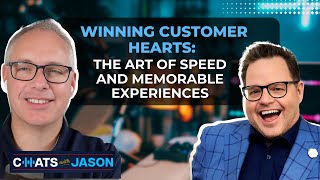
A recorded conversation on Chat with Jason between host Jason S. Bradshaw and guest Jay Baer focused on how speed and responsiveness in customer experience drive revenue, why many firms fail to operationalize CX beyond slogans, and how intentional "talk triggers" create word-of-mouth. Jay argues responsiveness is interpreted by customers as caring (research claim: 85% say speed is a critical loyalty factor), that companies underinvest in retention, and that AI changes both opportunities and measurement for CX. Practical examples (DoubleTree cookies, The Boucher steak-knife ritual, Westin Heavenly Bed) illustrate talk triggers and commoditization of core services.
Chapters
What if your marketing was making promises your customer experience can't keep? And what if fixing it wasn't about spending more, but rather responding faster? Hey friends, I'm Jason S. Bradshaw and welcome back to Chat with Jason, the show that helps you transform the experience to transform your business and the world around you. Today I'm joined by Jay Baer, a hall of fame speaker, New York Times bestselling author, and one of the most respected minds in marketing and customer experience. Jay doesn't just talk about loyalty. He builds it through data speed and unforgettable stories from talk triggers to time to win. Jay has helped global giants like Hilton and IBM, and today he's going to help you. If you've ever wondered why your best ads aren't driving repeat business or how to turn your customers into your best marketers, then this episode is your new secret weapon. So grab your metaphorical lunchbox and let's dive in. Jay Bear, welcome to Chats with Jason.
Jason, great to see you. I'm actually Jason C. Bear, but we'll go Jay Bear for convenience. So it's not two Jason's on the same episode, which would be a real challenge for the listener.
Yeah, I'm sure the editor would love doing the transcript too with that.
Exactly, exactly.
So Jay, you said that customer experience is marketing for the skeptics in the room. What's a moment or case study that proves this isn't just a slogan but a strategy?
I mean, I think it's all around us increasingly differentiators that we might have been able to hold on to and maintain in business in decades gone by. No longer can we protect them for long. It doesn't matter what your price is. It doesn't matter what your services are or the nature of your product. Very, very quickly now, because of the nature of the world that we live in, those will be mimicked by competitors. One of my good friends is a very successful startup executive. He had a post the other day that said there's no such thing as a moat anymore, especially in the AI era, that, that anything that you're trying to do to protect your company from competition is a fool's errand. That ultimately your products and services are commoditized. And what is the differentiator is how you deliver those products and services to the customers, which we routinely call the experience. And you know this Jason, as well as anybody. Executives identify this to be true. Like more than 80% of corporate executives say now that they compete primarily on the basis of experience. And so if it's their job to compete on that basis, then I think we should listen to them.
So we do hear that quite a lot that executive CEOs see that customer experience as one of the biggest challenges and opportunities for them going forward. Yet it seems that study after study shows that customer experience isn't going forward or that companies aren't investing in customer experience, they're just talking about it or putting a logo on the window. What myth is keeping companies, you know, on this one intellectual side? They know that it matters. So is there some sort of myth or some deep seated cultural norm that's keeping companies from creating truly remarkable customer experiences?
Yes, there is. I think it's primarily this problem that most organizations feel like experience optimization is largely an attitudinal issue. And it is not. It is an actionable issue. I can't tell you the number of people I've worked with, a number of conferences I've spoken at, whether they're industry conferences or internal company meetings, where the tone and tenor of the conversation is about we need to be more customer focused. Uh huh. Be more customer focused. That says, you know, we don't really care about customers, you know, we'll replace them. Every single company has in theory the attitudinal part. Right. Which is yes, we should deliver a good experience. Yes, we should make sure that customers are our primary way of thinking until it costs short term profits. Then wait a second, let's talk about this. Very few companies, Gartner would call them the customer obsessed companies. Very few companies are actually willing to trade short term dollars or revenue for long term customer satisfaction. And that's what it requires is an actual choice in the moment. Are you willing to do what it takes, even if it costs you today to build customer satisfaction? That pays off down the road. And most companies, especially public companies, because they're measured 90 days at a time, say they're willing to do it, but they're actually not.
Yeah. Probably not helped by the fact that most executives compensations are linked to those short term measures as opposed to long term sustainability.
Yeah, you don't see a lot of NPS bonuses. Right. Like you know, maybe there should be. But you know where you see it sometimes actual CSAT bonuses is in high dollar transactional categories like automotive. Right. Where dealerships are bonus, JD Power here in the states or things that are similar. And then individual salespeople and service managers are bonus accordingly. There are industries that have those aligned incentives, but most of the time it's not that way. It's revenue or net New revenue or growth. I've said this a million times that we would all be better off if everybody was bonused only on retention and churn reduction and not on net new business.
Yeah, yeah. I can remember decades ago being in a business where they were absolutely assisted about net new customers. But what they were forgetting is the back door of customers that was just disappearing constantly and the amount of money it costs to try and win those customers back after you've spent all that money on marketing to get them in.
The first place, even from a marketing standpoint. I did an analysis on this once. I think it was for my book, hug your haters, if I recall, and we looked at the top hundred or so B2B tech companies, SaaS companies, et cetera, and what they spent on customer acquisition marketing versus what they spent on retention marketing. And retention marketing was like 8%. So there you.
Yeah, the intern had the retention marketing job.
Exactly. Write a newsletter for people who are already paying us, intern.
So one of your new obsessions is speed, of course, and you've got the data to back it up. But why do most companies still default to delay, even when it's killing the conversations and killing conversion and loyalty?
Yeah, it's interesting. I wouldn't say it's a new obsession because all the books I've ever written have had at least a section on speed. And I finally wrote a book, the Time to Win, that's all about the relationship between responsiveness and revenue. I think the reason that we don't get it right is that I think anecdotally, everybody understands that the pace of the world is quicker. Now, I don't think many folks would deny that, but what executives typically don't understand, which is how we did the research and then the book, is it actually has a material financial implication. What I have heard from a lot of businesses, both large and small, is, Jay, we're going as fast as we can. And that's not true. You could definitely go faster. You would just need to make different decisions. Right. Whether it's different capital expenditure decisions, different human capital decisions, different policy and procedure decisions.
But.
But what I hear a lot is we can't go faster. And that is not true. You. You absolutely can. And so what we. What we showed in the research is that if you are faster, your customers will give you money, and if you are slower, they will stop giving you money. It's that simple.
Yeah. I think also if you're slower, you're giving the customer time to go. And look at your competition, you know, Absolutely.
And an excuse to leave. I think one of the most powerful and important stats in the research is that 85% of customers, which is a very high number for anything, 85% is overwhelming, say that speed and responsiveness is a critical factor. Not some factor, a critical factor in their brand loyalty. And it's because today, this is one of the things that's really important to understand about this work. Today we equate responsiveness with caring. We interpret speed as caring. Now, that may not be true, but that's how we interpret it. It's how we internalize it. So if you have an accountant, obviously you do, and you have a question for your accountant, and you leave your accountant a voicemail. If you hear back from your accountant in three hours, you feel one way. If you hear back from your accountant in three days, you feel a different way. Nothing has changed. The accountant's expertise hasn't changed. Your question hasn't changed. Their answer has not changed. The only thing that has changed is the time gap between the question and the answer. And that time gap has a literal impact on how you feel about that relationship and then your likelihood to continue to be a client of that accountant in the future. It's a psychological game, more so than an actual clock game, if that makes sense.
Yeah, it makes a whole pile of sense. And as you were explaining that to us, I was thinking, if my accountant took three days to get back to me, I'm probably thinking I'm with the wrong accountant. Even though, you know, I've been with him for a decade and obviously I've stuck with him. Just that thought. Triggering that thought is what means that some customers will choose to leave. So, well before we actually met in person or had our first conversation, I came into your world, so to speak, through your book, Talk Triggers. You pioneered this concept of talk triggers and the those word of mouth marketing moments that customers can't shut up about. What's one talk trigger that any small business can steal today?
Thank you. By the way, I should also acknowledge my co author on that project, Daniel Lemon, a good friend and a genius. He was a huge part of that project and continues to be. Look, word of mouth has always been and will remain the best way to grow a business, Period. Right? The best way to grow any business is for your customers to do it for you. Clearly, that's the best. The problem there is that businesses invariably make the same mistake in that they think competency will create conversations that if you run a good business, people will talk about it. And that sounds like, it should be true, but it's not true. Because people don't talk about the things that they expect. They talk about things that are unexpected. Like, if I go to an expensive steakhouse, the chances of me telling you about the steak are really low. Because I knew it was an expensive steakhouse, I assumed the steak would be good. That's what the money was for. But there is a restaurant, fancy steakhouse in Los Angeles, and it is at the top of the tallest building in downtown Los Angeles. It's called the Boucher. Their talk trigger, their word of mouth generator, is they have a steak knife menu. So when you sit down and you order a steak, the waiter comes out in, like, a walnut box lined in black velvet. And inside that box, they open it up in front of you, the table. Angels sing. There's 11 different steak knives, right? They've got big ones, small ones. They got the French one. They got the Japanese carbon ones. They got the giant, like, Australian Crocodile Dundee steak knife and everything in between. And you get to pick the knife that you're most interested in. Hey, man, if you want to use more than one knife, you want to use one knife for half your steak, the other knife for the other half steak, it's on you. Everybody takes pictures of the knives. That becomes the word of mouth generator. So a talk trigger is simply this. It is an experiential element that is designed from scratch to create conversations on purpose. So there's a number of different ways that small businesses or large businesses can implement them. But the first thing you got to figure out is what can we do that people don't expect? Because if they expect it, they're a lot less likely to talk.
Yeah. And when. When I was recalling the book, tool triggers, the word that comes to mind for me is intentionality. It's not just about hoping something works. It's about, as you mentioned just then, designing with intention.
Absolutely.
Your point of difference. And it's not about copying what someone else does, because as you mentioned in the book, DoubleTree provides a warm cookie when you check in. But if every hotel tried to do it, they wouldn't do it the same way, because it would be copying, not intentional. It wouldn't be unique to them.
Yeah. Or they would do it. And this does happen. They'll do it in a way that's watered down. So, yes, DoubleTree Hotels by Hilton makes somewhere around 75,000 chocolate chip cookies a day, which is a lot of cookies. Like, I don't know. If you stack those up, I don't Know how big that is? But it's a lot of cookies and it's a really good cookie. But the key is they make them there. So every hotel has a cookie oven, like behind the front desk. They make them on site so they're warm. They take them out of the oven, they put them in a paper sleeve and then they hand them to you. The hand to hand pass is brand standard because then you can smell it, you can, you can see it, obviously, but you can feel it. It becomes a tactile sensation as warm. And then obviously you can taste it eventually or right then in the moment if you want. Now, there are other cookies in other hotels. I've been given cookies by other hotels, literally. But Jason, it's a pile of cookies under a glass dome, sitting on a counter and somebody says, oh, would you like a cookie? That's not the same thing. Right. That's not going to trigger all your senses. And why do they do it that way? Because it's super expensive and complicated to put a cookie oven in like, you know, a thousand hotels. But that's sometimes what it takes to get it right.
Yeah. And to create that talk trigger.
That's right.
Yeah, yeah.
People try and create conversations by doing a thing 5% better and they'd be much better off doing a thing 50% different.
Yeah, yeah. So let's shift gears just for a moment. If you had to explain customer experience to a 10 year old using only things in their lunchbox, how would you do it?
Oh, I wish I had prep for this question. That's good. Okay, so let's say you've got a milk in your lunchbox and you go to drink the milk and it's sour. What would you do about that? Maybe I would send a message to the milk company and complain about that and see if I can get my money back for the milk. That's customer service. Customer experience would be, could we make milk that never turns sour? That's customer experience.
What an excellent way to explain customer experience. So you've worked with over 700 odd brands by today. You've worked with giants like McDonald's, Hilton, IBM, American Express. I don't think there's an industry you haven't had the opportunity to work in. What's one universal mistake that almost all of those brands have made? And what did you help them see instead?
I'll go back to what we talked about with talk triggers, because it is the one that is perhaps most universal. This idea, this pervasive idea that word of mouth is rooted in Quality. I hear it every single time in every single industry. We're the best or we have really good, or we do excellent at this and it doesn't matter. This is why if you look at the distribution analysis, Jason, you don't see a lot of three star reviews because there's not a reason to write one. So I bought a thing and I got pretty much what I expected, three stars. Like the only people who craft those reviews are the about 10% of people who just feel like they have to document everything they purchase. And I've done the analysis on that. There is a cohort like that, but everybody else is going to write what, a one star review warning or a five star review. Holy cow. I didn't see that coming. I think that universally what I find is that when executives in all categories of business think about marketing and customer experience, they either focus on attitudinal, as we talked about earlier, or they sort of focus on sort of tactical implementation like what AI tool should we use to replace our frontline workers with chatbots or whatever. Instead, what they need to understand is that all of this, literally all of this is born from consumer psychology, customer experience and marketing is really a psychology contest more than anything else.
Yeah, it's interesting the work that you've done that shows that most people don't grade threes because what's the point? Yet we're starting to see organizations, Uber comes to mind where if you give them anything less than five out of.
Five, they go one.
Yeah. And I'm like, I'm not giving you five for doing your job.
I agree. Well, but you obviously have a higher standard being a professional in the category. But it is funny. I did an analysis on this as well at one point. I actually worked with Yelp on it. And Google reviews is largely the same.
Right.
If you look at the average score, it's rare to see a business in the threes. It's rare. It happens, but it's rare. So we say that the typical review calculation, right, is a five point scale, ones to fives. But in reality, in almost all categories, reviews are actually a 10 point scale from 4 to 5 with decimal differences. Right? So in reality, the way the world actually works Review distribution is 4, 4.1, 4.2, 4.3, 4 4, 4, 5, 4.6, 4.7, 4 8, 4, 9 and 5. That's the actual world that we live in. Right. And so to your point about Uber, it's exactly right. If you get an Uber driver that has a 4.6, you're like, this is probably kind of a shady Uber driver. Right. In a lot of other categories, 4, 6, like that's pretty solid. But you never see an Uber driver lower than a 4, 3 because they take them off the platform, they deplatform them.
Right.
So the, the whole math of ratings and reviews has gotten skewed and distorted and it becomes a little bit less useful than we might hope.
I'd love to know some of the conversations going on internally when they're like, oh, look, we've got another five. And they said it was ordinary. So we've mentioned how busy the world is a few times during this show. There's no doubting that today's world is noisy. Is consistency more important today than creativity when building trust through marketing and experiences, or do you think brands need both?
I think one begets the other. So I always think about. There's two types of experience optimization. You have the experience optimization that prevents customers from leaving and that is rooted in quality and it's rooted in consistency. It's doing the thing you were hired to do well every time. And then you have experience optimization that's designed to create word of mouth and get new customers to turn your current customers into volunteer marketers into. And that's where it's more creative and different and not consistent every time. It can't be right. I think you've got to get the first one right first because there's no sense having a really terrific word of mouth talk trigger if you can't do the basics well, because all you're going to do is get customers and then disappoint them and then they leave and you got to do it all over again. So you have to execute, I don't want to say flawlessly because that's a tough assignment, but you have to execute at an exceptional level and then layer on top of that that different special thing that people didn't see coming, which creates the top of the funnel. Customer acquisition.
Yeah. And it's that layering on top that creates that loyalty and repeat business. Because if we go back to the cookie example, I'm pretty sure that Doubletree by Hilton gets that. They need to have a clean room, a comfortable bed and a functioning bathroom. They need to deliver on that constantly. But it's the talk trigger that they lay on top that gets people to talk about them and come back.
Absolutely. Because the core service, the bedroom and the bathroom is commoditized in almost all businesses. Eventually your core service becomes commoditized because again, that's what they're paying you for. It's pretty hard to be like, yeah, the water coming out of those pipes is really special.
Right.
And in fact, it's a funny story. You may remember, I don't know how long ago it was now. Fifteen years maybe, something like that. Westin Hotels at that point, part of Starwood, now part of Marriott, Bonvoy rolled out this whole program called the Heavenly Bet. So they literally went down this avenue of talk, triggers of a meaningful strategic word of mouth generating differentiator. And their whole deal was going to be, look, you spent a lot of time in bed in a hotel. In fact, most of your time we're going to have truly the most comfortable bed, the best bed, which good on you. Yeah, makes perfect sense. The problem was, and they spent a bunch of money rolling this out and promoting it and all that. The problem was you can't defend that. We talked earlier about people copying. Usually you're right that if somebody else did a chocolate chip cookie like, bruh, doubletree's got that one on lock. But a bed is so foundational to a hotel that Marriott's like, no, bro, we got the new super comfortable bed. I forget what they called it wasn't the heavenly bed, but it was like the super good bed. And then Hilton was like, nah, bro. We also got really comfortable mattresses now too. And everybody kind of jumped into the breach, so much so that Weston couldn't hold it and they had to back out of it as a differentiator. So that doesn't happen very often, but it can happen. Just doesn't happen a lot.
Yeah, I remember the heavenly angle that they took. You know, it's like so many categories that organizations, organizational leaders can think, my category is safe, My differentiation is safe. Hotels never saw Airbnb coming along, taxis never saw Uber coming along. Even things like hello Fresh, which is still relatively new entrant, you can say they have been around for decades. There's so many people trying to disrupt that now. So your product, whatever it is, can be commoditized, is the message.
It's a look at insurance with something like lemonade, right? That's built with AI from scratch, right? They'll process claims in a matter of seconds instead of a matter of days. Especially in this AI world. I mean, it's been true for a long time that there's no industry safe from innovation. People use the Netflix blockbuster example and things like that. That's always been true. But in an AI world, it is most especially true because people can use very simple, inexpensive tools to come at you in ways that were just unanticipated two years ago.
Yeah, so you once said that content is fire, social media is gasoline. What's your new version of that quote in the age of AI short form video and TikTok fatigue.
Yeah, I don't know that I have as pithy of a line at this point, but I would say it this, I did say this the other day on stage. Word of mouth is more important today than it's ever been in the history of the world. It will be more important even yet tomorrow. And it's because word of mouth, true word of mouth, me telling you a story out of my mouth hole is the one thing, arguably the only thing that AI can't fake. And so that veracity, the trust level of a human being making a recommendation to another human being, that is going to take on greater and greater and greater importance because it's the one thing that ours will never be. The robots.
Yeah, couldn't agree more. If a CXO or a business owner had only one metric to track customer experience and marketing success with this quarter, what should it be and why?
Yeah, one metric for a quarter to measure kind of customer success or a year.
I'll take either time frame.
It's a funny question because I'm actually doing a whole session on that at CCW in Vegas this month where we're interviewing a bunch of executives about in this AI plus CX era, how are your metrics and your scoreboards changing? And they are changing because this idea of doing a customer satisfaction survey or Net promoter score or whatever, all that takes a while. And now a lot of the AI tools can do predictive satisfaction, right? And actually say, we don't even need to ask people what they think. We can tell you what they think without asking them. Or the one concept that I'm really bullish on is the digital twin of customer things that people are doing, where they're building a whole AI powered database, which is a lookalike, essentially a ghost of your customers. And so if you're going to roll out a new product feature or a talk trigger, you don't have to do a survey of your actual customers, you can do a survey of the ghosts and they'll tell you what they think as if they were real people. Like that kind of stuff. Blows my mind. Right? It is truly extraordinary. But if you had to pick one thing and I will do it for a quarter, I would measure customer satisfaction as well. As much as you can. Lifetime value, repeat Order, whatever, however you want to conceptualize that customers who are interacting with human beings in your organization versus customers who are interacting with an AI agent. Because we take it right now as axiomatic that AI interaction is a net positive to the business because it's so efficient. But I'm seeing a lot of research and a lot of anecdotal stories that customers aren't quite ready for it yet. They know it's coming. They know that eventually they're always going to be talking to robots.
They get it.
But I think they're going kicking and screaming, not willingly. And so I would want to measure whether or not my team is going too fast with AI integration.
I think it also opens up another question around which moments is it appropriate, yes, to building brand loyalty to automate to use AI versus those moments that a human actually is the best outcome in the moment, but also for the long term, repeat and referral business metrics.
But it's hard though, right? If you ask customers when you want to talk to a robot, they'll say never. It's sort of like when you ask people, do they want an iPad? They're like, what's that? Until they had one. They're like, this is amazing. So customers have to experience it to have an attitude about it that's accurate. And then the other thing that's challenging right now as we have this conversation, is that the AI bots, especially the voice ones, right, the laden voice bots, are getting so much better so fast that we are not far away, like I think six months from customers, in many cases, not being able to discern the difference. Like today, a lot of times, if you're talking to an AI driven fake person, there's like that little bit of uncanny valley where you can tell sounds like a person, but I know it's not because of the pausing or the phrasing or there's just a little bit of frosting that's wrong, but that's going to get fixed quick. And then the question becomes, do you tell your customers that they're talking to a bot or do you just let.
Them figure it out themselves? Yeah, yeah. The one thing about the AI bot is they've been to communication school. They follow the rules constantly. Where us as humans, doesn't matter how much training we do. Perfectly. Not wrong.
It's too perfect. Yeah.
You need the AI bot that swears.
A little bit and is kind of frustrated and sweaty.
Yeah. It smashes the computer keyboard when it's not working. Exactly, exactly. And so, Jay, it's been a pleasure as we go to wrap up this episode. Just one last question for you. What's the one marketing or CX experiment that you're dying to try on your own brand, but you haven't pulled the trigger just yet?
As you know, listeners may not know, my side business is I'm the number two tequila influencer in the world, so I reach hundreds of thousands of people every week with tequila recommendations. I spend an unbelievable amount of time every night answering questions about tequila on direct messages. I want to build the AI bot that recommends tequilas to you.
Right?
So you say, here's what I like or here's a flavor profile I want. And JBOT says, okay, here's the tequila you should buy. And the bot knows what tequilas are available in your state or your market, and it allows you to shortcut that process. That's the experiment I want to create to see whether that would be efficacious and believable. I just might have to do it.
Well, there you go. I wasn't expecting that answer, but nor was I expecting that you were about to tell me that tequila has flavor.
I can dare your mind on that, my friend.
So I think we'll leave that experiment, the flavor experiment, to the time we get to catch up again in person.
Yes, sir.
Jay, been a pleasure as always. Now that's a wrap on another episode of Chats with Jason. And what an absolute masterclass. From the power of speed to the true difference between marketing and cx. Jay Baer just reminded us that great brands aren't built by ads alone. They're built by moments that matter, delivered faster than expected and more memorable than promised. If you've got value from today, do two things for me. Subscribe to the show so you never miss an insight that could change your business. And share this episode with a colleague who thinks good enough is still good enough. And as always, remember, when you transform the experience, you transform your business and the world around you. See you next time.
More from Jason

Bringing Wonder Back to Work | Leadership, Culture & Service with Peter Merritt







How to Lead With Empathy: Claude Silver on Emotional Bravery & People-First Culture


Inside Harley’s Cult-Like Loyalty | Ken Schmidt on Turning Customers Into Believers
