You Don’t Need a Title to Lead—You Need This One Trait (John Baldoni Reveals It)
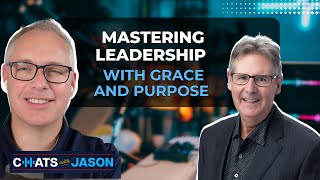
Leadership expert John Baldoni argues that grace—acting with openness, dignity, composure, and humility—is what transforms relationships and enables courageous decisions, regardless of title. He defines it as a catalyst for the greater good and explores how self-awareness and empathy shape the way leaders elevate others.
Chapters
What if the secret to stronger leadership was learning how to lead with purpose and act with grace? What if the greatest power as a leader isn't authority, but influence born from humility? Hi, friends. Welcome back to Chats with Jason. I'm your host, Jason S. Bradshaw, and today I'm joined by John Baldoni, a globally recognized executive coach, leadership educator, and the author of more than 15 books, including Grace Under Pressure and Lead with Purpose. He's been named a Top 20 Leadership Expert by Global Gurus and his insights have shaped leaders everywhere from nimble startups to C suites of the Fortune 500. John brings a unique lens to what it really means to lead with character, especially in times of crisis. This isn't your typical leadership conversation. This is about legacy, resilience and the unseen power of grace in action. So if you're a leader who wants to inspire others rather than instruct them, if you want to influence through empathy and to create an impact that outlives your title, this episode will stir your soul and sharpen your skills. So let's get ready to take notes because leadership just got a whole lot deeper. Let's dive into it with John Baldoni right here on Chats with Jason. Hey, John, it's great to have you on the show today.
Well, I have to say that is one of the most imaginative introductions I have ever had, so thank you. So we can end the interview right now because you said it all, so I don't know what else I can add. I think it's going to be downhill.
I'm sure you're just being very humble. I'm confident that we're about to go on a great conversation. So let's start with the heart of your message. What does it really mean to lead with grace?
Well, lead with grace. I define grace as the catalyst for the good, the greater good. So it's doing what needs to be done with a spirit of openness and hope and respect for others. I think treating people with dignity, dignity may be an old fashioned word, but it's certainly something that we all want to be. And think of the leaders that you have known who have, when they connect with people, say they're a senior leader, could be a president, could be a CEO. And when they make that one on one connection with people, maybe in a reception line or just walking the floor of a factory, or encountering constituents wherever they make each person feel very, very special. I have a very favorite story about this. I can say Winston Churchill. I've quoted him more times than I probably should. But this is one story you're down under, as I would try to say. There was a New Zealand airman who was flying a Blenheim aircraft and he crawled out over a wing and put out the fire. He was badly burned but made it back to base and Churchill honored him. And the man was, this was 1940 and he was stood before Churchill to receive a medal. And he was a little bit, I should say not a little bit, very much overwhelmed, tongue tied. And Churchill looked at him and he said, I know what you have done. And he said, imagine what I feel in your presence. That kind of puts it making the other person feel special. So I think that's a moment of grace. Grace can be transformational. It changes lives. As you know. I've done a show called Grace under Pressure for five years now and I've heard stories of life changing events, but also transactional things. A simple moment of kindness that came in a time that was relevant to the individual. So that's really what grace can do. It can be big or small, but it's a transformative thing. And I think when leaders act with, or all of us act with grace, we connect with people largely now because our world is sadly too graceless, at least on an international stage, shall I say. But I think people are, I want to believe, inherently good and just waiting for that opportunity. So when they see someone they respect act with grace gives them permission of hey, I should be doing this too, or I can do this too makes so much sense.
So I'm wondering, John, was there ever a moment in your life where you felt you weren't enough as a leader? What happened and how did you rise up from it? And how has that influenced your teaching and your coaching?
Haven't had management responsibilities? I do in my community, of course, but a leadership failing I have in my own life is happens about every other day. Just ask my wife. And that's where grace comes in. While we often talk of grace as showing respect and kindness to others, we need to do the same for ourselves when we slip up, as we all do. Give yourself a break and resolve to do better because you can do better.
Yeah. It's important to remember that it's not about being perfect. It's about giving ourselves permission to learn and to grow. In Grace under Pressure, you explore how leaders can stay calm and compassionate during a crisis. Can you share a story, either a personal one or from your coaching work where grace has changed the outcome?
It's a very good question and I probably can't give you a straight Answer. But I know that acting with spirit of composure works. I have seen leaders in moments of extremists. I talked to combat veterans and when things get really tense and tight, those who act the calmest are those who can bring people together. Now the thing about composure, our comportment and sense of extremists, is our military and our first responders, they train for this. So when they are encountered extreme situations, be whatever it is, an emergency, a combat situation, whatever, their reactions take over. That doesn't mean they don't feel fear. As many leaders from Franklin Roosevelt to John McCain have said, Courage is the management of fear, essentially. And so courage exerts itself when we need it. And we see these acts of courage when people just stand up and be noticed and said, I'm not going to do this anymore. And likely we are better for that when we see people stand up for what they believe in, if the causes more selfless or for the organization for the betterment of others.
So I'm wondering what's one mindset shift that separates an average leader from a truly great one in your opinion?
A leader's job, and I haven't said this much before, but it's obvious a leader's role is to elevate others. And so I think the leaders who make the biggest impact, often it could be business, could be nonprofits, are those that make others feel wanted and they belong and they elevate them. They show that they believe in them and when they do that, they bring people together for a common cause. But it's a personal connection. So elevation is that yes, you can do this and I believe in you and others do too. It's an aspect of confidence. Yes. But elevating others so that they can do their jobs better makes a lot of sense.
Absolutely. So shifting gears just a little bit, if you had to explain leadership to say a 10 year old, how would you do it?
Respect. And kids know this. I've got two grandsons and respect others and they know that. Respecting your voice. My two grandkids, I can brag on them, are pretty social little kids. When they meet new people, they are commended for their willingness to share. That's a form of respect. So I say respect others and how you do it is to share with them, listen to them, not do everything you want to do. But how about you can do things together?
Yeah. What great message for all of us to take with us. Now, when I speak to leaders, and I'm sure you too, I see that quite often they struggle to balance empathy with performance, you know, there's this perhaps incorrect assumption that I can't be empathetic and I get the level of performance that I need. How do you guide someone to be both compassionate while being results driven?
Well, there's two different things right there. Empathy is that feeling for others, that ability to put yourself and to experience what they're doing. Compassion is acting on it. So here's the difference and it shows. I mean, when I'm coaching senior leaders, I very often say that what makes a great manager is not empathy, it's being disassociating yourself. What makes a great leader though is acting with empathy. Acting with empathy is compassionate. So understanding that there's a human value there, but it's sort of a bifurcation. As a person in charge, as a manager and as a leader, you have every right to have the job done and provide for people so they have the resources and tools to do it. And if they lack that and you need to make a course correction with them, you know, provide them more training, or if it's just not going to work, then you need to do something different. That can be an act of compassion. I'm putting you in a position, not on our team, but setting you up for another role. And so often I've worked with so many people that best thing that ever happened to them was getting fired or getting terminated from one particular position because it enabled them to do what they really love doing and they succeeded at it. I'm not advocating terminating people, I'm just saying that you need to consider the whole thing. So empathy is that ability to feel for others. But too much empathy hurts a manager from making that hard decision about promotion or separation or tough asking people to work longer hours that will cut into their personal time. What makes us human is the degree of empathy. What makes us great managers sometimes is the distancing ourselves from them for the right reason and explaining people, hey, we are going through some tough times and this is what I'm asking for you. And you do the same thing. You're there for them too.
Yeah, great examples there to guide us there. And I have to agree there's that as a leader sometimes you. Well, not sometimes, always. You need to be prepared to make the so called tough decisions and you can make those with dignity. You don't have to humiliate people while making some of those more difficult decisions. So a phrase that I've heard a lot, and I'm sure many of our listeners have, and perhaps yourself as well, is that leaders are born or leaders are made based on your experience. What's the real truth behind that statement? Are leaders born? Are they made, or is it something else?
Well, I would arguably say that they are made, but there are people who are, by nature, perhaps because they're extroverts, like to be in charge. That can be a positive or a negative. It can be the bossy kid who gets things done, but nobody really likes him. But I think leaders are made in the holistic sense, where they see examples of leaders they respect as well as bad bosses. Bad bosses are great instructors. They're hell to live with or be banished by, but you can certainly learn a lot from them. It's a great exercise in early leadership development is to ask people in a group talk about the worst boss you ever had and what that person did. And it leads to a lively discussion and some humor as well. But what you learn from that experience is basically, I'm not going to do anything that person did. So that's a good thing.
Yeah, true. So you've authored quite a number of books. What would you say is the common thread across all of your work and an idea that you hope people will never forget?
Well, all of my nonfiction work has all been focused on the topic of leadership, and I began exploring communication because my original career was in corporate communications as a speechwriter and other things. So that evolved into purpose. I wrote a couple of books on purpose, and then guts and gumption, grit, if you will, called moxie. But probably my work I am most fond of is what I've been doing recently, and that's the topic of grace, you know, as I said, the catalyst for the greater good. So I've written three books on that topic because I think it's a different thing. It's the way I was educated. I learned this, of course, from my parents, who are both acted with grace, I would say, but also my education. I'm Jesuit educated, high school and university. And not that I acted with any grace, but the lessons rubbed off on me. So I'm kind of going full circle to things like that. Acting with grace is setting the right example and living that example, not just words, but living it. And I have been blessed, as I mentioned, by my parents, who live that they're now passed on. But also I've had inspiring teachers as well as colleagues as well as people I've worked for who really know how to set that example and make things better for others.
Great stuff. So, like I mentioned at the top of the show, you've been named one of the global thought leaders in leadership. Getting that honor really is a testament to your ability to stay relevant and authentic and impactful over an extended period of time. What have you learned about the evolution of leadership over the course of your career?
I'm glad you asked me that question because I always try to answer it by saying something that leadership as we know it today is actually a fad. It really started in the 80s, some with management literature and my interest in it too, because I was asked to write speeches for senior leaders on the topic of leadership. And I said, hey, I'd rather be saying these things than putting them words in the mouths of the speaker. So I crossed the Rubicon, if you will. Leadership, of course, is timeless. It's been with us for millennia, prehistoric times till now. And I used to be asked, has anything changed in leadership? And I'd say absolutely not, because the principles have changed. But actually there are some changes. One is the elevation, shall we say, of women in leadership positions. That wasn't allowed before and now is, and I believe our society is better for it. The other thing is globalism and the velocity of change. The COVID virus is an example. What happened in Wuhan, if it had happened 40 years ago, it might have been a page 10 story in the New York Times. And you know, it was an outbreak of this. But with international travel and commerce and all that, the virus spread very quickly and it became global. So that's one example that's a negative. A positive is this global trade and exchange of ideas and all of those things. But they put pressures on different communities in the States. We lost much of our manufacturing sector to Asia, which could do it cheaply and oftentimes better, more efficiently than we could at home. So we had to reinvent our manufacture. And I think we've done somewhat of a good job on that. But then there's that velocity of change. Now the other thing that's happening is generative AI, and I got no idea where that's going, but it's going to change us, and it's here. And I have dabbled myself in it because I have the Baldoni chatbot, which all your listeners are welcome to try. And it's free. You can ask it leadership questions. I call it leadership answers to management questions. So conflict management or boss and all that kind of stuff. And if you don't get the answer that you want right away, ask it in a little different way and you'll be helping me. And it's all free. And source is only my published work. I don't say that out of ego. It's a personal limitation we did. It's not the same as ChatGPT. It's my own work put in a generative AI form.
Yeah. Oh, that's great stuff. We'll definitely have to check it out. And a great way for people, I think, to access the breadth of your work because they'd have to devote quite a number of days to read every book that you've written and be able to assimilate all that information quickly. What do you see as one of the biggest blind spots that leaders have today? You know, we've talked about the, the change in management in terms of pace and other things and your desire for leaders to have more grace in the way that they lead. What's the biggest blind spot do you think that people have and how can they start to fix it?
Well, I'll steal this. It's self awareness. A colleague of mine, Tasha Urich, has studied this extensively and she said that something like only 20% of managers are actually self aware. And I think that's a couple of things. They don't spend enough time on themselves, developing themselves because they're under time pressure. They're other directed. Leadership is other directed. The other thing is I think they just don't think enough and reflect enough. And I don't mean that's not a form of being ignorant, but they don't take the time to reflect. So I think how you develop self awareness is through things of mindfulness, meditation, taking breaks, taking vacations, getting away from work, pursuing hobbies, sports, family, friends, all of those things are generative and will help you develop your awareness. And also looking at yourself critically, that takes. An executive coach can help you with this, but a peer can help you with it. A spouse can help you with this. Looking at yourself candidly and being able accept feedback. We all want feedback that says, boy, Jason, you are just terrific. But when I say, Jason, there are things we need to talk about and I don't think that you're quite with us on this particular thing that's going to sting. So you have to sit back and say thank you. As our friend Marshall Goldsmith has taught us to do. Thank people for their feedback, but then listen and see if you can do it better if you're going to be more effective that way.
Yeah, some great insights. When I think about everything that's going on in the world, there's quite a lot of noise and can be disorientating for new leaders, especially to understand how to navigate the world of Leadership. How do you think emerging leaders can find their voice and lead authentically?
The very good question. I have this saying and it was in one of my books called Square the Circle. Know what you can do within the parameters of your job. You can also look outside your job and how does my function, my department, help other departments work? If I'm in marketing, how do I help sales? How do I help delivery? How am I helping hr, whatever it is. And look for interconnectedness. Be open to feedback, certainly, but also look for role models. Seek out mentors. A mentor is not a coach. A mentor is someone perhaps often in your organization, but maybe not who is willing to listen to you. And mentorship is a commitment. So if, if someone's going to share their time with you, you be the one to seek them out and set the appointments and listen to them and do what's suggested of you. Or in a sense, you know, they're not your boss. But listen to them and learn from them. That's a sign of respect in a sense. As I said, squaring the circle. Stay in your lane as it matters. Don't get outside of your lane. So if you're in marketing, don't tell logistics how to do a job. Now, if they have a problem with delivery or something, just have this conversation like, hey, we have this new product out and it's not reaching the stores. Is there something I can do and our team can do to help you? Don't meddle. Seek to collaborate, seek to coordinate.
I love that. Seek to collaborate. What do you think the role of storytelling has when it comes to leadership? Does it have a place? Does it help leaders be more effective?
Oh, I think it's fundamental. I did a bit of book, how Great Leaders get Great results and I opened it with something I stole from a short lived series that Steven Spielberg had created for American television. I don't remember the name of it, but the first image of the credits was a prehistoric people huddled around a fire listening to the chief or a shaman tell stories. Storytelling is how we explain the world and so that is very fundamental to us. So I encourage leaders to develop their own story. I do work with veterans here in the States and they're part of the program not developed by me. I'm just, you know, facilitator here. But is storytelling know what you can offer knowing your own story, what are your strengths and benefits? Where did you come from? Those kinds of things and learning to tell that from a leadership standpoint, Sharing the stories of your own career with others, celebrating the stories of people in the organization. Stories are how we learn. In my book, how great leaders get great results. And I've seen this. Numbers tell stories. Trust me, I've helped leaders, tax auditors, with presentations. And if there's anything more dull than tax auditing, not for me. But I could make them tell that story in a compelling manner. And their presentation became more alive because they said, this is what this number means and what it relates to the entire organization. Those kinds of things. So just because you have a column of numbers that tells the story too.
Yeah, makes great sense there. And definitely more impactful when you can have a story or a meaning behind numbers. John, I'm sure by this stage in the show, a lot of people are wondering how they can follow your work and stay connected with you. What's the best way for them to do that?
At my website, john baldoni.com and there's a little bubble on there, the question bubble. They can access the chat bot from there. I also do a show called Grace under pressure. It's LinkedIn Live. It's also on YouTube and all the major audio channels. We've got 280 episodes so far. And learn from that. And of course, all my books are on Amazon. Where I'm headed now is poetry. And I've published three collections of poetry. And that's where my heart is, how I express myself. Now, I also write for Forbes as well as Smart Brief, but I'm more interested in poetry. And why I'm interested in poetry is because poetry has that ability to cut to the quick. We can get to the message and it's a form of storytelling, of course. And all of us are pressed for time, but I think we have more time for poetry or can make time for poetry.
Great stuff. We'll definitely be sharing links to all of those various resources that you you have mentioned to make it easy for people to connect with you. John, as we come to wrap up this episode, I have one last question for you. If this was your final keynote or podcast interview and you had just 60 seconds to share one message with the world on leadership, what would you say?
I would say grace is the catalyst for the greater good. It facilitates our ability to connect with others. It enables us to show courage, commitment, compassion. And when we do those things, the fundamental is the connection, as I said. And that's how we build community. We are all looking to belong to something and to add value to it. And community is how we feel wanted and belonged and how we help others.
Great message to end the show on. John, thanks for being a guest with us today. Thank you.
My pleasure. You asked terrific questions, Jason, so thank you.
Fantastic. I really appreciate that feedback. Now, from redefining grace under pressure to showing us how humility can be a leader's greatest strength, John Baldoni didn't just share insights. He shared wisdom that moves hearts and minds. If you're walking away today feeling more inspired, more centered, and more ready to lead not just from the front but but from within, then this episode did its job. Now, here's your challenge. What's one area of your leadership where you can show more grace this week? Not perfection, grace. Whether it's a tough conversation, a team that needs encouragement, or simply giving yourself permission to grow, remember, real leadership isn't about having all the answers. It's about showing up with purpose and with heart. Thank you for joining me on this journey. If this conversation resonated, be sure to share it with someone who leads, loves, or serves others. And don't forget to subscribe, leave a review and connect with me on LinkedIn for more real conversations that help transform the experience so you can transform your business and the world around you. I'm Jason Esprachel and this has been Chats with Jason where better experiences begin with better conversations. Sam.
More from Jason

Bringing Wonder Back to Work | Leadership, Culture & Service with Peter Merritt







How to Lead With Empathy: Claude Silver on Emotional Bravery & People-First Culture


Inside Harley’s Cult-Like Loyalty | Ken Schmidt on Turning Customers Into Believers
