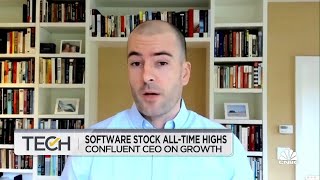
Jay Kreps, CEO of Confluent, tells Jim Cramer the company is the central nervous system for real-time data streaming. Built on Apache Kafka, Confluent serves Netflix, Walmart, and Morgan Stanley. The company is targeting profitability by year-end while pursuing aggressive growth in a competitive market.
Chapters
Last week I introduced you to a couple of red-hot enterprise software names that were part of the ill-fated IPO class of 2021. After getting killed last year, they've come roaring back. And the ones that come back are the good ones. Today, one of them sold off hard. I'm talking about Confluent, which is a data infrastructure story. Their data streaming platform helps clients harness their data as efficiently as possible after surging from from 120 to the high 30s in the past 6 weeks. Confluent had a bit of a speed bump. It fell nearly 7% to 34. Why? I think the stock's been up in a straight line. I think it's pure profit-taking after a miss of a magnificent last quarter. So is this pullback an opportunity? Let's take a closer look with Jay Kreps. He's the co-founder, chairman, CEO of Confluent. Learn more. Mr. Kreps, welcome to Mad Money.
It's good to be here.
All right. So first of all, you're one of the few companies that came from a tough cohort. Where everybody finally realized, you know what, we really need these guys. This is a real company. So tell people please, if you don't mind, why companies, and I'm talking about a lot of big companies that people have heard of, companies like a Netflix, companies like a Square, a Ticketmaster, Whirlpool, they all need you.
Yeah, yeah, you know, there's been a rise of a whole new paradigm for using data, which is around streaming. And it's not that different from like on your TV, where instead of having all the CDs stored, it kind of streams right down to you as you need it. It's a similar thing with data. Like the focus in data for the longest time was like storage of data.
It was like we thought about it.
Yeah, it was the Oracles and maybe more recently the Mongos and the Snowflakes. They're like the memory banks where the data goes to sit. And we're kind of more like the central nervous system that kind of connects it all together and has the data flowing in real time and lets you kind of react and respond as things happen. And that has turned out to be something that's incredibly mainstream.
Well, you have this— there's this open source technology that everybody uses.
Yeah.
And it's called Apache Kafka. It reminds me, it's like we work at LinkedIn, but it's something people get and they can't necessarily just bring the free source in and make, make it work. They have— they need somebody like Confluent to make it work. Yeah.
Yeah. So we offer a managed cloud service, you know, across the three major clouds. That, you know, offers this to you as a service. So instead of hiring a team and standing up your own servers, you can just kind of get it on demand and consume it. And, you know, we take account for all the operations and delivery of it. And then we also offer that as like a licensed software offering in people's data centers. And that's our, that's our business model.
Okay. So the large travel agency that you alluded to, how do they use you and how would AI help them even use you better?
Yeah, yeah, yeah. There's been a lot of interest around data in the context of AI. You know, if you think about what companies are trying to do, they have all this data locked up in all these different systems and they're trying to take advantage of these new capabilities. And so if you have something like the OpenAI language model, it has general knowledge about the world, but it doesn't know about your business and your customers and your stuff. And so how can you combine those two things? You have to kind of unlock all that data and get it in the right place at the right time. So a good example is in travel. We have a customer where They wanted to build an agent that interacts with their customers so that instead of calling them on the phone, you can immediately find out like, hey, where's my flight or what's happening or can I rebook? But to do that, they have to take this language model and then take the stream of what's going on and make that accessible so that they can send it off to prompt.
Well, is the alternative that they try to build it themselves? It costs a lot of money. They know what they're doing. Yeah.
You know, often the alternative for our customers is, you know, they need data streaming, but their other choice would be try and do it themselves with open source. And the challenge with that is usually it just takes a long time and it's usually a lot more expensive. You know, one of the things about these cloud services is they can actually be cheaper than even free software, because when you think about what you're spending, it's not just the software, it's the, it's the hardware, it's the people. All of that gets rolled up into these services that companies consume.
And I think one of the things that happened with you, there was that in the core, all anybody cared about was revenue growth. And then suddenly people said, listen, we actually want to see companies that make money. You did that pivot and yet you didn't lose your revenue growth.
Yeah, yeah, yeah. That was a hard adjustment for us. You know, obviously there's a big market in our space. And so the number one goal has to be go get that. And if you don't, if you don't capture that new opportunity, then you're nowhere. But we felt that, you know, hey, there's an opportunity to really take the path to profitability faster. And so we've put a lot of efforts in to make sure that we can hit, you know, non-GAAP breakeven by the end of this year. And that was definitely a significant pull forward. And we wanted to do it in a way that didn't just sacrifice growth. They didn't just kind of stop and give up on that because in our space there is a bit of a land grab in this new area and whoever gets it has it for a long time.
All right. Well, tell me, I just want to kind of know the process. Yeah, but Netflix, Walmart, Instacart, BMW, Citi, Morgan Stanley, these are big firms. Yeah. So you just have Salesforce just knocking on doors saying, listen, whatever you're doing with your data stream, we can do it better.
Yeah. Yeah. You know, if you were going door to door, right, with your sales team trying to tell some new paradigm for data, it'd be like a long hike, right? And this is actually where the open source helps. You know, the key thing for us is connect with the right use case, the right team that's building the right thing in a big company. And we don't want to do that by going door to door. We want developers to find us. And so for us, you know, the prevalence of the open source, the kind of low-friction access to our cloud service, all that makes it really easy for us to find the right use case and then help it spread within a company. We want to grow from that first use case to where they're literally connecting, you know, everything in their organization around these real-time streams.
Okay. So I want to know that there's a moat here. Like, you know, I'm listening to Larry Ellison last night talking to Oracle Corp. He's basically saying we're going to destroy anybody who's in our area. I talked to Frank Slootman. Oh, they're going to destroy everything. I mean, why won't they go after Confluent?
Yeah. Yeah. Well, you know, the good news is we're very complementary with data storage, right? You know, we're streaming. It's its own thing. It's about how you connect it all up. And that's a problem that has kind largely been ignored. And then beyond that, you know, there's a lot of technology to build one of these cloud services. It's not that we've just kind of taken the open source and given it to customers. That was kind of the older model, right? Was kind of selling support on open source. The Red Hats of the world, right? There is— of the world built, you know, I think in some cases respectable businesses around it. But in the cloud, there's a different way, right? Which is really building something that's differentiated. That has a deep moat of technology that nobody else can deliver. And I think that's the best way if you want to have, you know, a software business with, you know, the kind of margins of a software company, you have to have that. You have to have a way of doing things that's better and faster and cheaper and is unique.
Well, that's very clear. That's exactly what you have. Why we, we profiled you last week, why your meeting went very well, why the stock's been straight up. And to me, if it didn't have to take a little profit, then it was just nuts. I mean, look, Stocks don't go straight up to the sky. This one's had a really good run. That's Jay Kreps. He's co-founder and chairman and CEO of Confluent. Look, maybe the most important thing is you see the proven success stories about who they work with and you realize, boy, they have the right customers. So maybe they're the right company. They have money spec in. Right.
Coming up, what's on your mind, Kramerica? Give us a call. The lightning round is storming the NYSE next.