Becoming Your Own Banker Book Summary (Page 85)
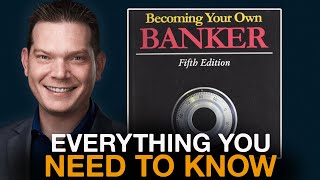
Richard Canfield breaks down Nash's seven core principles of infinite banking, including using whole life insurance as a wealth warehouse and the idea that you finance everything you buy, either through interest or foregone returns. Nash argues participating whole life policies can eventually generate premiums equal to your annual income in roughly 20 years.
Chapters
But it really doesn't take very long. Where you now have a system where every time you put money into that system, make a deposit, a premium deposit, that system grows greater than what you put into it. And then it will do that every single year for the rest of your life. Every year that you take air into your lungs, it will continue to produce that result. That's a machine.
Today we're going to talk about one of my favorite pages and this, this incredible book, Becoming youg Own Banker, written by R. Nelson Nash. There's my man Nelson right there. So my name is Richard Canfield. I'm an authorized infinite Banking practitioner with Ascended Financial, also co host of the Wealth Without Bay street podcast over here. Make sure to check out the Wealth Out Bay street podcast and subscribe to that channel as well. I want to talk to you about one of my favorite pages. So I have a ton of pages that I love in this book. If you can see, I'll flip through. You can notice there's a lot of highlights and notes and other commentary on different pages and stages of the book. This is also my copy that of course I had signed by Nelson Nash. And it's kind of shiny because I've had it laminated being and had to go to, you know, staples and get it bound because it was falling apart. And it's one of my most precious assets. And I love this book dearly. It's one of my most favorite possessions in the whole world. So I want to talk to you about one of my favorite pages. Now I'm going to go to page 85. Now if you have a Kindle version or perhaps you've listened to the audio, you may not have the same layout in that example. I always encourage people to get the physical book when it comes to this because it really is the kind of book that you want to be able to flip back to read different segments. And as you dig deeper and deeper into this discovery of the process of becoming your own banker, you're going to need to reference this book pretty frequently, much like I do. There's so much gold in here, so many gold nuggets to learn and things to take from it. It's kind of the gift that keeps on giving. Now, I know the recording of this video is early Q1 of 2022. We just crass past the Christmas season. The spirit of giving. This book has the spirit of giving in it all the time. So I would encourage you to read from it and read from it often. Anyone who has demonstrated success at implementing this process in coaching it, you know, like myself or implementing in their own life. Owns a copy of this book and references, probably flips through it, reads multiple segments at least one time per year. Page 85. One of my favorite pages. I really gravitated to this page. It's kind of a summary page. It encapsulates a lot of key thinking ideas that Nelson covers in the book. And I want to take the time to walk through the core points on here. He has seven key points that he identifies on points to consider and I want to walk through them, including my favorite which is point number two. But I'll start at the beginning. Point number one, there are only two sources of income at work, people at work or money at work. In the typical American family, or Canadian as it were, through the first half of the 20th century, the father worked outside of the home and the mother managed the home, nurturing the family and instilling spiritual values as the children matured. Now it is widely accepted that a family can't make it without both spouses working outside of the home. It takes two incomes just to make ends meet. Could it be a fact that this modern family has no money at work? Great question. It's a thinking question. Point number two, you knew @ passive income time that you would be getting back every single dollar that you put into a system that you paid into a system potentially tax free. Would you ever object to putting more money into it? Consider that it's a rhetorical question. I mean, obvious answer is no. But just think about where that's happening in your life. What Nelson teaches us in this book allows you to do that. So if you're Canadian or North American and you can implement the infinite banking concept in your life or in your business, you can accomplish point number two as identified in this book. Point number three, when you get paid for your work, you put all of it into someone else's bank. Then you write checks from that account, all right? To buy the things of life so someone else's bank gets all of your money. If you owned a banking system, which you're taught how to do that through this book, wouldn't you want to run all of your business through your own bank? If this is so, then life insurance premiums, participating dividend paying, whole life insurance contract premiums, well designed life insurance premiums paid each year should ultimately equal annual income. This can't be done immediately. It will take the average person about 20 years to reach this level. And if this message is taught to succeeding generations, a perpetual banking system can, can be achieved. Now we have another video on our playlist that talks about some of the underwriting, financial underwriting issues that we can come up with when you're trying to get your premiums to equal income. But this is about stretching your imagination and thinking bigger. The world has taught us that a premium or an insurance premium is an expense and it's a negative thing. And we've kind of had that, you know, it's kind of like a baseball bat upside the head. People have been beating us over the head with that kind of an idea for at least the bulk of my human existence. And I'd imagine you've heard some similar things as well. Here's what's really important. When you recognize that you will get all your money back again. Going back to point number two. You put money in, the insurance company piles it up. You put some in, the insurance company piles it up. Whatever they pile up is available to you to access by way of a policy loan. It's liquid, it's a capitalization that's building value. And it doesn't take very long for a policy. Again, depending on how much you're putting in, how well it's designed, how old you are, there's a few factors there, but it really doesn't take very long. Where you now have a system where every time you put money into that system, make a deposit, a premium deposit, that system grows greater than what you put into it. And then it will do that every single year for the rest of your life. Every year that you take air into your lungs, it will continue to produce that result. That's a machine that's a healthy, sustainable, really well tuned machine that, you know, if you had a business that had machinery, you would want a machine like that working at your business. You would want an employee like that working for your business. So again, I reiterate, you know, you put in, as an example, let's say you put in $10,000 and you're doing $10,000 a year or $50,000 a year. And every time that you put that deposit in, the machine's getting a little bit more efficient, a little bit more efficient, a little bit more efficient. And then all sudden now you put your 10,000 in and it gives you 11 back. The next year you put 10 in, it gives you 12 back. The next year you put ten in, it gives you 13 back. The next year you put10 in and it gives you 15 back. And it gets progressively better and better each and every year. Which means when it's done well, the Insurance doesn't cost you anything. In fact, the insurance company pays you. It's the exact opposite. They pay you for the privilege of giving you a tax free death benefit based on how they keep accumulating the asset base. It's a very, very powerful system when you understand it. Again, we got lots of videos on this channel. Make sure you check them out. Subscribe to the channel because there's a ton of great stuff here. You can learn exactly how to implement this in your life. Going back to the book, Point number four, when government creates a problem and then turns around and grants you an exception to the rule that they've just created, the problem that they've created, that is a tax qualified plan. So the problem is onerous taxation. The exception to the rule is a tax qualified plan in Canada. That would be the RSP program. We're going to give you a little tax deduction now, but we're going to nail you on the back end when the time is right. So Nelson says, aren't you just a little bit suspicious that you're being manipulated? Hmm. Consider that for a minute. We created the problem. Too much taxation and then we gave you an exception to the problem. We created a little tax deduction in the short term. Hmm. What's really going on there? Tax qualified retirement plans were all created under the guise of giving you a break. We're going to give you a break. Of course, that makes sense. First there were pension plans for corporate employees and then came HR10 plans. So these are plans in the United states and then IRAs and then 401ks etc etc. Now that's again American terminology for us. The RSP is the equivalent for us in Canada. That is now everyone had an exception to the IRS code. Woohoo. We all have an exception. If the government really wanted to give you a break, all they had to do is cut out the tax. So do you really think that they want to give you a break? Consider it. Point number five, wealth has got to reside somewhere. That is absolutely true. Wealth has got to reside somewhere. Where would you prefer to have it reside? So Nelson has a couple options, a real estate. Then take a look around and see what happens when one needs liquidity. Real estate is very much a frozen asset. Now I want to quantify that. What is Nelson talking about? Well, if you've seen the real estate market go up and up and up and up. And then if you've ever been in a circumstance where you've seen it down or you know someone where the real estate market's corrected. It can make a big problem for you. So circle back to your, in your memory to the 2008 financial crisis. A lot of that was led by a hot real estate market which led, you know, a lot of mortgages going out there in the marketplace. And you know, we heard about NINJA loans, no job, no income, get loans, all this kind of stuff that happened, leading to a, an explosion in the real estate market prices and then huge foreclosures and then everything kind of came crashing down. You know, a lot of areas they lost values on their real estate of 20, 30, 40, even 50% depending on where it was. Now if you're in that situation, the other thing that happened is if someone was trying to access capital, get equity out of, out of a property, well, they had two problems. Number one, they might have a job risk issue. The economy shifted, everyone's hurting, unemployment went way up. So if you lost your job, no banks giving you any money, there's no liquidity on the real estate. If you can't show the bank how you're going to make the payments, that's a big fat problem. Meaning that the real estate can become a frozen asset. Number two is when the real estate prices shift and change or the rules around lending change, which in Canada happens quite frequently. Read CMHC's website, look at all the changes that happen. There's, there's always adjustments to try to curb the hot real estate market that's happening in different areas of the country and that directly impacts you wherever you live in the country. It's a change to some of the lending criteria. So if you want to go and access equity out of a property, you could be limited to do it based on your income, based on a change to your income or your job or vocation or Covid or a pandemic or whatever. It can impact your ability to access capital, which means that real estate becomes frozen. It's a frozen asset. Nelson says. Then try reading from my recommended reading list in the back of this book. Now you can also go to Nelson's website, infinitebanking.org There's a recommended reading list there. Nelson read every single one of the books on that recommended reading list. And Nelson would tell you flat out to your face, if you read all those books, it was like, I think there's like 300 bucks. You'll have the equivalent of a PhD in economics and in history. Okay? You can't understand economics if you don't understand history. Until you have done so you are you qualified to make an intelligent decision about Such an action. So again, Nelson saying wealth has to reside somewhere, where would you have it reside? Real estate, potentially a frozen asset, the stock market? How much do you really know about that and are you qualified to be making that a good decision? Is that the place you want to reside? And that might be a place you want to invest. You might want to invest your money there because you know what you're doing. That's great. You understand the volatility and how to make a return. Also great. But that's an investment. Is that where you want your wealth to reside? Or do you want it to reside in some place safe, secure and accessible? That's what he's talking about. He's not, he's not suggesting don't invest in the stock market or don't invest in real estate. What he's suggesting is where do you want your wealth to reside? Where do you want to be home base for your money? Think about that. I'll give you an example. I'll give you an analogy. If you have a garage, you got a house, you got a garage. Well, a lot of people, as long as your garage is clean and it's not filled with tools and stuff, you can actually park your garage in there. Now, a lot of places in Canada in the wintertime, boy, you're really happy if you have a garage. So when you go park in your garage, you might go to work the next day, you might go to the grocery store. Well, you back out of the garage and you go to where you do the things you need to do. But your car always comes back to home base and it parks back in the garage. So it stays there when you're not using it. And then you go and you use it and you park it back in the garage. In other words, your car resides in your garage. It's a warehouse for your car. That's what a garage is. You need a warehouse for your money. High cash value, participating dividend paying, whole life insurance is the perfect warehouse for your money. That warehouse of capital, if deployed correctly, used correctly, can help you accomplish every other financial objective that you want in your life. You just have to understand how it works. Guess what? Here's a great book. It's 92 pages long. It was written by this amazing guy right here. And I suggest you get your hands on a copy. There should be a link that pops up on the screen that shows you how to do that. You can check the description. There's a link down below. Get the book. Seriously. I mean, it changed my life. It could change Yours. In worst case scenarios, you spend like whatever, 30 bucks getting a book and you decide you don't like it. You're not out a whole lot of capital to at least make a good decision about if this is something you want to do. Okay, now point number six, you finance everything that you buy. You either pay interest to someone else, pay interest to someone else, a third party, where you access the pile of their money and they're not going to let you do that for free. You have to pay them for the privilege of accessing that pile of money or you give up the potential of what your pile of money could have done. So you either pay up or give up. There are no exceptions. You finance everything you buy. Write that down. That's good. Number seven, your need for finance during your lifetime exceeds your need for life insurance protection. However, if you solve for your need for finance through life insurance cash values using participating dividend paying whole life insurance. So if you finance your need through through life insurance cash values, you will end up with so much life insurance that you can't even get it past the insurance underwriters. Seriously, they're going to have a problem issuing you that much coverage. You will have to insure every person in which you have an insurable interest. So that's why Nelson talks about a system of policies. You know, Nelson himself, he got policies on himself and his wife, on five business partners. He had policies on his grandchildren and his great grandchildren. He was working on the great great grands before he passed away and he sadly left us. And that's the system. Once you have a successful business, you want to duplicate that business, you go and open up another branch of the family banking system. Well, in order to do that you just need another body, that's it. And then you need to be able to get it past the insurance underwriters. So you know, you need a coach and a team of people that know how to help get that done and get accomplished. We have lots of clients who start to run into certain restrictions on their income and assets and ability to qualify for new coverage. Where a good cover letter, a good coach who understands how to implement that can help get that through the underwriting process so you can get the objective accomplished you're looking to achieve. Check out some of the other great content we have. I hope you enjoyed me going through my favorite page of Nelson's book, which is page 85. Again points to consider page 85 of becoming your own banker on the printed version, the black book we call it. Hope you enjoy that and make sure you made a comment about which one of these seven points most resonated with you. We would love to hear from you, and we'd love to hear how many times you've read Nelson's book. And if you don't have a copy again, click to make sure you order one right now. Subscribe to the channel like below, leave a comment and check out one of the other videos on the screen. Cheers.










