I Tested Infinite Banking on My Bitcoin Portfolio
Sebastian Daniels demonstrates how dividend-paying whole-life insurance policies can boost a mixed portfolio's performance. A 20-year backtest with $25,000 annual contributions showed $1.06M without IBC versus $1.12M with it, plus tax-free growth and death benefits. The strategy works by creating a controllable banking function that lets you borrow against policy cash value at your own pace.
Chapters
The value of the Bitcoin's $285,611. That's a total of $417,000 plus. We also have $663,000 in death benefit. Does that not have value both monetarily and otherwise? Our capital has to reside somewhere. What do we need to do to best position ourselves to take care of what we desire? And the answer is we gotta save.
They need to grow their money or something, put it in something so that it's not losing value over time.
Sometimes they say, I don't have any savings, or I'm not saving. And then when we look at their finances, we find out, ah, they are because they're paying down debt faster than they need to. There's no issue with the what. Infinite banking delves into the how. How are you financing those things? So here we're going to be getting into some strategies for growth, hopefully not just financially, but In terms of our perspective, not only in our mind, but then in our habit as well. So for those of you who are new to Infinite Banking, the act of financing and that component of the banking function draws a lot of our attention.
On how to save, invest, and always be ready for the right move and how the Infinite Banking concept enhances them. So let's get started.
Yeah. But what is me is this, the day that I became, I'm sorry for my language, but pissed off. One of the reasons I got pissed off is because I spent a long time trying to learn about finances, trying to learn about investing and consuming everything I could about it, just cuz I really wanted to make the right moves. And the one of the things that enraged me the most is when I realized the myth of the average rates of returns when we're looking at the performance of some fund, some index fund, some equities fund, what have you. And I called the banks and I nailed them with questions until they eventually had to admit the truth that the average rates of returns are not the same thing as the value that you can plug into a compound interest calculator. And yet I was basing my future plans on that, thinking that it was compound growth in the same way, and not realizing that it was being interrupted by all sorts of things, not the least of which are taxes and fees and even days of operation. So those who do know about Nelson Nash knows one of his sayings, opportunity will track you down. I could not resist using that for tonight's presentation. So Here we're going to be getting into some strategies for growth, right? Hopefully not just financially, but in terms of our perspective, right? It's mentioned opportunity readiness, and this is what Nelson means. This reminds me of the quote from Louis Pasteur, chance favors the prepared mind. There's a heavy parallel here, and I hope that as the presentation goes through, and especially as we get to the end, That's going to ring crystal clear for everyone in attendance. So first thing we're going to do is look at the cash flow stream. Everyone's heard of cash flow here before, of course, but sometimes we have a little bit of trouble getting it straight in our mind, what is in which position in this cash flow stream. So this— don't worry for those of— I wanted to appeal to any of my US teammates or any of our US prospects that might be out there as well, or clients. So there's some American bills. I have some Canadian ones coming later. So. It's all good. All right, so we have income coming in from a source. It's always, it always starts like that. It doesn't matter if it's passive income, investment income, earned income, what have you, right? Dividends from your corporation, for example. Either way, they have to go to a reservoir of some kind because our capital has to reside somewhere, right? From there though, there's an opportunity before we dive into our needs And what we can call our discretionary part of our income, right? That is the first place where we have an opportunity to apply control. So now we have a similar stream, but you'll notice it's bifurcated and we got 3 separations of this stream. The reason for that is because we are identifying needs on one hand, as you'll see shortly, and on the other end, even though this is all going to one reservoir, inside that reservoir. we have a chance to distinguish, right? And even after we've taken care of needs, we have various intentions with our money. And understanding where those intentions fall compared to the actions that need to come first is critical, right? And here we have it, a better view. I told you I had Canadian currency, so there we go. So we have a split between our needs and what I've called discretionary income or Desires right now. One thing that I didn't see mentioned was servicing debt, for example. So maybe, Jason, that's what you meant by money, in parts at least, right? So if you have existing debt, there's a servicing cost to that debt. So as typical examples, transportation was mentioned, housing was mentioned, mortgage, car payments. There is a required schedule for those payments. And who Decides what that schedule is. Spoiler alert, not us when we finance things the traditional way. So for those of you who are new to infinite banking, the act of financing and that component of the banking function draws a lot of our attention. And what we have to ask ourselves is, I can't help it, is what is, what do we need to do to best position ourselves to take care of what we desire? And the answer is, we We got to save, and that happens upstream. So the saving function is upstream. So income comes into our reservoir. From there, we distinguish between needs and discretionary funds. At the point where we put aside the discretionary funds and decide what to do with it after, that is where we have the opportunity to implement the Infinite Banking System because it is more to do with saving control and management. of our monetary system rather than any type of investment. But we will be diving into investments later on. So here we have these 3 buckets over here, and these represent the downstream fate of what we might choose to do with discretionary funds. And indeed, Ash, do you think most people feel the need to invest in order to try and secure the possibility of using a retirement, for example?
Yeah, I think that's definitely what the status quo is for sure. What people anticipate that they have to do other than maybe a traditional savings account, they need to grow their money or something, put it in something so that it's not losing value over time.
And ideally growing, which is meaning at the very least beating inflation and such. But as you can see, vacations was mentioned, traveling. Ash, are those usually very easily acquired commodities of experience or do they usually require A large expenditure.
I would say a large expenditure unless you got some kind of a great membership.
As long as you want the vacation to be any good, right?
That's right.
There we go. Okay. So as you can see, for the great deal, the great majority of the answers, or just all the different answers, tend to fall in one of these buckets. Even charitable contribution could fall in here as well, right? And that's a matter of perspective. Someone may see it as an investment. Others may see that as a large expense as well, because Some people are doing 10%. That's not nothing right here. I just want to quickly draw our attention to where it says accelerated debt repayment, right? And this is the first opportunity we have to create a distinction in our— second opportunity actually to make a distinction in our minds. So when we think about, oh, I got to pay off debt, or we have debt to pay off, or so on and so forth, we have to distinguish between what are you required to pay and what do you need to pay to accelerate The repayment of that debt. Those are different things. The servicing cost of debt is in a needs category. And here I've labeled it accelerated debt repayment because that is a choice. And folks, here's what I need you to understand. None of these buckets, the stream of money falling into them is possible without saving. So everything you're seeing here that's going into these buckets is in fact savings. Saving was most important because none of this would've been possible without it. And when we work with people, they often, sometimes they say, I don't have any savings, or I'm not saving. And then when we look at their finances, we find out, ah, they are, because we are— they're paying down debt faster than they need to. Not a bad thing at all. But our question is, we have no problem with what you're doing, the large expenses, accelerating your debt repayment, and certainly investing. There's no issue with the what. Infinite banking delves into the how. How are you financing those things? We now understand savings comes upstream, all these things come downstream. So what can we conclude? Saving is more important than investing because you can't invest what you haven't saved, and therefore saving is a prerequisite to investing. And this is something we're gonna focus on today. So let's do a quick Comparison between the two so we can distinguish it before we get into the second part of today's presentation, right? Let's compare key attributes of what is, what's involved with saving and what's involved with investment, right? So what, as we just spent some time going over the priority and the cash flow stream, savings has a higher position since investment would be dependent on the savings that we do. The risk that's associated with investment, before I go down this list, I'm actually going to go back here and I'm going to ask a question. Would you say that there's a big difference between saving and investing? Now I got a follow-up question. If you had to pick only one thing that differentiates the two, what one word would that be? Okay. So yes, priority in the cash flow stream. We talked about risk factor. What's the downside of saving? What is the downside of getting that kind of control? I can't perceive any myself, right? However, we do know, as was mentioned by several, the risk of investing. We are, we're all told, what's the first question we're told, we're asked when we go to some financial advisor at a big bank, for example, and we tell them, hey, Mr. Banker, Mrs. Banker, I'd really like to grow my capital. Can you help me with that? Sure. I just got some questions for you. First question, what's your risk tolerance? We are taught to embrace risk first, even though banks focus on security. They lend with security. Third focus, the locus of control. Who is in control of saving? If you are the person who is putting the funds aside, then it's 100% you, right? People don't typically save by accident. It does— it's an intentional— it's an intentional action, and it's certainly behavior dependent. Now, control over investments? No, because the locus of control there is external. So not all those other— all those answers are great. I was thinking about business for sure, right? But you have way more control over that as a form of investment rather than the stock market or any other of the commodities and so on and so forth. Market-dependent events, monetary policy-dependent events, et cetera. But your own business at least is dependent on your efforts. So at least there's that. However, most businesses involve a buying public, some type of market, some type of customers, and we have very limited control over them. So I would still say though, the business is a greater example of control, more in our sphere of influence compared to the foolproof act of saving. It certainly represents an external, more of an external locus of control, right? So I hope that point's well taken. Next, predictability. I know if I keep putting $10 into a jar every day, I'm going to have $70 at the end of a week. I'd say that's pretty predictable. Investments, predictability is moderate to low. Moderate risk, you may have moderate fluctuations. Higher risks, low fluctuations. And we're encouraged to Embrace the concept of higher risk if you desire high rewards. So I'm going to go ahead and say way higher with investment overall. However, there's one item that's green, and some— it was mentioned out there already— the potential for growth, potential for return, clearly greater with investment. No one's arguing that fact at all, right? So their investment has one up on the savings. So Do we want one of these things to the exclusion of the other, even if it was possible? That's a matter of perspective. Most people would probably be inclined to say ideally no. They'd like to take advantage of all the green components and attributes in both categories. That's only possible if you do both. But what is their relationship? Let's not forget the saving is a little higher up. If this is crystal clear in our mind, the rest of today's presentation Should ring very true. Before going on, we must obviously give a bit of homage and consideration to the source of IBC, which is this man right here and this book right there. So whoever has not gotten their hands on this book yet, you have an opportunity, right? So remember we said opportunity will track you down? It just did. This is it. So if I can get one of my teammates to put a link in the chat for anyone who may not have that book, Or may not have had gotten their hands on it, there is no downside to reading that book. It's 92 pages and it's like painting. One coat will not do the job. More the better, probably. So I've said my piece on that one. Nelson has taught us the importance to control the banking function using the power of saving. And as we'll discuss later, positioning capital gives us the flexibility, gives us the potential. That gives us choice. That's freedom. And we're gonna be digging into that. The process of becoming your own banker is what IBC's all about. The tool that is used is dividend-paying participating whole life contracts. They have predictability, they're majorly tax advantaged, and most importantly, these contracts are 100% in the control of the person who owns it. Right? They're in an ideal environment to save in. Nelson, having been a lifelong fan of— aviator and fan of aviation, brings our attention to the idea of headwinds and tailwinds and the importance of flying in an environment where that we must operate in an environment. And the same is true financially. Why would we choose to operate in an adverse environment? Inflation, taxation, lack of control of monetary policy, such things serve as headwinds. They slow us down. So does putting ourselves in a situation where we allow the control of our cash flow to go away by committing ourselves to required payments to outside sources to finance the larger items that we decide to get in life. And yes, That includes vacations sometimes, right? So Nelson brings our attention to the fact that if we could be all 4 characters in the financial play, the banker and the bank owner, in addition to what we are already excellent at, the borrower and the depositor, we can't— we will have full control. And that's absolute control. And that leads to peace of mind. What's the value of that? Open question. So as we move on, knowing How to be the 4 characters is actually the process that Nelson's getting us to appreciate. So what is the value of the power of control over money? Banking is the most important business in the world. Controlling the banking function will enhance everything else that we're trying to do financially because it is tantamount to controlling the environment within which a plane flies, creating a tailwind To accelerate approaching the destination as opposed to choosing to fly in adverse headwinds slowing us down. Okay, so today I'm not going to delve more, too much more deeply into the mechanics, too much of practicing infinite banking or becoming your own banker. We have many great, great resources on that. And I believe we still have the ability to go to watch IBC. And I recommend that anyone who has, who needs a more thorough introduction to it does so. But today I'm gonna focus a bit more, like I said, on the investing aspect and how it can be enhanced through what we're doing through IBC and also talking about traditional versus modern investment approaches. So first, a quick note, how I used to think about money before I got introduced to IBC. I, like most, realized, hey, one day we, I don't want to necessarily have to work. Right? Like I tell many clients, hey, if you wanna work in your older age because you love it and you're passionate about it, like I am about what I do, then hey, power to you, all the blessings to you. Right? But I just don't want you to work because you feel that you have to, because if you don't know what you're gonna do. So this is the perspective. I think we all have that in common. And Nelson does. I'm gonna, I'm gonna go ahead and do it. I'm gonna read right from the book because since we have so many new people here, I'm just gonna read a small passage, one of the last pages. and points of consideration. In my version, page 85, first point, there are only 2 sources of income, people at work and money at work. I'm not going to read the whole section, but he later goes on to describe traditional roles in the household and how it would take one income. But these days, he opens up the quote, it takes 2 incomes just to make ends meet. And he asked the question, could it be a fact that our modern family has no money at work? So let's consider that in the back of our minds throughout everything we do. And I used to think that meant we have to invest, and that's why we do it. What's the purpose of investing? Probably to create that passive income. We talked about people at work versus money at work. Part of us recognizes that we don't want to necessarily be the person at work, or maybe we won't be able to. So there are many approaches to investing, but I think One of the first things that comes to people's mind when they first broach the subject is the stock market and its potential for growth. And traditionally, those who have stayed in it longer have benefited. And there's some good saying out there. It's not about timing the market, it's time in the market. There's a lot of truth behind many of these adages, but none of them address the banking function itself. And that is why Nelson said you can't get a better rate of return in investing in anything without controlling the banking function first. That environment, that tailwind will be the subject of these next 2 sections. First, the purpose of investing. Traditionally, we're told the plan is to have a large enough nest egg built up, presumably because of investing, definitely because of saving, so that what? So that one day we can start drawing down from what we spent a lifetime building up. And then we have to cross our fingers and hope we don't live too long and run out of money. It's a little bit morbid, I'd say, right? It also involves engineered withdrawal and reduction of the wealth that one may have built up, at least in monetary terms, right? And some of those magic formulas of 4% and whatnot don't always seem to shake well. You only need to speak to those who majority of those who have been in that position and see what they have to say. Just like the RRSP crowd, there's a lot of opinions there. There's a lot of experiences there, and I'll let everyone else's experience speak for itself because that's not me. So Ash, one more question. How important is harnessing the power of compound growth in our financial strategy from 1 to 10? 10 being it's the only thing that matters in the world and 1 being What's compound growth? After I was done huffing and puffing about the myth of compound interest, the way that it was presented to me and the failure of those perfect formulas we learned in high school, like I've been doing for my whole life, I decided to step back, zoom out, open up my mind and perspective and wonder what else is out there to learn. That led me to IBC and the same mindset led me to more modern investment approaches, but I started to become disenfranchised. With my previous approach at investing, though I did well, I enjoyed the experience of it, but I'm looking at tickers all the time. It was consuming and it was stressful because of the uncertainty. And so I kept asking myself, is there another way? Since then, I have moved on in my own approach to investing, but I know that many people out there are still investing in that way. And there's nothing wrong with that. It's a personal decision. Again, IBC's about how we finance those things. So what I thought I'd do is first address our traditional investment style and see what it looks like with and without IBC positions inside that strategy. So we're gonna look at the real numbers. I'm not gonna bore you guys by putting all the charts up there. Trust me, whatever charts I show you guys, I had 20 times more than that, but we don't have time for all that. And, and some, for some people they'll be all into that, others will fall asleep. So I'm not gonna do that to you, but I promise you it's gonna be valuable, right? So we're gonna look at 20 years of wealth-building scenarios using with and without IBC in the mix, and we're gonna keep it super simple. I wanna look at someone in 2005 who's 40 years old, in this case happens to be male, right? After taxes and whatnot. And that's $100,000 a year. So not doing too bad, right? This person believes in saving, but they see the potential of investing. So they've made a decision. They've already done what they had to control their debts and expenses and have control over a good portion of their cash flow. So they've decided they can commit $25,000 a year of their after-tax income there, and they're going to put that whole amount into a combination of saving and investing. And this is, we're gonna look at multiple universes because Nelson tells us everything we do financially is compared to what everyone else is doing. And one of my aha moments in my journey with IBC is to picture the alternate universe where in terms of considering what would Sebastian Daniels do if he didn't know anything about IBC regarding fill in the blank. I'll never forget when I applied that. strategy to deciding on RESPs for my kids, the revelation was like a lightning bolt, and I knew exactly what I needed to do, right? So here we go. This person has a specific goal. They said, I'm going to work hard 20 years. I'm going to invest aggressively till the age of 60. What their goal is, they don't know the exact form it's going to take, but they know they want freedom to live the way they want. They know they want to travel. They don't want to be in the same few blocks of the same neighborhood their whole life. So they want to get out there, but they're interested in maybe having that sovereignty, starting their own business, and maybe even investing in some type of passive income or private lending or something of that nature. All they know is that they will have more choices with a good pile of capital. So they're saying, I'm going to invest for 20 years and I'm going to use a unique approach, which is actually very— this exact one may be unique for some of you, but Variants of this strategy are very common in traditional investing. In this case, because he's a high believer in savings, he's decided to keep 20% of his savings in safety or in some type of money market funds, which is exactly what I studied the results of and used for the numbers that will follow. And he's an 80% in equities. What I did, and also in regards to the fact that we may have some of our American friends here as well, I did include and decide to include the S&P indirectly because this is an S&P And TSX Composite. In case any of you are not familiar with the TSX, it's it's let's just think of it as the Canadian equivalent, even though it's the Toronto Stock Exchange and everything that's listed there. But the thinking is this particular composite, for those who want to know, is comprised of the sixty biggest companies on the market. So it's supposed to be more representative of equities at large. So there there I nerded out on you, right? So the idea is let's see how this looks like, right? So there are rules to this investment strategy. He's going to use the savings. They're not just going to be. title. Just yesterday I spoke to a lovely lady. When I asked her the question, would you say there's a big difference between savings and investing? She said, yes, savings to me is just sitting there doing nothing. For me, it's doing something for someone else. And she's not completely wrong about that, and certainly not the way she's going about it. As I pointed out, that she's not the one controlling the banking function in her life. But she pointed out what I said before, that she's of the mindset that investing is the only way out, quote, So, but in this case, this person understands that we're going to use these savings. And the strategy is this: there's $25,000, 20% of that, $5,000, is going to go to the money market fund regardless every year as a default. And the $20K goes to the equity. This always happens at the beginning of the year. On years that end positive for the equities, they routinely sell 5%— it's an index fund in this case— of the holdings, and they use it To take profit, to save inside the money market fund. On negative years, they decide to be more aggressive to take advantage of the drop or buying the dip, right? For my crypto friends out there. So on negative years, they use 15% of the saving reserves to purchase more equities or more of the index, right? And so let's take a look at what that looks like using the actual values that I took the time to calculate how it all looked. I'm not going to bore you with all the charts, but I will show you a couple real quick. Right. So in this first scenario, originally I was going to switch it up a little bit. That's why it says scenario 2. This is actually the first one. So we discussed how it's going to be done in terms of 20%, 80%, and the general strategy. And this was just a quick look at what the money market fund did. So you'll notice that even within the savings vehicle, there is a lot of variety, but it's ranging from 0.03% to 3.7%, right? You get a sense of what's going on there. And don't be surprised if you complement that with what's happening with the equities. We'll notice that, hey, those people talking about the stock market, they're probably right. I see a lot more positive or blue years than red ones. So I put the numbers out there for you for the percentages, but what I want you to understand is, hey, look at that big red bar or any of these red bars to have capital on demand for those years, right? After all, from the perspective of a longtime buyer, Hey, stocks are on sale, but if you got no money, you can't take advantage of the sale. You can't take advantage of that opportunity. Each of these red bars is an opportunity for someone who has plans to be in there for the mid to long term. This is a very quick rendition of the strategy at hand. You'll notice that these bars match these opportunities here. And what's happening here is the red bars represent when 15% of the savings holdings were used to buy the losers, which would've been the equities those years. And as the equities were winners most of the years, on each one of those years, 5% was taken to add to the savings pile as profit taking. So this is just a quick depiction of that right there. You have no idea how many numbers I'm saving you guys. The results of this If you wanted to calculate for the, for those who wanna nerd out on that, there's the compound annual growth rate of 8.33% per year. That was the average, right? It's not the same as the other average that got me really mad. In any case, it's not, it's similar. These are, these are the results between backdating, backtesting from 2005 to 2024 inclusively. Total contributions at $25K a year for 20 years is $500,000. At the end of this period, the equities balance was $681,132.84. At the end of that period, the savings component was close to the 40— it's close to 40%, a bit more like 35. Anyways, $380,583.77. The net profit, more than half a million. The total portfolio value is over $1 million, $1.061 million. So how did our little investor do? Not too shabby. They more than doubled up their money. Now, some of you might think, oh, we could have done better, but under what terms? If you don't get there, it doesn't count. So we have to, we have to think about that. The only way this person could stomach the market is by, with the confidence of knowing they always had a lot in their savings. So we have to, the right way for someone is the, or the right method is the one that they're actually going to follow. It doesn't matter how good our plans are, if it's not realistic for the individual, they may not follow it. By the way, nothing in tonight's presentation is financial advice of that nature. I'm not that kind of financial advisor. We are simply exploring ideas, strategies that may be utilized by many out there and how they look like compared to each other, and of course how they can be enhanced with IBC. So In order to break free from the restrictions of what we've been taught, now we use— we take the same backtesting of the same period and we use a properly designed participating dividend-paying whole life policy to do the trick. For those who aren't familiar, there is a portion that is more on the required side, and that is great for the savings aspect. You're only required to do that However, in this particular approach, the optional part that has its own attributes, one of which is that it enhances the growth of our cash value in the policy. And we're taking the same approach as we saw with the other traditional investor, except that by adding the right tool, the right mindset, and the right process, they're going to take profits and create more assets, and then they're going to leverage those assets when they want to buy back into the market because there's a sale, there's an opportunity there. And therefore, this person has not contributed in the optional part in a steady, consistent manner. Furthermore, because of the restrictions of the design, they do have a maximum, as you'll see shortly. This person had years when they had paid back all their policy loans. Policy loans were used to invest in the market, Meanwhile, for those who are more new to IPC, cash value is not affected by policy loans. Whose money do you receive when you get a policy loan?
Insurance companies.
Good.
Yep, consistent.
Beautiful. Love it. Beautiful. So what then? What is happening to our money then if that's not what we're getting? Is it frozen? What's going on with that?
Growing, continues to grow. It's invested, compounding, continues to grow, compounding, compounding, continues to grow.
Beautiful. Sounds like an asset to me. So it sounds like you're getting an opportunity to get another asset while your money's still in the form of a continuously growing asset, which, by the way, for those who aren't familiar, is uninterrupted compound growth through Uninterrupted compound growth. And I would challenge any and all to find another true example of that anywhere. If you find it, please tell us. We're the first who want to know, believe me. So that was an eye-opener for me with IBC, first of all. So here I think I've outlined the strategy that was used. When policy loans are used, there is no repayment schedule because remember the 4 characters, you are the banker. You don't pay back no matter what. You do so when you're good and ready, when it's convenient for you. And hey, we're talking about investing. When you take profits, what better time is there than a season of plenty to restore your own access to capital in your own system when you know that every time you pay back a policy loan, you are guaranteed access to more than what you have repaid? And yes, that includes policy loan interest. So in years when there was no room to repay policy loans and no more room for optional deposits because they had already maxed it out, I simply accounted for reserves on the side, cash reserves, and I assumed no interest gain, though that could have been the case. For those who know it, premium deposit fund would've been a no-brainer. Or, Ash, I'm going to ask you this. If you keep having a big enough reserve of capital because you're practicing becoming your own banker, And you don't have room to put it back in your own system. What can you do?
You can look at starting another policy.
Absolutely. You're in the banking business.
Like Nelson says, yep.
Might as well get more branches, right?
That's right.
Quick design. Look at the design. And there's a surprise about this later. This design that was used in this example, the $5,000 represents the required amount. The $8,000 plus was the optional portion. They only had room for a total of $13,500. As you'll see, not even the ideal design, and yet it produced great results. So when they had no more room to put in the $8,376, because only the $5,154 was required, and they had— they didn't have any policy loans left because it was done in that priority. For those who want to know, whenever money was set to come back to the savings portion of the investment, it was done as optional deposit. First, as long as there's room, then it went to policy loan repayment. Then if there's no room, just cash savings on the side, right? So that's a look at the structure. All I want to point your attention to is this column over here where it says cash premiums is referring— oops— is referring to the irregular contributions that are mentioned. When you see $13,376, it means they've done the most that they could do that year that they were allowed to do. Those are years in many cases where the rest went to either other cash reserves alone or a combination of policy loans repayments and additional cash reserves. So nothing much— there's a lot to see here, but all I wanted to point out was that there are irregular behaviors here that are consistent with the taking of policy loans like yours when you see just the $5,000 go in, right? So no additional funds are deposited that year. And on years where it's maxed out.
Yeah.
There's likely other funds being deployed to policy loan repayment and to cash reserves. What's the results? By the 20th year, they have $315,421 in cash value. Their reserves on the side in cash are $51,000+, right? They couldn't fit into their system. The value of their equities is just over $750,000. And as a bonus, we have $708,000+ in death benefit. Ash, do you usually get a death benefit when you invest in the stock market or any money market funds?
Not to my knowledge. At least I haven't come across that kind of fare yet.
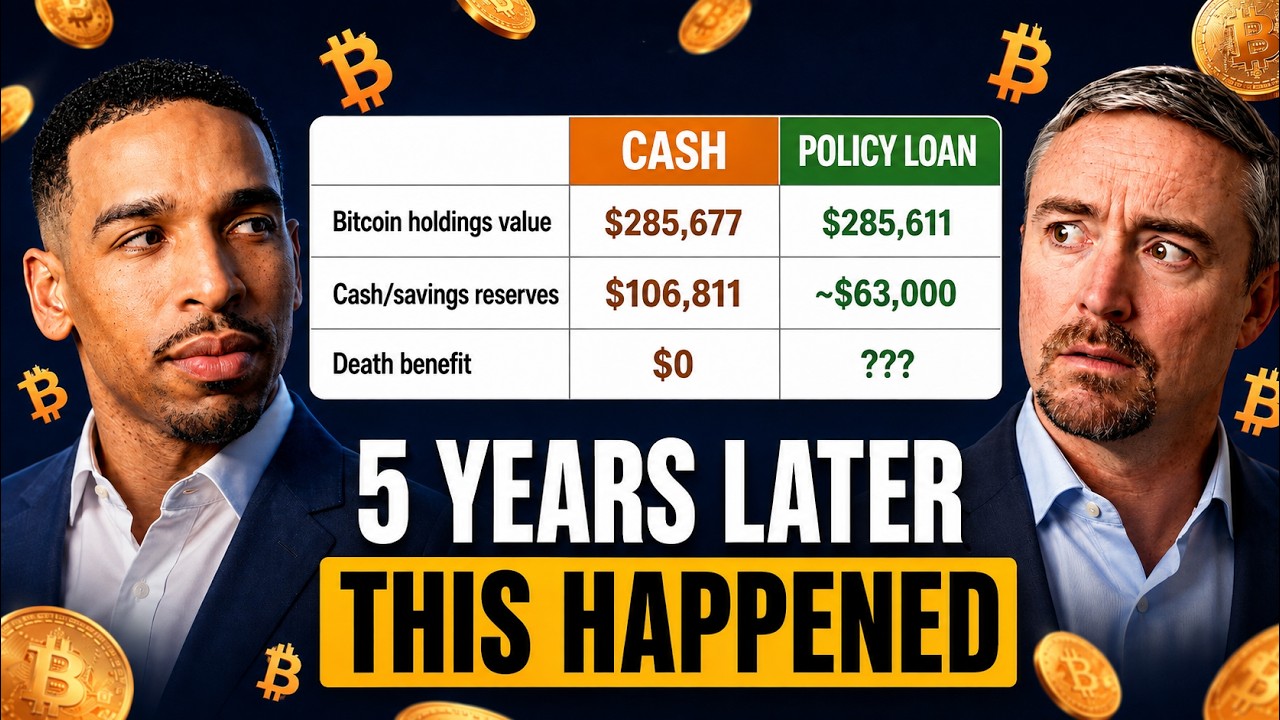
Outside of working with a life insurance company, I have yet to see it myself. So if anyone else has seen that, please let us know. We are interested. All right. In this case, accrued capital was $1,120,000 plus, right? Versus the $1,061,000 from before without IBC. Is it more? Sure was. But also, did we take more or less risk? The money market fund is still in someone else's hands, not in our control, subject to the banking, commercial banking system out there. Safer? Yes. Not foolproof, not in our full control. And what your difference you're seeing here is a result of controlling the banking function. I didn't even touch taxes. And as I already mentioned, that it's a tax-free environment. Here's some other considerations. Money market fund gains are potentially taxable as opposed to the tax-free ecosystem we create with these properly designed policies. They're not offering a death benefit. IBC does. Now, at the end of the 20 years, the way of doing the IBC, where you have a matured system that attracts annual dividends on top of its consistent cash value growth. And as you'll see in a second, by continuing to capitalize just the minimum at $5,000 a year, right away at that age of 60 produces another $20,000 of engineered growth. 10 more years and the same $5,000 contribution habit every year produces $36,000 in that same year. And another 10 years The same $5,000 injection produces a $50,000 increase in cash value. At this point, as you'll see, the total cash value is over $1,000,000, which is an additional $700,000 from the endpoint that this person had at age 60 of additional growth in those 20 years, even though in those 20 years, 5 times 20, only $100,000 went in. My question Is this an efficient use of money? What was stupid about putting $5,000 in when it's gonna produce 4 times, 7 times, or 10 times the growth in our system? This is not an accident. It's the result of that compound growth in our system and of being consistent and capital and you, and taking advantage of the features of these policies and what Nelson Nash has laid out for us to maximize and harness the control of the banking function. Here's an example at age of 60 with the same policy design. There's age 20 when the person says, hey, you know what, I'm done with my aggressive investing. But can they still afford to put $5,000 in? How can they not, knowing that it's going to produce approximately $20,000 of growth here? Quickly, age 70, as I mentioned, same exact policy design and everything. Cash value growth is here. You're seeing it's almost just about $35,000, right? Just shy, $35,000 by putting in the same amount. I'm pretty sure they're getting quite good at putting in that $5,000 at this point. And that's, this is the last one I mentioned at age 80, the same policy. This contract goes on until age 100, but yet I just stopped it there. Because seriously, how have you not seen enough by now, even for the number crunchers out there? Right. It's good stuff. Okay. As I said, the reason I didn't want to just focus only on that is because I no longer practice that approach to investing myself. In our modern day, technology advances, opportunities abound, and one of the very predominant things in our financial landscape these days in investing is the advent of new asset classes such as digital assets. And this is worthy of investigation, awareness, and education, because what's the downside of learning, right? So we're going to look at the synergy of using IBC and Bitcoin, and we're going to compare it to the strategy that we just saw. For those who are curious, don't know, or just a little rusty on their knowledge of Bitcoin, not going to give you a whole big thing here, but it's the king of the digital market world. That's what you need to know. Quick introduction to it. Do your own diligence first and foremost. There's so much more you need to learn. But for those of you who embrace the aspects of Austrian economics, you're going to love what some of the qualities of Bitcoin have because it represents a great example of sound money. Just because it can— its supply cannot be inflated. It's on a fixed 4-year cycle. Every 4 years, an event, for those who don't know, an engineered event known as the halving occurs where its production rate is cut in 2. Yes, folks, its supply increase is decreasing, is decelerating, not accelerating. I know, isn't that a novel thing from the way most countries handle their money? The adoption, however, I'm happy to say, is rampant now as opposed to 5 years ago, 10 years ago. And one of the great things about this is there's a fixed supply. There will only ever be 21 million Bitcoin ever. Knowing that it has these qualities, it might be worth looking into. That's what I told myself. And I was so lucky that shortly after I discovered IBC and started implementing it, I finally listened to my passionate and persistent friend and I said, I'm going to look at this Bitcoin thing. All right. And I would just have you know that out of that 21 million, over 95% is already mined, right? Someone should check that number, but I'm pretty sure that's true. I think I lowballed it actually. Okay. Enough about Bitcoin. Here's a quick look at some of what it's done, not in the last 20 years, because I wanted you guys to see some of the time that I was exposed to the market here, but in the last 20 quarters, it's so volatile. that we can take advantage of some of the same aspects of the stock market measuring in quarters, not years. So that's just a quick look at it. I wanted to use 20 quarters, so I used Q3 of 2020 until Q2 of 2025, right? Here's a quick look at what has happened in these quarters, right, in terms of the percentage of, of return. If someone were to have invested in it. So what I did is I actually did all these calculations, or I rendered them anyways, and I decided to use a similar approach as the $25,000 person that we saw there in wanting to show this. So I use those numbers. I'm not using my own numbers just for privacy reasons, but I wanted you— I wanted to show you consistent, let's just say, means of investing. In the examples that we looked at, so essentially what you're going to see here is that this person decided to do the same thing. I have an example where they just DCA'd it, dollar cost averaged it the whole way through, took it out. And so where you're going to see is an example where someone just used plain old savings. Twenty percent of that went into savings every year. Eighty percent went into Bitcoin. And what you're going to see is a strategy where on every red quarter. 20%, 25% of the savings are going to be used to buy more Bitcoin. And every green quarter, 10% of the reserves are used to add savings. This is a strategy that I just described, right? Over the 20 quarters that described the total that went in, the $168,000 involves some of the gains that went back in, by the way. The final Bitcoin Canadian dollar value holdings was $285,677. The final Savings component of the pool without using IBC is $106,811. Total capital access, $392,488. These results use— now we look at the results using policy loans instead and using a system at the same time, using another asset, as we just saw earlier, by capitalizing the policy when we take profits, saving profits permanently. Rather than just putting them back at risk immediately. Big difference for a lot of investors out there and what they're used to. At the end of this, the cash reserves alone— this is over 20 quarters, everyone— almost $63,000. We just didn't have room in the policy. An additional $68,000+ of cash value is already available. And the cash and the value of the Bitcoin is $285,611. That's a total of $417,000 plus, slightly better than the $392,000. But again, in small writing here, it reminds you we also have $663,000 in death benefit. Does that not have value both monetarily and otherwise? How much more risk would we have taken By simply keeping things in savings, which are subject to inflation versus in an environment that combats inflation every day. Here's what I didn't show you. This is first what I have described, 5 years, same exact policy system. It's with this strategy, they had to max fund it every year. Remember how many reserves were left? $68,000 in cash value. Like I said, there's a $663,000 death benefit. That's $60,000, almost $63,000 in cash reserves. Ash, is that enough to maybe consider starting a new policy as well?
I'd say so.
Could they not have done that before the very end of that 5-year period?
Absolutely.
And yet I'm not even going to show that. What I will show you is this. Remember I told you this design wasn't even optimally designed? Actually, this happened as a mistake, everyone. But I love the mistake because if you liked what you saw, please realize this policy had room for an additional $10,000 a year. And I showed you what was possible by using the process of infinite banking, even when its full potential wasn't released yet. This is why you need to connect with someone on our team if you haven't already. And if you have, When's the last time that you connected with them, right? Have you ever connected with them and come away from that meeting not feeling better about what you're doing? Open question. There are some additional strategies I did not discuss today, such as the fact that I typically don't sell my Bitcoin when I do this. I leverage it and I use it to build up my IBC system, and I use my IBC system to build up my Bitcoin system. And when I use loans from my Bitcoin system, I observe Nelson Nash's teachings, becoming your own banker mentality and rules. I will recognize my own interest in my own Bitcoin reserve, just like my IBC reserve, but they're different tools with different attributes, but they have other things in common, like I said, and it works for me. So I wanted to share that with you. And here's some concluding ideas. What if we utilize the full room of the policy like I just showed you? What would happen then? After everything we've seen, what's the true value and potential of control itself? If freedom has to do with choice, and this having savings or reserves and access to capital provides choice, we got to ask ourselves, what is the full value of harnessing savings and everything it can do? Not just an emergency fund, not just sitting there to benefit someone else. Let's think, how can we put it to use? In addition to what we're already doing and be strategic as a strategic reserve, just like you hear people talking about using Bitcoin as a strategic reserve. I wonder why. I'm talking about using IBC, the knowledge and the tool, as a strategic reserve as well. We need to embrace innovation. Our world's changing a mile a minute. AI is changing a lot. Our money's even changing. Everything is Out of control. And it may be in a good way, kind of scary for others, a little bit unpredictable. But there's one thing that is predictable, one thing of which you can be absolutely certain of, for those who have positioned their capital in a place that's under their control. That said, opportunity will track you down. And when it comes, I ask, will you be ready? And I ask you again, what is the power of control? What's the power of control? Over your own capital. Capital has to reside somewhere. What do we need to do to best position ourselves to take care of what we desire? And the answer is we gotta save.
You need to kind of grow their money or something, put it in something so that it's not losing value over time.
Sometimes they say, I don't have any savings, or I'm not saving.










