Is Infinite Banking REALLY Better Than Investing in the Stock Market?
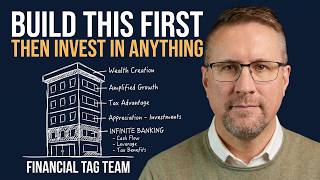
Jayson Lowe, who manages 77 whole-life policies for 6,500+ clients, argues that Infinite Banking and stock market investing aren't competitors but partners. The real choice is controlled capital versus uncontrolled capital, and combining both gives you liquidity for opportunities while your dividends compound uninterrupted.
Chapters
Is Infinite Banking better than investing in the stock market? Everybody wants to turn money into a street fight between two things that, uh, were never supposed to be enemies in the first place. Many people think the approach to money is like every dollar has to pick a parent. It has absolutely nothing to do with the function of investing whatsoever. When you combine them, it is an unstoppable financial tag team. Welcome back to the Command Post. And Ash and I were chatting before we hit the record button here. We're going to tackle a question, a frequently asked question: is infinite banking better than investing in the stock market? It's a question that, um, Ash and I agree it confuses the hell out of people because everybody wants to turn money into a street fight between two things that were never supposed to be enemies in the first place. And that, to me, if I think of, um, a correlation to the question, it's like, what's better for a carpenter, a hammer or a saw? It depends on what you're trying to build, right? And, and most— many people, I don't want to say most people, But I think that many people think, um, the approach to money is like every dollar has to pick a parent. It's like, should I do infinite banking? Should I, um, should I invest money in the stock market? Should I invest money in real estate? I can tell you from firsthand experience, so I've been practicing the infinite banking concept since 2008. We've got 77 policies We pay more than $1.5 million a year in premium. I've been a dividend reinvestor since I was 19 years young. That's 33 years this September. And so I'm addressing this question from lived experience. And I've realized personally over that timeframe of what I refer to now as a financial tag team, where I'm doing both infinite banking and dividend reinvesting, is that, um, they're, they're not in competition with one another. They're, they're, they're tag team partners, right? You, you control how you finance the things that you need throughout your lifetime. You've got ready access capital. You're not interfering with compounding. You've got ownership and quality durable companies, growing ownership because you're automatically reinvesting dividends. You've got, um, a lot of financial horsepower when those two are combined together. And so on this Command Post, Ash and I are— we're going to talk about this. We're going to talk about why it became the ultimate financial tag team for me, why most people wrongly treat this as an either-or option, and, um, how combining them both really completely, uh, accelerated everything that I had already been doing financially up to July of 2008. And so let's get into it. So Ash, I think that most people, they understand, right? The internet, social media, it sort of trains people to pick a side, right? Do you want to do this or do you want to implement the Infinite Banking Concept? What are your thoughts on that?
I agree. We're always encouraged to pick which team we're on.
Yeah.
Or what side we're on. And the conversation starts out the correct way by people asking the question. And here, you know, we encourage people to ask questions because that's the only way they're going to get to clarity about what is a concern to them or what's frustrating them or what's unknown to them. So, we encourage that bit. The difference becomes when we get into the comparison piece. And they say when comparison is the thief of joy, and that's when we compare ourselves to someone else. But if you're going to compare, you have to make sure that you're comparing equal things to get an actual proper answer. And when it comes to infinite banking, that's where we run into a lot of issues because they're looking at and not comparing like-minded things. As an example, when we looked at, you know, should I invest in IBC or should I invest in the stock market? Well, we're asking the wrong question and we're comparing the wrong things.
Should I control how I finance all the things I need throughout my lifetime while investing in the stock market?
That's exactly what you should do.
Right? It's just immediately the human brain goes, "Well, logically, yeah, you should absolutely do that," versus trying to compare what cannot be compared, right? The infinite banking concept, the essence of the concept as outlined in the number one bestselling book titled Becoming Your Own Banker. If you don't have this book in your wealth building library, you have an opportunity. It'll take an afternoon to get through. And what the late R. Nelson Nash, our mentor, whom we were blessed to be coached and mentored by for so many years, the developer, the pioneer of this process, He always wanted people to understand that the essence of the concept is a few things. One, it has absolutely nothing to do with the function of investing whatsoever. And so if your desire is to invest so that you can produce a capital gain, you can produce dividend income, combination of both. Someone must control the banking function as it relates to your needs. No matter what you're doing financially, the process of banking is going to go on in your life no matter what. And so if you're not controlling some or all of that function, you have an opportunity. And he never said don't invest money pay premium into dividend-paying whole life insurance policies. He said, build your warehouse of wealth by paying premium into dividend-paying whole life insurance contracts, and then from that place you can set about achieving all of your financial objectives that require money to get done. And it just clicked the more he said it. The more it clicked. It just made perfect sense, right? It's controlling how you finance the things that you need. The stock market has absolutely nothing to do with the banking function as it relates to your needs and the financing needs that you'll have throughout your life, which are extensive.
Yeah, the closest that this gets to an investment would be investing in your future and your family's future, right? And it's like anything that we're going to do in life. Before we start, we're going to come up with a good plan and we want to lay down a solid foundation, a solid baseline before we then go and do what we're doing. And, you know, we're not— that's the reason why we're not talking about investing. We're talking about enhancing what you're already financially doing. And taking control of that process. And if you can figure that out, I mean, I don't know about you, but I like being in control.
Oh yeah, there's no disadvantage to it. None. No disadvantage whatsoever. And I would say that, um, I, I can speak for my own journey in, in now entering my 19th year in practicing the Infinite Banking Concept in our family and with literally 6,500+ clients across North America, up until July of '08, I was well into my journey with dividend reinvesting. And for me, what that represented was, um, ownership, right? I had share ownership accumulating, as I still do today, inside of really quality, durable businesses. If you just looked inside of your own pantry, your own fridge, your own master bathroom, and you looked at all the products that you have consumed up to this point in your lifetime that you'll continue to consume, if you look at all the apps on your phone, your banking, your services that you consume, I can guarantee you, you're in very short order going to find a list of companies that I've been invested in since I was 19 years young. And I take the quarterly dividends from all of these businesses, I reinvest them automatically. So there's no intervention required on my part. That expands the ownership, which produces more dividends, which expands the ownership, which produces more dividends. And wouldn't you know it, that's the very same phenomenon that happens inside of our 77 dividend-paying whole life insurance contracts. The distinction is those life insurance contracts never have been and never will be an investment. They're unilateral binding contracts. The life insurance carrier itself is contractually obligated to fulfill their mandate, which is daily guaranteed cash value accumulation that must equal the total death benefit by age 100, period. It can't go backward, it can't be repossessed, can't lose value. It's not tied to the stock market, it's not correlated to that in any way, shape, or form. And so if you've ever heard Van Halen's song Best of Both Worlds If you want the best of both worlds, uh, I'm living proof that you can have that. So I never grappled with— the point I'm trying to make is that I never grappled with should I do one or the other. It just made complete sense to me to have that total and absolute control that Ash described while compounding my ownership in quality, durable, profitable businesses that'll still be here long after Ash and I are gone. Isn't that good?
Absolutely. The only comparison you made was what gives you control and what doesn't.
Yeah. Good point. Expand on that.
So, when it comes to the Infinite Banking Concept, it gives you control over ready access to capital to deploy for opportunities. Which could potentially include investments, right? So, you know, we're talking about what you're able to do once you have control over the banking function. So you can pick whatever lane you want to go down, whether it's real estate investing, whether it's the stock market, whether it's dividend reinvesting, whatever that is. But if you don't have that foundational control and you don't control that banking function,, you're always going to be one step behind. If you combine the two, if you have that strong foundation, and then from there, you then pursue whatever it is that you want to, and then you can make your comparisons all day long. Should I be in the market? Should I be in real estate? What should I be in? Compare— you can compare those for what's going to give you a better return on your investment or return on your time. But that's not what we're talking about when it comes to the Infinite Banking Concept.
Oh, absolutely. Like, this isn't about choosing, you know, between Wall Street and, uh, the, the infinite banking concept or, or dividend-paying whole life insurance contracts. It's about understanding what job each tool is supposed to do. And it's, um, I have never obsessed over stock picks in terms of pricing, right? If I look at a, a quality company I'm understanding that what I'm buying is an ownership interest in a business. So let me expand on my train of thought. If I look at a company like Johnson Johnson, if you were to go into ChatGPT, if you were to go into Gemini, Perplexity, doesn't matter, whatever AI platform you use and you prompt it, give me a list of every product and service that Johnson Johnson provides globally. Ask yourself the fundamental question, are they still going to be providing those products and services 10 years, 20 years, 30 years, 40 years, 50 years, and beyond from today? Of course they are. And when I look at paying premium in dividend-paying whole life insurance contracts with reputable mutual life insurance companies, are those mutual life insurance companies still going to be distributing and placing dividend-paying whole life insurance contracts 10, 20, 30, 40, 50+ years from now? Of course they will. All the attributes of what I desire are available to me on both tools. And so that appeals to me personally. Yet the dividend-paying whole life insurance contracts give me everything Ash described. I've got ready access to capital on demand on my terms. I've got optionality so that when high-caliber opportunities track me down, I can take advantage of those opportunities with without reducing the asset's value or interrupting and interfering with any of its compounding growth. I'm not triggering any taxable events. What a peaceful, stress-free way of life it is when you get the banks out of your life. And then you've got this dividend reinvestment portfolio of quality companies like Johnson Johnson, as an example, that continue producing profit no matter what the economy is doing, no matter what interest rates are doing. No matter what political turmoil is occurring, people are still taking Tylenol, they're still changing diapers, they're still putting Band-Aids on. All of that continues. Very predictable human behavior. And so every time you open up a Band-Aid or you pop a Tylenol, I'm getting paid. It's a good position to be in.
Makes sense to me, right?
And so I never grappled with the either or, right? I didn't have to. I was already well into my journey of dividend reinvesting. Then I was introduced to the Infinite Banking Concept. I'm well into my journey with the concept. You couldn't convince me to choose one or the other. When you combine them, it is an unstoppable financial tag team. Unstoppable. I'm living proof of that.
And I think it's worth mentioning that you can combine other things as well.
Oh yeah, yeah, yeah, absolutely. Expand. Yeah, yeah.
So is your example of the dividend-paying whole life insurance contracts and the dividend reinvesting— those just mesh really well. They have similar attributes and they go, they go together well, and they're great. They create excellent forward momentum.
Yeah.
But when we talk about combinations, you can come— you can combine a lot of things to further enhance what you are already financially doing. And if you utilize the dividend-paying whole life insurance contracts. To do that, you can then combine it with whatever other asset class you want to get into, whatever other opportunity, and whatever other investment. And that's, and that's really the essence of what we're talking about here, is just deconstructing what you're already doing and saying, can I insert something before all of my investments? Or my opportunities that's going to benefit me from now until I graduate. And at that given time, it just so happens that the tool that we use has other amazing attributes where there will also be a windfall that gets paid out tax-free to your beneficiaries. And we didn't even touch on that. That's just something that comes with it. That's just icing on the cake.
Ah, so true. What comes up for me when I hear this and I engage in these types of conversations, which are great conversations to have, right? Like prospects that we meet with across North America, they're contemplating that question. And that's a fair question to contemplate. That's why it's good to have a sounding board to say, well, okay, why don't we look at this through a different lens? Like, why would I force one asset to do every job. I think that that would be a central mistake, right? Should I do infinite banking or invest in the stock market? That question already assumes that one tool should solve every financial problem, and I think that personally, I think that's, um, illogical or, or even irrational, right? Um, it's different tools exist because different problems exist. So if you understand the problem, then the solution matters to you. The infinite banking concept is not a product, it's a process. A dividend-paying whole life insurance contract is absolutely a product, and that's the tool that's used to implement a process. Investing in the stock market is a completely different financial proposition altogether. And that's what I'm trying to get across. The real comparison isn't dividend-paying whole life insurance versus stock. I think the real contrast that Ash and I have been talking about is controlled capital versus uncontrolled capital. Most people, Ash, they earn money, they permanently transfer that money away, then they borrow conventional banks. They hope that their investments are going to bail them out at some point in the future. That financial posture, in my humble opinion, is just fragile. And the infinite banking concept, inserting that, it just changes the formation of capital, the movement of capital, Dividend reinvesting changes the ownership of capital much like co-owning a mutual life insurance company. But when you put them both together, that's really productive ownership. They both have ownership attributes, right? But you combine them both and man, is that ever productive ownership.
I think there's some confusion too. Just around maybe terminology and naming of products and concepts and things like that. But once they understand and it's explained to them what it actually is, vice, what the title is, then it starts to become a lot clearer, right? Like even Nelson had said at one point, like, "If I had to rename it, I probably would. And it would be something to the effect of we are creating a personal monetary system with a death benefit thrown in for good measure." That's exactly—
yeah, that's exactly it. Yeah.
And if you look at it that way, it's like, oh yeah, okay. I mean, I mean, that makes sense, you know?
Right, right. Yeah. And, and, and think about— I think one, one of the most simplistic examples that we share with people is we say, look, if you have ever, uh, paid cash for, leased, or financed a car— and maybe for most people, it's been more than one up to this point in their lifetime. If we just understand opportunity cost, right? When you spend money traditionally, I think the opportunity cost is enormous. Whether you pay cash, lease, or finance, right? You make a payment and that money is permanently transferred away from you.— and all of the interest earning power on that money is permanently transferred away from you, not just from you, from every future generation that comes after you. That money, the amount of money in that payment, that is capital. And it stops compounding for you versus you've got capital formation that remains within your system. You've got investments that continue compounding. You've got financing that you totally and absolutely control. What a winning combination, in my humble opinion. Again, just from, just from my humble experience, it's just a winning combination. And, and what, what, what's the human condition that Nelson talks about? He spends a good portion of the book titled Becoming Your Own Banker, talking about the human condition. And you can, you can understand it for what it is. People panic or they overspend, they'll interfere with compounding, they'll react emotionally during downturns in a stock market.
That's a big one.
The Infinite Banking Concept is a process What Nelson was trying to get across is that if you implement this properly and you understand how ridiculously simple it is, it creates behavioral stability because you don't have to lay awake at night when some talking head on, uh, you know, financial networks is talking about all the volatility that's going on inside of a stock market. And that matters psychologically to people. And I think Nelson wanted us to understand that the best process is the one that survives human behavior, period.
Well, you know, if you just think about it, one of the largest stressors in people's lives throughout the duration of their lives is finances, right? All comes down to money. Yeah, it's whatever Whatever your relationship is with the dollar, whatever it is, however you feel about it, you're going to need it. You're going to need to use it. It has to be employed properly. And that's what's going to— it's something that we have to be aware of. And your relationship with that money and how you utilize it and how emotional you get around it, that affects a large part of your life. Throughout the duration of your life. So, if you can put control measures, let's call it that, in place where you can eliminate a bunch of those stressors when it comes to money, why wouldn't you do something like that? That's what the question becomes.
Logically.
Yeah, logically. Like, do you enjoy being continually stressed over dollars? Like, do you enjoy having difficult ongoing financial discussions and arguments over money? Because if you don't, well, this is a solution that you can put in place to mitigate most of those issues. Because once you're in control and you realize you are, then it'll be a stress-free way of life.
It sure will. A little further into logic, I would say that a person with liquidity would behave differently than a person who's trapped financially. If liquidity creates, you can take advantage of high-caliber opportunities that find you. You've got emotional calm. Versus if you go back to the last financial crisis, '08, '09, and the market conditions at that time, the sheer volume of high-caliber opportunities that surfaced, the people with liquidity could move quickly. Everyone else just froze. If you combine that with compounding, so if you think of just— it's the one thing in life that's sure to work if you just leave it alone. What is the greatest enemy of compounding? Interference. It's not taxes, inflation, or stock market volatility. It's interruption. You know how many shares of stock in my dividend reinvestment program I've sold?
I would say zero.
Goose egg. I do nothing to interfere with compounding, and I understand That the share price is not the business and the business is not the share price. The share price is the value of the story of that business at any given moment in time. That's it. And why do people constantly interrupt compounding? Because they need ready access to capital and they don't have the reserves or they panic emotionally. And again, I'm just living proof. The longer that capital remains uninterrupted, believe me, the outcome gets even more extraordinary and it becomes massive. Massive. Isn't that good?
As they would say, fantastic.
What did— who's— oh goodness, the late Charlie Munger. He said something. I don't know verbatim what it is, but the stock market exists to transfer money from impatient people to patient people. Because that's what people do. They're investing based on share prices. They're not really evaluating the businesses that they're investing in. And again, just from my own experience, when you combine the Infinite Banking Concept with what I've been doing with dividend reinvesting, oh my God, the ownership is remarkably productive on both sides of the fence. And you just avoid all those things that Ash and I talked about It's completely avoidable and you can create a peaceful, stress-free way of life financially. It's absolutely something that's within your reach. And I'll just say this, if the Infinite Banking Concept was truly instead of investing, if that's really truly what it is, I would've never spent 33 years this September Dividend reinvesting. And if, if dividend reinvesting alone solved every single financial problem, then wealthy families, banks, and now 6,500+ clients across North America wouldn't be spending billions in premium payments to buy these dividend-paying whole life insurance contracts. They're not competing ideas. Their complementary disciplines. We come up with some good ones today, Ash. Like, we got— you mentioned one earlier that we got a trademark, but come up with some pretty good ones here today.
Yeah, you know, it's interesting too because it's not, it's not as if we are just personally doing this. You know, there's personal applications you can do in your life, right? You can do this from a business application as well. And if you're, if you're curious about that aspect of it You know, just look to the banks, right? Bank-owned life insurance. Just look to that. Like, that right there should show you that there's something there that they know that you should probably want to know as well. And right there, that also puts them back in control as well. So, if banks are about control, I mean, we should be doing the exact same thing. And you have to pick the right tool to accomplish the right job. And it's also going to be dependent on what your goals and objectives are, right? That's like, that's first and foremost one of the most important things, because if you haven't figured that out, you're not going to know exactly what to do, what path to take, and what tool to pick.
100%, man. And so let's, let's leave viewers and listeners with this. When, when somebody asks our team at Ascendant, when you're speaking with an authorized Infinite Banking Practitioner on the Ascendant Financial team and you ask, "Is Infinite Banking better than investing in the stock market?" The advisor is going to suggest that might be the wrong question. The real question is, why are you trying to force one financial tool to do every job in your life? Because after 33 years as a dividend reinvestor and practicing the Infinite Banking Concept since 2008, I personally, I don't think in either/or terms. I think in a system. And that's what changed my life. And so if this Command Post episode helped you think differently about that, if it helped you think differently about money or controlling how you finance the things that you need throughout your lifetime, hit subscribe. And just as Ash and I always say, just drop comments, right? And, um, if you think somebody that you know would benefit from watching this, just share it. Because, um, I don't think anybody that we've been blessed to work with as clients, they weren't looking for, uh, any magic beans, right? They, they just They just wanted to construct a system that would help them create a very peaceful, stress-free way of life financially. And so that's another episode of The Command Post. This is fun, Ash.
Agreed.
This was good. Money flows. Once you begin to observe the pattern of flow, you start seeing something that most most people miss. Money is always being stored somewhere and borrowed from somewhere. You've got car payments,










