RRSP Tax Bomb Explained (And How to Avoid It)
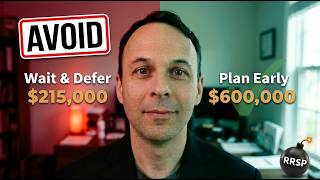
Two fictional sisters show how RRSP withdrawal timing changes everything. Susie waits until 70 and faces a tax bomb and 15% OAS clawback. Peggy withdraws $50,000 yearly starting at 60, funneling after-tax money into whole-life insurance that leaves her heirs nearly $600,000 instead of a depleted estate.
Chapters
If you take money out of your RSP, you're going to get taxed. The thesis of her planning process— worried that the government's going to come for her RSP and she doesn't want to deal with that. So she wants tax-free growth, much smaller tax bomb. In the genre of R. Nelson Nash, becoming her own bank, who wants to warehouse her capital in a place that feels secure and where the government can't get its hands on it. You got to ask yourself, if you're building a warehouse of wealth, What foundation are you building it on? We're going to walk everybody through tonight a bit of a scenario that sort of two paths, if we can put it that way. And the idea is that, you know, it's going to demonstrate how you can either reduce or enhance your estate depending kind of what path you pick and what CRA can collect and what then your kids and your loved ones actually inherit. So So, with that being said, I'd like everybody to meet Peggy the Planner and Scared Susie. So, we're going to meet them. We're going to learn a little bit about them and their journey into retirement and through retirement. So, with that being said, this is sort of the starting point for the two sisters. They're twin sisters. Okay? They both just turned 60. They're married. They have some adult kids, and they're sort of entering that retirement phase of their life. They have both managed to build up a $500,000 RRSP, but in addition to that, they have some TFSA savings and they have some non-registered assets and savings as well. So throughout their career, they acquired sort of a modest workplace pension that they're gonna be able to access starting at age 60. Both of them are gonna take the same CPP, the same OAS at age 65. And what they've determined is they need for retirement for kind of the essentials is about $48,000 of after-tax money. They're going to get that amount between their pension, eventually some more CPP and OAS, and from those sort of unregistered savings and TFSA. That's how they're going to fund sort of their day-to-day operations in retirement. Now, what about the RRSPs? Well, the RRSPs are for them, it's really that icing on the cake and it's going to help them really enhance their retirement, you know, going on trips, spoiling the grandkids, that rainy day fund. So if, you know, the furnace breaks or, or they, you know, the roof leaks, they've got some money that they can pull. But also mostly they want to have it to— they've built it up, they've worked hard their whole life. They want to pass something on to the next generations. So, so in short, they're starting at the same place. So we've got identical scenarios right out of the gate here. Now we're going to We're going to talk about Susie here, Scared Susie, for a bit. So, you know, one of the things about planning and looking forward is examining how we think about things. And one of the big things, and I see it all the time with people, and it's human nature, right? And that's something called loss aversion, right? We don't want to part with something that we believe to be ours, right? We want to defend against what we have. I don't know if it— I'm not a psychologist. Just by any means here, Rick, but I don't know if it's almost something like historical or evolutionary in our psyche, in the way our brain functions. But there's a lot of us that have this sort of loss aversion, and we carry that into how we plan financially. So, in Scared Susie's case, she is going to kick the problem down the road. She's not going to touch her RSP. She's going to live off the money she's got from her pension, so on and so forth. She's not going to address her RSP. And then the main reason is she's scared of losing. She looks at her RRSP and her accountant is in her head. And her accountant said to her kind of in a throwaway line, but not as the main point, but just she said, you know, if you take money out of your RRSP, you're going to get taxed. So Susie's kind of made that the thesis of her planning process. She's worried that the government's going to come for her RRSP and she doesn't want to deal with that. So she's pushing that down the road. She's not even going to touch it until she's 70. Okay, now contrast that with her sister, uh, Peggy. So Peggy has seen the CTV, um, news story that we've all watched tonight, and she says, okay, I, I need to do something, I need to plan. Okay, so she devises a plan where she is going to take strategic withdrawals out of her RSP starting at age 60. So before she's getting OAS or CPP, she's going to take $50,000 out. Now, Peggy, unlike her sister, views the RSP for what it is. Part of it's hers, but she recognizes that a good chunk of it already belongs to the CRA, and she's just a guardian over that money, over that future taxation. So she says, you know, I want to deal with this now. So she starts taking out $50,000. That leaves her about $37,000 a year. And she starts to build her own banking system with $37,000 of after-tax money. We're going to get into that in a bit. Okay. What that does is it has the net effect of bringing that $500,000 RSP down to about $100,000, a little over $100,000 by the time she's 70. So, you know, I know she started with $500,000. We're assuming there's a little bit of growth in there over the 10-year period as she's making these 10 years' worth of withdrawals. Okay. So like I said, this is her mindset. She is thinking, you know, CRA, some of it doesn't belong to her, it belongs to the CRA. But if she keeps it in there, the share that the CRA has is also going to grow. So she wants tax-free growth because she's 60. She's got a long ways to go still. And not only does she want tax-free growth, she wants access to capital on her own terms. So as I said, she's making these withdrawals, she's taking this $37,000 in after-tax money for 10 years and she's creating capital on demand on her terms for supplemental income, travel, so on and so forth. And like I said, it leaves the RSP with a much reduced amount, so much smaller tax bomb. And what does she do with the $37,000 for 10 years? Well, what she does is she takes the advice of Evelyn Jackson. She looks into life insurance. She looks into build a banking system in the genre of R. Nelson Nash, becoming her own banker. Warehouse her capital in a place that she feels secure and where the government can't get its hands on it. So, she turns to a dividend-paying whole life insurance policy with a great coach, an authorized Infinite Banking Practitioner. And inside that, she's growing her wealth tax-free. It comes with a death benefit. It's going to protect her family to carry on her legacy when her time comes. As I've said a couple of times, there's access to capital on demand. And here's another thing that a lot of people don't understand about life insurance is when you leverage the cash from it as opposed to withdrawing it, all of the money that is in there, all of the— I shouldn't say money— all of the cash value continues to grow, all of it, even if she's leveraging against it. Okay. And now what she's able to do then is after those 10 years, she's still able to cycle her CPP and OAS because that money is going to come in from the government. It's going to hit her bank account and she wants to cycle it through this great system that she's built because she knows the more she cycles through over the course of her life, the bigger it grows, not only for her, but her family and, you know, her kids and her grandkids. So what Peggy is doing is she's building her warehouse of wealth on a very solid foundation. Now we get to 70. And Susie realizes she's got a problem on her hands. She realizes that she's let this RRSP grow, which is great. You know, that's great. But now she's got a real tax problem because her RRSP has grown from $500,000 to $700,000 in a 10-year period. Okay. And now what starts to happen is she's still got that pension. She's collecting CPP, which is taxed. She's collecting OAS, which is taxed, and now she's doing the same thing that Peggy was doing in terms of withdrawal amount. She's taking another $50,000 out of her RSP because she knows at age 71 she's going to have to start doing that anyway. So she's like, okay, I got to start, I got to start using this money and taking this money out. Now, I know, Rick, we had talked a little bit about this. So if you look at this case here, if you sort of do the quick math here, You know, Susie has a taxable income now in these years into her 70s of $108,000. And for any of those people out there who are taking the old age security, you know that there is a clawback provision where if you make over a certain amount of money, the government starts saying, hey, wait a second, you're making too much money. We're going to, we're going to take some of that back. And, and so that's, that's what can happen with the old age security. I think this year, Rick, it's the clawback starts around $95,000. Yeah.
So what, you know, what happens is that, you know, so you're earning above $95,000 with old age security, they start taxing back all these. You're already paying tax on old age security, but then you— but because you're over $95,000, they start taking another 15 cents on the dollar, another 15% away of your old age security. So, you know, normally you would not be in an over 50% tax bracket at that amount of money. But with old age security, you are.
You are.
So if there's a reasonable way to minimize or eliminate the impact of clawback, it can be very, very impactful.
You know, it's an interesting thought here too, Rick, as you know, as you're saying all this, right? So you're already being taxed on your OAS. So in Susie's case, you know, she's probably paying about, with this amount of taxable income, she's probably paying about 35% in her top marginal rate. And then to get another 15% clawback, her Old Age Security is effectively being taxed at about 50%. Yeah. Whatever margins is sort of over. So that's, yeah, that's quite the hit. So that's her plan as Susie turns 70. So just as a kind of a recap, if we kind of freeze time here at age 70 now, They've got the same income coming into them in retirement because again, I want to make things completely even, right? So Susie's taking out the $50,000, she's left with about $35,000 a year. So to make that even, Peggy starts taking out $35,000 of after-tax money out of her banking system to also enhance her lifestyle. Okay, so we're talking everything's even here. Okay, they're just going about it in a different way. So they had same pension, same CPP and OAS. They're just using where they warehouse their money and accessing it is different locations. Okay. So let's, let's go through this. Okay. So from age 70 to 85, they're doing this same income. Everything's the same. Year 85 comes and sadly it's the year that Peggy and Susie, they meet their demise. So You know, for Susie, she's built up such a huge RRSP that there was still around $400,000 left in it. And so by the time she pays, her estate pays the tax bill, she leaves her kids about $215,000. Now compare that with Peggy. Peggy's banking system, her RRSP is effectively completely whittled down. There's nothing left in it, but her banking system pays out a death benefit after any of the money she's leveraged out of it, a net death benefit of just shy of $600,000. That's a third of $1 million in after-tax money more than Susie's kids are going to get. Okay. And recall, this is an apples-to-apples comparison. It's just where they were warehousing their wealth. Okay. And I'm going to go through some numbers because the numbers are important, but it's not the whole thing. But I just want to share these numbers for tonight. That's at 85. We saw the, uh, the Gallia story where people in their early 60s this happened to. And, and unfortunately, folks, for Susie, it doesn't get any better if she passes away earlier. So if we look at age 80, even though Susie's leaving more, $266,000 versus $215,000, she's leaving a whole lot less compared to her sister. It's almost a $500,000 swing between the two of them if they passed away at age 80. I do want to take a moment here, Rick, because these numbers are assuming that their spouses had passed away and left nothing, that there was no spousal rollover into an RRSP. Because the reality is, is if that had happened, well, Susie would have the same problem as the Gallia's head, right? And conversely, Peggy, if her spouse had built a banking system, there'd be even more tax-free money. So the numbers would just even— the differences would be even that much more stark. And at age 75, you know, if they pass away at age 75, the numbers are even that much more stark. So these are things to remember as we're building out our RRSPs and how we're planning our retirement. So, yeah, I've already mentioned the RRSP rollover, but just going back to what Evelyn Jack says, you want to do the planning in your late 50s, at the latest, early 60s about how you're going to deaccumulate and how you're going to live through your retirement. And so, numbers are great, but what doesn't show up on a spreadsheet, Rick, you and I both know this is control, right?
Right. No, absolutely. It's fine to look at the numbers. The numbers are important. You know, a big difference between, you know, hanging on to the RRSP and pulling that income in retirement is that there's really little flexibility with that RRIF asset. You're getting income and you can always take out more. You got to take out a minimum, but if you ever needed money for an emergency, if you ever, you know, wanted to splurge on a big vacation, I mean, you could. You could splurge on a big vacation and take a lump sum withdrawal from your RIF, but you got to calculate the tax though, because it's all taxable. Versus the, the other side of it is doing something different. In this example, we're using having somebody put their money into a participating whole life policy starting at 60. Then they're building up this big asset that they can access at any time by way of policy loans. Without tax implications if it's done right and the assets still grow. So there's— it's about control. What we're talking about here is numbers, but more importantly, it's about the control of an asset.
You know, and Rick, well said. And, you know, the other thing that's coming up for me is the idea that, you know, you said, hey, it'd be great for a great trip, but you got to calculate the tax, you know, We know of a number of Canadians that for one reason or another, they decide, hey, you know what, medical treatments here in Canada, you know, I don't want to wait in line. I need to go somewhere else, right? Having access not to have big attacks because you're sick and you want to go get treated somewhere else. You know, that's another key piece. The other piece about this banking system is as you're sort of leveraging out, and this is another strategy that we use here is as people sort of transition through their late 70s into their 80s, that they might transition out of some real estate they're living in. And there's maybe a big windfall. Where are they going to put that? They can't stuff that then back into their RSP and shield it from tax. But you sure can do that with a banking system. And you can bolster, you can reinvigorate your banking system as well. So that's just yet another strategy that can be deployed here. So, you know, this is what we're seeing between these two. Peggy's got access to capital on demand. The draws, if I can put it that way, from her banking system, they don't interrupt the compounding. I shouldn't have said withdrawals. I want to say access to capital there. And it's guaranteed growth. It's contractually guaranteed growth. She's not on the stock market roller coaster. I mean, how many of us know somebody in the retirement years and they're glued to their phone and they are watching with a defibrillator beside them, whether the stock market's going up or going down or up or down. I mean, what a way to live retirement. But so many people are doing it that way. And so we've already addressed, Rick, you've already addressed how nimble the system can be. Susie's living a different retirement. Okay. She's on that roller coaster. Every time she withdraws from her RSP, that slows down any compounding. And I like to say, you know, her money is trapped behind the Great Wall of China, the great tax wall of China, right? She can't get it out without paying that tax toll. So these are some things to consider tonight as we've kind of gone through this. You know, you really want to think with all this promotion by the big banks and the government to make your RRSP contributions, whose system is that feeding? Who is that designed to serve, these government programs? Is it truly you? Is it truly your family? It's just something to reflect on. As we've already heard many times, your early 60s, late 50s, early 60s are the best time to proactively manage your RSP. And I know we haven't maybe spoken enough to this demographic tonight, Rick, but if there's people on the call tonight that are younger in your 20s, 30s and 40s, please understand this. You're in a better position because you have more time. And so, the idea of, hey, you're going to make that RRSP contribution, you might want to think about that. You might want to think about where you could put that. Maybe you could divert that instead to building a banking system. Are you going to get that carrot, that deduction that seems to be the carrot that drives everybody into the RRSP? No, you're not. but you're also not going to get the tax bill for hundreds of thousands of dollars on your estate later either. So something to think about here. And, you know, we saw with Susie that she was stacking her income and what sort of impact that had on her taxes versus having a proactive withdrawal plan like her sister did. So, you know, you got to ask yourself if you're building a warehouse of wealth, What foundation are you building it on? You know, is it going to stand the test of time or is it going to come crashing down on your family like it did sadly for the Gallius? So you take money out of your RSP, you're going to get taxed. The thesis of her planning process worried that the government's going to come for RSP and she doesn't want it to deal with that. So she wants tax-free growth, much smaller tax bomb.










