What Happens to Your Investments When You Add Infinite Banking | 10 Year Side by Side
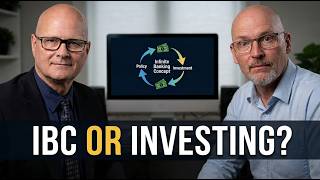
Les and Dan explain Infinite Banking, where you use dividend-paying whole life insurance to act as your own bank. A ten-year case study shows Jake earning $188,900 combined from policy cash value and external investments while building a $532,000 death benefit, versus Brian's $150,625 gain from direct investing.
Chapters
Money almost seems to come in as fast as it goes out. So when we spend cash, that money's gone forever. And I just, I touched on before, we give up interest that we could have otherwise put to work and put that money to work. So we can see that there, the hidden cost of using cash is opportunity cost. So the question is really not what should I invest in, it's how should I fund that investment along the way? And who really controls the capital? Infinite Banking is not an investment. It merely changes the way you fund the investment. You ever wonder why you earn the money and then it leaves? You did all the work, but somebody else benefited from that. So if we could do something a little differently and have more money flowing towards us at the end of the month or the year or the decade, What would that mean to you and your family? Would it free up any time, vacation? Would you invest more? So we all know those other people that benefit first— governments, banks, Wall Street. It seems like everyone's got their hand in your pot, in your pocket. Let's talk about money right now. So really, most people have two choices. We either can use cash or we can borrow, and both are financing decisions when it comes to money. We can obviously barter chickens or hay bales for meat, but that's kind of outside of this conversation right now. So when we use cash, it feels, it feels inexpensive. It feels like, hey, we're doing, we're doing good because there's no cost of borrowing. There's no interest cause, uh, cost to using cash. It's just straight up, we save up that money and we spend it once we have accumulated enough to do the things we wanted to do. So with that though, using cash, there's an invisible cost. So when we spend cash, that money's gone forever. And I just, I touched on before, we give up interest that we could have otherwise put to work and put that money to work. So we can see that there, the hidden cost of using cash is opportunity cost, and that's what we mean by that. So pay cash, or you could put it somewhere, put it to work first, and then use it to buy the investment. Thought I was doing good. I had a great opportunity come up to buy some land out here. And I had the money to pay cash for it, and we did. And much like you, and that was 15 years ago, and I don't even want to shudder to think of what that, what that would have cost me, because I guess I'm in denial because I haven't gone through that exercise to figure out what it would cost. But sure enough, it's quite a bit. Your money has to reside somewhere, and we kind of touched on that a little bit. Before, right now, conventional way, it's with the banks. And then the second fundamental truth is that somebody must perform the banking function as it pertains to your needs. So what is that? What does that mean exactly? Like, who's the banker in your life? And so when we put that money into someone else's bank and they put that— the bank, they just don't let it sit there. It's not a big vault where it sits. Actually, they go out and they put that money to work. And then when we do that, that money is being transferred away from us. So really, the objective would be to keep the money in our family, reverse that flow of capital to you instead of away from you. So really, what the question becomes is how much of the banking function do you want to control as it relates to your needs? And what we mean to that is we get it into a system that we own and control, and we control the liquidity of that capital, and it's going to stick with our family not only for our needs but for our future generations' needs, our kids' needs and our grandchild's needs, much like, you know, the Rothschilds did back in the day, and they still do, you know. So really, unless we understand the problem The solution of becoming your own banker just won't matter. This is one of the most important things to understand, that we're not competing with your stocks or your real estate or your business investments. It's not asking you to earn a different rate of return. We're just asking you how to rethink how you fund those investments. So really, this is just one of those ways so we can keep your capital working while you deploy it.
If you're not familiar with this concept, which is called becoming your own banker or the infinite banking concept, this is the tool that we use for this. Now, the only reason why— well, there's a few reasons why we use this tool. A, it allows you to do uninterrupted compounding of your cash value. Interrupted. Doesn't matter what happens. I mean, you go every day you're alive, your cash values have to contractually increase. So that's the tool we use. It's called permanent life insurance designed to build accessible cash value, and it's dividend-paying whole life. And this tool gives you a very solid foundation. So just a little more about that. It is permanent protection. Yes, that's, that's something that comes along with this permanent protection. It's there for as long as you own that policy, you have protection. Secondly, you're participating. So you're owner, you're an owner, you participate with that life company in their results. That's one of the things I love, you know, the policy that I have I get to vote if I want at the annual general meetings because I'm a co-owner of that life company. So I get to participate in the divisible surplus through dividends. That's a pretty amazing thing when you think about it. And cash value. So this is something that I really wanted to take a bit of time to speak about. So there's a contractual guarantee that's in every dividend-paying whole life insurance policy and it states that cash value has to grow to equal the death benefit. Well, if you're in Canada, they use 100%. If you're in the US, it's 120%. Doesn't matter, the same thing's happening. Your cash value has to grow to equal your death benefit. So every day you're alive, this cash value grows, and you get to access 90% of that cash value, no questions asked. They're not going to ask you what you want it for. They're just going to give you access to it. Simple process. You get to use that while you're alive. So it's like— some people have heard it explained— it's kind of like using part of your death benefit while you're alive because you can access that cash value. So that's a little about the tool. What the policy is built to do and the attributes that matter for this whole infinite banking concept is cash value starts to accumulate and becomes value— valuable to the owner. We already talked about that. It's contractually guaranteed to grow. That's right, contract. It's contract law, and you never want to lose sight of that. There's a contract that you have between yourself and the life company, and that contract's going to be contracted to grow that cash value to equal the death benefit. And the longer you own it, the quicker cash values will grow. And you, as the owner of that policy, you decide— get to decide when and what for you're going to access those cash values. So one of the things I always like to point out at this point, Les, is cash value is not cash. Some people think it's cash.
Yeah, a lot of people get that figured out saying, oh, the cash in my policy. So what, how would you explain the cash value, Dan?
It is just that, it's a cash value. So if you think about, you can turn it into cash. So it's kind of like, one way I like to describe it, Les, is if you and I had a little brick of gold here, it's not cash. But we could take that gold and convert it into cash. And that's what cash value is like. It's something that you can use to convert that into cash. So I just wanted to clarify that little statement. Now, why does this tool fit so well for this whole process we're talking about? Well, here's the process you follow. You pay premiums. Yep, you got to put premiums into your policy. That's the first part of it. Capital is directed into the policy, cash value starts to grow, and it builds a usable reservoir over time, something you can access. You can use policy loans. So people say, what's a policy loan? Well, you're accessing that cash value. It's a contractual right you have with the life companies and they'll give you up to 90% of your cash value. And the key thing is, it's not your money. Les mentioned this earlier. It's the life company's money that they're going to lend you, because your cash value stays in that policy and it grows uninterrupted. So I want people to be aware of that. And again, what we teach people to do with this process is repay and repeat. You manage the flow of the money back into your system. That's why this tool fits so well for the Infinite Banking Concept.
Yeah, absolutely, Dan. Appreciate you going through that tool and how it works.
Yeah, it's— again, I just want to remind everybody, Les, it's the tool, it's not the concept, it's not the process, but it's the best tool that we have found. And if anybody comes up with a better tool, we're always open to that, and we just use it. It's got a lot of great attributes: permanent coverage, long-term guarantees in one contract. What a great tool. That's what it is.
A little better than the shoebox.
Yeah. All right, so now we're going to jump into the case, back into the case study, unless you've done a great job of just walking through the investor. And when we were talking to Brian, we, we brought in another, uh, idea for him to consider, and we just used, you know, in this case we're using Jake, but we just walked through these same numbers with Brian. And so we're— tonight we're saying, well, Jake's You know, 40, just like Brian is 40. He owns a landscaping company, and Jake's just going to do something a little different, you know, same opportunity, different process. So that's what we're going to walk through now, and we're going to just see the difference that Jake used to help Brian see the opportunity to to invest less and earn more. I don't know. So we're going to go through that, and Les is going to take and start from here and just keep on going.
He has the same $20,000 that he's going to use as Brian. We're just going to deploy it a little bit differently. And as Dan mentioned in that tool, well, the dividend-paying whole life, part of having that tool is paying premium. So in first year, Jake pays $20,000 in premium, which gives him access to capital— cash value— gives him access to his cash value in the policy right away. So what he does is he's going to take a loan from the policy that we mentioned before that he has access to and deploy it into the investment. So he takes a loan for the amount of $12,670, puts it into that same investment as Brian, and he's got a gain of $12,126 for that first year. Now, isn't that great?
Yeah, yeah, that's pretty good. Let's just talk about why did he only take a loan for $12,670? That's like the tool right at the start. Like we're talking, you know, just a couple of days, weeks after he puts his $20,000 in his premium, he can already access 90% of his cash value, and that just happens to be $12,670. So that's what he chooses to use to put it in that same investment opportunity. That's what we showed Brian. We're just going to put the $12,670 in there, and yep, everybody figures, yep, 10%. It's pretty easy math. It's $1,260. And Brian's sitting there going, haha, that didn't work out so good for you and such. So that's just—
we're a bunch of fools.
Yeah. And that's where we just went on to show them a little more. So let's move forward on that less. Yeah.
Let's compare the results. So we've already went through what Brian's done and this is just year 1 and we're going to extend this out. 10 years, as we mentioned earlier. So Jake takes that policy loan, he's got the— his return on the investment, that outside investment. But let's look at what happened inside the policy while Jake's capital, our access to capital, was deployed. That policy, the cash value in that policy in that first year grew just almost by $3,000. So his total gain was actually about $4,000.
Yeah. So what you're explaining there, and a great job on that, Les, is that the cash value from the time he took the policy loan at the start of the year until the end of that first year grew by $2,830.
That's right. Yeah.
So that's value that, hey, it's real. It's, it's there. You can access it. It's capital if you want. So what we're saying is, yeah, even though part of it's still in the policy, because that's where it is, when you look at it from a, you know, a 30,000-foot view, who come out ahead?
Yeah, exactly. And so let's be clear on that too, that he's using other people's money. He's using that life insurance company's money when he accesses that policy loan.
Yep. And, uh, yeah, so that's a good point. And it's, you know, again, we get to this stage with Brian— I still remember this, Les, I don't know if you do— and he starts to chuckle, but he goes, though, well, isn't Jake gonna have to put premiums into his policy next year? And absolutely, definitely. Like, you know, you start building a system for your for you to bank in, you don't wanna stop capitalizing it. So we say, yeah, Brian, you're 100% right. So both of these two gentlemen are gonna be putting $20,000 into this play for the next 10 years. So how does Brian get that money? So we asked him, Brian, where's that money gonna come from? He said, well, I'm gonna save it up over the year. 'Cause he was able to do that. And so he said, I'm gonna start saving, I'm gonna save it. and I'm gonna have it available to invest again at the start of the next year. And so, well, same thing for Jake. Jake's got a, you know, same $20,000. So continue on. Let's walk through this.
Yeah, that's great, Dan. You're right. So they both plan with the same $20,000. Now the only difference is that Jake's got that policy loan. Now what about, he's gotta pay interest on that policy loan, doesn't he?
Yeah, he definitely does.
He definitely does. So, but why would he want to do that?
Well, it's, it's, uh, you know, every dollar you pay back, you get the access and more.
Absolutely. And that cash value in his policy is going to continue to grow, and most likely it's going to grow at a rate faster than the interest will accrue. So that's what he does.
Sorry, it does.
Absolutely. So that's one of the other benefits. So that's his year 1, $20,000. Year 2 is going to look a little bit different because Jake also decided, hey, of that $20,000 that I'm using to pay my premiums, I want to pay a little bit less premiums in year 2 because I want to pay that policy loan back. I want to pay that policy loan back each and every year. Can I do that with using that same $20,000? Absolutely he can, because we design the policies with this flexibility in mind to allow you to do what it is you want to do. So Jake, the way we designed this one, we put in $7,000 premiums on year 2, and then we put $13,000 back to the policy loan. So to cover the policy loan plus that interest that he's already accrued. So that's $20,000 right there.
Yeah, maybe let's just build off of what we demonstrated to Brian that Jake was going to be doing. He's going to be saving each month just like Brian was, and part of what, you know, Jake was doing was he's paying back his loan. Every month he's paying back a payment on his loan. That's simple interest that the life company charges. So when you look at it, all he paid for interest in that first year, because he was paying it back consistently over those 12 months, was $330 of interest. And, you know, his cash value grew much more than that.
That's right. Yeah, absolutely, Dan. So, and he says Just much like Brian, uh, he wants to invest again. So year 2, we're going to take out another policy loan, but because we've got access to more cash value, we can take out a bit bigger loan in year 2. So he decides he's going to take out a $14,000 policy loan in year 2, and then we'll extend that out to the next 3 to 10 years. It's going to look a little bit different yet because he's taken out a larger policy loan So he wants to— remember, he wants to keep paying that back. So using that same $20,000, he puts about $5,400 in premiums and $14,000 back towards the policy loan repayment. And then he just keeps on continuing, rinse and repeat. Now he takes that $14,000 policy loan and puts it into that outside investment. So again, he's using the life company's money to fund his investment. So Just a great example of, you know, we got investors on the call tonight. Great example of using other people's money.
Yeah. And key thing is too that you went through there is like we wanted to show Brian that Jake wasn't using any more than $20,000. So Jake didn't use more than $20,000. He saved it up each year like Brian was. Part of his savings was going to pay off the policy loan from the year before. So that's what Jake did year after year. And yeah, and the reason why he only borrowed $14,000 in the years 3 to 10, because he could have borrowed more, is we wanted to show Jay— or Brian, that Jake wasn't going to be putting out more money because we know, hey, Jake could have been borrowing more money to put into that investment, but we just wanted to keep everything even.
Yeah, absolutely. Thanks, Dan. So Let's look at that over the 10 years. Let's look at Jake's full picture, uh, what that would look like for him over the 10 years. So on the last slide, he's invested $138,600 via policy loans into the investment. Uh, his investment fund gain was $103,000, just over $103,000, similar to Brian's. But the difference here is that his policy Cash value grew inside his policy over that 10 years and then accumulated over $85,000. So his total net gain is $188,900. His total net gain combined from the investment fund and the cash value in the policy after 10 years.
Great, great share, Les. Yeah, so Those are the same things we want everybody to understand. The investment gained $103,000. His cash value from starting that policy all the way through the 10 years using the way we just described went to $85,600. So when you combine those two, that's what he got— $188,000+ for his gain.
So let's look at that after 10 years head-to-head. We already know what Brian has done. He's taken that, put it in the outside investment. We know his returns. So after 10 years, Brian's total gain was $150,625. Again, nothing to sneeze at. It's good for him. Now Jake did the same thing. We invested a little bit less, um, hence the title of this webinar, using the life insurance company's money His annual return was the same, but his investment gain was less. It was $103,000. So Brian is, is, uh, he was laughing at us at this point, saying, why would you even do it? Until we showed him that the policy cash value that we spoke about on the last slide was over $85,000, bringing his total gain to $188,900. So both of these guys are thinking long range. They had the opportunity to do this over a 10-year time, and the only difference is, um, with the $20,000 that Jake was deploying, he built an asset at the same time he was deploying capital into another investment. So he's built up that pool of capital that he can use.
Yeah, the key thing is, you know, both of them put $20,000 in a year.
Exactly.
Two different systems, two different outcomes.
And I just want to mention, we paid off that policy loan as we went, year after year, and he's going to continue to do that as time goes by. So it's all about control and recycling and reusing capital. So control and reuse. And I like this, I like this graphic a lot because what it shows is that we put the capital inside the policy via premiums. Those premiums compound inside that whole life policy, growing cash value, tax advantaged. And then we take out that loan, we deploy it to the investment So the policy loan funds the investment opportunity outside of this. Then that investment returns are generated so that external investment produces its own return independent of the policy. So that's the key here. And Jake was a good banker, he was an honest banker, he repaid those policy loans, which restored access to that cap cash value that he had, which continued to grow year after year. Now, he could have taken out— we showed in this example he's taken out $14,000 a year, but as time goes by and that cash value grows, he could have taken out more, and he could have done a lot more about investing in that. But our goal was to show Brian what it would look like if we done the same, we deployed the same amount of capital, but There's one thing that we haven't spoken about, Dan. There's one bonus we haven't spoken about.
Okay, what's that, Les?
I'm glad you asked, Dan. The added bonus is that Jake will leave a legacy for his family. So the added bonus of using dividend-paying whole life contract is that we're buying insurance. And so after that 10 years, um, you know God forbid something happens to Jake, he would have— his family would receive a death benefit of over $532,000, and that will continue to grow each and every year that he decides to pay premiums in his policy, and it will grow until the family needs it.
All right, so that's kind of key. And you know, when we talked over this with Brian, he said, well, I could buy term I could do the same thing. I could get a death benefit and can't argue with that, 100%. Brian could have done that. This is, you know, again, we're talking about banking, but we love how it provides protection at the same time. And the nice thing about whole life insurance, that coverage is there for how long?
Whole life.
Your whole life. And if you have term, very few life companies even let you keep it after age 85, and the cost keeps going up. So the reality for most people is, you know, we look at the stats all the time, it's less than 2% of term insurance that ever pays out the death benefit. Sure, it's a great thing, we use it, we have people that use it. It's a great tool when people are in certain stages of their life to help build that protection in their life. But this process, that's, you know, the— and the tool we use with it, it builds permanent death benefit. And that's what the conversation went like with Brian.
Absolutely. And










