Jason Boehmig On Raising $183 Million To Make All Business Contracts Easier
Jason Boehmig, CEO of Ironclad, raised $183 million to build software that makes business contracts easier to create, track, and manage. He moved from law to coding after discovering automation could solve a real market problem. The company now has 250 employees across four offices and recently acquired Pacsafe.
Questions this video answers
May 31, 2021
250 people
New York, San Francisco, Indianapolis, and a remote hub
Over $180 million (Jason says '180 something', possibly 183–187M); described as Series D stage
Acquisition of Pacsafe, which formed the Indiana (Indianapolis) hub
Chapters
Category creation requires, like, a little bit of predicting where the market is going to go regardless of your existence as a company, and then orienting your company towards that. It's the Gretzky, like, skate to where the puck is going to be. Yeah. So we're exactly 250 people, not even a rounded number there.
We've got four hubs, so we've got New York, San Francisco, Indianapolis, and a remote hub.
Alrighty. Hello, everyone, and welcome to the Deal Maker Show. So today is definitely an exciting guest. You know, a guest that is a recovering lawyer just like myself. And I think that we're going to be learning quite a bit on his journey. Definitely not the journey that he thought, you know, like, he would, he would embark on because no one really on the family was an entrepreneur, but we're going to get into that. But remarkable what he has been able to accomplish. So I don't want to wait, make you wait any longer. So without further ado, let's welcome our guest today. Jason Bimick. Welcome to the show.
Thanks for having me here. It's an honor.
So originally born in Pittsburgh, so how was life growing up there?
Life growing up in Pittsburgh was actually really interesting from a historical perspective. Actually, one of the things I talk about is growing up in the shadow of some of these industrial titans that existed in Pittsburgh of the Carnegie Museum and the Frick Conservatory.
But actually kind of like a depressed economic environment. I grew up in the 80s in Pittsburgh and the population was just going through a lot of decline and, you know, economic hardship. So interesting to have lived in a place that was once the center of industry, but was going through a kind of tough economic environment when I was growing up.
And after, after, I mean, you obviously went to university, you did North Carolina, and then you decided to go into investment banking, so Lehman Brothers. So obviously at that point, you know, investment banking was the time where dollars were flushing, you know, everyone making rain. But you had to face, you know, quite the not so fun, you know, part of it. So tell us about this.
Yeah, I mean, it was a great way to start the career, actually. I learned a ton. And the reason I decided to do it actually coming out of school was, hey, this is a chance to, to learn a lot about finance, which I studied economics in school. But, you know, it's. It's one thing to study a topic and the other to actually learn it as a profession and kind of looked at it as I'm going to come in, I'm going to do a two year stint at one of the great investment banks. I loved working at Lehman and learn a lot and then figure out what I want to do with my career as a next step. I'd always thought about law school but wasn't really sure. So looked at it as just this two year stint to learn a lot and from that perspective was, was really successful and ended up sticking around for four years and doing a internal transfer over from the IB side to the sales and trading side of things.
Got it. So obviously once everything.
I guess crashed, I mean, everything was imploding and everything, you decided that law school, maybe that was the thing that pushed you to really go for the next chapter in your career, which you felt that it was law, the way to go, but. But you decided to. I mean, you were in the city, in New York City. I mean, here we're talking about the city where you have like most of the big law firms. And you know, I actually used to work in midtown too, at a law firm called King and Spalding. But you know, why did you decide, you know, to go to San Francisco to practice law when you have some of the biggest firms in the city where you were living for so long?
Yeah, I mean, so part of it, the journey was really this understanding that I wanted technology to be a big part of my career.
At Lehman Brothers, I had the fortune of sitting next to some quant traders. And it was the first time I realized there is a revolution in the way that we work happening right underneath our noses. These quant traders were able to tell you things about bonds or securitized products that no one, even if they'd sat on a chair trading desk for 30 years, was capable of processing in their mind. You had to process it through computer code. And so that really sitting on the desk there and seeing that planted the seed of technology seems like one of the great historical transitions of our lifetimes. And it's exciting to play a small role in that. And the center of that universe, particularly back in 2008 when I was leaving Lehman Brothers and 2012 when I was graduating, law school was definitely San Francisco and to some extent remained that. But that was really why I definitely had the snobbish New York viewpoint of San Francisco, of it's a backwater and no city is as great as New York. So it was begrudgingly that I moved to San Francisco to practice law after cutting my teeth in New York.
So I'm sure that, you know, it's interesting to hear what you got in terms of experience because on one end you had access to the investment banking side of it. So you were able to see how deals were done, you know, what maybe made good companies versus bad companies. And now you were going into law where you were able to really take a good understanding as to how contracts are really written, how to really prevent from making mistakes when it comes to putting pen to paper. And you did that for a few years. So I guess what were some of the things that you learned? Maybe like some no nos that you saw with your own eyes that you knew that if you ever were to start a business, you would never perhaps do?
Yeah, I mean, I think one of the things that I was able to internalize working on Wall street and then making the transition to the law is it really is important to have a motivational connection to the work. Um, I, I enjoyed finance, but it wasn't the, the job I felt like I could be happy at for the next 20 years, just in terms of natural interest in the subject. And it did influence how I thought about the, my career in the legal profession and being willing to take that pretty big step back in my career. I mean, working on the street for four years, it's not a ton of time, but it's enough to get pretty senior and, and a lot of my colleagues were, were doing really interesting things. And all of a sudden I had just taken three years off of my career to go back to law school and I was a first year associate, you know, eight years deep, almost nine years deep into my career was kind of like starting over again. But the, the perspective that I gained was it, it's okay to start over if you've, if you're closer to the center of that, that passion and place that you feel like you can get curious about for the next 20, 30 years.
And I really do think that one single lesson is attributable to a lot of the success of Ironclad. Like, we've just gotten more curious than our space than anyone else. There's been 30 plus companies doing what we're doing. But the level of questions and the depth of curiosity is much higher at Ironclad than our competitors and historical competitors as well.
So let's talk about then that transition from Fenwick and West, where you were an attorney all the way to really bringing Ironclad to life. At Fenwick and Wes, you were exploring with technology, perhaps like building your own like side things or your weekend projects, so to speak. So what kind of like, I mean, a lawyer, I mean a lawyer coding is kind of like strange. So I guess how or perhaps like building stuff in that nature. So tell us what perhaps triggered you really building stuff or what kind of stuff were you building that really push you over the edge to really, you know, think, hey, maybe, you know, like there's something that I can do here more as a business?
Yeah, I mean there are some. I would say my inspiration for doing this was, was really the quant trader and that's how I kind of wanted my practice to work. If you think about what the quant trader is doing, they're using computers in a new and computer language in a.
A way that helps them do their core job, which is trading. They're still functionally trading. They're not just pure coders. The objective is to trade better and gather new insights that help you make better trades. And that was really how I conceptualized my technology involvement at the law firm. I'm still going to be a lawyer. I'm just going to be a tech enabled lawyer. And it turns out I'm going to have to build a lot of that tooling myself because it's just not in the market. My intent was never to build the technology, my intent was to go find it in the market. And it was only when I couldn't find it in the market that I realized I'm going to have to make this if I want it to exist. So went out, hired a coding tutor.
Taught myself to code over a multi year time span and really started making very, very simple applications. As simple as writing a Visual Basic script that would automatically compare a set of documents in one folder with the set of documents in another folder and generate a bunch of PDF red lines. I mean you as a lawyer know the amount of time you spent like clicking buttons to make a red line for a deal packet, it's like actually insane. And what I was really trying to do was not the really high end work, but just the low level administrative work. And that just proved to be a lot more fruitful than I would say I thought it would be going in. I thought I would discover ways to do this that existed in the market and I thought that I wouldn't be able to get as far as I did just hacking together on my own time and nights and weekends. And once I started to go down that rabbit hole, I realized there's really a market opportunity here, especially around this common problem that every business has, which is making and keeping track of its business contracts.
Yeah, so then, so then tell us about the moment where, you know, all of a sudden you said this is something that I have to do because obviously, you know, for you it was not a good time. You know, you had like close to $300,000 in student, you know, loans, which is, you know, outrageous. You know, like it's just broken the whole education system. But anyway, that's a different conversation. But I guess here you are not in the best situation to really start a business. Probably people you thought you were nuts because you also as a lawyer were probably making a decent living to be able to repay that amount back. So tell us about that process because I'm sure it was full of uncertainties and probably not a good position to be in to start a business.
Yeah, I mean, it was frightening, I'll be honest, but it was frightening. But it also felt right at the core of it because it did feel like I could see something in the market that I was comfortable making. A huge bet would be more of a thing than it was when I started. And it really did feel like I had this insight that I kind of recognized from the trading floor, which is this is going to happen. It's definitely going to happen. Can I be a part of it happening? That's the bet and that's what I'm willing to kind of take the risk on. But I'm willing to bet anything that this will be more of a thing five years from now than it is right now. And I feel like I've got a pretty good fighting chance at actually being part of that, the creation of it. And that thing of course was a system for business contracts. Like a more automated and streamlined and Internet enabled and connected way of creating a business contract and a better way, an automatic way of keeping track of the terms in business contracts.
So it really was like quitting was this moment of this is going to happen. I'm comfortable betting my career on it. And fortunately we live in a place where Silicon Valley, where even if it doesn't happen, what's the worst thing that could happen? I could go bankrupt. Yeah, my student loans. Don't get disappointed. Discharged. But I've kind of already started over with the legal career anyway, so let's do it. And I was, I was in a position where I wasn't in a, you know, relationship or didn't have kids, where I felt like I was only impacting myself and only making foolish decisions for myself. So it was enough to put me over the edge to take the leap.
So what ended up being the business model of Ironclad for the people that are listening to really get it.
Yeah. So Ironclad has uniquely, I think Always been focused on the same thing, which is helping companies create and manage business contracts.
We kind of have this belief as a company which is really what led me to quit my job and start up with my co founder.
And that belief is that there needs to be a digitally native way to make and keep track of business contracts. It's really kind of nuts that something that every business in the world does, which is make contracts. There's no standardized or singular way to do that. If you and I were to even make an NDA and we're not using Ironclad, we're going to maybe download a template from somewhere where I'm going to maybe put it into Google Docs or email you a Microsoft Word file when you send it back. I'm probably going to redline or we're going to do some track changes stuff. If I have to get it approved on my side, I'm going to randomly send that around my organization. If we're going to get it signed, let's open up another browser tab. We need to save that as a PDF first. Then maybe we're going to load it into an E Signature platform. Then if we want to keep track of the information in that, we're probably going to do some manual data entry in a spreadsheet maybe or a customized CMS or something. And it's just like, why are we opening 17 browser tabs to make a business contract? That doesn't make any sense.
The Life's work is to just streamline that into an easier process and capture the digital information in that. Like there's some pretty good terms that NDA, you know, we might want to know if that information is applicable in some other deal intelligently. And if there's payment terms in a contract that we make, we probably want to actually like send that to our financial system. So those payment terms can actually happen. And you know, from that perspective, connecting it to a comment you made earlier, I think lawyers do code. I don't think that lawyers code in programming languages that computers can understand, but if you're writing legalese, you're coding and it's the same type of.
Work. And so part of what we're doing is connecting those a little bit more explicitly is letting lawyers actually write code. You don't have to learn JavaScript, but you can write a contract that's going to act like software and not act like a PDF.
Got it. So then I guess in this sense, why do you think there hasn't been? Because, I mean, you guys basically created a new category Here. So why do you think that there hasn't been maybe that much innovation around maybe like the legal type of segment or around what you guys were doing? Why is that the case?
So a couple reasons and I think a lot of folks even in our market miss this and it's hard for buyers to even understand. The real art to what we're doing is building a customizable, configurable and robust system for all business contracts that you can create and manage them on.
You and I could probably just hack together in the time of this call a cool AI demo that would scan a contract and pull out a clause or two. And that's great, but the reality is you're not going to use that in business because it's wrong 10% of the time and it's impossible to figure out what 10% of the time it's wrong on. You might as well just like do the manual data entry, right? What, what's cool about Ironclad is it's got all of the enterprise y things that a customer would need to like hey, if this contract has this language in it when it comes back, like you can automatically trigger this fallback provision and it's going to go to Joe in finance if it's above $10,000 per your company policy. And we're also going to send the payment information to Netsuite when it's done and we're going to send the customer information to Salesforce. And so like just nothing in no one action in that is complicated. Sending data to Salesforce like triggering an automated approval. But if you look at the landscape pre Ironclad and the landscape post ironclad, it's like 17 different systems that's handling that, that contract round trip. And what we've really done is is build the layer, the like beautiful interface layer over all of those other systems. And where we found true white space, we've, we've actually built it. But you know, like you as a lawyer, I mean I used to use a separate redlining software, I used to use a separate document managed software, I used to use a separate word processing software. And like in the digital world that stuff needs to be combined together and there's just a lot of technology decisions that need to be made to do that in a way that's usable and configurable.
Absolutely. So I guess in this case for you, for Ironclad, how much capital have you guys raised today?
It's 180 something. I believe it's 187. It might be 183. You're putting me on the spot there.
Let's say over 180 million.
Let's say over 180 million. That's 100% accurate.
I guess for you guys. I mean, it probably has been an incredible journey when it comes to raising money, especially when we're thinking about a new category here that you were developing. I mean, now maybe it gets easier, you know, to, to convince and to. And to talk to people because you have all the historicals and all of that stuff. But I guess at the beginning, I'm sure that it was quite a beast to be able to get people comfortable with and enrolled in, in what could be possible with this? So how has been that journey and that progression from one financing cycle to another one, all the way up to your Series D that you recently closed?
Yeah, yeah. I mean, it's. It's funny you bring up an interesting point, which is, I think, like, everyone loves to say, like, oh, fundraising is easy. Like you, you must have it so easy. And, you know, not complaining here. We certainly have incredible partners. But fundraising is never easy. It's always convincing folks. And building a business that folks are investing hundreds of millions of dollars in is.
That doesn't happen lightly. And it is a heavily diligence process. I once applied for government work earlier in my career and.
Went through a pretty intensive background check.
For that. Fortunately, didn't pursue that career path. But the Sequoia background check, much more intensive. There was people from all walks of life getting interviewed about me. And there's really deep dives on diligence that the best investors do.
And not just on the fundamentals of the business, but two, three layers down within your org, like, who are the people working there? And it's been kind of interesting and fun to watch how the best investors make decisions. And we have Excel and Sequoia and.
Bond Capital and Y Combinator, of course. So we have a nice spectrum into that world.
So I guess talking about diligence, because especially with the legal background, you had an idea of what diligence was about, especially being on the other side, like pushing. Pushing paper. Right. Pushing the contract. But I guess for you, what was the most surprising thing, you know, being the one that was receiving the diligence, what was the most surprising thing that you discovered from. And obviously we don't have to mention names, but that some of those investors did to really get down and really understand, you know, who was behind this business or what was this business about.
Yeah, it's interesting. So I Think like a commonality among all investors is they care about fundamentals. And I think that's investors of all, all levels. I would say, having observed probably hundreds of investors at this point and their process, the best investors in the world are more focused on people than other investors. And they will spend more time relative to other investors investigating people and giving you their reads on people and doing background reference channel checks on people that are more detailed and more layers removed from the network than other investors. And I don't know, this is a data point of one, but if I've drawn any conclusions from being on the other side of hundreds of investors, it's that the folks that have the best reputations, it's deserved and it's because they'll go a couple layers deeper on the personal side of things, not only on the business diligence side of things.
Got it. So I guess one of the questions that come to mind is here we're talking about business contracts, right? But one of the things that is super interesting to me is that definitely for Ironclad, one of the things that has been remarkable is the community and how you guys have been thinking about Community to really push this thing forward. So talk to us about why Community has been a big driver for Ironclad.
Yeah, I love this topic and I think there's some lessons that are applicable to other segments as well. If I had to draw one piece of advice or learning, it would be that if you are doing category creation, which I think we are, you have to do community because category creation requires a little bit of predicting where the market is going to go regardless of your existence as a company, and then orienting your company towards that. It's the Gretzky skate to where the puck is going to be type of thing. And if you're going to create a category, you kind of have to. You can't just will that category into existence. Category prediction might be a better.
Term than category creation. You just have to skate to where that category is going to be. I don't think you can actually do a lot to will it into existence. And you know, a company that just kind of like thinks up a category and then tries to go to create that I don't think will be successful. But a company that tries to identify a category that's going to exist and the market hasn't figured it out yet, I think that's where I'm going to make my bets on category creation. And community allows you to be a better predictor of where a category is headed or where a need is headed that a category will form around than other.
Means available to you as a software company. So I'm a lawyer like you and really what we did is we just got curious about the lawyers in the early days and the in house legal departments and from there the legal operations folks who are often non lawyers working in legal departments. And so we kind of just got to know them as people. Not just like what they would want in a piece of software but like where do you live, what's your family like, what do you read on the way to work? Just really curiosity about their lives. And we found forums to do that, which we still have today. They're often pretty nerdy forums. Like we have an event coming up tomorrow called Rooftop Law School. We've done since we were like four person company and it's people reading a legal case together and discussing it and all sorts of folks come to this, like potential prospects come to it, random people come to it. But just like creating that forum for people to be nerds about their profession lets you learn about it in a way that the bigger companies are not holding Rooftop Law schools and trying to get to know their customers at that level.
That's really cool. So I guess in this sense for the people that are listening and watching to get an idea on the scope of the operation or perhaps even the size of Ironclad, anything that you can share in terms of numbers, maybe numbers of employees or anything.
Yeah, so we're exactly 250 people, not even a rounded number there.
We've got four hubs, so we've got New York, San Francisco, Indianapolis and a remote hub. We just announced our first big acquisition. It's a company called pacsafe that's the basis for our Indiana hub. And they're a really interesting addition to our kind of product arsenal in that they do click wrap and terms of service agreements. So think about how many of those exist on the web. Pacsafe is powering hundreds of millions of those. Number one provider in the world in terms of quality of product and pervasiveness in the enterprise around Qlik Wrap. And it really just fits into our vision of creating the digital business contract. So yeah, 250 people, 180 plus million raised. Series D stage.
Based in those four hubs, including remote. And we're, we're moving.
Very cool. And I guess, you know, imagine if, if you go to sleep tonight Jason, and you wake up in a world where the vision of Ironclad is fully realized. What does that world look like?
Ah, that's an amazing world. So that world looks like Ironclad is the platform for business contracts. And a lot of what folks are excited about with AI or blockchain is possible on Ironclad. And when you sign a contract, the information automatically flows over to your payroll system and.
Lights up a big green check when that payment has actually been received. And your sales folks always know the latest customer information. And diligence happens in a snap because all of the contracts at every company are automatically organized and tagged and searchable and existing in one place. So it's a world of very seamless and sophisticated business contracting.
Very cool. Now imagine that I put you in a time machine and you're able to go back in time. To go back in time perhaps to that time where you were still a practicing lawyer at Fenwick and West and you were thinking about maybe a world where you would launch your own thing, your own business, and really put all those problems that you are seeing and, and solving them with a solution. So if you were to have a chat with your younger self, with that younger Jason that was still a lawyer, and give yourself one piece of advice before launching a business, what would that be and why, given what you know now?
Great question.
I think it's something about like, know thyself I. That's been one of the highest leverage things for me is as a CEO, a lot of roles, there's a prescriptive way to grow. I think the job of the CEO is to keep up with the pace of the organization and really lead the pace of the organization. And as a founder, there's no training for this job, there's no training for being a founder CEO and you have to do a great job. So the only tool you really have for aligning those two things is self knowledge and personal growth. And it's like deeper than just professional growth. So investing in that and, and like getting serious about committing to that.
Is something I've learned to do, but I probably could have learned to do earlier. And I think that would pay the highest dividends if I was able to. To get there faster.
Wow, I love that. So I guess, Jason, for the people that are listening and watching, what is the best way for them to reach out and say, hi.
Yeah. So we have chat on our website. I've loved this feature. Best way to reach out to ironcloud is ironcloudapp.com and there's a number of ways to get in touch on there, but give a try on the chat bot. Actually, it's not even a bot. I think there's a person behind that, so we give us a shout there.
Amazing. Well, Jason, thank you so much for being on the Deal Maker show today.
Thanks for having me. It's been a pleasure.
More from Jason
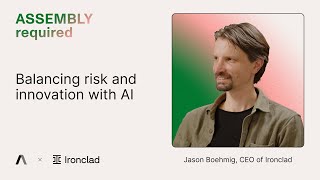
Jason Boehmig, CEO of Ironclad on Balancing Risk, Innovation, and AI Opportunity in the Legal Field