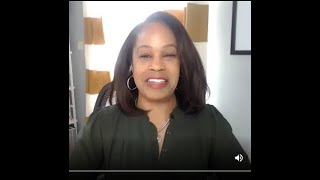
Jennifer Dent-Brown, a weight-loss coach, explains how emotional eating during lockdown stems from anxiety and boredom, not hunger. She recommends pausing before eating to identify your feeling, planning meals 24 hours ahead, and replacing automatic snacking with breathing or grounding exercises instead.
Chapters
Which is super exciting. Good afternoon. Good Sunday afternoon. I am so excited to be back with you. And I brought another fantastic resource, an informative health coach for you to chat with. So those of you joining, hello, I am Dr. Siobhan Peratt. I am a life and marriage coach. And most of my work centers around helping women and couples love their marriage again. But we also know that a marriage does not exist in isolation and that given all that is happening right now with the current health crisis and just the range of emotions that people are experiencing, I wanted to address a broader range of topics. And so I have connected with several experts and several other coaches to bring you sort of topics and information that I know from talking with so many of you are really sort of top of mind. And one of the things that I have chuckled at and needed to raise my hand for as well was emotional eating. So I am super excited for the conversation that we are going to be having. With Jennifer Dent-Brown, who is a life and weight loss Coach. So, Jennifer, I will just let you actually just go ahead and introduce yourself. I am going to check the Facebook live feed to make sure that everything is operating as it should, and you can just go ahead and let people know, like, who you are and what you love to do.
Great. Thanks, Siobhan. Always happy to chat with you, and I really want this to be a open dialogue. So any questions that you guys have about emotional eating, about how to just avoid the eating while you're sheltering in place, go ahead and type them into the chat. If we have anyone on Zoom, go ahead and type them in. This is us talking, like, let's be real. So a little bit about me for those of you who don't know me. My name is Jennifer Dent-Brown. As Siobhan said, I'm a life and weight loss coach. The way that I became a Life and Weight Loss Coach is simply because I had a weight problem. Very, very easy. Went to college, gained the freshman 15. Never really had a weight problem before that, but just a lot of bad habits that I gathered and started to do in college and just gained 15, 20, 25 and continued to gain weight. All through my undergrad career, all through my graduate career. And eventually I actually got a job finally after years of school as a management consultant. I was traveling 90% of the time, so living in a hotel every week and eating out every day. And all this time trying to figure out why I kept gaining weight. And I was doing all of the diets even in school. I remember junior year was my first first time doing Weight Watchers. And ever since then, it was like diet after diet after diet after diet, workout program after workout program after workout program after workout program, and literally nothing would work long term. I was able to lose 10 lbs. by taking prescription medication called Fen-Phen to lose weight. Killed my appetite. But of course, as soon as I started eating again, I gained it back. So needless to say, I have a lot of experience with the yo-yo dieting. The one thing that I did not realize was the reason that I was overweight was simply because I was overconsuming calories. This could be true for you. The reason why you are overweight is because you are eating too much food. The reason why I was eating too much food was just because, well, yeah, I really like to eat. I really like good food, but I was also using food to help me feel better in all of these other areas of my life where I was unhappy. So at the time I was single, I hated my job. I didn't think I was good enough. Lots of feelings and thoughts of inadequacy. And so because food was always plentiful, everyone likes to eat, right? It was always easy to go to happy hour. It was always easy to go out for drinks. It was easy for me to keep eating to make myself feel better. And that result was an extra 20, 30, 35 lbs. So it wasn't until I worked with a holistic health coach myself that I realized, like, oh, you mean my life is the reason why I'm overweight? And so that was kind of like a huge aha moment for me. And that started my journey of like researching how my mind is connected to my body and how I'm living my life results in my weight. And so I went to school, got certified, and then I started working with a life coach. And then it was like, oh yeah, I get it now. Wow. It is not the diet that doesn't work. It is my brain and my thinking that was a little off. So, I always tell Clients that your weight is just an outward manifestation of the things that are not right in your life. Good news is you can fix that, right? Get your thoughts ready or get your thoughts shifted about what is happening in your life and stop using food to make yourself feel better or alcohol to make yourself feel better. The weight will eventually show that result of those actions. And so happy to be here today to talk about this new normal that we're all experiencing, this global crisis of all of us sheltering in place and trying to avoid the quarantine 15.
Yeah, I can't tell you, like, I love this conversation and I probably will hate it at the same time. Because, you know, I think thinking about what you described in your own experience in terms of your college, the weight gain, like I too gained weight in college, and I see so many parallels to what all of us are experiencing now, right? So there is, you're in a new environment, right? So like for us, maybe we're still in our homes, but it's like it's under different conditions than were normal. So transitions create emotional responses for for us. And there is, you know, like, eating out, like a lot of people are being able to take advantage of or want to support their local restaurants and their local businesses. And so there's a lot of eating out. And so I guess one of the first things that will probably be important just to sort of ground this whole conversation is really getting an understanding of emotional eating. I think a lot of people like, "Oh, I'm an emotional eater," and it becomes just a thing you sort of throw out there, a term you throw out there. But how can you like really truly know, like in a serious way, like if this is what's happening to you? Like how would you tell someone or how would you let them know like, "This is probably emotional eating." It's so funny because I never wanted to associate myself as an emotional eater.
And even when I was studying to be a health coach, there was like a module on emotional eating and I was like, "Oh, that's not me." like, no, there's just something wrong with me. I just need to figure out what the right foods are. And it wasn't— I didn't— it didn't click in my own brain. So I never associated myself as being an emotional eater. For those of you who are thinking like me and wondering if you're an emotional eater or have your head in the sand about you being an emotional eater, very simply, if you eat when you're not hungry, you are probably an emotional eater, right? That's like The baseline, if you're standing in the refrigerator or standing in the pantry looking and trying to figure out, hmm, what do I have a taste for? You're probably an emotional eater and you're probably trying to distract yourself from something else that's happening.
Right? I'm gonna like, this is, you know, we're friends. And so I'm gonna like, I'm gonna be the voice of the people.
Be the voice.
So what if it's, I just really like the food?
Right?
I just really, I want that. I am not hungry, but I really enjoy the taste of those cookies or of those french fries or whatever people are picking at these days.
Whatever your thing is, right? You can really enjoy whatever food you really want to eat. Right? But in that enjoyment, you need to be OK with enjoying the weight as well. Enjoying the extra weight. That's, that's, that's the simple, simple fact of it, right? You can eat all the cookies and all the chips and everything that you want to eat and be like, oh, this is perfect. This is what I really want to eat right now. But you also have to be okay with being overweight. You also have to be okay with having sore, achy ankles or a sore back or arthritis, right? You have to be okay with being winded when you're going up the steps, right? You can't have both and expect it to be okay. So when you get to the point where you're like, you know what, this over here, my achy joints, it's not okay. This over here, me being winded by going up one flight of steps, it's not okay. Right? When you have that thought, when you have that belief, then you look at the cookies and you're like, you know, not today. Or maybe you'll just say, you know, instead of having 5 cookies, I'm going to eat one and be done with it.
OK, that I can deal with, right? So it's the eating the one cookie, like, yes, you can enjoy it. So the message is emotional eating is when you're eating when you're not hungry. Desire feels to be like the emotion that is leading a lot of people. They're not making perhaps the connection between their emotions. It just feels like, no, I just want to have this. I enjoy it. Right. So you're not saying don't enjoy it. Just don't overindulge in it.
Yeah, good.
So, and then the way you do that is you plan ahead. Okay, talk more about that.
Talk more about that. So that's another key to show you if you're an emotional eater. If you find yourself just eating and you're not really planning for it and you feel like your emotions are driving you to eat, right? So what I teach my clients is like, we plan, we plan 24 hours ahead of time. What do we want to eat for the next 24 hours? And that's what we're going to eat. Now, if you really want to eat that cookie, we just put the cookie into the plan. If I really want to eat french fries, I'm just going to write down and say, OK, I'm eating french fries today. No big deal. And that's what I eat. But I'm not going to eat the french fries and the chocolate cake and the glass of wine if I hadn't already planned ahead of it. Right. So when we plan ahead, we are 100% learning how to commit to ourselves and commit to doing what we say we're going to do. When we just kind of like willy-nilly freestyle it and like, oh, I think I feel like a glass of rosé right now. And some chocolate, right? That is probably coming from some type of emotional need that you're wanting to fill in the moment. Got it.
I'm just checking the newsfeed to see if people have questions. So if you're watching this live and you do have questions, feel free to type them into the live if you're watching on Facebook. And then if you are on Zoom with us, there's a chat box where you can put your questions as well. So here's one of the things that I'm curious to hear your take on, like, if a person is to a place where they can accept, like, yes, I'm an emotional eater because I'm eating when I'm not hungry. How do you recommend people sort of tap into, like, what is the emotion, right? This is something that as I've, you know, known you and, you know, heard your perspective on things, I find myself even wondering, like, what am I even really feeling? Like, sometimes it's very hard if people aren't, like, cognizant of it to even identify what the emotion is that's driving them to eat in that moment. What do you, what do you say to that?
So it's very hard for people who, who this is new to, to tap into what that feeling is, because most of us who are overweight, we've just been on autopilot all this time. We've just been like, OK, I'm going to eat now. I'm going to eat now. Let me eat this, right? Oh, I got— I feel like I need something to eat. We're just automatically on autopilot. We're not even aware of the reasons why we're wanting to eat. So one of the things that— well, one of the things I do teach my clients is, and I practice myself, whenever you get the urge to eat, whenever you get the thought like, oh, I want to get something to eat, or like, I'm feeling like— you just stop, right? Just stop yourself. You're not denying yourself and saying you can't have the thing. All you're doing is delaying it for like 15, 20 minutes. Stop yourself and think and say, okay, what's happening right now that is triggering me to want to go eat something? For those of us who this is brand new to, I would say grab a piece of paper, write down what is going on in your brain, right? What are you feeling right now? What are you— what's happening? What just happened in your environment or in your circumstance?
All of a sudden you're like, Ooh, I need to go get something to eat.
Because it's not going to be a natural thing for you to be like, oh, I'm feeling lonely right now. No, you have to kind of like get used to it and it's a process. So the more consistent you are with pausing, the better you get at it. So every time you get the urge to eat or drink something that you haven't planned, even if it's just like, let me go just see what's in the refrigerator, just pause, stop, and question and say, okay, what's happening right now that I feel like I need to eat a little something?
Mm-hmm. Yeah, as you say that, I think about almost like a cheat sheet of what might be happening. Like, what do you see as the common reasons or the common emotions moving people to eat, especially as we think about this quarantine situation that many are facing? What might be some of those top emotions?
I would definitely say anxiety would be number one, and just stress, uncertainty, not knowing what's happening outside in the world. If you're watching, I noticed for me last week I was watching the evening news while eating dinner and I just could not stop eating. And it wasn't until later I was like, oh, I probably shouldn't have been watching that. Even though happy stories, sad stories, it was just for me It was very just, you know, bringing up those emotions of anxiety. I would say those are the top ones, especially right now in the situation that we're in. We're in like spaces with people who are here all the time. The kids aren't going anywhere, the spouse isn't going anywhere, they're still here. There's like no place to have alone time and be by yourself. So that can be— can cause a lot of anxiety and stress if you're not managing your thoughts about it appropriately.
One thing I wonder too that happens for people is just associating food with activities, right? So like being in the house, so first there's boredom that may be coming at play as well, but also like I know like when I want to like snuggle up with my kids and like watch a movie and like, "Let's get some popcorn and like watch a movie." What do you say, like, are other ways to either enjoy activities that you've normally associated food with, or other ways to just cope with the anxiety and the stress and overwhelm? What are like your top recommendations or things you want people to start thinking about instead to sort of get them to break those habits?
Yeah, habits. That's exactly what I was gonna say. That is a habit. So sometimes the emotions that cause us to eat or triggers that cause us to eat are also just plain old habits, bad habits that we have. I was going to say, for me, I have this. I work from home. I've worked from home forever. And I had a habit of going to eat every time I got off of a call, like out of a meeting. Right. Because you're on a call with a meeting and you're working with other people and you always have this list of things to do as soon as you finish up the meeting. That, for me, is like a little bit of anxiety there. So my habit was just like, well, let me take a break. That's what I was telling myself. I'm going to take a break and walk away from my desk. And I went to the kitchen and I would just go grab a snack, just go grab something to eat. So it wasn't until I started to realize like, oh, there's a little bit of anxiety that happens when I click hang up and I look at my to-do list. And so for me, when I was able to recognize that and pause, I recognize— I realized that the The feeling passes eventually, right? It flows through you and it passes away. So with the habits, the first change in you, the first step in you changing your habit is being aware that it is a habit and then understanding and being like, OK, I have the option to decide, well, I want to keep this habit because I know my weight is just the same and whatever. Or do you want to consciously decide, you know, I'm going to choose something different to replace this habit so I can begin to release some of this weight that I've been carrying around? Does that answer your question?
I think it does. Yeah. Yeah, it definitely does. So for those, especially now, given sort of like what is happening with COVID what are other ways to cope? Right? So, you know, Facebook is flooded with joking about the fact, like, I ate all my snacks in 10 minutes, right? We can all relate to some of those feelings. But in a more conscientious, serious tone, what would you say? What are some other strategies that have really worked that are satisfying, right? Because it feels like the reason people go to food is because food is first there and very plentiful. And it feels so satisfying to just be able to just reach for the cookies or the wine or whatever it is. What are some other ways to cope besides eating?
So what I've been telling my clients is just give yourself some grace, right? If you're feeling anxious, just acknowledge that anxious feeling and just sit with it for a second. Like, just sit back and be like, dang, take a deep breath, right? And don't rush to go do something else to try to like squash down the anxious feeling because all it's going to do is bubble up. Acknowledge the fact that you're stressed out right now. Acknowledge the fact that your kids or your husband or your spouse is getting on your nerves right now. Go stand in the closet somewhere, go in the bathroom and just take a minute, do some deep breathing. There's so many apps and timers and things on your watch that can help just guide you through deep breathing and just calming yourself down, giving yourself some grace, telling yourself, I'm doing the best I can do right now, and just let that feeling just sit and pass through you, right? It will eventually go away, right? When we have the urge to kind of want to go do something else, like, oh, let me just go do— I'm not going to eat, but I'm going to go do something else, like scrub the kitchen floor, right? You're just buffering and you're just You're not acknowledging that feeling and that emotion that is happening within you. So if you just take some time, you're not alone with this. Everybody is kind of feeling the same way and everybody's dealing with it in their own way. But if you just give yourself some grace and say, whew, all right, this really sucks, but I'm going to be okay.
Got it.
And then go about your business.
We've been talking a lot about sort of things people can do, tell me about the mindset of the person that through this quarantine period, let's say we're in a state like this or even a similar, you know, limited, um, social distancing and all of that stuff for the next like 3 months. Like, let's just say like that's sort of how I've begun to just wrap my head around it. Like, this may be my reality for the next 3 months. For the person who either really wants to start losing weight or the person who at least just wants to maintain, what is the mindset that they really have to have to be successful?
I love that question because it is really a mindset. And the first thing that I do with my clients is like, who do you want to be at your goal? Like, at your goal weight. What does that person think like? What is she thinking? What is she doing? How is she feeling? Because you need to start thinking like that woman who weighs your goal weight or weighs less than what you do now in order for you to start making different choices and different options. So just say, for example, your current weight is 180, right? And you want to get down to 150. Well, you need to start thinking like a 100 and like a 150-pound woman. You have 180 down, perfect. You know how to be 180 lbs. Like you got that down pat. You know exactly what you need to do to be 180 lbs. You know enough not to weigh 280 lbs or 380 lbs because let's face it, it's possible, right? We all watch My 600-lb Life. It's totally possible. So instead of thinking like a 180 lb self, ask yourself what would your 150 lb self do? And if you can't picture yourself and what she would do, what would somebody you know who weighs 150 pounds do? Like, we all have that one friend, right? You all go out to dinner, everyone else is ordering, you know, cheese fries and nachos, and she's like, "I'd like to have the Cobb salad with the dressing on the side." Like, we all have that friend, right? And that's why she's probably the size she is. So you just have to start thinking like that person, the brain of the person who weighs the weight that you want to be. Now, it's not going to be instant like that. Like I Dream of Jeannie, do my nose thing, and all of a sudden I have the brain of somebody who weighs my goal weight. No, it takes intention. It takes consistency for you to think like that every day. That's why I say every time you get the urge to eat, you got to pause and check yourself. 15, 20 minutes, say, okay, hmm, what choice am I about to make right now? Am I going to eat the thing, or am I going to like feel this emotion, or I'm just gonna let it pass and do something else? And someday you might be like, I'm just gonna eat the thing, I don't really care.
Got it. I'm gonna check the Facebook feed for questions, but why don't you share like, as you think about it, what do you feel like is maybe the biggest mistake biggest mistake that people are making right now when it comes to like their weight?
The biggest mistake. Well, I would say with what I see, the women who come to me, the women I do strategy calls with, is that they, they've given up. They think it's not possible because most of the women I talk to are in their 40s, 50s. I have some clients in their 60s and they've done all the things. They tried all the things and nothing is working. So I think the biggest mistake— and it's probably not those women because those women, they decide, like, OK, I am going to talk to her and see if there is something I can do. I think the biggest mistake for everybody else who thinks the same way is not reaching out for help and just giving up and thinking like, well, the older I get, the fatter I'm going to get, the sicker I'm going to get. Right. I think they stop thinking about longevity. I think they stop thinking about how to have a healthy life going forward. And I think that's just a huge disservice to themselves.
Great.
Thank you.
Thank you for that. Anything else you want to say or mention? How do people stay in touch with you? How do they access some of the information that you are sharing and what you're up to? To during this time?
I'm all over social media. That's one. So you can definitely check out my Facebook business page, which I post on there all the time. It's at Coach Jennifer Dent Brown. So you can find me there, like me, and then you'll see all my stuff. You can find me at my website, JenniferDent.com. If you're interested in signing up for a consult, you can do that there. You can follow me on Instagram @jenniferdentbrown. And I, for those of you who follow me, Siobhan follows me, I post pretty much everything that I eat. I like to post my recipes and what's going on in my life.
So I made some lentil soup today and I thought about you because that was part of one of the things that I did with you, one of your challenges. So I'm having lentil soup for dinner tonight.
That's a great idea. See, inspiration. We have lentils too. And I was like, hmm, maybe I'll be making some lentil soup. Yeah, that's— those are the best ways to follow me.
Tell people about like your consult. What is it for? So for someone just like coming on this livestream, doesn't even know really what coaching is about or what a consult call is or like what it would mean for them to reach out to you directly, like tell them what they can expect and like what they'll walk away with from that experience.
Yeah, that's a great question. So I call them my Stop Dieting Forever strategy calls because my goal, if you work with me, I am your last stop. You're not doing any more diets after you work with me. So I tell all of my clients, your last money spent on dieting products, whatever, is with me. It's done. So this is your Stop Dieting Forever strategy call. We get on the phone, you tell me what your challenges are, what are you struggling with, why haven't you been able to lose any weight? What is your story? Even though you think your story is so special, there are so many commonalities in all of the women that I talk to and also with me, right? We talk through all of your challenges. What is your goal weight? Why is that your goal weight? Then we just figure out, we strategize, we figure out. I tell you what I do, how I work with my Clients, and we decide this is something that would work for you and your lifestyle. If you have never done coaching before, very, very important. The one thing that I tell people is like, oh, yes, you can do all the things. You can go get a trainer. You can follow a meal plan. You can get the diet book and make all the recipes. You can do all of those things, right? Your willpower and your desire to do that will only last for a little bit of time. So where I come in as a Coach is like I pick up the slack of when that willpower dissipates and disappears and I help you create that brain like we talked about, that identity of like, look, I need to just naturally do these things every day. I need to wake up every day and decide this is what I do. This is what I am going to eat and just follow all the plans. But you have got to have your mindset straight in order for that to happen. So I think the missing piece— well, actually, I think— I know the missing piece for everybody who's doing all the A's, all the action, is trying to lose the weight, is that your mindset is not in the right place.
Thank you. Thank you so much. So in this time where we are not going out, getting our nails done, our hair done, all of those things, you're probably canceled your gym membership. I think it would be an excellent use of your resources, given that everyone is sort of in home, to get that mindset right. If this is an area of life that you know you want to be different, that you know you should be doing things but just can't sort of consistently do it, I think reaching out to Jennifer would be an amazing, amazing thing. How do they do that? On your website is where the link is to sign up for a call.
Yeah, go to JenniferDent.com. There is a link to sign up for a call with me and I would just love to talk to you and encourage you because this is not the end of the line. Like you can lose the weight no matter what age you think you are, no matter what physical problems you have, right? You can lose the weight. You just have to make the decision and commit to it.
That's awesome. Awesome. Awesome. Alright, thank you, Jennifer.
Thank you, Dr. Simone.
Thank you so much for sharing your knowledge, and I hope you guys take advantage of being connected to her. She has been a blessing to my life, so I'm very grateful for you.
Thank you for the opportunity to talk to your folks.
Alright everyone, we are going to sign off for now.
Bye! Later!
More from Jennifer

Overcoming the Weight Loss Struggle #perimenopauseweightloss #womensweightloss



Overcoming weight loss frustration #womenover40 #perimenopauseweightloss #weightlossover40

How to Stop Food Noise in Perimenopause #perimenopauseweightloss #weightlossover40


Closing the Friendship Gap for Weight Loss #podcast #womenover40 #weightlossover40




The Real Reason Smart Women Stress Snack (It Has Nothing to Do With Food) #weightlossover40 #podcast