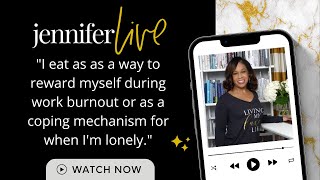
In this weekly live session, life and weight‑loss coach Jennifer Dent‑Brown addresses a viewer’s struggle with emotional eating, explaining her “Name it and Claim it” method from the Stop Dieting Forever program. She begins by introducing herself and her mission to help women stop dieting forever, citing statistics that 56 % of U.S. adults (roughly 94 million women) are actively trying to lose weight and have attempted an average of 56 diets in a lifetime. The viewer, Magic Magic, reports using food as a reward during work burnout and as a coping mechanism for loneliness. Jennifer validates the prevalence of emotional eating, praises the viewer’s self‑awareness, and outlines a step‑by‑step process: identify the specific emotion behind the eating trigger, name and claim the emotion, write it down to slow the brain, and let the logical brain decide whether to eat. She emphasizes building emotional literacy through daily journaling with her 90‑day planner, shares her own experience as a reformed emotional eater, and recaps the actionable steps. The video concludes with a call to join her upcoming 30‑day boot camp (starting August 8) and to obtain the planner via jenniferdent.com/bootcamp, providing contact information for further questions.
Questions this video answers
You eat as a reward during work burnout and as a coping mechanism when you feel lonely.
Identify the exact emotion, name and claim it, write it down to slow your brain, then let your logical brain decide whether to eat. Practice this repeatedly to build emotional literacy.
Chapters
All right, hello everyone. Let me just make sure I do my tech check. I am Jennifer Dent-Brown and I have important things to say, so I want to make sure you can hear me okay. Dent-Brown and I have important things to say. Okay, there we go. All right, we are working. Mic check, 1, 2, 1, 2. All right, y'all, it's Jennifer Live, and this is when I come on live once a week or so and answer one question that you all have sent to me, or a challenge that maybe you all are having. Um, and I like to keep it brief, right? Answer one question and let you all go. Hey, Yusefa! And if you miss the live one, no problem, you can come back and watch the replay. Um, the also, the other thing I want to mention is like I have all of these archives, so just if you want to just scroll on the page and see some of the other questions that I've answered, you can do that. So if you're new to me, welcome, welcome to my corner of the internet. I am Jennifer Dent-Brown. I'm a life and weight loss coach, and my sole purpose in life is to help women learn to stop dieting forever. Y'all, I just did some statistics, like some research the other day, because I was just curious. There are 165 million people in the United States of America. 56% of adults at any point in time are working to lose weight. 56%. So if I look at just the number of women that are in America— I think the number was like 94 million— 94 million women, 50%, 56% of adults in America— I don't know how many women that is— are looking to lose weight. And here's the other thing that killed me, is that the average American adult has tried— um, got my numbers mixed up— like 56 diet attempts over a lifetime. 56, y'all. Like, why wouldn't you want to learn how to stop dieting forever? Beyond me. So this is why I'm so passionate about helping specifically women. I do have some men that chime in and listen. Love you guys. But for people who identify as women, you are my primary audience. I'm here to help you get off of the weight loss struggle bus. Alright, so the question that I want to talk about today was submitted to me a while ago from someone named Magic Magic. And I don't remember whether it was an email or maybe it came through on social media, but she said, my biggest struggle is emotional eating and I eat as a way to reward myself during work burnout or as a coping mechanism for when I'm lonely. So let me first just say you are not alone. 99.9% of my clients that come to me, the women that come in and join the boot camp, are emotional eaters. I am an emotional eater. Y'all have heard me talk about my emotional eating, and I've talked about it on the podcast as well. Um, so you are not alone. Here's what I want to offer. I noticed you said, I eat as a way to reward myself during work burnout or as a coping mechanism for when I'm lonely. Now, I just want to first of all applaud you for even recognizing that you are an emotional eater. A lot of us just eat and we don't tie it to our emotions. So you are at least— you're like one step to reaching your forever weight. You have that awareness that you are emotionally eating. And you are aware of when it's happening. Very specifically, you said during work burnouts, when work gets, I guess, too stressful, or as a coping mechanism for when I'm lonely. Okay. So first of all, like, just pat yourself on the back. Like, no, you are— you are walking in the right direction because, one, you are aware of your eating habits are tied to your emotions, and two, you're aware of when you're doing it, right? There's very specific circumstances of when you're doing it. Okay, here's what I want you to begin to do, and you already are very aware of like what's happening. I want you to begin to identify what the emotion is. You're very clear on the circumstance, you're very clear like what's happening— work burnout. You understand what that is, but what is the emotion that's coming along with the work burnout? Right, you said you eat as a coping mechanism for when you're lonely. Okay, so, well, loneliness would be the emotion that's tied to that. Okay, so just be very, very clear and just be super specific about all the emotions that you're feeling, because even in your loneliness, there may be some other emotions that are swirling around that you haven't yet, like, gleaned onto. Okay, hold on, y'all, my eyelash. Giving me some, some trouble here. Okay, so the first step to break this pattern of emotionally eating to feel better is to, one, identify what's happening and what is the emotion that you're feeling. Okay, name it and claim it is what I teach inside the Stop Dieting Forever process. Name the emotion and then claim it, right? Don't try to like, um, you know, discount it or like, well, I'll feel better tomorrow, or like, it's just like— no, name that emotion no matter how uncomfortable it is and claim it, okay? So in that process of naming it and claiming it, what's happening on the other side, right, in your brain, is that you are now you're beginning to disconnect yourself from the emotion. Because before, it was all like, ooh, work burnout, or I'm just feeling lonely, and it just feels like those emotions are all-consuming, right? I'm assuming the emotion associated with work burnout, we're just gonna say, is like stress, right? So those feelings of stress and loneliness may be all-consuming, but when you name the emotion and you claim it and be like, yep, I'm feeling lonely right now, I'm feeling sad, I'm feeling stressed, I'm feeling angry, I'm feeling irritated, Whatever those emotions are, name all of them and claim them. Bonus points for writing them down. If you've been following me for a while and if you're familiar with the Stop Dieting Forever process, you know I am a proponent of writing things down. I've created a planner, right, for my people so you guys can write things down. The reason why we write things down is because it slows our brain down. It slows our brain down and it separates, again, us from the emotion. When you can like disconnect yourself from the emotion. Because when you're eating emotionally, you're just being driven to eat by the emotion. When you slow that down and you're looking at, oh, this is how I'm feeling right now, and you're looking at it on black and white, it's like you're disrupting that thought pattern. And so now your logical brain has like a moment to like snap and connect, and you can be like, girl, yes, you're feeling lonely, but Is eating this plate of cookies gonna make me feel better? Is finishing off this bottle of wine gonna make me feel any more loved, right, and less lonely? So when your logical brain kicks in, like, it's, it's got an opportunity for you to be like— it just— first of all, your, your thought pattern is disrupted. Your logical brain has a moment to like sneak in there, kick in And then you have an opportunity to choose again, which is, do I really want to eat this food right now because I'm stressed from work? Do I really want to eat this food right now because I'm feeling lonely? Or is it just like, I'm feeling lonely, like this is just how I'm feeling right now? Okay, so this is how you begin to break that pattern of emotional eating. The more you can do that The more often you can do that, the easier it becomes. In the beginning, it's difficult. In the beginning, because you're just— your, your habit is so driven by, like, feeling lonely, go eat ice cream. Like, that's just— it's that you, you've made this habit connection in your head. But what I'm telling you to do is when you can stop, pause, identify the emotion, you actually in that moment decrease the intensity of it. Right, so the next time you're feeling lonely, I want you to remember my hand going pause, stop, questioning how are you feeling right now, right? What are all the emotions? Oh, Jennifer said write them down. Okay, I'm gonna go write them down. And then in that moment, you get to decide, like, okay, do I want to go ahead and like eat the ice cream to deal with these emotions, or is this just like how I'm feeling right now and leave it at that? You get to choose again. Difficult in the beginning, but the more that you can do it, it gets easier. So this is why, um, inside the Stop Dieting for Process, when you join the boot camp, you guys get the planner, you get the process, the written process, because every single day you've got to practice. What are— what am I feeling right now? You're, you're creating emotional literacy. How am I feeling right now? You're learning like, what do these emotions feel like in my body? You're looking at all the reasons why all these different circumstances, why that are, that are driving you to eat, right? Maybe it's not just loneliness. Maybe it's not just work, work burnout. Maybe some other things. Maybe it's happiness. Maybe it's excitement. Maybe it's just because it's 12 o'clock, right? So the more that you are able to take the time to intentionally think about these things and, and what you're feeling, what you're dealing with, what's happening, how you're— what's— what, what the feeling is in your body, what the thoughts are you will begin to break that emotional eating habit. Okay, I am a reformed emotional eater, and even now I can— when I sometimes I can feel when I get the strong urge to eat, it's just, uh, it doesn't mean I have to like, oh, go to the refrigerator and like start grabbing stuff to eat. It's like, oh, let me just check in. I'm like, what's happening right now? Am I feeling stressed? Oh yeah, I think I'm a little bit stressed right now, or I'm a little bit irritated. Right, it's just a, a trigger for me to just check in and be like, what's happening right now that I feel the immediate urge to eat? Okay, so old me just would have been like, urge to eat, go eat, that's it. All right, so I hope that was helpful for you. I'm just going to recap real quick. When you struggle with emotional eating, it's not a problem, right? This is just an opportunity for growth. The next time you feel yourself emotionally eating and you're very clear already of what you're— what's happening in your life, I want you to pause, stop, check in with yourself and be like, how am I feeling right now? Name it and claim it. Name all the emotions, claim it. Bonus points for writing them down. And then you have an opportunity to choose again. Okay? So when I say choose again, I mean you have an opportunity to continue to eat the thing that you said you were going to eat. Drink the thing you said you were going to drink, or you can choose again and be like, you know what, I'm not going to have the ice cream right now. I'm just gonna sit here and watch TV and be in my feelings, right? It's perfectly okay. It's a normal human emotion. All right, so if you're interested in learning more about the Stop Dieting Forever process, you want to be able to take this concept of name it and claim it and really learn to apply it to your life on a consistent basis, and you want a copy of this 90-day planner, then what you want to do is go sign up for the boot camp. Go sign up for the boot camp. Go to jenniferdent.com/bootcamp. Your next opportunity to join is August 8th. 8/8. I'm like so excited. I just realized I was like, oh, 8/8, we like that number. So go to jenniferdent.com/bootcamp, get your name on the advanced notification list, and then make sure you are ready in August to join the 30-day boot camp because it's getting a reboot, y'all. It's getting a refresh. So I'm going to explain to you what that is in the coming weeks. But just know if you're on the advanced notification list, you're going to find out first. All right. Jenniferdent.com/bootcamp. I will see you all next week in another Jennifer Live. If you have a question or a challenge or something you're struggling with, send me an email, jennifer@jenniferdent.com, or just send me a message on the socials and I will get it. All right, see you guys later. Bye!