He Built a Link-in-Bio Tool to 8.9 MILLION Users & Raised $30M 🤯 | Jesse Zhang (Beacons AI)
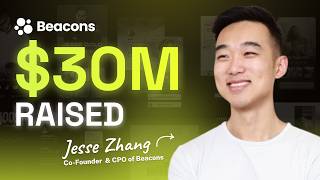
Jesse Zhang built Beacons AI, a link-in-bio platform for creators, to 8.9 million users and raised $30 million. The company's AI assistant Beam helps creators land brand deals using analytics. Early growth came from cold DMs and recreating Linktree pages, then TikTok outreach created network effects.
Chapters
Today on the podcast, we have Jesse Zhang. He's a co-founder and chief product officer at Beacons AI. So far, they have raised $30 million, and in the last 7 years, Beacons AI has over 8 million users. Jesse, can you explain the business behind Beacons AI?
At Beacons, we think of content creators as entrepreneurs and the businesses of the future. But it turns out that when you are a business, there's a lot of things you have to deal with that have nothing to do with content creation. We're here to help take all that other stuff off the content creator's hands. Uh, in short, we're building the AI teammate for the content creator. And historically we've built a bunch of different software tools like LinkedIn Bio, email marketing, digital e-commerce stuff, media kits, etc.
What was the inception of the idea and how has that idea evolved over time?
So my co-founders and I, we all met over 10 years ago while doing graduate school at Stanford, and we were all working in different areas of machine learning. And going into the last year of graduate school, we wanted to find a way to apply, you know, our AI and machine learning expertise to create value in the world. When pivoting through a lot of different industries, a friend of ours, she was running a Shopify store at the time, e-commerce, and she was doing all of her marketing through influencers and content creators on like a day-to-day basis. She would just go to Instagram, search for hashtags relevant to her business, and then talk to creators all day about negotiating how much she should pay them for them to post about her product. It was very manual, but she was making a decent amount of revenue, so she came to us. You guys are machine learning experts. Can you just build me something that automates all this away, that tells me which creators are the best fit for my business and how much I should pay them? That's how we got into the content creator space. None of us were content creators, but we liked the idea of democratizing influence and like empowering the individual to monetize their passions. And yeah, as we spoke to a lot of content creators, That's when we started realizing these are the businesses of the future. They're like aggregating huge audiences online and figured out how to monetize and make money. How do we help even more of them?
Can you talk about the product feature that you love the most about Beacons AI?
The product feature I love the most is Beam, this AI teammate. And the reason why Beam is so exciting to me is I like his design. I think he has this friendly but competent vibe to like a space beaver, but he's actually like really powerful because as creators already run their businesses through Beacons, We can kind of see a lot of data. We see what kinds of people come to the creator's link in bio. We see what those people click on. Creators will also connect their social media to use features like our media kit, which is like a one-pager that organizes all the creator's social information so that they can secure brand deals. With all this context, Beam is like ChatGPT or Claude.
What's the business model behind Beacons? Like, you charge creators a small $9 subscription. Or is it more like a payment processing? What's the main business behind the company?
We try to give as much of the product for free as possible because it's like a key component of our growth strategy. But there is like a $10 a month plan and a $30 a month plan for more premium features. So the main reason why people upgrade to the $10 a month plan is so that they can use a custom domain. So rather than having like ethans.ai/manav, if you happen to have manav.com, you can have that. And the main reason why people upgrade to the $30 a month plan is to send unlimited email marketing emails to the email list and also do more digital e-commerce stuff like selling PDFs and courses and memberships.
What were some key observations you had initially and which blew your mind? Like we can scale internationally, we can go wherever we want. What was some key metrics that you saw and blew your mind?
When we started the company in 2019, the first product that got traction was the LinkedIn bio product. Really simple website builder and building a website is, it's pretty difficult. Even Webflow has a whole Webflow University on how to set up these web pages. But there was like a real need in the market, and especially for creators, to do a simple mobile optimized landing page where the creator can just list all the links that they want to funnel traffic to, whether it's products, whether it's like blogs, whether it's their other socials. Uh, Linktree originally solved this problem and then we kind of just took it to the next level. It took a while for us to get the growth engine going, but once it did, It was really cool to see the flywheel working because the nice thing about a link in bio product is whenever a creator uses it, they also market it, right? Because they'll constantly tell their audience, like, go check out my link in bio. And then over time, if you're seeing like the Beacons.ai link everywhere, you start becoming familiar with as a brand. And then when you want to do your own content creation stuff, you might remember that like a lot of people use Beacons.ai. Websites retain pretty well because Very often when someone makes a website once, they'll just put it up and they won't really take it down, especially if it's like collecting analytics for them. That information is aggregated over time. You don't want to really lose that, and especially as their audience gets used to associating them with this website.
So what Jesse Zhang is saying here for the listeners is they had initial network effects. So when they put the link in bio, more people see Beacons AI and it subconsciously wires them. Most creators are keeping tabs on other creators, right? And they see a creator with Beacons AI and the link looks sexy, they want to do that too. When you guys first started, what was the growth strategy? Was it ads? Was it let's just do events? Was it like let's do marketing? How did you go about getting your word out?
I think when we first started going through Y Combinator in summer of 2019, we shifted into building for creators like 3 weeks before Demo Day. So Demo Day is the last week of Y Combinator where you pitch your progress. Or your company in front of like thousands of investors. We had like basically no traction at that point. And to get our first few users, we were aggressively cold DMing and cold emailing people. And we were asking our friends if they knew content creators. At the time, we just had 4 people at the company, right? So 2 of us would be building out the product and then the other 2 would just be like trying to get people to talk to us. And then that's how we initially started learning. We also like went to this influencer marketing conference in LA. I think it was September of 2020, we realized we only had 8 months of runway left. We estimated that it would take about 3 months to fundraise. That meant we only had 5 months to make a chart that, you know, looks like that. I remember at the time, Neil, my co-founder, he read this article about 19 different growth channels, including events, direct sales, email marketing. We stacked, ranked all of them, and we chose 3 growth channels to invest in. PLG, word of mouth, motion was nonexistent still. We tried building more community. That did not work. We did some form of like email marketing, That did not work either. The thing that ended up working that really got the flywheel going was I was going through my TikTok For You page, and for every person that had a Linktree link, we would add them to just like a Notion table or an Airtable. We would recreate their page on Beacons, same links. We would make it more personalized. Like back then you couldn't customize Linktree at all. Even on the paid plan, you didn't have that many more design knobs. We would embed a YouTube video that was theirs. They had one, we would like add things that weren't just links, right? Like you can add some text block. Then we would email the person, hey creator, I'm the co-founder of this creator company. Saw that you were using Linktree. You should check out Beacons because free monetization features, free analytics. Also, we built the entire page for you already. All you need to do is click on this link to claim it and it'll be ready. We were kind of inspired by Yelp's tactic where they would put up unclaimed business profiles and then actual businesses would claim it. 25% of people we reached out to ended up signing up for Beacons. And then half of them would actually put their link up in their bio. These were like pretty big creators with like millions of followers on this up-and-coming platform called TikTok. And then after doing that for like a month, 2 months, we started noticing we were getting organic signups. Like at first it was 10 signups a day and then it eventually became like a couple hundred and then so on and so forth.
How much time-consuming was it to make those profiles? Was that really time-consuming?
It really was. I had multiple existential crises while doing it for a couple of weeks. I was like manually putting together these Beacons pages for content creators, like researching who they were. We hired a small team in the Philippines to help put these pages together. We use scrapers and other automations to very quickly put together these Beacons pages. Like you can just put in the name of the TikTok user and then we will automatically like scrape whatever information we had on them to like very quickly construct this page. And then this team in the Philippines would QA them. And then we have like a whole system where we would just like automatically send a couple hundred of these emails every single day. And then like, uh, we'll follow up as well.
What was the inflection point where you were like, wow, today we saw like 100,000 users signed up? For example, I interviewed the founder of NeuroGum and he was telling me like when Joe Rogan mentioned NeuroGum, they literally blew up like overnight. For Beacons, like, was there any moments like that where you were like, whoa, like what happened?
The first moment that comes to mind for me is when we started getting multiple signups a day, like 10 signups a day. We started growing maybe like October or November of 2020, and then we raised our with CBrown in May of 2021. So about 6 months later, I think that's when we realized this is really interesting. Suddenly investors were kind of coming to us and we were talking to like Connie Chan from A16Z or the Chainsmokers, Nawal Rabeeqan and Scott Belsky and a few others. It was just like a really interesting moment where we went from like being nobody to being somebody.
If you can give like a quick advice about fundraising, for other founders, what would you suggest? I meet a lot of founders who really struggle with fundraising, and I talk to some people like you, it feels like they just had it on lock.
I would not say we had it on lock. Spring of 2021, we had traction, so it was easy to fundraise. After we finished YC, Neil, my co-founder and the CEO, did all of the fundraising. Demo day, he went to like 150 to like 200 meetings and basically got nos from everyone except like 10 people. Huge props to Gunil's, like, determination. I don't know how you can, like, deal with that many nos and still keep going. But we learned that the best thing you can do for fundraising is actually just make a business that's working. Once you have traction, you don't need to spend too much time figuring out how to tell a story. If you find that you're spending a lot of time trying to be smart about crafting the perfect story because you don't have the data or the expertise, that might be a warning sign that you're not building the right thing.
How do you feel about where AI is right now, especially with the rise of Claude and all these other tools. And what is your— some of your prediction? Like, what do you think will happen in the next 3 years?
I think we live in a time where it's more possible than ever for individual people to work on things that actually fulfill them. It's easier than ever to distribute your content and impact a huge audience, but it's also easier than ever to use AI to help run other parts of your business. To do the things that you would have previously had to hire people to do. The optimistic view, it's not clear we completely understand how AI works. With all technologies, there's going to be bad actors around the world. Yeah, I remember speaking to this cat content creator. At the same time, creativity is being democratized. You can be like a 10-year-old kid with a phone and you can tell stories. If they're compelling, they can reach the right audience around the world.
I think a lot of people would have to reinvent themselves. Which is definitely harder for older people. I think for creators, opportunity is more and more, but for white-collar jobs like consulting, why would I hire a consultant when I can just go on Claude and press deep research, get like insane insights on competitor analysis or whatever? I don't need to pay someone.
I agree. I think people will just have to figure out how to work in more creative states.
Can you tell, uh, some of the big names that use Beacons AI?
I think a lot of big musicians use Beacons, like Sia, like Green Day, Chase Walker's invested in us, Wong Fu Productions, Jeremy Lin, Chloe Shi.
Before we wrap up, I want to know, like, what's the next big thing for Beacons AI? Like, how— is there any exciting updates you're about to announce soon?
Beam, the AI teammate, he's getting smarter every single day. The main competency or skill that we're teaching him right now, or like empowering him to do right now, is help creators with brand deals. Beam will be able to reduce the friction between like creators, managers, and brands.
Creators are getting literally screwed over every single day on so many deals. And this is a very common thing in the creator space where I see like most creators just don't know how to price themselves. If you're a content creator, go on Beacons.ai. It's the best link in bio tool right now. How can people find you and reach out to you?
You can go to Beacons.ai/Jesse Zhang. All of my socials are there. On LinkedIn, I'm Jesse M. Zhang, and then on Instagram, I'm Jesse.zzzz.
Oh yeah. Thank you, Jesse, for coming on the show. Really appreciate your time.