University of Illinois Commencement Speech - May 14, 2016: Find a Better Way (Jeff Huber)
Commencement speech by Jeff Huber at the University of Illinois (May 14, 2016) in which he recounts three pivotal chapters from his life — growing up on a farm, being fired and finding a home at Google, and his wife Laura’s battle with cancer — to argue for a guiding belief: “There has to be a better way.” He discusses his career in technology (eBay, Google, Google X) and his role as CEO of Grail, a company working on ultra-deep DNA sequencing to detect cancer early, and challenges graduates across disciplines to find better ways to address major social problems.
Chapters
Pleasure to introduce this year's commencement speaker. Jeff Huber's Lincoln bio lists his specialty as getting stuff done. This, practically tinged with humility, has been his calling card as he spearheaded groundbreaking technological developments at ebay, Google, and now Grail. It's been his job to shape everything from how we shop online to how we navigate the world. And he's done it with an innovative spirit that's grounded in his desire to have a real and lasting impact on the world. Given his latest venture, it's not an understatement to say that he's in the business of saving lives. We're proud to claim him as one of our own. At the University of Illinois, we ask our students to think deeply about the implications of what they're learning, from agriculture to engineering to the arts, and then act on it. There's no question that in this respect, Jeff is a true Illini. When he graduated from Illinois in 1989 with a degree in computer engineering, he had already spent his undergraduate years running his first venture, the computer supplies and software business. He started when he was 14 to put himself through school. Not too shabby. After graduation here, Jeff went on to get a master's degree from Harvard. He put his tech and business knowledge to work at McKinsey & Co. And high speed Internet provider Excite at home before becoming vice president of architecture and systems at ebay. Then in 2003, Jeff moved to Google. For the next 10 years, he headed some of their most groundbreaking divisions. Working on technology. Excuse me, I'm feeling like I'm going to blow away on technology that we now interact with every day and is used by literally billions of people. Google Ads, Google Apps and Google Maps. If you've communicated or collaborated on the Internet or used your phone to navigate and help guide your adventures, you should thank Jeff. After a decade of managing these signature projects, Jeff took a step even further into the future when he became senior Vice president at Google X in 2013. Many of you know it as Google's Moonshot program. Google X projects like driverless cars are pushing the boundaries of what we consider possible. At Google X, his focus was on the life sciences, the intersection of biology and technology to crack the code, so to speak, of major medical challenges. While he was there, he suffered a loss that directed him down an ambitious and deeply personal new path. Jeff's Moonshot is cancer. Today he is the CEO of Grail, a new startup whose mission is to detect cancer early when it can be cured. Grail is using groundbreaking ultra deep sequencing of DNA. He'll be the first to tell you that they're not there yet. But that's why we're so glad he's on the job. It's an honor to have him here with us today, and we're especially grateful that he's chosen to be with us on his birthday. So happy birthday, Jeff, and welcome back. Please welcome your 2016 commencement speaker, Jeff Huber.
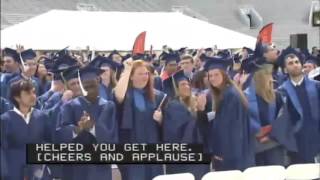
God damn it, I wish you would stop trying to figure out. So when I first agreed. When I first agreed to do this, I would have thought that if my knees were shaking at the podium, it was because I was nervous, not because I was freaking freezing. Chancellor Wilson, President Killeen faculty, distinguished guests, it's an honor, a true honor, to be back here at the University of Illinois class of 2016. That's your cue. It's more fun if we do this together. I'm here to congratulate you, but I'm also here to thank you. For many of you, this is your first college graduation ceremony. Well, this is also my first college graduation ceremony. See, I didn't come to this event. When I graduated in 1989, I had excuses. I had a new job. I was eager to get on with my life. I don't have many regrets. But 27 years later, that is one of the decisions I do regret. Because I didn't get to share this day with the people who loved me and who supported me. That might also explain why I have 15 members of my family and my curse section here today. And why my 90 year old father in Dubuque, Iowa is watching on the live stream right now. Hi, dad. Love you. That's a life lesson that took me a while to learn. It's important to reflect and celebrate and to be grateful for those who bring learning and love into your life. In fact, how about we all show our appreciation for the people who helped you get here. Your families, friends, mentors, and loved ones. So, graduates, please stand up, stand up, turn around, and show your appreciation for those who helped you get here. You may also want to do a few. Today, I'd like to share three pivotal chapters from my life. The experiences themselves may not be universal, but the lessons of failure and resilience, of passion and purpose, of loss and renewal, may be. And they're united by an overarching belief, one that I hope I can convince you to share. The belief is this. There has to be a better way. The first chapter opens in menominee, Illinois, population 248. Anybody heard of it? No, not a chance. Downtown Menominee had A church, a firehouse, a four room school hall house, and of course, a tavern. I grew up on a small dairy farm. The youngest of five. The farm was a great place to grow up, although it wasn't without its character building moments. A key feature of the farm, of the dairy farm is a cow yard. A key feature of the cow yard is, of course, cow manure. Lots and lots of it. When you add in spring rains, it's a thick soup and one particularly soggy day, when I was about 12 years old, my job was to walk out through the cow yard and open the pasture gate for our cows. Every step I took, I sang deeper and deeper and deeper up to the top of my boots. Cow poop threatening to seep over the top of my boots. Not quite able to get them out, I yelled for help. But no one could hear me except the cows, and they didn't seem all that interested. I started to panic a little, but then a remarkable calm came over me. It was very Zen. I saw my future. It was filled with cow manure. Don't get me wrong. Farming is a worthy and noble way of life if you're passionate about it. In that moment, I knew I needed to find my purpose elsewhere. For me, that meant I had to to find fulfillment in a different future. And that meant going to college. My parents believed in education, but they could only afford to pay for the first year of college. After that, it was up to me. At the time, I had an uncle and a much older brother who were working in accounting jobs in a big city in Chicago. I thought their work within cutting edge computer programs was impossibly cool. So I started lobbying my parents for a computer, an Apple II. Apple II at the time was about $3,500, about the equivalent of a year's earnings on the farm. But my mother used her inheritance from my godfather, all of it, and bought me that computer. Being a precocious kid, I wasn't happy enough to just use it. I had to take it apart and soup it up. My parents were horrified. For me, the problem wasn't putting it back together. It was that I needed storage. I needed floppy disks, lots of them. Floppy disks were the thumb drives of the day of the 1980s, except it would take about 7,000 disks or a stack 50ft high and cost $35,000 to equal the storage in a 1 gigabyte thumb drive you buy for about 3 bucks today and easily fits in your pocket. Progress technology is really damn cool. But the nearest computer dealer was 15 miles away and a box of disks cost about 10 weeks of my allowance for doing farm chores. That's a lot of cow poop scooped. So my brother helped me find a distributor in Chicago where I could buy them at wholesale for myself. I took out ads in some very geeky computer magazines, Byte and Nibble to sell to others. I was a budding 14 year old entrepreneur. I added other computer products over time and taught myself how to code. I bootstrapped the business out of my farmhouse bedroom into one of the first mail order computer product companies in the country. And that's how I created Amazon.com. Well no, I'm kidding. That's a different Jeff who's now an investor in my new company. But we'll get to that in chapter three. But that business, born out of desire and need, got me to and through the University of Illinois. It was my better way. And that excitement about what technology makes possible shape the rest of my life and career. Which brings me to chapter two, which includes something I've never told anyone except my wife, Laura. It starts in 2002. I was at ebay, drawn in by founder Pierre Omidyar's deep belief that he too had found a better way. A way to use technology to level the playing field so that little guys could compete with big companies in online commerce. And a way for mom and pop shop to be open 24 7, 365 days a year. I was a technologist who was passionate about innovation through technology. But ebay then was increasingly focused on marketing. I wanted to keep the playing field level. The marketers then wanted to charge more for an ad with blinking text. Basically it was the plot of the HBO show Silicon Valley a few weeks ago. I felt the dissonance pretty acutely. And I guess it showed because, and this was the part I never told anyone except Laura, I was fired. I thought I was going through the motions pretty convincingly, but I was still going through the motions. My heart wasn't in it and it showed. If you're not passionate about what you're doing, then there has to be a better way. Still, getting fired was a shock and incredibly humbling. I was devastated at the time, but it turned out to be the best thing that could have happened. That failure led me forced me to find a better way. The way for me was Google, where I worked with believed in innovation through technology as much as I did at ebay. I had a fancy title and a big team. But my new boss at Google felt that you really have to earn leadership. In his words, go work with the team. Show them what you can do. Show them how you are going to help them win. Be a leader. It's vitally important to put your head down, do the work, and earn it. So I did. I took a title cut and a pay cut. Launched a career at Google in 2003. Got to work with some of the best people in the world and build Google Ads, Google apps, Google Maps and Google X. I found a better way for myself, my career, and maybe the world. Now we're at the third and last chapter of the story. It's the most important one and a difficult one for me to tell. It starts two decades ago when I was asked by my then employer to investigate an online dating service as a potential partner. I created a profile out of purely professional interest. Of course, it was 1996, so there weren't mobile phones with cameras or really. The service was kind of like Tinder or Hinge, You know, but without the pictures or phones or swiping. It was text only. Old school. The first profile that caught my eye was of a woman named Laura. She was a designer and art director for magazines and was an expressive and gifted writer. I thought she seemed smart and super cool. Our first date, I went to her house and picked her up. I was greeted by a beautiful, athletic, artistic hippie chick wearing a radiant smile, a long flowing dress and cowboy boots. I fell in love with Laura at the door. In that instant, she became a part of me. We built an amazing life together over the next 20 years. We have two beautiful children and future Illini. Who are here today. And they will come to believe, as we all do, that orange and blue actually really go together. Laura became my partner in everything and inspired me through her deep caring, her kindness, willpower, boundless positive energy to be a better person, a better husband, father and human. But then one day, Laura told me she felt tired, which was unusual because she had always been super fit and high energy. We saw doctors, but none of the explanations seemed right. Two years, one month and one day ago, we found the answer. A small tumor in her colon. It was cancer. Still, that's treatable. Pretty straightforward and good outcomes if you catch it early. But before the surgery, the doctors did a CT scan. When we looked at the results, it just lit up. We saw the cancer wasn't just one small tumor. It had spread to her liver, her abdomen, her chest, and through her lymph system up to her neck. It was stage four cancer. Laura fought me. God, did she fight. And we fought alongside her. She had maybe the best team of cancer doctors ever assembled fighting for her. She took her art supplies to her chemotherapy sessions and her kicking cancer's ass took bag when she couldn't move her legs to roll over or get out of bed. She asked me to order some hand weights for next day delivery so she could rebuild her muscles and be strong again. She never, never, never gave up. Even at the very end. She passed away six months ago this week. And that's why I told you earlier, Be grateful for those who bring love into your life. Because I didn't have her for long enough. Our kids didn't have her for long enough. The world didn't have her for long enough. Grateful that we had Laura. I miss her every day. And every day, her bright spirit, determination and character inspire me. It fuels my conviction that there has to be a better way for us as a country and as a world to fight cancer. At Google X, I've begun studying the intersection of life science and computer science, Focusing on how digitizing biology, big data and machine learning could accelerate our understanding of complex biology. Losing Laura made me determined to understand one of the most complex processes, the biology of cancer and how it can be seen stopped. When cancer is caught early, stage one or stage two, it has 80 to 90% positive outcomes where lives are saved. Even with the limited treatments available today. When cancer is discovered later, when it's spread and has become more complex like Laura's was, and which happens in over half the cases that are diagnosed, the outcomes are the exact reverse. 80 to 90% negative outcomes where lives are lost. Currently, we spend billions of dollars Treating late stage cancer when it's nearly futile. Instead, we have to detect it early when it can be cured. Laura's cancer is just one story out of millions. There are 8 million cancer deaths every year. And it all starts when one cell out of the 37 trillion or so cells in your body Divides and does it wrong. Those mutated cells shed DNA and RNA into the bloodstream and multiply. If we can detect that early signal, we can catch cancer much earlier. That's what my new company, grail, is working to do. Our mission is to detect cancer early when it can be cured. That's what I'm working to do. I believe it's within our reach. I believe it's within our reach. I believe in that better way. So what does all this mean for you? Died. Lots of very well intentioned people told me that everything happens for a reason. I'm a spiritual person. I grew up in a religious family and so this isn't A commentary on faith, but I reject that. Things don't happen for a reason, but you can find purpose and meaning in the things that do happen. Things don't happen for a reason, but how you respond can reveal your true character. Things don't happen for a reason, but they do often happen because nobody has yet found a better way. That's my message to all of you. Find a better way. College of aces graduate. That's agriculture, consumer and Environmental sciences for folks in the crowd. College of ACEs graduates. 800 million people in the world don't have enough food. You can find a better way to feed the world. College of Engineering. College of Engineering graduates. More than 1 billion people today live without access to energy. You can find a better way, a cleaner way, to quite literally empower people. College of education graduates. 8 out of 10 low income students can't read at grade level. You can find a better way to give everyone a fair chance. College of Applied Health Science graduates. Millions of veterans have returned home with injuries that will last a lifetime. You can find a better way to serve those who served us. College of Liberal Arts and Sciences. Those guys know how to party. I remember that. From history to anthropology to biology and of course, computer science. You can find a better way to learn from our past and innovate for our future. And specifically political science graduates, please, please find a better way to make our democracy work. Seriously, people, I don't want to have to move to Canada. From law. Law. From law. Lawyers are very conservative, apparently. To labor relations, To media. Thank you. To journalism. To social work. To business. There are so many areas crying out for a better way. And so this is my final thought for you. Even when you feel like you're stuck in the mud or cow manure and there isn't a path forward, even when you feel like you failed and are humbled, even when you're at your darkest hour and you've lost a part of yourself, there is still hope. There's always hope. You can find purpose and meaning from those experiences. There is a better way. You have the passion you have the tools. You have the skills. Use them for your own fulfillment and betterment of the world. Use them and find a better way. Thank you. It. Thank you so much. It.