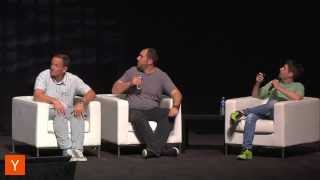
Fireside Chat With Sequoia Capita's Jim Goetz

Sequoia's Jim Goetz and Palo Alto Networks founder Nir Zuk argue enterprise startups are vastly undervalued. In the past decade, 56 enterprise IPOs topped $1B versus 23 consumer ones. SaaS recurring revenue models, now standard after Marc Benioff, let new companies compete against entrenched incumbents.
Chapters
Well, I'm glad Vinod has slowed down. It gives us a lot of comfort at Sequoia. Pulled back.
So the title of this panel, I don't know if it was listed on the guide that they have, but it's called Revenge of the Enterprise and you serve on the boards of a couple of enterprise companies, Jive Palo Alto Networks, Nimble Storage, which just raised a bunch of money and sort of eyeing an.
Eye for Suresh is here.
What do you think about that title of that panel? Do you believe there's a.
Should I bore you guys with that.
Or are you saying enterprise is boring?
It's interesting. At Sequoia, in a typical week there are probably 100 entrepreneurs that present. If we're lucky, maybe there's a dozen. Focusing on the enterprise space. There's a enormous opportunity. You talked about those IPOs, but in the last 10 years there have been 56 IPOs in the enterprise space that have gotten north of a billion and just 23 in consumer it's a secret. In many ways it's shocking how few entrepreneurs are focused on the enterprise space. We today in the partnership talk about $500 billion to spend annually going to these legacy companies and we believe most will be disrupted in the next Dec decade. The notion of reinventing the IT stack is a here and now opportunity for just about everybody in the audience. There are a number of advantages that the enterprise companies have. The first is that business model, thanks to Marc Benioff, is now a weapon for all of you. It's something that you can use to disrupt that legacy incumbent that is probably selling with either an enterprise structure or hardware structure. It's very difficult for them to compete. It also removes the lumpiness, if you will, of being a public company and in the enterprise space.
Do you credit Marc Benioff for sort of.
I think Mark Benoit for being the iconic figure around SaaS and recurring revenue, although I think others have done it better in the mobile ecosystem. And we see literally kind of a best practices being displayed in the better enterprise companies. We also see a technology shift. You've got flash, you've got virtualization, you've got cloud delivery, you've got completely different multi core architectures. And most of the technology incumbents are looking at a decade or longer in terms of their own architecture. So there's an enormous opportunity. And then there's a myth about enterprise being bloatware and not focusing on active usage and thinking about things like cohorts. Our best enterprise companies spend enormous amounts of time thinking about the nuance of design. It's not just eye candy but usage and spending what I would consider energy taking the best practices from consumer into product design, but also customer acquisition. And so I think all those changes, if you add them up and combine them with a very different dynamic where our enterprise startups, they have one competitor, typically maybe two. The incumbents, they're large, they're slow, they're flat footed, it's rare for them to have more than a couple of upstart competitors. And so it's almost blue ocean and and if you compare that to consumer, the categories that are interesting often have a couple dozen companies that are well funded. It borders Malthusian. So it's shocking in some ways that we don't see more engineers and entrepreneurs interested in enterprise.
I'm curious. So you know you've two of the companies I mentioned earlier, Jive and Palo Alto Networks, Both went through IPOs recently in the past year, relatively successful public offerings. When you compare them to some of the consumer, I won't name any names but consumer offerings that have gone public. Is this public market one for the enterprise, do you think now or you know.
Well, I think the benefit, I mean it's been Info Blox, Jive ServiceNow, Palo Alto, all gone public in the last six months and there'll be another half dozen in our portfolio and I'm convinced within the portfolios of Greylock and Benchmark.
And other firms, there will be another half dozen enterprise companies in your portfolio that will go public in the next one.
It's the recurring business model and if you think about consumer, it's oftentimes difficult to get them to part with a dollar. If you're chasing the developer ecosystem in open source, getting them to pry out their credit card and spend 100 is challenging. But in the enterprise space you have this enormous spend going to the incumbents which you're attempting to disrupt. So you know, getting $100,000 on a renewal basis is not a outrageous challenge. And so their business models are established. Most of them have embraced a recurring business model and so they're predictable and their multiples have expanded over the course of time. And so I think we're going to see a very healthy enterprise IPO market for at least the next couple years.
So tell me a little bit about Palo Alto Networks. You know, do you, you know, you've worked with that company for some time now. What, what makes Palo Alto successful?
Well, I should mention Nir Zook is actually in the audience, the founder of Palo Alto near.
Well, we should just bring him up. Let's have him answer this question.
Nir, do you want to come up and join us? Enterprise entrepreneur. Come on here. Don't be shy. Cold call near when I met.
Do you have a mic for him?
Okay.
Pulled up into the Sequoia parking lot with a German car with a license plate that had the NASDAQ symbol of a large incumbent. And KLR afterwards. I would characterize Nir as a disruptor at birth and one of these entrepreneurs that have enormous ambition and intelligence. But he's also got domain expertise. He started his career Checkpoint where he was part of the team that invented Stateful Inspection. Later led Netscreen's technology efforts and both Ashim Chan and I at Greylock had the good fortune of backing near six years ago. So what's it like to be an enterprise?
Is your mic on? Let's see. Not working, just screaming.
Okay, okay, I think it's on.
I said, why don't you talk to these folks about what it's like to be an enterprise entrepreneur?
I'm curious. I mean, Palo Alto Networks, you're working in network security. You know, definitely a big issue in the enterprise. You know, companies need to make their firewalls more secure. What has been your key to success? How have you been able to kind of rise beyond what the incumbents do, the big companies, and build a successful company in the past few years?
I think it's boils down to disruption. When you go up against incumbents, what you have that they don't is the ability to disrupt. And it's actually deeper than just them being a big company and you being a small, so you can move faster. Incumbents by definition cannot disrupt because if they're going to disrupt, they're going to disrupt themselves. Which is why incumbents don't disrupt markets. And the only way to disrupt a market is for a small company. And I think this is really what's been fueling Silicon Valley's enterprise companies branch over the years. It's the fact that only small companies can go and disrupt a market. So as an entrepreneur, what I decided to do almost just over seven years ago and what I think anyone that's thinking about starting an enterprise company should do is to find a big market that is ready for disruption. And I think, as Jim said, are.
There markets left that are ready for disruption?
Because, you know, there are many markets.
David Sachs has a, maybe a different opinion on that. But you know, I'm curious, are there markets left in the enterprise that are, that are left for disruption?
Yes, Yeah, I mean saying that there are no markets left for disruption reminds me of what the, the head of the U.S. patent Office said. I think it was late 19th century. I think he said that there's nothing left to invent so they should shut down the US Patent Office, which by the way would have been a great thing. But there have been many patents filed since then and some of them are even worth something. So I disagree. I mean, Jim has invested in several companies, what in storage? Right.
There's enormous opportunity around bring your own device byod and that's just a large category that has maybe a dozen upstart opportunities that we've identified recently. There's the next generation data center with the shift in both compute and storage where you see lots of energy. Nicera, which was just recently acquired, where Steve Mulaney, who worked with near for a number of years was leading the company as CEO. There's cloud delivery in general and as I think about the incumbents, whether it's BMC Software or Oracle, all of them are at risk in some ways of being disrupted. And so look at the large enterprise companies and there's probably an opportunity for somebody here in the audience to disrupt that technology position.
Nir, are you afraid of being disrupted? I mean, you're now a public company. You know, do you feel like you're an incumbent? You know, like are you afraid of being disrupted?
Yeah, of course. And that's why when I built the company, I built it in such a way that I won't make the mistakes of previous companies I used to work for, which is being able to continue to innovate and embrace disruptions. And that's something very important from early on to create the right culture and also the right product that allows for new innovation to be built on top of the existing ones and to go to the market with that.
Is there another enterprise company that you can look that you look to as an example of a big company or a public company that, that continues to innovate, maybe more at the startup level. Jim, I mean, feel free to.
I think salesforce.com is innovating all the time and it's going to be hard to disrupt them right now. Unless. I mean, there are many companies that are trying, but if you read at least the signs on one, on one their value proposition is were cheaper. And that's never a good value proposition when you sell to enterprise. I'm sure there are many others like that.
Yeah, there are a lot of admirable public companies in enterprise. Even Oracle for a moment I think would be easy to point at as a technology laggard. But what they've done with go to market and business innovation has been shocking and they're still in an enviable position in the software arena. But my guess is that folks like Oracle and F5 and others will continue to innovate, but the risk of losing share to upstarts will increase meaningfully over the next decade.
Nir, you didn't never graduated from college?
No.
Yeah. So I'm curious, you know, there's definitely a whole slew of very well known entrepreneurs that didn't go to college.
Yeah. Bill Gates.
Yeah.
A number haven't graduated.
Do you have any regrets about that or. I mean, what do you, how do you feel about hiring someone who went to college versus not went to college?
I have no regrets. I mean I do have a regret about spending two years in college and not zero, but no, I have no problem hiring someone that hasn't gone to college. It's all about what they know and how they know it. I grew up in Israel and in Israel everybody has to go to the military and I've learned much more in the military, which was my first job versus what I would have learned in the in college.
And you taught yourself programming?
That's what I read, yeah.
How did you teach yourself programming?
Just when I was fifth grade.
What year was that?
What year? When I was fifth grade, don't remember, like early 80s.
Okay.
I was born 71, so yeah, 81. 81 or so.
So were you inspired by anyone?
Yeah, a friend of mine just got a really expensive computer back then, a Spectrum ZX ad, and I just taught myself how to program it and that started from there and then.
So what inspired you to start Palo Alto Networks? You had joined Juniper, Right. You know you've had a sale to another big incumbent. What inspired you to sort of say let me start another enterprise?
I like to build products. I just like to build product, as Jim said. I started my career at Checkpoint, which was one of the first network security companies. And I was there as long as I could build products. And then I couldn't build products anymore because it became too big of a company and they didn't take care of the culture so that the culture there did not allow building new products. So I started another company and that was sold to a company called Netscreen, which was then sold to Juniper, where again I felt I couldn't build products anymore. So I started Palo Alto. So that's on the personal side, but on the bigger side. What made me start a company is what we talked about before. It's the fact that I saw a big market. I've been building products in that market for a long time. But that market was ready for disruption. And what made that market ready for disruption is the focus of network security, on just protecting email and web traffic. And I saw all the other applications, both pure enterprise applications like Microsoft, SharePoint or WebEx, as well as consumer applications that are used by enterprises like Dropbox and others today. I mean, back then it was a different set of applications. I just saw that enterprises are dying to use these applications. And that was my entry, the disruption entry. The disruption was, okay, the big guys are selling something to protect web and email. Enterprises are saying that they're sick of the security department, telling them to block all the other applications, let's find a way to secure these other applications. And that I started. But in any market that anyone here is thinking about going after, there is always a place to disrupt. You just need to find it, make sure that customers are going to buy it, and that that disruption can actually create a new market out of an existing one.
Did you get any acquisition offers?
Yeah, we got several acquisitions offers throughout the way.
And who are your acquisition offers from?
I cannot say who they were from, but they were from big companies. They were substantial, they were appealing. But we're playing in a $10 billion market. We believed and continue to believe that we are a disruptor. Our goal is to be the leading independent network security vendor, and we're continuing that. And I think part of it was the backing that we had. I was in the same situation ten years ago in a previous company where we got acquisitions offers. I didn't want to sell the company, but I had the wrong VCs and we had to sell the company. Luckily this time we had Sequoia, Jim from Sequoia and we had Greylock. Ashim Chana from Greylock as our early investors. And they, like us, believed in building and believe in building big companies. Not just us, but generally building big companies. And as an entrepreneur, I would not work with anyone that is not here.
To be clear, though, it was near and his passion to build something meaningful and enduring that made the final decision. I think both Ashim and I wanted to continue. The offers were substantial. And one of the big challenges for the venture industry in general is that the best companies are going to get a dozen or more offers in their history. And it's entrepreneurs like near that say, no, they want to keep going. That I think create these Enduring companies that become, as time compounds their advantage, meaningful part of a legendary tech landscape that's been developed here in Silicon Valley. And I think it took near actually going through that bittersweet experience at Juniper, along with his co founder Rajiv Batra, to have the passion and energy to say no.
What was bittersweet about that experience? Did you feel like you weren't innovating once you went there or.
Yeah, I think big companies tend to focus. Again, it depends on the culture. And it's really up to the founders to define the culture of the company and to make sure throughout the journey that the culture remains the same. And I feel that companies I worked for in the past and companies that Rajiv worked for in the past did not try to preserve the culture of being able to innovate and build new things. And they started counting more on their sales and marketing and their incumbency, which is fine. I mean, you can build a great company like that. I mean, Cisco is a company that's been exploiting their incumbency for many, many years and have been doing pretty well. It's just that as an engineer, I just don't find that intriguing.
Now, when you chose to take the company public, what was that decision? I mean, how did you know? How did you know that you should go right then? Did you have any doubts? You saw Facebook go out, you saw a couple of the rockier offerings. Jim, I'd love to get your perspective on that too, because you have experience.
From my perspective as an entrepreneur, going public is just a milestone. It's like another funding event. And I mean, it does provide some liquidity. As an entrepreneur and as someone that believes in the company, it's not that important. I think the more important part is the fact that the company now has equity to go and buy other technologies so that we will not get disrupted easily. And it also, as an enterprise company, it's makes it a little bit easier to sell to really, really large customers when you're public, just because some customers prefer to buy from stable companies. The way I look at it is that again, it's just a funding event. And if you look at history with all great companies, most value was created after the company went public. I mean, you guys invented in Cisco, they went public at what? At 130 million dollar market cap, 200 million dollar market cap. Today they're trading at 100 billion. And, and just look at history. Most companies are like that. Most value gets created for enterprise companies, not for consumer companies, which most value gets distracted after they Go public. For enterprise companies, most value gets created after they go public, I guess.
Lena, my comment would be that near innovated in the technology area, but he also embraced the business model that we talked about earlier. Palo Alto has a recurring business model and so revenue lags, bookings and we could have gone public probably 18 months earlier, earlier than we did, but wanted the COVID of darkness to make a bunch of investments that would be more difficult to make as a public company. And I think when you're in a position where you've got a lot of confidence about your long term vision, you can delay the ipo. I think a lot of high quality companies take that path. And I think near. I remember debating this with him early on, had the courage to kind of push the sales team to innovate on that model of acquiring customers where we forced them into a recurring model that only at that point in time started to show up in the SaaS ecosystem. But it was still very early. It's made a huge difference in the company's valuation and our ability to predict the next handful of quarters.
Yeah, I also think that another factor decided when we go public was when we were ready, not financially, as Jim said, we were probably ready financially before that. And I mean our numbers are public. You can look at that also from a team perspective. We, and personally I. And by the way, Jim is the same. I think we, we believe that you need to have the right people at the right time in the company. And it's extremely rare that the same people that are right for you when you start a company are the same people that are right for you when you get to where we are right now, which is around $300 million in run rate. And when you get to a billion and 2 billion and so on and so forth. And we wanted to go public with the right team that will bring the company to a billion and above. And it took time to, to do that. So startup phase to a company phase and then go public.
So now that you are, I have a question for you. Is this the first time you've had an enterprise entrepreneur on stage?
No, no, we just had the panel yesterday with enterprise.
Oh, it was a panel, but not. No, we do a great job covering enterprise.
Personally, I think I heard Michael Jones yesterday.
He did? Yeah.
Like a muffler.
Hoffman said that the next wave of IPOs will be consumer enterprise. You know, enterprise companies that have a consumerization angle.
Look at recent IPOs. Okay, you mentioned, I don't know, you often mentioned Splunk. They're Not a Sequoia company. But Splunk went public, so big data company, they went public. They're valued by Wall street above where Zynga and Groupon are now. Yes, ServiceNow. Sequoia Company went public not too long ago. They are valued above Zynga and Groupon. Palo Alto Networks went public just over a month ago. We are valued more than Zynga and Groupon combined. So in terms of enterprise value, there.
Is certainly your handlers are going to be getting nervous. You're sure?
Maybe enterprise sounds dull and boring, but I'll tell you, it takes, I mean, we talked about it before. It takes two years to build an enterprise product. You can build a consumer product in two months. I mean, how can you be proud of that as an engineer? That's what that, what you do is you build in two months.
Easy.
I mean, how difficult can it be? And also how easy it is to go and copy what you did. I mean, it's, it's a marketing challenge, you know, to take what you built and get it first to market.
I'm just going to let you go.
I think from an engineering perspective, I'm much more intrigued as an engineer at sitting down and building a really complex product that takes two years and a huge team to build. And I think that when you do that, as I said a few minutes ago, you create real value.
Jim, you're an investor both in consumer and enterprise companies. So what do you think of what he just said there?
Well, I do think there's an interesting contrast in folks that are drawn to consumer and enterprise opportunities and we're thrilled to be involved with both communities. The folks in the enterprise space usually are involved with a company that's currently selling into the enterprise and they have deep domain expertise. So in this case, Nir had a background at Netscreen, but Varun and Umesh at Nimble had a background at data domain and network appliance. And so having history and context in a prior disruptor, if you will, is important. But you know, Nir had children and he had a minivan. And many of the consumer entrepreneurs we back are younger and looking to get to market in six months and are interested in the spotlight.
So you're saying the enterprise.
I never had the minivan, by the way. It was a Toyota Sequoia.
The enterprise entrepreneurs looks a little different than the consumer entrepreneur. Is that fair to say?
You need experience, you need maturity, you need a team that followed you from previous companies to be able to do this.
To be clear, near started his first company in his 20s, his second company in his early 30s. So yes, you had experience near. But I think it's, you know, a broad range of talent. You do typically find people in the enterprise space that have a passion and a desire to build a committed crew of engineers who see a 10 year vision to disrupt one of the large incumbents. And you usually do see people channeling their energy towards one of the large enterprise players. And I won't mention who NIR was focused on, but trust me, he had somebody on his license plates.
Well, you can't mention names.
Absolutely not. Near.
Now that you're a public company, what keeps you up at night? What is it that keeps you up at night?
Being disrupted. You know, I have, I have a great CEO. Mark McLaughlin was running. Mark McLaughlin was running VeriSign before that and a great management team. We just hired a great sales leader from F5 and others to worry about the business. And I let them stay awake at night because of that. I stay at night just worrying about being disrupted and making sure that I don't.
So you said, you mentioned earlier that you would be interested in maybe acquiring some of these startups that you know, maybe are trying to disrupt you, I mean or.
Yes.
Yeah.
Yeah. So we have a roadmap and we know what we want to build over the next few years. And if we find someone that has already built it and are small enough, preferably local, with a great engineering team, there is no reason not to pick them up and accelerate the roadmap. And also if we find something that we believe is disruptive, that we cannot replicate ourselves or it makes sense to buy them just again because of time to market, we'll acquire them. So certainly. Yes, and that's something that being public helps a lot with.
How many acquisitions do you think you'll do in the next year?
As many as we need to.
Cricket.
Cricket.
What'd you say?
I said cricket. Something my daughters attempt to do when they don't want to respond to one of my questions.
As many as we need to. And hopefully we'll find the right acquisitions to accelerate our roadmap. I mean the faster we can accelerate it, the further away we'll be from our competitors. I mean we are playing a game where we are disrupting. We are the technology leader and they are trying to keep their customer base happy with marketing. What I call putting lipstick on the pig. And the faster we run, the easier it is going to be for us to replace them.
Well, we really appreciate you coming here. We're going to end and thanks so much, Jim as well.
Thank you, Lena.
Thank you. Okay, thanks a lot.
More from Jim

Sequoia Partner Jim Goetz on the importance of solving a specific pain point for a specific customer