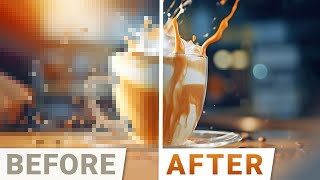
Károly Zsolnai-Fehér reviews Gigagan, an AI that generates images from text in fractions of a second and upscales them up to 1000x larger. It lets you edit images in real-time by tweaking the latent space and control style separately from content.
Questions this video answers
Gigagan.
Károly Zsolnai-Fehér.
August 30, 2023.
Generation in a fraction of a second; can create several images per second.
Up to a thousand times more pixels in the new image.
Chapters
Today we are going to look at an amazing new AI system that can perform four tricks. The first is cool. The second is great. The third one is simply incredible to the point that I couldn't believe the results and had to look over and over again. And the fourth is a thing of beauty. So what are the tricks? First, this work is called Gigagan and it can perform text to image or. We fellow scholars have seen this before. Many, many times. You enter a text prompt and it paints you an image. What is great about it is that it can give us reasonably high quality images. That is okay. But here is the kicker. It can perform this in a fraction of a second. That is extremely quick. For instance, a previous Stylegan based method that could be roughly as fast. We needed to make significant concessions in terms of quality. Not anymore. Loving it. Two, it is not only fast, but it is so fast that it can create several images per second and thus it offers a controllable latent space. This is a hallmark for GAN based methods and leads to incredible artistic controllability as you see here. But what does all this mean? A GAN based method means a generative adversarial network where two neural networks begin battle each other. One tries to generate new images to fool the other one, while the other one trains to be able to spot these synthetic images. Over time, they battle each other and they improve together. Now, third, and this is where things get out of hand. Super resolution, or in other words, image upscaling. Here a coarse image goes in and the AI guesses what this image could be and synthesizes a new really detailed image. Now hold on to your papers and look at that. The difference can be really huge. Up to a thousand times more pixels in the new image. So how does it compare to previous methods? For instance, the amazing stable diffusion. Oh my, look at that. It is so much better across the board. Pretty much everywhere but the eyes. The eyes are truly something else with the new technique. What a time to be alive. And finally, fourth, it also offers a disentangled latent space for controllability. Now I hear you asking doctor, what does that mean? This means that we can control the style in place with the text prompts. So whenever we get a teddy bear that we really like, but we would like to see it crocheted a bit fluffier or made of denim, we can do that, but without generating a new teddy bear. All the changes are applied to the same subject. That is incredible. I also loved the ball example here. This almost looks like an image straight out of a material Modeling paper in computer graphics. So cool. And what I absolutely love about this paper is that normally for these four problems we would need four separate tools. Not anymore. Today we are getting all of these amazing capabilities with just one tool that can do all of them. And not only that, but it is so much faster than previous methods. While it is still competitive in terms of visual quality, it is not the best and fastest at the same time. Not even close. But this trade off is, I think, an amazing value proposition. If you enjoyed this paper, make sure to subscribe and hit the bell icon to not miss out. We have some more amazing papers coming up soon. This video has been supported by Weights and Biases. Look at this. They have a great community forum that aims to make you the best machine learning engineer you can be. You see, I always get messages from you fellow scholars telling me that you have been inspired by the series but don't really know where to start. And here it is. In this forum you can share your projects, ask for advice, look for collaborators and more. Make sure to visit WNB Me paperforum and say hi or just click the link in the video description. Our thanks to Weights and Biases for their long standing support and for helping us make better videos for you. Thanks for watching and for your generous support and I'll see you next time.