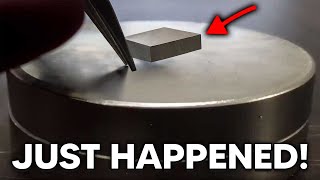
This YouTube transcript reports new corroborating evidence for the LK99 material's diamagnetic and levitation behavior. Hwajong University of Science and Technology (HUST) posted arXiv results and a supplementary video showing pronounced room-temperature levitation (Figures 3–4) and tests ruling out ferromagnetism. Lawrence Berkeley National Lab (LBNL) ran simulations supporting a mechanism where copper substitution alters electronic bands near the Fermi surface, potentially enabling superconducting pathways, though such configurations may be rare in samples. The Korean Society of Superconductivity and Cryogenics has formed a verification committee and multiple top South Korean universities have begun independent replication and measurement efforts. The transcript emphasizes that while results are promising, independent tests (electrical measurements, broader replication) are still needed.
Chapters
Earlier today, an unexpected revelation was made in the world of superconductors. Noted scientist and author Hyund Tak Kim, one of the key contributors to the groundbreaking LK99 superconductor paper, released new evidence supporting the extraordinary capabilities of this material. This pivotal development has been brought to light thanks to a video clip Kim shared exclusively with the New York Times. The video showcases an LK99 sample which appears to be defying gravity by levitating. It's a remarkable feat that underscores the tremendous potential held by the Lk99 superconductor. This phenomenon, often associated with superconductors, is known as quantum levitation or quantum locking, and it occurs when a material becomes superconducting in the presence of a magnetic field. In addition, the Hwajong University of Science and Technology Chust, a renowned Chinese research university, has just published their findings on the LK99's diamagnetic properties on arXiv, the open access repository for scholarly articles. This makes HUST the first independent lab to provide tangible corroborative evidence of strong diamagnetism in LK 99, lending further credibility to this fascinating material's unusual properties. Diamagnetism is a fundamental property of superconductors, which is a material's ability to create an opposing magnetic field in response to an external magnetic field. In simple terms, it's what allows superconductors to levitate above a magnetic source, a phenomenon often associated with the Meissner effect. The HUST's results show that the LK99 exhibits strong diamagnetism, suggesting that this material could indeed possess superconducting capabilities. A key highlight of their research paper is Figure 3, which showcases a compelling demonstration of the LK99 sample levitating at room temperature and atmospheric pressure. The levitation is not just marginal, but strikingly significant. When a ferromagnet is brought near the sample, it rises and aligns perpendicularly to the base, a more pronounced levitation angle than was observed in Suk BAE Lee's previous sample. For those wanting a more tangible proof, HUST has included a supplementary video capturing this levitation phenomenon. What's more, the team at HUST conducted an additional attraction test on the LK99 sample illustrated in Figure 4. To rule out the possibility of ferromagnetism, a property where a material is attracted to a magnetic field. The sample showed no response when a ferromagnet was introduced, thereby confirming that the levitation observed was not due to ferromagnetic properties, but rather A result of diamagnetism, a fundamental trait of superconductors. In their conclusion, the researchers reaffirmed the successful growth of the LK99 materials, which consistently exhibited diamagnetism transition and pronounced levitation angles at room temperature and atmospheric pressure. Their findings underscore the importance of factors like crystallinity and precise copper doping, pointing to the potential superconducting mechanism driven by copper oxygen induced band changes in such phosphate oxides. The HUST team is optimistic about the future, anticipating that more comprehensive tests, such as electrical tests conducted at room temperature, will further unveil the exceptional potential of phosphate oxides like LK99. These results from HUST are a monumental stride forward, marking the first independent corroboration of the diamagnetic properties of the LK99 superconductor. It's a scientific development that not only confirms previous findings, but also instills fresh excitement and anticipation for what future studies may reveal. As we all keep a close eye on this unfolding story, it's clear that we're at the cusp of a possible revolution in the superconductivity domain. New results from Lawrence Berkeley National Lab are now supporting the belief that LK 99 could be a room temperature superconductor. This is the science equivalent of finding a unicorn. If LK99 turns out to be a room temperature superconductor, this could change everything from power grids to transportation. So how did the scientists at LBNL make this discovery? They used some very powerful computers to simulate what was happening inside the LK99 material. They looked at a theory proposed by Korean scientists about how copper atoms were swapping places with lead atoms in a crystal structure, causing the crystal to squeeze together a bit. This swap, they thought, could be the magic trick that makes LK99 a superconductor. Think of the crystal structure like a big Lego house. The scientists simulated what would happen if some of the LEGO bricks, the copper atoms, started moving into different spots, replacing other bricks, the lead atoms. They then examined how these changes would affect the house's structure and whether the house would still stand. One crucial thing they looked at was the electronic structure of the material. This is basically a roadmap that shows how electricity or or electrons can move through the crystal. They found that with the copper atoms in specific spots, there are some perfect routes for the electrons to take. These are the superconductor highways that allow for perfect electrical flow. These highways, or electron pathways, are near what scientists call the Fermi surface. Imagine this like the sea level for electricity. It's a level where conditions are just right. It's currently believed that the more of these highways near the Fermi surface, the better the material can superconduct at higher temperatures. However, there's a catch. The superconductor highways only form when the copper atoms move into less likely locations in the crystal structure. This would make the material hard to make, since only a small fraction of the crystal gets its copper in the perfect spots. These findings are a huge deal for humanity. The possibility of a room temperature superconductor could revolutionize many areas of our lives. But there's still a long way to go. Like any good science, these results need to be tested and verified by other scientists. But for now, it's an exciting development in the world of superconductors. Another major development has taken place in the superconductivity field, particularly with respect to the verification of the LK99 superconductor. The Korean Society of Superconductivity and Cryogenics has convened a dedicated verification committee to scrutinize the properties and capabilities of the LK99 specimen. The committee's primary role will be to conduct rigorous measurements to authenticate the claim of LK 99 being a room temperature superconductor. This can significantly impact our understanding of superconductivity. And considering that achieving room temperature superconductivity has long been a holy grail for physicists, this verification process is conditional upon the Q Center Research center, where the two founders of the LK99 are affiliated, providing specimens of the material for independent testing. A stellar lineup of researchers from top South Korean universities are slated to be part of this verification committee. These include Seoul National University, Sungkyungkwon University, and Pohang University of Science and Technology. These institutions are known for their advanced research facilities and their commitment to scientific progress, making them a suitable choice for this important task. In a parallel development replication attempts of the LK99 superconductor are underway at multiple universities. This includes the center for Superconductivity of Quantum Materials at Sungkyunkwan University, the Superconducting Materials and Applications Laboratory at Korea University, and the center for Novel States of Complex Materials Research at Seoul National University. It is critical to highlight that these universities are some of the top academic and research institutions in South Korea, reflecting the importance and scientific significance attached to the the LK99 superconductor. If successful, these replication attempts could further validate the original findings and accelerate potential applications of the LK99 superconductor. In the coming weeks and months, all eyes will be on these universities and the KSSC's verification committee. Their findings will not only confirm or refute the groundbreaking claims made about the LK99 superconductor, but but also chart the course of future research and technological applications in this field.