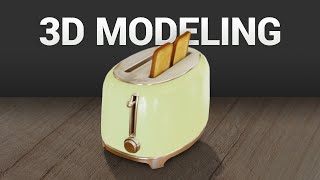
Dr. Zsolnai demonstrates a new method for interactive 3D modeling that lets novices edit complex objects like toasters and trains with simple brush strokes. The technique infers part relationships and adjusts to brush size, making detailed edits possible without professional training.
Chapters
Dear fellow scholars, this is Two Minute Papers with Dr. Zsolnai. Today we are going to build the best virtual toaster that you have ever seen. And it's going to be so easy that it hardly seems possible. All this technique asks for is our input geometry to be a collection of parametric shapes. I'll tell you in a moment what that is, but for now let's lets see that toaster. Hmm, this looks fine. But what if we feel that it is not quite tall enough? Well, with this technique, look, it can change the height of it, which is fantastic. But something else also happens. Look, it also understands the body's relation to the other objects that are connected to it. We can also change the location of the handle. The slits can be adjusted symmetrically. And when we move the toast, it understands that it moves together with the handles. This is super useful. For instance, have a look at this train example where if we change the wheels, it also understands that not only the wheels but but the wheel wells also have to change as well. This concept also works really well on this curtain. And all this means that we can not only dream up and execute these changes ourselves without having to ask a trained artist, but we can also do it super quickly and efficiently. Loving it. Just to demonstrate how profound and non trivial this understanding of interrelations is, here is an example of a complex object without this technique. If we grab one thing exactly that one thing moves, which is represented by one of these sliders changing here. However, if we would grab this contraption in the real world, not only one thing would move, nearly every part would move at the same time. So does this new method know that? Oh wow, it does. Look at that. And at the same time, not one, but many sliders are dancing around beautifully. Now I mentioned that the requirement was that the input object has to be a parametric shape. This is something that can be generated from intuitive parameters. For instance, we can generate a circle. If we say what the radius of the circle should be, the radius would be the parameter here. And the resulting circle is hence a parametric shape. In many domains this is standard procedure. For instance, many computer aided design systems work with parametric objects. But we are not done yet. Not even close. It also understands how the brush sizes that we use relates to our thinking. Don't believe it. Let's have a look together. Right after we click, it detects that we have a small brush size and therefore infers that we probably wish to do something with the handle. And there we go. That is really cool. And now let's Increase the brush size and click nearby and bam. There we go. Now it knows that we wish to interact with the drawer, same with the doors and hold on to your papers because to demonstrate the utility of their technique, the authors also made a scene just for us look nice. This is no less than a 2 minute papers branded chronometer and here we can change the proportions, the dial, the hands, whatever we wish. And it is so easy and showcases the utility of the method so well, now I know what you're thinking, let's see it ticking and will it be two minutes? Well, close enough. Certainly much closer to two minutes than the length of these videos. That is for sure. Thank you so much for the authors for taking their time off their busy day just to make this so. This is a truly wonderful tool because even a novice artist without 3D modeling expertise can apply meaningful changes to complex pieces of geometry. No trained artist is required. What a time to be alive. Now this didn't quite fit anywhere in this video, but I really wanted to show you this heartwarming message from Mark Chan, research scientist at OpenAI. This really showcases one of the best parts of my job and that is when the authors of the paper come in and enjoy the results with you fellow scholars. Loving it. Thank you so much again. Also, make sure to check out Yannick's channel for cool in depth videos on machine learning works. The link is available in the video description. This video has been supported by Weights and Biases. Check out their recent offering Fully Connected, a place where they bring machine learning practitioners together to share and discuss their ideas, learn from industry leaders and even collaborate on projects together. You see, I get messages from you fellow scholars telling me that you have been inspired by the series but don't really know where to start. And here it is. Fully Connected is a great way to learn about the fundamentals, how to reproduce experiments, get your papers accepted to a conference and more. Make sure to visit them through WNB Me papers or just click the link in the video description. Our thanks to Weights and Biases for their long standing support and for helping us make better videos for you. Thanks for watching and for your generous support and I'll see you next time.