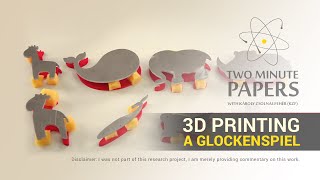
Researchers at Harvard, Columbia, and MIT created an algorithm that redesigns glockenspiel bars so 3D-printed pieces produce exact target sounds. The system optimizes bar shape and support structure to match desired frequencies and overtones, letting you print custom instruments with professional-quality sound.
Chapters
Dear fellow scholars, this is Two Minute Papers with A Glockenspiel is a percussion instrument that consists of small pieces of metal that are tuned to emit a given musical note when they are struck. In order to achieve these sounds, this instrument is usually manufactured as a set of metal bars. Researchers at Harvard, Columbia University and MIT became interested in designing a computer algorithm to obtain different shapes that lead to the same sounds. And if it's possible, then one should be able to mill or 3D print these shapes and see whether the computation results are in line with reality. The algorithm takes an input material, a target shape and a location where we'd like to strike it, and a frequency spectrum that describes the characteristics of the sound we are looking for. Furthermore, the algorithm also has to optimize how exactly the stand of the piece looks like to make sure that no valuable frequencies are dampened. Here's an example to show how impactful the design of this stand is and how beautifully sustained the sound is. If it is well optimized, You'll see a set of input shapes specified by the user that are tuned to standard musical notes and below them the optimized shapes that are as similar as possible, but with the constraint of emitting the correct sound. The question is how should the technique change your target shape to match the sound that you specified? One can also specify what overtones the sound should have. An overtone means that besides the fundamental tone that we play, for instance on a guitar, higher frequency sounds are also emitted, producing a richer and more harmonious sound. In this example, the metal piece will emit higher octaves of the same note. If you have a keen ear for music, you will hear and appreciate the difference in the sounds. In summary, with this technique one can inexpensively create awesome custom made glockenspiels that have a comparable sound quality to to professionally manufactured instruments. Staggering results. It seems that we are starting to appear in the news. It is really cool to see that there is a hunger for knowing more about science and research. If you liked this episode, please help us reaching more and more people and share the series with your friends, especially with people who have nothing to do with science. Thanks so much for watching and I'll see you next time.