Researchers developed a method to automatically design acoustic filters by optimizing tiny connected resonators that transform sound. The technique can create custom mufflers, design musical instruments with unusual shapes, and embed acoustic tags in 3D-printed objects that smartphones can detect.
Chapters
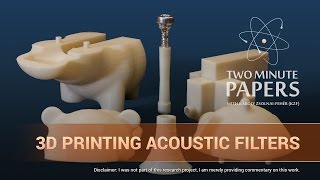
Dear fellow scholars, this is two minute papers with what is an acoustic filter? Well, it is an arbitrarily shaped object that takes a sound as an input and outputs a different sound. These filters have some really amazing applications that you'll hear about in a minute. In this work, a novel technique is proposed to automatically design such filters. It works by building an arbitrarily shaped object as a set of connected tiny resonators and and chooses appropriate sizes and setups for each of these elements to satisfy a prescribed set of acoustic properties. Instead of resorting to a lengthy and flimsy trial and error phase, we can use physics to simulate what would happen if we were to use a given arrangement in reality. Again, one of those works that have a deep connection to the real world around us. Absolutely amazing. The goal can be to eliminate the peaks of the sound of a car horn or an airplane engine. And. And we can achieve this objective by means of optimization. The proposed applications we can divide into three main categories. The first is identifying and filtering noise attenuation components for a prescribed application, to which we can also refer to as muffler design. In simpler words, we are interested in filtering or muffling the peaks of a known signal. Designing such objects is typically up to trial and error. And in this case it is even harder because we are interested in a wider variety of shape choices other than exhaust pipes and tubes that are typically used in the industry.
With this unoptimized muffler, the three peaks are not suppressed. Now we replace the muffler with an optimized one. The three peaks are more suppressed. Another application for muffler design is acoustic earmuffs. We made adapters that allow for switching between acoustic filters. The first pair of earmuffs is optimized to reduce engine crank noise. We can see the three peaks are now suppressed to a lower sound level.
Second, designing musical instruments is hard, and unless we design them around achieving a given acoustic response, we'll likely end up with inharmonious gibberish. And this method also supports designing musical instruments with, hmm, well, non conventional shapes. Well, this is as non conventional as it gets, I'm afraid. And also, that is about the most harmonious sound I've heard coming out of the rear end of a hippo. And third, this work opens up the possibility of making hollow objects that are easy to identify by means of acoustic tagging. Check out this awesome example that involves smacking these 3D printed piggies.
Our acoustic filter design also opens up possibilities for few new applications. In this acoustic tagging example, we optimize the tapping sound of three piggies to three sets of frequencies in taps. Each piggy filters sounds differently so that our iPhone app can detect and identify each of them. To go one step further, we demonstrate the ability to encode a bit string pattern, making use of the fact that the iPhone has both the speaker and microphone on the bottom, we modulate the input white noise to encode different bit patterns. Foreign.
If you feel like improving your kung fu in math, there are tons of goodies such as transmission matrices, the Helmholtz equation. Oh my. The paper and the talk slides are amazingly well written. And yes, you should definitely have a look at them. Let us know in the comment section if you have some ideas for possible applications beyond these ones. We'll love to read your take on these works. Thanks for watching and for your generous support. See you next time.