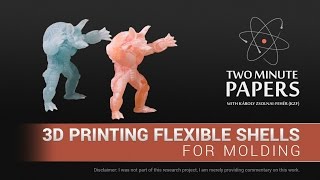
A short Two Minute Papers video summarizing research on 3D printing flexible shells for molding detailed objects. The work frames mold removal as an optimization problem (minimize number and length of cuts while limiting deformation), uses simulated extraction force/deformation to predict and avoid damage, and discusses practical considerations such as air bubbles and a custom optimization method.
Chapters
Dear fellow scholars, this is two minute papers. With this work is about 3D printing flexible molds for objects with detailed geometry. The main observation is that the final object not only has to be cast, but also has to be removed conveniently from the mold. Finding an appropriate layout for the cuts is a non trivial problem. The technique endeavors to have the least amount of cuts and the length of the cuts is also subject to minimization. I see the light bulb lighting up in the heads of our seasoned fellow scholars immediately noticing that this sounds like an optimization problem. And in this problem we start out from a dense cut layout and iteratively remove as many of these cuts as possible until some prescribed threshold is met. However, we have to be vigilant about the fact that these cuts will result in deformations during the removal process. We mentioned before that we are interested in shapes that have geometry that is rich in details. Therefore, this distortion effect is to be minimized aggressively. Also, we cannot remove these cuts indefinitely because sometimes more cuts have to be added to reduce the stress induced by the removal process. This is a cunning plan, however, a plan that only works if we can predict where and how these deformations will happen. Therefore, we have to simulate this process on our computer. During removal, forces are applied to the mold, which we also have to take into consideration. To this end, there is an actual simulation of the entirety of the extraction process to make sure that the material can be removed from the mold in a non destructive manner. Wow. The paper discusses tons of issues that arise from this problem formulation. For instance, what one should do with the tiny air bubbles stuck in the resin. Or the optimization part is also non trivial, to which a highly effective homebrew solution is presented. And there's a lot more. Make sure to have a look. Of course, as always, we would love to hear your ideas about possible applications of this technique. Leave your thoughts in the comment section. Thanks for watching and for your generous support. Now, see you next time.