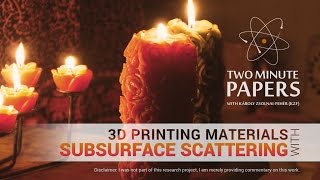
How to 3D print materials that look real by measuring how light scatters under their surface, then optimizing layers of tiny voxels to match those properties. The technique uses a fast Hankel transform method to simulate light behavior and find the right material stacking without testing thousands of combinations.
Chapters
Dear fellow scholars, this is two minute papers with subsurface scattering means that not every ray of light is reflected on the surface of the material, but some of it may get inside somewhere and come out somewhere else. For instance, our skin is a great and fairly unknown example of that. We can witness this beautiful effect if we place a strong light source behind our ears. Note that many other materials, such as plant leaves, many fruits, such as apples and oranges, wax marble, also have subsurface scattering. The more we look at objects like these, the more we recognize how beautiful and ubiquitous subsurface scattering and translucency is in Mother Nature and today. Our main question is whether we can reproduce this kind of effect with 3D printed materials. The input would be a real material, such as these slabs, and and the output would be an arbitrary shaped 3D printed material with similar scattering properties. Something that looks similar. What you see here is already the result of the 3D printing process. And wow, they look very tasty indeed. The process starts with a measurement apparatus where we grab a real material and create a diffusion profile from it that describes how light scatters inside of this material. We have talked quite a bit about diffusion profiles before. I've put some links to earlier episodes in the video description box. If you check it out, you'll see how we can add subsurface scattering to an already existing image by kind of multiplying it with another image. This is one of those amazing inventions of mankind. Now, onto 3D printing. When we would like to 3D print something, we basically have a few different materials to work with and we have to specify a shape. This shape is approximated with a three dimensional grid. Each of these tiny grid elements typically have the thickness of several microns, which basically means a tiny fraction of the diameter of one hair strand. And we like to call these elements voxels. Now, before printing, we have to specify what kind of material we'd like to fill each of these voxels with. This is a general workflow for most 3D printers. We what is specific to this work is that after that we have to take one column of this material and look at the scattering properties of it. Let's call this column one Stacking. We could measure that stacking by hand and see how it relates to the original target material. And we are trying to minimize the difference between the two. However, it would take millions of tries and would likely take a lifetime to print just one high quality reproduction. So basically we have an optimization problem where we are looking for a stacking that will appear similar to the chosen diffusion profiles, the difference between the appearance of the two is to be minimized. However, we have to realize that in physics the laws of light scattering are well understood. And the wonderful thing is that instead of printing a real object, we could just use a light simulation program to tell us how close the result should be. Now, this would work great, but it would still take an eternity because simulating light scattering through a stack of materials would take the very least several seconds, and we have to try up to millions of stackings for each column and there is a lot of columns to compute. Why a lot of different columns? Well, it's because we have a heterogeneous problem, which means that the whole material can contain variations in color and scattering properties. The geometry may also be uneven, so this is a vastly more difficult formulation of the initial problem. A classical light simulation program would be able to solve this well in a matter of years. However, there is a wonderful tool that is able to almost immediately tell us how much light is scattering inside of a stack of a ton of different materials. An almost instant multilayer scattering tool, if you will. It really is a miracle that we can get the results for something so quickly that would otherwise require following the paths of millions of light rays. We call this technique the Henkel Transform. The mathematical description of it is absolutely beautiful, but I personally think the best way of motivating these techniques is through application like this one. Imagine that many mathematicians have to study this transform without ever hearing what it can be used for. These are not some dry and tedious materials that one has to memorize. We can do miracles with these inventions, and I feel that people need to know about that. With the use of the Henkel transform and some additional optimizations, one can efficiently find solutions that lead to high quality reproductions of the input material. Excellent piece of work. Definitely one of my favorites in 3D fabrication. As always, we'd love to read your feedback on this episode. Let me let us know whether you have found it understandable. I hope you did. Also a quick shout out to Betterexplained.com Please note that this is not a Sponsored message. It has multiple slogans such as Math Lessons for Lasting Insight or Math without Endless Memorization. This webpage is run by Khalid Azad and contains tons of intuitive math lessons I wish I had access to during my years at the university. For instance, here is his guide on Fourier transforms, which is a staple technique in every mathematician's and engineer's skill set and is a prerequisite to understanding the Hankel transform. If you wish to learn mathematics, definitely check this website out. And if you don't wish to learn mathematics, then also definitely check this website out. Thanks for watching and for your generous support, and I'll see you next time. Sam.