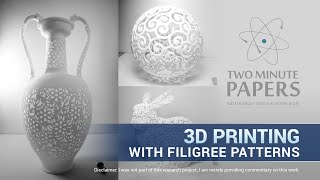
Short YouTube video/transcript describing a method to generate complex 3D-printable shapes by arranging filigree (thin decorative) patterns. The work frames the task as an optimization problem that minimizes overlap and maximizes connectivity of pattern elements, discusses control fields (size, orientation, ratio of element types), compares results to prior work, and concludes with evaluation praise and a viewer call-to-action.
Chapters
Dear fellow scholars, this is two minute.
Papers with filigrees are detailed, thin patterns.
Typically found in jewelry, fabrics and ornaments.
And as you may imagine, crafting such.
Motifs on objects is incredibly laborious.
This project is about leaving out the.
Craftsman from the equation by choosing a.
Set of target filigree patterns and creating.
A complex shape out of them that.
Can be easily 3D printed.
The challenge lies in grouping and packing.
Up these patterns to fill a surface evenly.
We start out with a base model.
With a poor structure, which is not.
Completely random, but as you can see.
Is quite a forlorn effort.
In several subsequent steps, we try to.
Adjust the positions and shapes of the filigree elements to achieve more pleasing results. The more pleasing results we define as one that minimizes the amount of overlapping.
And maximizes the connectivity of the final shape.
Sounds like an optimization problem from earlier, and that is exactly what it is.
Really cool, right?
The optimization procedure itself is far from.
Trivial, and the paper discusses possible challenges and their solutions in detail.
For instance, the fact that we can also add control fields to describe our.
Vision regarding the size and orientation of the filigree patterns is an additional burden.
That the optimizer has to deal with.
We can also specify the ratio of.
The different input filigree elements that we'd.
Like to see added to the model.
The results are compared to previous work and the difference speaks for itself. However, it's important to point out that even this thing that we call previous.
Work was still published this year.
Talk about rapid progress in research.
Absolutely phenomenal work.
The evaluation and the execution of the.
Solution as described in the paper is.
Also second to none.
Make sure to have a look.
And thank you so much for taking.
The time to comment on our earlier.
Video about the complexity of the series.
I'd like to assure you that we.
Read every single comment and found a.
Ton of super helpful feedback there.
It seems to me that the vast.
Majority of you agree that a simple.
Overlay text does the job, and while.
It is there, it's even better to.
Make it clickable so it leads to.
A video that explains the concept in.
A bit more detail.
For the more curious minds out there.
I try to make sure that everything.
Is available in mobile as well.
You fellow scholars are the best, and.
Thank you so much for everyone for leaving a comment.
Also, please let me know in the.
Comment section if you have found this.
Episode to be understandable or if there were any terms that you've never heard.
Of if everything was in order.
That's also valuable information, so make sure.
To leave a comment. Thanks for watching and for your generous support.