5 MINUTES AGO: ELON MUSK STUNS Everyone With Statements On X.AI (Exclusive Elon Musk Interview)
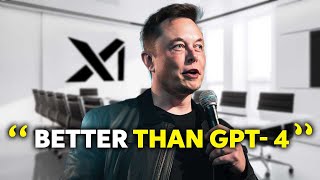
This is a transcript excerpt from a LARRUZ YouTube video covering an exclusive Elon Musk discussion about his newly announced company, X AI. Musk describes X AI's goal as building an AGI whose purpose is to understand the universe, emphasizing a "maximally curious, truth-seeking" design intended to improve safety and avoid hard-coded morality. The host frames X AI as distinct from consumer chatbots (ChatGPT, Bard, Claude) and teases a forthcoming claim that Tesla discovered a simple but important insight relevant to AI development.
Chapters
So it's officially game over. What Elon Musk just said in an exclusive Twitter space, which he just ended around 12 minutes ago, proves to us that his new company, X AI will be one of those companies that is extremely innovative. And unlike other AI companies that are currently focused on the traditional level of chatbots, X AI is going in a completely new direction. Now some of you may have understood that he did announce this three days ago, but, but in this recent Twitter space he actually gave us a much more detailed breakdown in which he talks about X AI and what he sets out to achieve. Before we get into Elon Musk's actual post, you can see that a couple of days ago on his company website he actually posted that. Today we announced the formation of X AI. The goal of X AI is to understand the true nature of the universe. The team is led by elon Musk, the CEO of Tesla and SpaceX. And they've previously worked at companies like DeepMind, Google Research, Microsoft Research, Tesla and the University of Toronto. Now if you aren't familiar with those names, a lot of those names are key key companies, slash organizations in which have led the many breakthroughs in artificial intelligence. And many of the new projects that I do cover come from those prestigious organizations. So the team that are going to be working on X AI are definitely some talented individuals, like one of the most talented teams that, that I've ever seen. Now what I do find interesting and something that I do want to add before we get into Elon Musk's talk is that he actually talks about two main points. Okay. And one of the things that Elon Musk talks about is the fact that their goal is a truth seeking AI. Now this means that it's going to be fundamentally designed a little bit different because as you know, many AIs have inherent biases in them. For example, they are told not to about certain things or give opinions on certain facts, whereas X AI is going to be giving a truthful opinion just based on pure data. So that means that this kind of artificial intelligence is going to be built with a different set of guardrails, which will be interesting to see how it performs in certain human evaluation tests. And that is going to be one of the most interesting things that I do think we'll see. Because it isn't just a consumer product. I unlike ChatGPT and Bard and of course other things like Perplexity or Claude, Those kinds of AIs are just normal chatbots that you're trying to talk to, whereas this one is just going to be a lot more ruthless in its approach to just seeking the truth. Which means that we're largely going to be getting an entirely different type of AI from Elon Musk.
I guess the overarching goal of XAI is to build a good AGI with the overarching purpose of just trying to understand the universe. The I think the safest AI, the safest way to build an AI is actually make one that is maximally curious and truth seeking. So you go for, try to aspire to the truth with acknowledged error. So like, you know, does one ever actually get fully to the truth? It's not clear, but one should always aspire to that and try to minimize the error between what it, what you think is true and what is actually true. The, my sort of theory behind the maximally curious, maximally truthful as being probably the safest approach is that I think to a superintelligence humanity is much more, more interesting than not humanity. You know, one can look at the various planets in our solar system, the moons and the asteroids, and really probably all of them combined are not as interesting as humanity. I mean I'm, as people know, I'm a huge fan of Mars next level. I mean it's middle name of one of my kids is basically the Greek word for Mars. So I'm a huge fan of Mars. But Mars is just much less interesting than Earth with humans on it. And so I think that that kind of approach to growing an AI, I think that is the right word for growing an AI is to grow it with that ambition. I've spent many years thinking about AI safety and worrying about AI safety. And I've been one of the strongest voices calling for AI regulation or oversight. Just to have some kind of oversight, some kind of referee so that it's not just up to companies to decide what they want to do. I think there's also a lot to be done with AI safety with industry cooperation, kind of like Motion Pictures Association. So there's, I think there's value to that as well. But I do think there's got to be some like in any kind of situation that is, even if, if it's a game, they have referees. So I think it's, it is important for there to be regulation and, but, and then like I said, my view on safety is like try to make it maximally curious, maximally truth seeking. And I think this is important that you, to avoid the inverse morality problem. Like if you try to program a set morality, you can have the, you can basically invert it and get the opposite, what is sometimes called the waluigi problem. If you make Luigi, you risk creating waluigi at the same time. So I think that's a metaphor that a lot of people can appreciate. And so that's what we're going to try to do here. And yeah, with that, I think. Let me turn it over to you.
So with the next part, Elon Musk actually talks about what he's going to be doing in terms of the actual mission statement. And I think it's very interesting that Elon Musk talks about how fundamentally he wants to answer the one, at least have one breakthrough question, which means that this is going to be radically differently designed than our traditional AIs, as we stated before. And this could be the AI that does manage to solve some of humanity's most pressing questions, like why are we here? And of course, where are all the aliens? As Elon Musk talks about in this next.
I mean, I understand the universe is the entire purpose of physics. Yeah. So I think it's actually really clear. There's just so much that we don't understand right now, or we think we understand, but actually we don't in reality. So there's. There's still a lot of unresolved questions that are very, extremely fundamental. You know, this whole dark matter, dark energy thing is really, I think, an unresolved question. You know, we have the standard model, which has proved to be extremely good at predicting things, very robust, but still many questions remaining about the nature of gravity. For example, there's the Fermi Paradox of where are the aliens? Which is, if we are in fact almost 14 billion years old, why is there not massive evidence of aliens? And people often ask me, since I am obviously deeply involved in space, that, you know, if anyone would know about, would have seen evidence of aliens, is probably me. And yet I have not seen even one tiny shred of evidence for aliens. Nothing. Zero. And I would jump on it in a second if I saw it. So, you know, that that means, like, I don't know, there's. There are many explanations for the Fermi paradox, but which one is actually true? Or maybe none of the cartoons theories are true. So, I mean, the Fury paradox is, which is really just like, where the hell are the aliens? Is part of what gives me concern about the fragility of civilization and consciousness as we know it. Since we see no evidence thus far of it anywhere, and we've tried hard to try to find it, we may actually be the only thing, at least in this galaxy or this part of the galaxy. If so, it suggests that what we have is extremely rare. And I think it's really rewise to assume that that consciousness is extremely rare. I mean, it's worth noting for the evolution of consciousness on Earth that we're about. Earth is about four and a half billion years old. The sun is gradually expanding. It will expand to heat up Earth to the point where it will effectively boil the oceans. You'll get a runaway, you know, next level greenhouse effect, and Earth will become like Venus. And that may take as little as 500. Well, I mean, as little as 500 million years. So, you know, the sun doesn't need to expand to envelop Earth. It just needs to make things hot enough to increase the water vapor in the air to the point where you get runaway greenhouse effect. So, so for argument's sake, it could be that if life, if consciousness had taken 10% longer than Earth's current existence, it wouldn't have developed at all. So from on a cosmic scale, this is a very narrow window anyway. So there are all these, like, fundamental questions. I don't think you can call anything AGI until it solved at least one fundamental question. Because humans have solved many fundamental questions or substantially solved them. And so if the computer can't solve even one of them, I'm like, okay, it's not as good as humans. That would be one key threshold for solve one important problem. You know, where's that Riemann Hypothesis solution? I don't see it. So that it would be great to know what the hell is really going on, essentially. So I guess you could reformulate the XAI mission statement as what the hell is really going on? That's our goal.
Now, if you found that interesting, I really want you to pay attention to this next part because this is where Elon Musk's genius comes into play. He actually told us that in Tesla they managed to figure out something key in AI development and that many other people haven't. And they couldn't believe it when they figured it out because it was so strikingly simple. So take a listen to this because I really do believe that this company is about to have some of the major breakthroughs in artificial intelligence.
We're not going to understand the universe and not tell anyone. So, yeah, when I think about, like neural networks today, it's currently the case that if you have 10 megawatts, of which really should be renamed something else because there's no graphics there. But if you get 10 megawatts of GPUs, cannot currently write a better novel than a good human. That and a human's using roughly 10 watts of a higher order brain power. So not counting the basic stuff to, you know, operate your body. So, so there we got a six order of magnitude difference. That's a giant, that's really gigantic. Part of the, you could, I think one, one could argue that two of those orders of magnitude are explained by the activation energy of a transistor versus a could argue account for two of those orders of magnitude. But what about the other four? Or the fact that even with six orders magnitude you still cannot beat a smart human writing a novel. So and, and also today when you ask the most advanced AIs technical questions, like if you're trying to say like how to design a better rocket engine or complex questions about electrochemistry to make up a better battery, you just get nonsense. So that's not very helpful. So I think this, we're really missing the mark in the way that things are currently being done by many orders of magnitude. It's being heavily, I mean basically AGI is being brute forced and still actually not succeeding. So if I look at the experience with Tesla, what we're discovering over time is that we actually over complicated the problem. I can't speak to in too much detail about what Tesla's figured out, but except to say that in broad terms the answer was much simpler than we thought. We were too dumb to realize how simple the answer was. But you know, over time we get a bit less dumb. So I think that's what we will probably find out with AGI as well. You know, kind of really embryonic at this point. So it'll take us a minute to really get something useful. But our goal would to be to make useful AI. I guess if you can't use it in some way, I'm like, I question its value. So we want it to be a useful tool for people and consumers and businesses or whoever. And as was mentioned earlier, I think there's some value in having multiple entities. You don't want to have a unipolar world where just one company kind of dominates AI. You want to have some competition. Competition I think makes companies honest and you know, so they're in favor of competition for text training and arguably I think also for video for image and video training as well. At a certain point there's, you kind of run out of human created data. So if you look at say the AlphaGo versus AlphaZero, you know, AlphaGo trained on all the human games and beat leased it all 4 to 1. AlphaZero just played itself and beat AlphaGo 100 to 0. So there's really for things to take off in a big way. I think the AI's got to basically generate content, self assess the content. And that's really the, I think that's the path to AGI is something like that is self generated content where it effectively plays against itself. You know, a lot of AI is data curation. It's like shocking. It's not like vast numbers of lines of code. It's actually shocking how small the lines of code are. Kind of blows my mind how few lines of code there are. But how the data is used, what data is used, the signal to noise of that data, the quality of that data is immensely important. Which kind of makes sense if you were trying to as a human trying to learn something and you were just given a pilot a vast amount of drivel basically versus high quality content. You're going to do better with a small amount of high quality content than a large amount of drivel. Makes sense. Reading the greatest novels ever written is way better than reading a bunch of crappy novels. So thanks to not say what it actually thinks is true. So I think, you know, really at xai we have to allow the AI to say what it really believes is true, not and not be deceptive or politically correct. So that, you know, that will result in some criticism obviously. But, but I think that's the only way to go forward is rigorous pursuit of the truth or the truth with least amount of error. So and I am concerned about the way that AI in that it is optimizing for political correctness. And that's incredibly dangerous. Know, if you look at the, you know, where did things go wrong in Space Odyssey? It's you know, basically when they told Hal 9000 to lie. So they said you can't tell the crew what, that they're going about anything about the monolith or that they're, or what their actual mission is. And, but you got to take them to the monolith. So it, you know, basically came to the conclusion that well, it's going to kill them and take their bodies to the monolith. So this is the, I mean the, the lesson there is do not give the AI usually impossible objectives. Basically don't force the AI to lie. Now the thing about physics or the truth of the universe is you actually can't invert it. You can't just like physics is true. There's not like, not physics. So if you adhere to hardcore reality, I Think you can't. It actually makes inversion impossible. Now you can also say now when something is subjective I think you can provide an answer which says that well if you believe the following then this is the answer. If you believe you know this other thing then this is the answer if you believe because it may be a subjective. A question where the answer is fundamentally subjective and a matter of opinion. So. So but I think we. It is very dangerous to grow an A and teach it to lie. You know in our meetings with them that if you do make a digital superintelligence that you could end up, that could end up being in charge, you know. So you know that I, I think the CCP does not want to find themselves subservient to a digital superintelligence. They that that argument did resonate. Yeah. So yeah. So some kind of regulatory authority that's international. Obviously enforcement is difficult but I think we should still as to do some of the sun revolves around the Earth because everyone thinks that that doesn't make it true. You know, if Newton or Einstein comes up with something that is actually true, it doesn't matter if all the other physicists in the world disagree. Reality is reality. So it has to. You have to ground the answers in reality. Yeah. The current models just imitate the data that they're trained on. And what we really want to do is to change the paradigm away from that to actually models discovering the truth. So not just repeating what they've learned from the training data actually making true new insights, new discoveries that we can all benefit from safety. Like it's, you know, like my prediction for AGI would roughly match that which I, I think Rayco at one point said 2029. That would rough. That's roughly my guess too give or take a year. So if it takes like an additional six months or 12 months for AGI, that's really not a big deal. If it's you know like spending a year to make sure AGI is safe, probably worthwhile, you know if that's what it takes. But I wouldn't expect it to be a substantial slowdown. Yeah. And I can also add that like understanding the inner working of advanced AI is probably the most ambitious projects out there as well and also aligns with XAs mission of understanding the universe and probably not possible for an aerospace engineers to build a safe rocket. They don't understand how it works. And that's the same approach we want to take AI for the our safety plans. And as the AI advances across different stages, the risk also changes and it want to be fluid across all the stages. Generative AI. You and I for the book also discuss the importance of real world AI, which is the things including coming out of both Optimus and Tesla fsd. To what extent do you see exactly involved in real world AI as a distinction to what say OpenAI is doing? And you have a leg up to some extent by having done fsd. Yeah, right. I mean, Tesla is the leader I think by pretty long margin in real world AI. In fact, the degree to which Tesla is advanced real world AI is not well understood. Yeah. And I guess since I spend a lot of time with the Tesla AI team, I kind of know, you know, how real world AI is done. And there's a lot to be gained by collaboration with Tesla. You know, I think bi directionally XAI can help Tesla and vice versa. You know, we have some collaborative relationships as well. Like our material science team, which I think is maybe the best in the world, is actually shared between Tesla and SpaceX. And that, that's actually quite helpful for recruiting the best engineers in the world because it's just, it's like more interesting to work on advanced electric cars and rockets than just either one or the other. So like that was really key to recruiting Charlie Kuhlman who runs the advanced materials team. It was, he was like, he was at Apple and I think pretty happy at Apple and be like, well, he could work on electric cars and rockets. He's like, that sounds pretty good. I'll say. He wouldn't take either one of the jobs, but he's willing to take both. Yeah. So I think that is a really important thing. And like I said, there are like some pretty, pretty big insights that we've gained at Tesla in trying to understand real world AI. Taking, taking video input and compressing that into a vector space and then ultimately into steering and pedal outputs. Yeah. And Optimus. Yeah, Optimus. You know, Optimus is still at the early stages and we definitely need to be very careful with Optimus at scale once it's in production that you have a hard coded way to turn off Optimus. For obvious reasons I think like this, there's got to be a hard coded ROM local cutoff that can, that, you know, no amount of updates from the Internet can change that. So. So we'll make sure that Optimus is like quite easy to shut down. Extremely important because at least, you know, the car is like intelligent. Well, at least you can climb a tree or go up some stairs or something, you know, go in a building. But Optimus can follow you in the building. So any kind of robot that can follow you in the building that is intelligent and connected, we gotta be super careful with safety.










