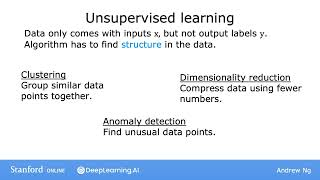
Unsupervised learning works with data that has no labels. The video covers clustering (grouping similar points), anomaly detection for finding fraud, and dimensionality reduction to compress datasets while keeping what matters.
Chapters
In the last video you saw what is unsupervised learning and one type of unsupervised learning called clustering.
Let's give a slightly more formal definition.
Of unsupervised learning and take a quick look at some other types of unsupervised learning other than clustering. Whereas in supervised learning the data comes.
With both inputs X and output labels.
Y, in unsupervised learning the data comes only with inputs X but not output labels Y.
And the algorithm has to find some structure or some pattern or something interesting in the data.
We've seen just one example of unsupervised.
Learning called a clustering algorithm, which groups.
Similar data points together.
In this specialization you learn about clustering.
As well as two other types of unsupervised learning.
One is called anomaly detection, which is used to detect unusual events.
This turns out to be really important.
For fraud detection in the financial system, where unusual events, unusual transactions could be a signs of fraud and for many other applications. And you also learn about dimensionality reduction.
This lets you take a big data.
Set and almost magically compress it to a much smaller data set while losing as little information as possible in case anomaly detection and dimensionality reduction don't seem to make too much sense to you yet. Don't worry about it, we'll get to this later in this specialization. Now I'd like to ask you another question to help you check your understanding and no pressure. If you don't get it right on the first try, it's totally fine.
Please select any of the following that you think are examples of unsupervised learning. Two are unsupervised examples and two are supervised learning examples. So please take a look. Maybe you remember the spam filtering problem. If you have labeled data you know labeled as spam or non spam email, you can treat this as a supervised learning problem. The second example, the news story example, that's exactly the Google News and Tandem example that you saw in the last video.
And so you can approach that using.
A clustering algorithm to group news articles together. So that would use unsupervised learning, the.
Market segmentation example that I talked about.
A little bit earlier.
You can do that as an unsupervised learning problem as well, because you can give your algorithm some data and ask it to discover market segments automatically. And the final example on diagnosing diabetes, well, actually that's a lot like our breast cancer example from the supervised learning videos, only instead of benign or malignant tumors, we instead have diabetes or not diabetes.
And so you can approach this as a supervised learning problem, just like we did for the breast tumor classification problem.
Even though in this. In the last video we've talked mainly about clustering in later videos in this.
Specialization, we'll dive much more deeply into anomaly detection and dimensionality reduction as well.
So that's unsupervised learning.
Before we wrap up this section, I.
Want to share with you something that I find really exciting and useful, which.
Is the use of Jupyter notebooks in machine learning.