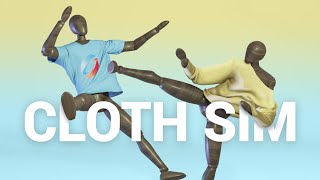
Dr. Zsolnai reviews nine years of cloth simulation progress, from yarn-level methods that took hours per garment to newer techniques achieving 5x to 60x speedups. The tradeoff: faster results but less detail on individual yarn pulling.
Chapters
Dear fellow scholars, this is Two Minute Papers with Dr. Zsolnai. This day is the perfect day to simulate the kinematics of yarn and cloth on our computers. As you just saw, this is not the usual intro that we use in every episode. So what could that be? Well, this is a simulation specifically made for us using a technique from today's paper. And it has a super high stitching density, which makes it all the better. By the end of this video, you will know exactly what that means and why that matters. But first, for context, I would like to show you what researchers were able to do in 2012. And we will see together how far we have come since this previous work was about creating these highly detailed cloth geometries for digital characters. Here you see one of its coolest results where it shows how the simulated forces pull the entire piece of garment together. We start out by dreaming up a piece of class geometry and this simulator gradually transforms it into a real world version of that by subjecting it to real physical forces. This is a step that we call yarn level relaxation. So this paper was published in 2012 and now nearly nine years have passed, so I wonder how far we have come since. Well, we can still simulate knitted and woven materials through similar programs that we call direct yarn level simulations. Here's one. I think we can all agree that these are absolutely beautiful. So what's the catch? The catch is that this is not free. There is a price we have to pay for these results. Look. Whoa. These really take forever. We are talking several hours, or for this one, almost even an entire day to simulate just one piece of garment. And it gets worse. Look, this one takes more than two full days to compute. Imagine how long we would have to wait for complex scenes in a feature length movie with several characters. Now, of course, this problem is very challenging and to solve it we have to perform a direct yarn level simulation. This means that every single strand of yarn is treated as an elastic rod and we have to compute how they react to external forces, bending deformations and more. That takes a great deal of computation. So our question today, can we do this in a more reasonable amount of time? Well, the first law of papers says that research is a process. Do not look at where we are, look at where we will be. Two more papers down the line. Let's see if the law holds up here. This new paper promises to retain many important characteristics of the full simulation, but takes much less time to compute. That is amazing. Things stretch, bend and even curl up similarly, but the simulation time is cut down A great deal. How much less? Well, this one is five times faster. That's great. This one, 20 times. Oh my. But it gets better. Now hold on to your papers and look. This one is almost 60 times faster than the full yarn level simulation. My goodness. However, of course, it's not perfect. In return, pulling effects on individual yarns is neglected, so we lose the look of this amazing holy geometry. I'd love to get that back. Now, these examples, we're using materials with relatively small stitching density. The previous full yarn level simulation method scales with the number of yarn segments we add to the garment. So what does this all mean? This means that higher stitching density gives us more yarn strands, and the more yarn strands there are, the longer it takes to simulate them. In these cases you can see the knitting patterns, so there aren't that many yarns. And even with that, it still took multiple days to compute a simulation with one piece of garment. So I hope you know what's coming. It can also simulate super high stitching densities efficiently. What does that mean? It means that it can also simulate materials like the satin example here. This is not bad by any means, but similar simulations can be done with much simpler simulators. So our question, why does this matter? Well, let's look at the backside here and marvel at this beautiful scene showcasing the second best curl of the day. Loving it. And now I hope you're wondering what the best curl of the day is. Yes, here goes. This is the one that was showcased in our intro, which is two minute papers curling up. You can only see this footage here. Beautiful. Huge congratulations and a big thank you to Georg Speerl, the first author of the paper, simulated this two minute paper scene only for us and with a super high stitching density. That is quite an honor. Thank you so much. As I promised, we now understand exactly why the stitching density makes it all the better. And if you have been watching this series for a while, I am sure you have seen computer graphics researchers destroy armadillos in the most spectacular manner. Make sure to leave a comment if this is the case. That is super fun. And I thought there must be a version of that for cloth simulations. And of course there is. And now please meet the yarnmadillo. The naming game is very strong here. And just one more thing. Georg Sperl, the first author of this work, was a student of mine in 2014 at the technical University of Vienna, where he finished a practical project in light simulation programs. And he did excellent work there. Of course he did. And I will note that I was not part of this project in any way. I am just super happy to see him come so far since then. He is now nearing the completion of his Ph.D. and this simulation paper of his was accepted to the Siggraph conference that is as Good as It Gets well done Georg. This episode has been supported by Weights and Biases. In this post they show you how to use their tool to build the foundations for your own hedge fund and analyze the stock market using learning based tools. If you work with learning algorithms on a regular basis, make sure to check out weights and biases. Their system is designed to help you organize your experiments and it is so good it could shave off weeks or even months of work from your projects and and is completely free for all individuals, academics and open source projects. This really is as good as it gets and it is hardly a surprise that they are now used by over 200 companies and research institutions. Make sure to Visit them through wnb.com papers or just click the link in the video description and you can get a free demo today. Our thanks to Weights and Biases for their long standing support and for helping us make better videos for you. Thanks for watching and for your generous support and I'll see you next time.