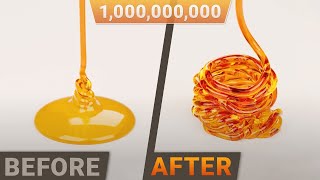
Two Minute Papers episode (YouTube) by Dr. Zsolnai reviewing advances in fluid simulation, highlighting a recent paper/technique that simulates up to 1 billion particles. The narrator contrasts earlier notable works (jellies, two-way coupling, baking physics, photorealistic rendering), emphasizes the computational cost of high-fidelity simulation, and reports empirical performance: typical speedups around 3× over prior methods (and up to 15× on viscous "honey-buckling" scenes). Reported runtimes are ~30 seconds per frame for 150 million particles and ~10 minutes per frame for 1 billion particles. The video frames this as substantial progress in a mature field and invites viewer discussion.
Questions this video answers
September 4, 2022.
Dr. Zsolnai (Two Minute Papers).
100 million (two years prior), 150 million (example), and 1 billion (new result).
About 3× typical speedup.
About 15× speedup on the honey-buckling scene.
Chapters
Dear fellow scholars, this is Two Minute Papers with Dr. Zsolnai. Today we are going to find out whether it is possible to write a fluid simulation on a computer that showcases no less than 1 billion particles. So is this the one? Maybe. Of course I will tell you in a moment. But note that there are plenty of fluid and and physics simulation research papers out there. This is a mature research field and we can do so much today. Here are four of my favorite works in this area and then we will talk about what is the problem with them. 1. In reality we can experiment with whatever objects we have at our disposal. But in a simulation we can do anything, including changing the physical parameters of these objects from and thus this previous work can simulate three jello blocks of different stiffness values. So cool. 2. This technique simulates strong two way coupling. What does that mean? Well, you see a simulation here that doesn't have it. So is this correct? Well, not quite. The honey should be supporting the dipper and it not only falls but but it falls in a very unnatural way instead. This technique can simulate strong two way coupling and finally it gets it right. And not only that, but what I really love about this is that it also gets small nuances right. I will try to speed up the footage a little. So you can see that the honey doesn't only support the dipper, but the dipper still has some subtle movements both in reality and in the simulation. A love it. 3. We can even simulate the physics of baking on a computer. Let's see. Yes, expansion and baking is happening here. Are we done? Well, let's have a look inside. Yep, this is a good one. Yum. And perhaps my favorite work in this area is this. 4. Now you may be wondering, why are you showing a real video to me? Well, this is not a real video. This is a simulation. And so is this one. And hold on to your papers because this is not a screenshot taken from the simulation. Nuh, no sir. This is a real photo. How cool is that? Whenever you feel a little sad, just think about the fact that through the power of computer graphics research, we can simulate reality on our computers. At least a small slice of reality. Absolutely amazing. However, there is a problem. And the problem is that all of these simulations have a price. And that price is time. Oh yes, some of these works require long all nighters to compute. And unfortunately as a research field matures, it gets more and more difficult to say something new and improve upon previous work. So can we expect no more meaningful speedups at this point? Are we at a Saturation point. Well, just two years ago we talked about a technique that was able to simulate the 100 million particles. My goodness, this was absolutely amazing. And now just a couple more papers down the line we go 10x. Yes, that's right. Here is an even better one that is finally able to simulate 10 times as many particles. Yes, 1 billion particles. Now hold on to your papers and let's marvel together at this glorious footage. This is a scene with 1 billion. Can that really be? Well, I can hardly believe it, but here it is. Look. That is a beautiful simulation. I love it. Now this technique is not only able to simulate this many particles, but it also does it faster than previous techniques. The speed up factor is typically 3x but not on honeybuckling scenes. Why is that? Well, the more viscous the fluids are, at the risk of simplification, let's say that the more honey like they are, the higher the speed up. How much higher? What? Yes, that's right. On this honey buckling scene it is 15 times faster. What took nearly two all nighters now only takes an hour. That is is insanity. What a time to be alive. Now note that these simulations still take a while. About half a minute per frame for 150 million particles and about 10 minutes per frame for a billion particles. But for a simulation of this quality, that is not a lot at all. Sign me up right now. So as you see, even for such a mature research field as fluid simulations in computer graphics, the pace of progress is nothing short of amazing. You see a lot of videos on what AI techniques are capable of today. And what you see here is through the power of sheer human ingenuity. So what do you think? Does this get your mind going? Let me know in the comments below. Weights and Biases provides tools to track your experiments in your deep learning projects. Using their system, you can create beautiful reports like this one to explain your findings to your colleagues better. It is used by many prestigious labs including OpenAI, Toyota Research, GitHub and more. And the best part is that Weights and Biases is free for all individuals, academics and open source projects. Make sure to Visit them through wnb.com papers or just click the link in the video description and you can get a free demo today. Our thanks to Weights and Biases for their long standing support and for helping us make better videos for you. Thanks for watching and for your generous support and I'll see you next time.