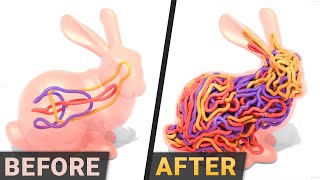
Dr. Zsolnai breaks down a graphics paper on using repulsive forces to untangle objects and prevent intersections on curves and surfaces. The technique solves problems from freeing tangled earbuds and handcuffs to reconstructing 3D geometry from incomplete data and repairing broken meshes.
Chapters
Dear fellow scholars, this is Two Minute Papers with Dr. Zsolnai. Today we are going to learn why you should not even try to handcuff a computer graphics researcher. And it's not because they are criminal masterminds. No, no. So what is it then? Well, if they have read this paper, handcuffing them will not work. See, they will get out easily. So what is all this insanity here? Well, this paper is about simulating repulsion, or to be more exact, computing repulsive forces on curves and surfaces. Now of course, your first question. Ok, but what is that good for? Well, believe it or not, it doesn't sound like it, but it is good for so many things. The applications just keep coming and coming. So how does this work? Well, repulsion can prevent intersections and collisions. And look at that. If we run this process over time, it creates flows. In other words, it starts mingling with the geometry in interesting and it turns out, also useful ways. For instance, imagine that we have this tangled handcuff and someone comes up to us and says they can untangle this object by molding. And not only that, but this person gets even more brazen. They say that they even do it gently, or in other words, without any intersections. No colliding or breaking is allowed. Well then I say, I don't believe a word of it. Show me. And the person does exactly that. Using the repulsive force algorithm, we can find a way to untangle them. This seems like black magic. Also, with some adjustments to this process and running it backwards in time, we can even start with a piece of geometry and compute an ideal shrink wrap for it. Even better, when applied to point clouds, we can even create a full 3D geometry that represents these points. And get this, it works even if the point clouds are incomplete. Now make no mistake, the topic of point cloud reconstruction has been studied for decades now. So much so that during my PhD years I attended to well over a hundred paper talks on this topic. And I am by no means an expert on this, not even close. But I can tell you this looks like a pretty good solution. And these applications emerge only as a tiny side effect of this algorithm. But it's not over. There is more. It can even fix bad mesh geometries, something that artists encounter in the wild all the time. Loving it. And it can also create cool and crazy surfaces for your art installations. Now, so far we have applied repulsion to surfaces, but this concept can also be applied to curves as well, which opens up a whole new world of really cool applications. Let's start with the most Important one. Do you know what happens when you put your wired earbuds into your pocket? Yes, of course. Exactly. This happens every time. Right. And now hold on to your papers because it turns out it can even untangle your headphones without breaking them. Now wait a second. If it can generate curves that don't intersect, maybe it could also be used for path planning for characters in a virtual world. Look, these forks intersect, but if they use this new technique for path planning, there should be no intersections and yes, no intersections, thereby no collisions. Excellent. And if we feel like it, we can also start with a small piece of noodle inside a bunny and start growing it. Why not? And then we can marvel at how over time it starts to look like intestines and it just still keeps growing and growing without touching the bunny. So cool. Now onto more useful things. It can even be used to visualize social media connections and family trees in a compact manner. Or it can move muscle fibers around and the list just goes on. But you are experienced fellow scholars over here, so I hear you asking. Well, wait a second. All this sounds quite trivial. Just apply repulsive forces to the entirety of the surfaces and off we go. Why does this have to be a paper published at a prestigious conference? Well actually, let's try this. If we do that, uh oh, this happens. Or this happens. The algorithm is not so trivial after all. And this is what I love about this paper. It proposes a simple idea and this idea is simple but not easy. If we think it is easy, this happens. But if we do it well, this happens. The paper describes in detail how to perform this so it works properly and and provides a ton of immediate things it can be used to. This is not a product, this is an idea and a list of potential applications for it. In my opinion, this is basic academic research at its best. Bravo. I love it. And what would you use this for? Please let me know in the comments below. I love to hear your ideas. And until then we will have no more tangled earbuds in our pockets. And. And we can thank computer graphics research for that. What a time to be alive. This video has been supported by weights and biases. Being a machine learning researcher means doing tons of experiments and of course creating tons of data. But I am not looking for data, I am looking for insights. And weights and biases helps with exactly that. They have tools for experiment tracking, dataset and model versioning and even hyper parameter optimization. No wonder. This is the experiment tracking tool choice of OpenAI, Toyota Research, Samsung and many more prestigious labs. Make sure to use the link wnb me paperintro or just click the link in the video description and try this 10 minute example of weights and biases today to experience the wonderful feeling of training a neural network and being in control of your experiments. After you try it, you won't want to go back. Thanks for watching and for your generous support and I'll see you next time.