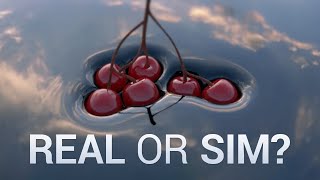
Dr. Zsolnai reviews a physics simulation that couples solids, fluids, and surface tension together. A paperclip 8 times denser than water floats through capillarity, and the 3D scenes render in seconds per frame without machine learning, just handcrafted equations.
Questions this video answers
July 17, 2021.
About eight times as dense as water.
It "pretty much runs interactively" (interactive for a two-dimensional scene).
Runs in less than two seconds per timestep.
No — the video states "No learning algorithms anywhere to be seen."
Chapters
Dear fellow scholars, this is two minute papers with Dr. Zsolnai. I am stunned by this new graphics paper that promises to simulate three way coupling and enables beautiful surface tension simulations like this and this and more. Yes, none of this is real footage. These are all simulated on a computer. I have seen quite a few simulations and I am still baffled by this. How is this even possible? Also, three way coupling, eh? That is quite peculiar to the point that the term doesn't even sound real. Let's find out why together. So what does that mean exactly? Well, first let's have a look at one way coupling. As the box moves here, it has an effect on the smoke plume around it. This example also showcases one way coupling, where the falling plate stirs up the smoke around it. And now on to two way coupling. In this case, similarly to previous ones, the boxes are allowed to move the smoke, but the added two way coupling part means that now the smoke is also allowed to blow away the boxes. What's more, the vortices here on the right were even able to suspend the red box in the air for a few seconds. An excellent demonstration of a beautiful phenomenon. So coupling means interaction between different kinds of objects. And two way coupling seems like the real deal here. It is also required to compute how this fiery smoke trail propels the rocket upward. But wait, we just mentioned that the new method performs three way coupling. Two way was solid fluid interactions and it seemed absolutely amazing. So what is the third element then? And why do we even need that? Well, depending on what object is in contact with the liquid, gravity, buoyancy and surface tangent forces need additional considerations to be able to do this. Now look carefully. Yes, there is the third element. It simulates this thin liquid membrane too, which is in interaction with the solid and the fluid at the same time. And with that, please meet three way coupling. So what can it do? It can simulate this paperclip floating on water. That is quite remarkable because the density of the paperclip is is eight times as much as the water itself. And yet it still sits on top of the water. But how is that possible, especially given that gravity wants to constantly pull down a solid object? Well, it has two formidable opponents. Two forces that try to counteract it. One is buoyancy, which is an upward force, and two, the capillary force, which is a consequence of the formation of a thin membrane. If these two friends are as strong as gravity, the object will float. But this balance is very delicate. For instance, in the case of milk and cherries, this happens. And during that time the Simulator creates a beautiful bent liquid surface that is truly a sight to behold. Once again, all of this footage is simulated on a computer. The fact that this new work can simulate these three physical systems is a true miracle. Absolutely incredible. Now, if you have been holding onto your paper so far, squeeze that paper because we will now do my favorite thing in any simulation paper. And that is when we let reality be our judge and compare the simulated results to real footage. This is a photograph. And now comes the simulation. Whoa. I have to say, if no one told me which is which, I might not be able to tell. And I am delighted to no end by this fact. So much so that I had to ask the authors to double check if this really is a simulation and they managed to reproduce the illumination of these scenes perfectly. Yes, they did. Fantastic attention to detail. Very impressive. So how long do we have to wait for all this? For a two dimensional scene, it pretty much runs interactively. That is great news. And we are firmly in the seconds per frame region for the 3D scenes. But look, the boat and leave scene runs in less than two seconds per timestep. That is absolutely amazing. Not real time, because one frame contains several time steps. But why would it be real time? This is the kind of paper that makes something previously impossible possible. And it even does that swiftly. I would wager we are just one or at most two more papers away from getting this in real time. This is unbelievable progress in just one paper. And all handcrafted. No learning algorithms anywhere to be seen. Huge congratulations to the authors. What a time to be alive. Perceptilabs is a visual API for TensorFlow, carefully designed to make machine learning as intuitive as possible. This gives you a faster way to build out models with more transparency into how your model is architected, how it performs and how to debug it. Look, it lets you toggle between the visual modeler and the code editor. It even generates visualizations for all the model variables and gives you recommendations both during modeling and training. And does all this automatically. I only wish I had a tool like this when I was working on my neural networks during my PhD years. Visit perceptilabs.com papers to easily install the free local version of their system today. Our thanks to Perceptilabs for their support and for helping us make better videos for you. Thanks for watching and for your generous support and I'll see you next time.