Accelerating Your AI Career
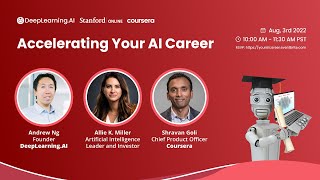
Ryan Keenan moderates a panel with Ali Miller, Sravan Goli, and Andrew Ng on starting and advancing AI careers. They discuss the range of technical and non-technical roles available, why foundations matter more than chasing every new research trend, and how platforms like Coursera have made AI education accessible to everyone.
Chapters
Sam.
Hi everyone and welcome. My name is Ryan Keenan and I'm the Director of product at DeepLearning AI. We really appreciate you taking the time to join us for today's event and we're super excited to see people joining us from all over the world. Personally, I'm in Reno, Nevada in the Western U.S. but I wish you good morning from where I'm at. But good afternoon, good evening, good middle of the night to you if you stayed up late to join us. Really excited to have you with us wherever you are. Today's event is going to be focused on accelerating your AI career. So we'll be talking about the steps you can take to either get started or if you've already gotten started, how to move in the direction that you want to go within the AI space. Today's event is also a celebration of our new machine learning specialization that recently went live on Coursera. You can think of this if you're familiar with Andrew's old machine learning course. That was actually the first course on Coursera. This is an updated and expanded version of the content from that course. We're really excited that this is now live on Coursera. That previous course had been such a standard in machine learning education for the last decade and now we have a brand new version, updated and expanded. Very excited to say that the developer team, some of the folks who helped Andrew build this set of courses are here today and if you want to give them a shout out in the YouTube chat, you can do that. Eddie Hsu is there who is the curriculum architect and product lead for that program, leading that team of developers to help Andrew build these awesome courses. Today we'll have a discussion amongst the panelists and then we'll have a Q and A session where you can get your questions answered. And so what you need to do to ask a question of the panelists is, is follow the link in the description box below the video here and you can go ahead and enter your question in there and you can also upvote other folks questions. And when we get to the Q and A section, we'll ask the panelists to answer as many of those most upvoted questions as we can get through in the time that we have. Without further ado, I want to introduce our panel speakers for today. First off we have Ali Miller, who is an artificial intelligence leader, advisor and investor. Previously Ali was the global head of machine learning business development for startups and venture capital at Amazon Web Services. Ali is the co founder of Girls of the Future and serves as A national ambassador for the American association of the Advancement of Science. We also have Sravan Goli, who is Coursera's Chief Product Officer. Before joining Coursera, Sravan served as the President of Dice, which is a tech job marketplace. He also served as President and CEO of Dictionary.com and prior to that has led product and business teams across a number of high impact companies including Yahoo and Microsoft. And last but not least, we have Andrew Ng, our founder here at DeepLearning AI, also a co founder of Coursera and well known around the world for his work in AI innovation, entrepreneurship and education. Welcome to all of you. Very excited to have you here on our panel. And what I would like to get started with is just to give you each a chance to say a few more words about who you are and also what you're excited about right now in the AI space. So Ali, if you could kick us off, that'd be great.
Sure thing. So thank you to Andrew for inviting me and thank you to the team. My role here is really to talk about AI side jobs that are outside the engineering world. So my role has largely been leadership and management. I was in product management at IBM, Watson and most recently, as Ryan mentioned, was running machine learning for startups in BC at aws. The biggest thing that I am excited about is Transformers and large language models. And Andrew's course, you know, the big one with 5 million people was 10 years ago. The two biggest papers on this topic is in the last five years. So AI is always new, always innov keep up to date on papers, but that's my big interest point.
Thanks a lot, Ali Sravan, could you tell us a little bit more?
Sure. Thanks Ryan. First of all, welcome everyone. I'm really excited to be here. So to me, I think I did my master's in 92 and computer science bachelor's in 88. We talked about AI back then. Andrew, in your course AI for Everyone, you talk about machine learning, 1959 reference, kind of when the term was defined. So the thought that was coming to me was where is AI in the Gartner hype cycle at the end of the day? And so as I was thinking through that, we're definitely part of, kind of gone through the peak of that hype phase and we're probably not in the sort of, I think we went through the disillusionment in a way that I think about actually AI is for real and there's a lot, a lot of different applications and experiences and products that are getting built all over the world. And so that's been exciting for me, and especially as I think about how Coursera can leverage AI and machine learning and data science to innovate as well.
Thanks, Charlen. Andrew, what are you excited about?
Well, so good to see Ali and Charlie here, and nice to see everyone looking for their questions later today as well. I think a lot about how to continue to help more people get involved in AI and to get also learn the skills and also get connected to the global AI community. Today we have, I don't know, estimates say, tens of millions of software engineers, and, you know, collectively software engineers have really moved the world forward. But AI is this new type of technology where instead of telling computers what to do, we show or teach or, you know, have a computer learn what to do. And in the future, I think the world likely needs probably tens of millions, maybe even many more people able to do this. And we're so far from that today. So many AI jobs, so many projects that no one is working on that seem exciting and meaningful and will help people. So I'm really excited about finding ways for more people to enter this exciting field and then also, maybe equally important, also get connected to this global AI community.
Thanks, Andrew. Yeah, great themes already here, getting more people involved. Where are we at in this AI journey as a, as a, as a society? And also that this goes way beyond engineering. These are roles that are, or skills and knowledge that are relevant across an organization. All right, so for the next 30 minutes or so, I'll be asking questions of each of you panelists, and I'd like to encourage informal conversation. So feel free to jump in, feel free to add your $0.02, and we'll just kind of go around on a couple different themes in the next 30 minutes, and then we'll step into the Q and A. So, as I said, what we're hoping to give people a little bit of insight in today is how they can start their career or if they're early in their career, take the next steps in the direction that they want to go. And I thought that it would be very interesting for people on the call today to hear a little bit more about how each of you got started. And. And so, Andrew, I'd actually like to start off with you. How did. How did you get started? And then I'd love to go around the room and just hear more about how each of you get started.
Sure. Maybe two quick stories. I was living in Singapore when I once had an internship, like a job where I was an office admin. And what I remember in that job was I was doing a lot of photocopying and the highlight of my job was when I got to use the shredder. That was cool. But I remember doing all this photocopying thinking, boy, if only someone could write some software, build a robot to do this photocopying for me, then maybe I could go do something else that's shredding maybe, or something else more meaningful. So for a lot of my career, I've been excited about automation as a way to help people free up time and do high level, more meaningful things. And then I think I was also really fortunate that my father, who still is a doctor, was trying out to implement very basic AI algorithms way back to try to help with medical diagnosis. And you know, I recently reread a paper he published like decades ago, 30 years ago or something, and it was really, really old AI algorithms was fortunate that he taught me about, you know, very nascent neural networks when I was a teenager and other AI technologies are really obsolete today. And that started me on the path that fortunately, because of the AI world's growth, I guess have not yet run out of things to do yet, yet. And really what I hope to do is I was lucky to have had these experiences, you know, help me get into AI. I, I hope that collectively, not just me, but all of us together can create these experiences to the next generation and make it easy for that next generation to also enter this exciting world. Awesome.
I actually had never heard that you were running a photocopier in one of your early jobs. That's exciting. Ali, how about you? How did you get started?
Yeah, I was obsessed with math at a young age. My mom was a programmer, so I was kind of lucky to see that path and see that that was possible. I dropped history to take a second math class and I ended up reading the book Thinking Fast and Slow by Daniel Kahneman, which is my number one book recommendation, and just got obsessed with the mind and how humans and computers could possibly work together to really advance society. So, so I studied cognitive science, which is computer science, neuroscience, linguistics. I did ML research in natural language processing in college, ended up working at some startups, got my MBA from Wharton, launched an AI initiative that is now a full AI curriculum at Wharton. Worked at IBM, Watson as a lead product manager and then was at AWS running ML for startups in bc. The reason I mention all that is despite having a technical background, there are so many technical roles that are not engineering and also non technical roles that I work with. A bunch. So I'm excited to talk about those, but that's my path.
Thanks, Ali. Yeah, I would love to talk more about those as well as we get into the discussion. Shravan, how about you? How did you get started in this?
Yeah, thank you. Double math course. Oh my God. Not for me. I enjoy math. But you know, when I think about like how I got into this, obviously I was kind of referring when I got my bachelor's and master's computer science degrees and sort of my first exposure is through sort of that computer science curriculum. And I was actually, I was pretty interested, just kind of. We talked about neural networks back then as well, but I just didn't believe in any of it. Like hell, this is too complicated. You know, it's never going to happen. It's never going to work. It's all like sci fi and all that stuff. Right. And I think what has changed me over time, I think it's just kind of falling sort of that hype cycle is as I started building products and services for various consumers and customer bases, you could start looking at the problems. I think, Andrew, to the point you just made like automation, repetitive tasks, and how do you kind of start predicting behavior? How do you start predicting how you, you know, kind of solve different problems? For example, at Coursera, we think of like, hey, we want, we need to continue to attract a lot of learners to our platform. But then we also need to kind of make sure, because there are all kinds of learners with all kinds of needs. How do you kind of give them the right product or the right course or the right certificate to kind of pursue? That's a huge, big challenge. And so it's both a combination of understanding the learners, processing the data, and then leveraging that data to actually make their experience better. That gets me excited. And I had to use this kind of the paradigm. At Dictionary. When we were building a machine learning based vocabulary building application, we actually had my data scientists, they just went in and indexed the entire dictionary and they just scored the dictionary keywords with difficulty index and they created this how easy some word to learn versus how hard it is to learn. Through that process, we actually gamified and created an app for vocab building. So I get excited about these kinds of problems where technology can actually help solve this scalability, but really about improving people's lives at the end of the day.
Fantastic. Thanks. I kind of want to follow up on a piece of that and a piece of what you said first about kind of where we might be in this grander scheme of things in a transformation towards AI. So I think one thing we've all heard about, maybe increasingly, is that we need to be lifelong learners in the sense that the skills you have today might not be relevant tomorrow, or that there might be whole new technologies or other things that are coming that, that, that people just, you know, don't know about yet. So that there will be things that you need to keep learning throughout your life in order to keep advancing or moving in the direction you want in your career. And so I think that a question that might arise among some of the folks watching today is how does this work in the AI space? Like, am I learning AI skills today that will be irrelevant tomorrow, or do I need to take certain steps in order to be on the right track? But you've mentioned how to recommend paths, for example, at Coursera, how you think about doing that for people on the platform. But also maybe if you could give some context on where you think we are in this AI journey, how things might look down the road a piece and what the future people could plan for might look like.
Sure, Ryan, I'll try to kind of give a little bit of a context. And then I would love to hear other panelists as well here. You know, when I think about how do you get started and how are you going to continue to kind of build on and kind of really think about the future, the place where I start is like, what does that future look like? And so when I look at like the World Economic Forum report of emerging in demand skills, when I look at the Microsoft Data Science report that published what kind of emerging digital jobs are emerging in the next three, four years, what they have come up with is there are going to be about 150 million new digital jobs in the course of the next three years. And there aren't enough people that know these skills. And if you look at actually what are the top. Well, so what, like, what are the top 10 skills that are going to be in demand? Top three, it's data analysts and scientists, AI and ML specialists, big data specialists. These are just top three. And Al your effort, like, it's not. AI is not just for the technical roles. AI is just for like, you know, business, finance, marketing, all kinds of different types of people. So when you start adding the need for how you can leverage AI as any sort of functional individual, it starts to kind of expand. And so when I think about this is like, I think we're through the hype cycle. We're through sort of this reality cycle. And What? We're just at the beginning stages. There's so much innovation to be happened. More importantly, so many jobs that are emerging in this field that need to get filled. And so I would encourage people to kind of get started, no matter where you are and what you're doing in the field of AI and ML.
Maybe I'll just follow up to. Well, happy to hear your thoughts, Sravan, but Andrew and Ali as well. How can people think about what they're learning today? As. I don't know, Is there some way to distinguish between am I learning foundational stuff that's going to be relevant in 10 years, or am I learning things that might actually need to be replaced by new skills within a short period of time?
It's a mix of both. Right. So Strava mentioned the Ghana Hype cycle. Technology rises, maybe gets overhyped, and then eventually it stabilizes and creates a lot of value. That's a useful framework for analysis. And when I look at AI, I feel like there's one other view that I found useful, which is not AI as one monolithic thing that rises or rises and falls, but. But I think of the development of AI as a sequence of different S curves stacked on top of each other. So what I mean is there are technologies like, you know, fitting a straight line or linear regression that's been around for a long time, feels pretty mature. I'm sure there are researchers pushing on it, but works well. So that technology started, matured, flattened. I don't see linear regression getting that much better. Maybe I'm wrong. And then there are a lot of different technologies in AI. And even as the stuff that, you know, people are working on 10 years ago gets quite mature, there are new technologies being invented every. Every month or every week almost. Then these different growth curves, these S curves that grow and then mature, they get stacked on top of each other so that collectively AI still feels like it's rapidly rising because all these new S curves were stacking up on top. So in terms of how learners might think about it, there are foundations in machine learning that have stayed quite similar for a long time. Linear regression, logistic regression, the basics of deep learning, algorithms. Sometimes little things do get obsoleted and fall off the list, but a lot of it, a lot of foundations actually worth learning, will be useful for a long time. In addition to that, because these AI researchers and engineers that continue to invent new stuff all the time, there is that lifelong learning aspect of it as well, where if all your knowledge is five years old, you know that's probably not as great as if you continue to keep on top of the newest developments. So that's how I think about my own lifelong learning as well. Go to learn the foundations have that really solid and also see when there are these new S curves stacking up and then to follow that, or even maybe some of you be the one to create the next S curve someday.
Yeah, yeah. That's interesting to think about it as S curves. I guess maybe the S curve for self driving cars was just bigger than people thought. I know that at some point, you know, people thought, oh, 20, 20, 20, 21, we'll have cars with no steering wheels.
And that's, that's called Elon Musk. Elon Musk's S curve. That's not right.
Right. But nowadays they are. There are cars driving around without drivers in them in San Francisco. So maybe this is something that's coming. Ali, what are your thoughts? Where are we in this, in this sort of trajectory?
I guess so. First I want to validate. There's a wide spectrum of what people say about AI. Some people are like, oh my God, it's this literally. HBR called it the sexiest job of the 21st century. And then there are some people who are like, data science is going to die in a year. And so I first want to validate. Wherever you are on that spectrum, you're not the only person thinking that. The trends that I look to this is both what Travan and Andrew were touching on is what are the trends for the rest of the world and the next couple decades that I believe will actually make AI grow. So you have the fuel pieces, better research, more people getting into it, more data, stronger libraries, all that. But the biggest two pieces that I actually think prove that AI will continue to grow. One is the expansion of who can do the AI, the like improvement of accessibility. This idea of AI for everyone. You see a lot of low code, no code, ML tools starting to come out. And so one is expansion of who can do the AI. And the second is the value of when to use AI. And that is when there's greater uncertainty, volatility and complexity. And there is only more of that for the next several decades. You can see that with climate change, you can see that with prediction of things like Covid. And so if you say to yourself there will be more uncertainty as the decades go on, that means that there's actually a stronger place for AI. That's why when the VC market had a downturn, AI was much less affected because of this Uncertainty and capacity.
Hey, can I ask Ali something? So Ali. So I feel like, you know, I think developers, software engineers, many of them really encouraged to learn about AI. What I see at Stanford is when almost all the undergrads majoring in computer science will take one or often multiple AI classes. So the next generation of software engineers got to know this stuff, I think. But then there are all the people that don't self identify as developers or software engineers years and what we're seeing is a world where you know, if you have some other job, whether you're a marketer, recruiter or sales rep or something else. Right. Knowing that AI skills actually really helps you. And I see lots of biologists that now, you know, they don't self identify, they're not software engineers, but they use machine learning models to great effect or Ryan was a astrophysicist, just appear at the stars and I think he's an AI person. Lots of astrophysic and Audi. One of the most instincts interesting things I think I heard you say was your analysis or what you talk about when someone, not a developer wants to shift the work to be AI. Plus that thing is actually maybe easier than one might expect in terms of percentage of work they need to learn or shift.
I think so. Thank you for bringing that up. I do think that there's kind of two worlds to AI and the two worlds I think of are ML core where the business you are on would not exist if ML did not exist. Self driving cars is actually a fantastic example of this really hardcore deep learning, tons of research engineering. Then the other 85% of the world is AI on top of the thing you're doing. I worked with a startup who was like taking dentistry notes and coming up with a transcription tool for that. Right. You can think of it in the real estate industry, retail industry, kind of aifying something that already exists, exists. And Andrew, you're totally right. The idea of adding AI into that world because you already have that industry knowledge, that subject matter expertise, AI would maybe shift your job 20 to 50% and not 100%. So the leap into AI is not as big as what people think.
Yeah, if I, if I can add something, Andrew, to that question, Ali, I. I think part of the other aspect is access to high quality AI education. I think we've broken through the barriers. Thanks for starting Coursera today with over 100 million learners, anyone, anywhere can learn from top experts in these emerging fields, including your own ML specialization. I think there's also to me, I think Pandemic accelerated this idea about online learning and hybrid learning as such. So this access, coupled with access to sort of this expert content from experts with the ability to go online and also then just cannot access from anywhere in the world to mobile, et cetera, all the different platforms, has really created an opportunity for anyone to be able to learn. I think when going back to the days that I was kind of learning this, you have to learn it from a professor in a school and maybe just get to read a little bit on the Internet at best. But the best high quality teaching is available anywhere. So I think there's both this idea that there's need in the world, but there's also the ability for someone to kind of quickly learn.
You know, there's one thing when describing this elegance, there's one thing that reminds me think a lot recently about the role of community. And sorry, Ryan's going to think I'm going off topic probably, but when the AI works was small, you know, conferences had like a couple hundred people or something. There was this culture of welcome new people into the field. So if there was a newcomer to the conference, if someone was submitting a research paper for the first time, you probably don't really know how to submit a research paper that well yet it's your first research paper. But the conference leaders, the, you know, the more senior folks have been around for a long time. A lot of us would wake up and think, all right, how, how do we structure the rules of how we review papers, how do we set up mentoring things? How do we just help? Certainly we should help the experienced people. Yeah, let's help them out. But even more, let's help the less experienced people. That spirit has been around for AI and I've seen this in the most successful, thriving communities. I hope we can all preserve that through the work of every one of us as we continue to grow.
Thanks, Andrew. Yeah, I think that touches back to what you said in the beginning of getting more people involved. And a lot of times the folks who need the most support are the ones who are just getting started.
Yeah, Ali, I just want to add, and maybe I share your less rose colored glasses view, Andrew. It can be really discouraging, particularly as a woman or a person of color or some other historically underrepresented group. Perhaps you don't feel like the community is there for you, even if with Andrew's hope that people become more welcoming. And so maybe my second ad is create your own community. I have a text thread of six women and we rely on each other. And so if you don't see the leader or the community that you want to join. Create a group of six and start your own and don't let that be the thing that discourages you and take the course together. Accountability buddies rock.
Oh, that's great advice. Yeah. So I wanted to follow up, maybe pulling together a couple of these themes because something you mentioned earlier, Ali, was that it's not just about the obvious sort of AI engineering roles or companies that do. Sorry, there's a siren going by outside. Just, just the companies that are doing something that clearly can't exist without AI. But really there's a whole lot of the. The AI of roles that have been around for a long time or endeavors that have been around for a long time. So astrophysics, where I was coming from, is a, I think a field that was slow to adapt and perhaps still is adapting. I only realized too late that there was so much I could have done had I started with AI and machine learning earlier and combined that with the research I was doing. But what something. Well, something I've heard you speak about, Andrew, in terms of the. The way AI can get implemented at an organization, it's not just about the engineering team doing new things, it's about an organization wide change. And Ali, I know that you've thought deeply about how to think about your own skills and how your or how AI and AI skills and knowledge might add to what you already know how to do well. But, but maybe you could just follow up a little bit on that thought you mentioned earlier about the AI ification of different roles or organizations and like how someone who perhaps isn't interested in becoming the next machine learning engineer can think about moving in the direction of AI.
Sure. So I guess I think of even in the world of engineering, by the way, there's ML engineers, there's ML ops, there's solution engineers, there's data engineers. There's still a lot of roles within that. And so if you're an engineer and you're excited to be one, just know that there's multiple tones of it. In the non engineering roles, I think of things like product manager, business development, legal, finance, marketing, pr, customer support, even technical recruiters that focus on ML product design that focuses on ML, just know that probably like I would have a hard time imagining that some role that someone is in could not have an ML lean to it. And so if, if you're watching this webinar and you are brand new to ML, literally type in your role plus the phrase machine learning and see what comes out Read the top five articles and start to get more familiar with the, you know, ML avocation. Maybe I regret saying that phrase, but start to get familiar with that flavor. And if you're a manager, if you're already deep into your career, if you're mid, you're late stage. My advice for those folks is really, you know, one, start to get familiar with when I can or should not be used right. Figure out when to say no to the world of AI. We can often overhype and get too excited by it. And the second is obviously what we've been talking about lifelong learning, get curious about it, read about it, learn more about the tech. And the third is understand the system thinking, understand all these roles that I just rattled off, how the ML lifecycle even works. Why does new data have to come in? How should we think about concept drift and how that might impact our roi? So there's really a broad range of how you can take advantage of new things in AI.
Yeah, I can add a little bit to that, Ryan, when I look at the One of the ways to think about this is also AI for everyone. Over 800,000 people have enrolled in that course on Coursera. This is from Andrew's course, but I learned a lot from that too. Just to refresh and get to the basics of AI. I also think when you look at your own personal job, are you dealing with a lot of data? And is data going to be useful in terms of building models or predicting behavior or optimizing an experience or maximizing a certain value creation? Whether it's for the learner. Sorry, whether it's for the customer or whether it's for your own business. So I think these are all the questions. And if you are like for example, you're a digital media marketer, it used to be you could just have some basics of data and then just be a digital media marketer. But today, if you don't understand the life cycle of the customer, and if you don't understand how you model a life cycle and segment various journeys within that life cycle and then start thinking about models that can help you become really smart about how you target what offering to that customer what life cycle is really important. And so now you don't have to be that ML engineer, like Ali's point, you don't have to be that ML scientist, but you should know how to work and engage with ML scientists and ML engineers and really understand what the applicability of that AI for your sort of the domain of the problem.
I would say yeah, this is a great point. In fact, what's happened in society for the last few decades, there's a shift toward digitization. So take marketing or social media marketing specific as travel is saying. There's just much more data around that's accessible now that was not true, you know, five or ten years ago. So there's this new capability and what that means is that in the career landscape the marketers that gain this new skill will probably move ahead much faster. Whereas you know, marketers or whatever role that doesn't learn how to do this, they just won't develop and grow as fast as the ones that now can do this thing that is now possible. That wasn't so to people, not even software engineers that want to develop your careers and move ahead faster. This is actually one good way to do so because it's now possible.
Thanks. Yeah, very, very interesting input there, Andrew. I know. I just wanted to follow up one little bit on that. I know that you've advised a number of organizations out in the world, both organizations that you're leading within the ecosystem we work within, or external organizations. But could you give examples of kind of how you've suggested people think through this at their own organization? I don't know for, for something that people might not have thought of.
Sure, yeah. So actually there's in the AI for everyone calls that Shaba mentions on Coursera talk about the AI transformation playbook, which is a sequence of steps for companies to hopefully become more AI enabled. And so I think I, I think well, five steps, maybe I won't go through all of them, but I think two, two key steps are one, often organizations should jump in and run quick pilot projects. Not because the pilot projects are that valuable, but the learning sets you up for bigger and bigger successes. So I've seen many more organizations or individuals go too slowly because they needed to start too big. Whereas starting too small, even your first project doesn't go that well. Those initial learning sets you have the longest the of. So I say jump in quickly, start small if that's what it's needed. And the second thing is eventually also the organizational change in terms of making sure everyone again developers, absolutely. But leadership executives, not non technical roles. That mindset is very different. It's very different when I walk to a company that knows how to use data, speak with marketer and they'll pull up data and say look, we did xyz. And then that decision making culture is very data driven. I know that there's a concept that's talked about for decades, but Even today, among different companies right here in Silicon Valley in California, I see a huge range in terms of maturity. Some companies routinely say, oh, I think I have 20 years of experience. Let's do that. Other companies say, oh, let's look at the data and just go. And it's clearly the second type of company performs much better. Many organizations still have a long ways to go in that transformation.
Wow. Today's a busy day for sirens going by my office, but thanks for that. You know, I think you touched on another thing that I'd like to follow up on with all three of you. But the project work you mentioned in an organization.










