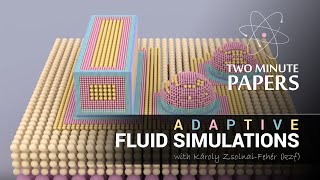
Fluid simulations are expensive to compute, but adaptive grids solve this by increasing resolution only where it matters. The technique uses smaller spheres where detail is needed and larger ones elsewhere, with examples showing view-dependent refinement and how objects interact with the fluid.
Chapters
Dear fellow scholars, this is two minute papers with. As we discussed before, simulating the motion of fluids and smoke with a computer program is a very expensive process. We have to compute quantities like the velocity and the pressure of a piece of fluid at every given point in space. Even though we cannot compute them everywhere, we can place a 3D grid and compute these quantities in the grid points and use mathematical techniques to find out what is exactly happening between these grid points. Still, even if we do this, we still have to wait up to days, even for a few seconds of video footage. One possible way to alleviate this would be to write an adaptive simulation program. Adaptive means that the simulator tries to adapt to the problem at hand here. It means that it recognizes the regions where it needs to focus a lot of computational resources on. And at the same time, it also tries to find regions where it can get away with using less computation. Here you can see spheres of different sizes. In regions where there is a lot going on, you will see smaller spheres. This means that we have a finer grid in this region. Therefore we know more about what is exactly happening here. In other places you also see larger spheres, meaning that the resolution of our grid is more coarse in these regions. This we can get away with only because there's not much happening there. Essentially, we focus our resources to regions that really require it. For instance, where there are lots of small scale details, the spheres are only used for the sake of visualization. The actual output of the simulator looks like this. It also takes into consideration which regions we are currently looking at. Here we are watching one side of the corridor where the simulator will take this into consideration and create a highly detailed simulation at the cost of sacrificing details on the other side of the corridor. But that's fine because we don't see any of that. However, there may be some objects the fluid needs to interact with here. The algorithm makes sure to increase the resolution so that the particles can correctly flow through the holes of this object. The authors have also published the source code of their technique, so anyone with a bit of programming knowledge can start playing with this amazing piece of work. The world of research is incredibly fast moving. When you are done with something, you immediately need to jump on to the next project. 2 Minute Papers is a series where we slow down a bit and celebrate these wonderful works. We're also trying to show that research is not only for experts, it is for everyone. If you like this series, please make sure to help me spread the word and share the series to your friends so we can all marvel at these beautiful works. Thanks for watching and I'll see you next time.