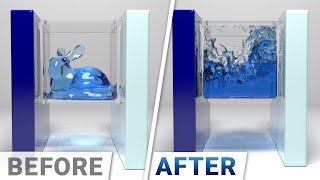
Dr. Zsolnai walks through Adobe's new physics simulation that handles two-way coupling and frictional contact in granular materials, demonstrated with virtual bunnies. The technique solves problems that made it hard to simulate objects interacting realistically with loose materials like sand or gravel.
Questions this video answers
January 29, 2022.
About five minutes per frame.
About two and a half minutes per frame.
Over 70,000 particles.
The Monolith paper (previous technique addressing two-way coupling).
Chapters
And dear fellow scholars, this is Two Minute Papers with Dr. Zsolnai. Today is going to be all about simulating virtual bunnies. What kinds of bunnies? Bunnies in an hourglass with granular material. Bunnies in a mixing drum. Bunnies that disappear. And we'll try to fix this one too. So what was all this footage? Well, this is a follow up work to the amazing monolith paper. What is monolith? It is a technique that helps fixing commonly occurring two way coupling issues in physics simulations. Ok, that sounds great, but what does two way coupling mean? It means that here the boxes are allowed to move the smoke. And the added two way coupling part means that now the smoke is also allowed to blow away the boxes. This previous work simulates these phenomena properly. It also makes sure that when thrown at the wall, things stick correctly. And a ton of other goodies too. So this previous method shows a lot of strength. Now I hear you asking Caroj, can this get even better? And the answer is yes, it can. That's exactly why we are here today. This new paper improves this technique to work better in cases where we have a lot of friction. For instance, it can simulate how some of these tiny bunnies get squeezed through the hourglass and get showered by this sand like granular material. It can also simulate how some of them remain stuck up there because of the frictional contact. Now have a look at this. With an earlier technique, we start with one bunny and we end up with. Wait a minute. That volume is not one bunny amount of volume. And this is what we call the volume dissipation problem. I wonder if we can get our bunny back with the new technique. What do you think? Well, let's see. One bunny goes in, friction happens, and yes, one bunny amount of volume comes out of the simulation. Then we put a bunch of them into a mixing drum in the next experiment where their tormenting shall continue. This is also a very challenging scene because we have over 70,000 particles rubbing against each other. And just look at that. The new technique is so robust that there are no issues whatsoever. Loving it. So what else is all this simulation math good for? Well, for instance, it helps us set up a scene where we get a great deal of artistic freedom. For instance, we can put this glass container with the water between two walls and look carefully. Yes, we apply a little leftward force to this wall. And since this technique can simulate what is going to happen, we can create an imaginary world where only our creativity is the limit. For instance, we can make a world in which there is Just a tiny bit of friction to slow down the fall. Or we can create a world with a ton more friction. And now we have so much friction going on that the weight of the liquid cannot overcome anymore. And thus the cube is quickly brought to rest between the walls. Luckily, since our bunny still exists, we can proceed onto the next experiment where we will drop it into a pile of granular material. This previous method did not do too well in this case, as the bunny sinks down. And if you think that cannot possibly get any worse, well, I have some news for you. It can. How? Look, with a different previous technique, it doesn't even get to sink in because, ouch. It crashes when it would need to perform these calculations. Now let's see if the new method can save the day. And yes, great. It indeed can help our little bunny remain on top of things. So now let's pop the scholarly question. How much do we have to wait for such a simulation? The hourglass experiment takes about five minutes per frame, while the rotating drum experiment takes about half of that. Two and a half minutes. So it takes a while. Why? Of course, because many of these scenes contain tens of thousands of particles, and almost all of them are in constant frictional interaction with almost all the others at the same time. And the algorithm mustn't miss any of these interactions. All of them have to be simulated. And the fact that through the power of computer graphics research, we can simulate all of these in a reasonable amount of time is an absolute miracle. What a time to be alive. And as always, you know what's coming. Yes. Please do not forget to invoke the first law of papers which says that research is a process. Do not look at where we are, look at where we will be. Two more papers down the line. Granular materials and frictional contact in a matter of seconds, perhaps. Well, sign me up for this one. This video has been supported by weights and biases. Check out their recent offering Fully Connected, a place where they bring machine learning practitioners together to share and discuss their ideas, learn from industry leaders, and even collaborate on projects together. You see, I get messages from you fellow scholars telling me that you have been inspired by the series, but don't really know where to start. And here it is. Fully Connected is a great way to learn about the fundamentals, how to reproduce experiments. Get your papers accepted to a conference and more. Make sure to visit them through WNB Me papers or just click the link in the video description. Our thanks to weights and Biases for their long standing support and for helping us make better videos for you. Thanks for watching and for your generous support. And I'll see you next time.