AI Gone WILD: Google's New AI - SEMANTICA, Elon Musk Says No One Will Work Anymore!
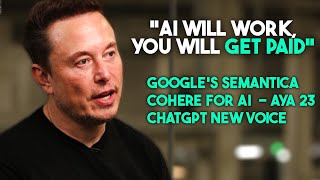
LARRUZ covers this week's AI news: Elon Musk says AI could eliminate work and create universal income, Google DeepMind released Semantica for image-to-image generation, Cohere for AI launched Aya23 supporting 23 languages, and Amazon plans to upgrade Alexa with generative AI behind a paywall.
Chapters
In this week's AI News Roundup, we've got some exciting updates. Elon Musk predicts a future where AI takes over all jobs Google DeepMind introduces an amazing new image generation model called Semantica, and Cohere for AI launches aya23, a powerful multilingual language model. Plus, we'll dive into the latest drama with OpenAI and Scarlett Johansson, Amazon's big plans for Alexa, and Meta's groundbreaking chameleon model that could revolutionize AI. Okay during a recent talk at the Viva Technology conference in Paris, Musk shared his vision of a world where artificial intelligence takes over all jobs. So not just certain jobs, but all jobs. Musk, who's the CEO of Tesla and founder of companies like Xai, SpaceX and Neuralink, believes there's about an 80% chance that AI will advance to the point where humans won't need to work anymore. Instead of worrying about losing his own job to AI, he he's looking at a future where no one needs a job. Instead of just a basic income, Musk thinks we'll have a universal high income, meaning everyone will have plenty of money and there'll be no shortage of goods or services. But here's the catch. Musk says the big question will be about finding meaning in life. If robots and computers can do everything better than us, what will give our lives purpose? He's also mentioned before that AI is the most disruptive force in history, and that eventually having a job will be more about personal satisfaction than necessity to so, according to Musk, we're heading towards a future where AI takes care of everything and we'll need to figure out what to do with all that free time. Pretty wild, right? Alright now Google DeepMind just introduced Semantica, a new AI image conditioned diffusion model that can create new images based on the details of an existing one. Instead of fine tuning models for each dataset, Symanteca uses in context learning, it's trained on pairs of images from the web, using one image to help generate another, assuming they share common traits. Now, Symanteca is incredibly flexible. It uses pre trained image encoders and content based filtering to produce high quality images without extra fine tuning, making it perfect for various image sources. The model works by gradually refining an image from random noise, balancing efficiency and quality, which actually makes it ideal for content creation, image editing and virtual reality. Symanteca has many practical uses in creative industries. It can generate artwork or design elements based on a specific style. In education, it can create visuals for different topics, making learning more engaging for e commerce. It can generate product images that match customer tastes, boosting sales. Researchers found that semantica effectively captures the core details of input images, producing consistent and relevant results. They say it's a big step forward in image generation technology. Okay, now big news from Cohere for AI. They've just launched Aya 23, which is a new series of super advanced language models that can understand and generate text in 23 different languages. These models are available in two sizes, one with 8 billion parameters and another with 35 billion parameters, and they're releasing them for free. So what's the deal with Aya23? Well, it builds on an earlier project called Aya where thousands of people teamed up to create a massive multilingual dataset. While Aya 101 covered 101 languages, Aya 23 focuses on going deep with 23 languages, making it super powerful for those languages. Cohere for AI wants to change the game by making sure more languages get top notch AI support, not just the usual few. They've tested Aya 23 against other big name models and guess what? The 35 billion parameter version outperformed them all in the languages it covers. Even the smaller 8 billion parameter model is a top performer with. What's cool is that the 8 billion version is also really efficient, so it doesn't need a ton of computing power. This makes it easier for developers everywhere to use cutting edge AI. If you're into AI research or just curious, you can check out aya23 on hugging face and for more details, head over to Cohere's site. Now let's talk about a recent drama with OpenAI and Scarlett Johansson. So last May, OpenAI was looking for voice actors to give their chatgpt a human voice. They wanted non union actors who sounded between 25 and 45 years old with warm and engaging voices. Fast forward to this week. Scarlett Johansson claimed that OpenAI copied her voice for a new chatgpt voice named sky, even after she said no to their CEO Sam Altman. She's known for playing an AI in the movie her, so people quickly notice the resemblance. But here's the OpenAI had already hired an actress in June to create Sky's voice before Altman even contacted Scarlett. This actress's natural voice just happens to sound like Scarlett's AI character from her. After Scarlett's claims, OpenAI paused using Sky's voice and explained the whole process in a blog post. They insisted they never meant for sky to sound like Scarlett and hired the actress way before reaching out to her. Experts are saying Scarlett might have a strong case if she sues, comparing it to a similar situation in the 80s with singer Bette Midler. But OpenAI stands by their story, saying Sky's voice is just coincidentally similar. So that's the gist of it. Let's see how this plays out. Alright now. For nearly a decade, Alexa has been our go to for voice commands like setting timers and streaming music. But compared to the advancing AI world, Alexa's capabilities have felt limited. That's about to change. Amazon plans to transform Alexa into a truly intelligent conversational AI assistant using large language models and generative AI Reports suggest Amazon will upgrade Alexa to handle natural back and forth discussions. Essentially, Alexa will do everything ChatGPT does and more without needing to open an app. However, this enhanced Alexa will come with a monthly subscription fee separate from Amazon Prime. Amazon needs to stay competitive in the tech world, and integrating more AI is essential. While most of us use Alexa for simple tasks, Amazon aims to add complex features features to keep up with Google and OpenAI. Under CEO Andy Jassy, Alexa has become less of a focal point. But there's pressure to improve it. The Alexa team has reorganized, with many now working on artificial general intelligence, raising concerns about privacy and AI's role in our homes. Upgrading Alexa with generative AI is a big challenge. Amazon must attract top AI talent and manage the high costs of AI computing. Each query could cost around 2 cents, adding up quickly. Hence the subscription fee makes sense to cover these expenses. With Alexa in millions of homes, Amazon has a huge opportunity but also faces risks if the upgraded Alexa has glitches. They plan to use their own large language model Titan for this upgrade. Even Jeff Bezos has shown concern about Amazon staying competitive in AI. Okay now. Language models like GPT3 revolutionized AI by understanding and generating human like text. This opened new possibilities for AI assistants, creative writing, coding and more. Multimodal AI models took it further. Handling text, images, audio and video examples like dall E&GPT4 blend visuals and text seamlessly. Now Meta's chameleon model changes the game. Previous models used a late fusion approach, processing each data type separately before merging them. Chameleon employs an early fusion architecture integrating all data streams from the start. This deep integration eliminates inefficiencies. Training Chameleon was complex, using two stage learning and massive data sets. With over 4 trillion examples, the results are extraordinary. Chameleon excels at tasks like image captioning, visual question answering, and generating documents with intermingled text and images. It matches top language models on text only tasks too. Chameleon's unified architecture boosts effectiveness across scenarios. This breakthrough points to future AI systems that seamlessly understand and generate multimodal content. Applications could include advanced robotics, AR VR interfaces, and multimedia search and generation. Meta's Researchers see Chameleon as a step toward artificial general intelligence, mastering all modalities. While human level cognition is still distant, early fusion brings us closer. Though Chameleon isn't publicly released yet, it may soon become a powerful tool for research and commercial use. Alright, don't forget to hit that subscribe button for more updates. Thanks for tuning in and we'll catch you in the next one.










