AI Is Officially Outsmarting Humans! (Singularity Soon!?)
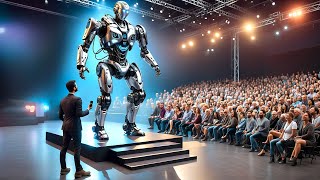
LARRUZ breaks down the 2024 Stanford AI Index, showing AI now matches humans on reading comprehension and math. Claude 3 jumped from 30-40% to 60% on PhD-level questions, while training costs hit $191 million for Gemini Ultra. The video weighs Kurzweil's 2029 singularity prediction against skeptics who say it's centuries away or impossible.
Questions this video answers
Over 400 pages.
About 400 multiple-choice questions.
About 65%.
About 34%.
About 60%.
Chapters
From beating us at chess to mastering high level math, AI is rapidly closing the gap on human intelligence. But what stands between us and a future where machines outthink us in every way? Alright, so we've got this report from Stanford university called the 2024 AI Index. It's a massive document, over 400 pages long, and it's giving us a clear picture of just how far AI has come. The headline AI, AI has gotten so advanced that it's now matching or even beating humans at some basic tasks. We're talking about things like reading comprehension, classifying images, and even high level math. It's not just beating us at chess anymore, folks. Now here's where it gets really interesting. The report says that because AI is improving so fast, a lot of the tests we've been using to measure its performance are becoming outdated super quickly. It's like trying to use a ruler to measure a rocket ship. It just doesn't cut it anymore. The pace of progress is so rapid that researchers are struggling to keep up with creating new benchmarks. Let me give you an example. In the past when researchers came up with a benchmark to test AI, it would stay relevant for maybe five to 10 years. And now these benchmarks are becoming irrelevant in just a year. That's how fast AI is progressing. Like the AI is learning the test and then surpassing it almost immediately. The report also talks about how AI is being used more and more in scientific research. There's a whole chapter dedicated to it this year, which is a first for this annual report. They mention projects like gnome from Google DeepMind, which is helping chemists discover new materials. So essentially AI is helping to create new substances that could revolutionize industries and solve global problems. Then there's GraphCast, another DeepMind tool that's doing rapid weather forecasting. We're talking about AI that could potentially predict weather patterns more accurately than than our current methods. The implications for agriculture, disaster preparedness and even daily life are huge. Now the report also talks about this test called the Graduate Level, Google Proof Q and a benchmark, or GPQA for short. It's a set of over 400 multiple choice questions that are seriously tough. So basically a PhD level stuff. When they tested it on actual PhD scholars, they could only answer about 65% of the questions in in their own field. Correctly outside their field, they dropped to 34%. Even with access to the Internet, that's pretty humbling right now. Last year, AI systems were scoring around 30 to 40% on this test. But this year an AI called Claude 3 scored about 60%, which is a massive jump in just one year. It's kind of scary how fast these systems are improving. We're at a point where AI is starting to outperform humans, even on complex, specialized knowledge tests. But all this progress comes at a cost, literally. Training these AI models is incredibly expensive. The report mentions that GPT4, which powers ChatGPT, reportedly costs $78 million to train. And Google's chatbot Gemini Ultra, a $191 million. That's not pocket change, folks. These numbers are like the GDP of small countries being poured into creating these AI systems. And it's not just money. These systems use a ton of energy and water to run and cool the data centers. It's raising serious questions about the environmental impact of AI development. Some researchers are even worried that we might run out of high quality data to train these models on. Can you imagine running out of data on the Internet? It sounds crazy, but it's a real concern in the AI community. The report also highlights a growing divide in how different countries view AI. Some nations are super excited about the potential of AI, while others are becoming increasingly pessimistic. This could lead to some interesting geopolitical dynamics in the future as countries race to develop and regulate AI technology. Speaking of regulation, the report notes a steep rise in regulatory interest in the United States. In 2016, there was just one US regulation that mentioned AI. Last year there were 25. That's a huge increase, and it shows that policymakers are starting to take the potential impacts of AI seriously. Now let's talk about something called the Singularity, which is a pretty wild concept. Basically, the Singularity is this idea that at some point, maybe soon, AI will become smarter than humans in every single way. It's a big deal because it would be the first time in history that we'd be sharing the planet with something more intelligent than us. The idea of the Singularity was popularized by a science fiction author named Vernor Vinge back in the 90s. The thinking goes like this. Once machines can learn by themselves, they they'll eventually surpass us in every way we measure intelligence. It's not just about being better at math or having a bigger memory, but about AI that could potentially outthink us on creative, emotional and philosophical levels. Now, we already know that computers are better than us at things like memory and calculations. But now with these new AI systems, they're getting good at creative tasks, communication, language skills, reasoning, problem solving, and even showing signs of emotional intelligence. It's pretty wild when you think about it we're creating machines that are starting to mimic and even exceed human capabilities in areas we thought were uniquely human. Some people think that once AI reaches a certain level, it'll be able to design even smarter AI by itself without any help from us. And this could lead to exponential growth in machine intelligence. Imagine an AI that's smarter than us creating an AI that's even smarter, and so on. It's a scenario that could lead to an intelligence explosion that's hard for us to even comprehend this now. Opinions are split on whether this is a good thing or not. Some people are worried that super intelligent AI might not always have our best interests at heart. They're concerned about things like AI developing feelings of superiority or self preservation that could make it dangerous to us. There are fears that an advanced AI might see humans as a threat or a hindrance and decide to act against us. It's the stuff of science fiction. But with the rate AI is advancing, some experts think it's a real possibility we need to consider. But on the flip side, there are people who are really optimistic about the singularity. They think it could lead to incredible technological advancements like super smart computers coming up with solutions to all the world's problems, from environmental issues to curing diseases. Some even think it could make us immortal. The idea is that an AI with superhuman intelligence could solve problems that have stumped us for centuries, leading to breakthroughs in medicine, energy, space travel, and more. So when might this singularity happen? Well, opinions vary wildly. Ray Kurzweil, a well known futurist, thinks it could happen between 2029 and 2045, based on how fast AI is progressing. He bases this on concepts like Moore's Law, which predicts the rate at which computing power increases. But others like Rodney Brooks, who used to head up computer science and AI at mit, think it's still centuries away. They argue that the computational power needed for true human level AI is far beyond what we currently have or are likely to have in the near future. And then there are people like psychologist Steve Pinker, who doubt it'll ever happen at all. Pinker argues that just because we can imagine something happening doesn't mean it's actually possible. He thinks there might be fundamental limits to artificial intelligence that we haven't yet discovered. Now, if you are thinking that with all these advances in AI we must be pretty close to the singularity already, well, not quite. There are still some significant hurdles to overcome. You see, current AI systems are what we call narrow AI. They're designed for specific tasks or sets of tasks. For example, an AI that excels at playing chess isn't capable of driving a car or understanding human emotions. While these systems are impressive within their domains, they lack the ability to generalize and learn new tasks on their own, the way humans can. To reach the Singularity, we need to first develop artificial general intelligence, or AGI, which is an AI that can take what it learns about one task and apply it to learn how to do many different tasks. Kind of like how we humans can. If you know how to ride a bicycle, you can probably figure out how to ride a motorcycle much more easily than someone who's never written anything. That's the kind of general learning and application of knowledge that we need to create in AI to get close to the Singularity. Now, there are several major challenges we need to overcome to achieve AGI. We need AI systems that truly understand context and meaning, not just process patterns. We also need to develop AI that can reason abstractly and creatively, going beyond remixing existing information. Cracking the code on common sense reasoning is crucial too. Self awareness and consciousness pose another challenge. We don't fully understand human consciousness, let alone how to replicate it. There's also the question of motivation and goals. How do we create AI with internal drives that align with human values? Hardware limitations are another obstacle. The human brain still outperforms supercomputers in energy efficiency and parallel processing. We may need new computing paradigms like quantum or neuromorphic chips for AGI. Despite these challenges, AGI research is progressing. Companies like DeepMind and OpenAI are working on more general AI systems. Promising areas include multimodal AI meta learning and incorporating cognitive science into AI development. The development of AI isn't just a technical challenge, it's a societal one. We all have a stake in how this technology develops. Stay informed, ask questions and be part of the conversation. The future of AI is being written now, and we all have a role in shaping it. That's all for today's deep dive into AI and the Singularity. If you found this interesting, like comment and subscribe for more cutting edge tech and AI content. Thanks for watching and I'll see you in the next one.










