AI is Taking Over: This Week's AI News are Pure Fire!
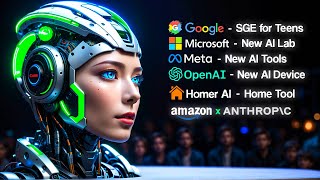
Google's expanding AI search to US teens, Meta is adding AI across WhatsApp and Instagram, and OpenAI is working with Jony Ive on a new device. Amazon plans to invest up to $4B in Anthropic, and researchers built an AI that detects signs of life with 90% accuracy.
Questions this video answers
October 1, 2023.
Users aged 13 to 17.
About 90% accuracy.
134 samples.
555 California Street.
Chapters
This week has been packed with cool AI updates and I can't wait to discuss them with you. Kicking things off Google's AI search functions are leveling up for younger audiences. While Meta unveils a bunch of new AI features for apps we use every day, OpenAI is teaming up with Joni, I've the Apple Design Legend and SoftBank for a project that's set to redefine AI devices. Scientists break new ground with AI technology that discerns signs of life with with unmatched precision. Microsoft's got a new AI spot in San Francisco and added a fun art tool to paint, whereas Amazon deepens its alliance with Anthropic betting on the future of AI assistants. And speaking of assistants, OpenAI's ChatGPT has a web browsing feature again for those looking to capitalize on their property. A new AI tool is set to revolutionize house valuations. And before we dive in, remember to subscribe to my channel to stay updated with all the latest AI news and developments. Alright? Now Google is improving its AI search functions and making them available to younger users. They have been working on AI supported search features, including a chatbot named Google Bard. Google recently introduced Search Labs which allows users to try out these new AI features and share feedback. The data shows that people aged 18 to 24 found this very beneficial. Now Google plans to let users aged 13 to 17 in the US also use these AI search tools. One feature, SGE while browsing lets users see AI created main points of a web page they're looking at for students. This new access to Google's AI tools can be very useful, but Google wants to ensure it's safe. They're adding features to prevent younger users from seeing unsuitable or harmful content. Also, Google is providing a guide about AI for teenagers and their parents to understand the benefits and limits of this technology. There's a new feature named about this Result that explains how the AI gives answers to the users regarding content online. Google recognizes the need to protect and respect publishers. AI systems learn from online content, which could be seen as using someone's work without asking. So Google introduced a tool named Google Extended. It lets website owners decide if they want their site's content. To train Google's AI tools Next Meta has introduced new AI tools across platforms like WhatsApp, messenger and Instagram. One new feature, AI stickers, lets you create custom stickers by typing commands like sticker Happy birthday. The AI uses Llama 2 and EMU technologies to make these stickers. Initially this will be available to some English speaking users on WhatsApp, Messenger, Instagram and Facebook stories. Two upcoming Instagram features, Restyle and Backdrop will let you change how your images look. Restyle lets you give your photos different visual styles. Backdrop allows you to change your photo's background. Both use technology from EMU and other Meta models. Meta's new AI assistant will soon be available on platforms including WhatsApp, messenger and Ray Ban. Meta Smart Glasses. This assistant can provide information, create images, answer questions and even tell jokes. It uses Llama 2 technology and Microsoft's Bing search engine. Furthermore, Meta is testing 28 AIs with unique personalities. Some, like those played by Snoop Dogg and Naomi Osaka, reflect famous personalities. These AIs still in beta, have information up to 2022 and will soon be able to search the web. Initially, they'll be US exclusive. Lastly, Meta is launching AI studio platform. Here people can build their own AIs even if they aren't tech experts. This can help businesses answer questions or individuals create their own AI characters. Meta will also release a sandbox tool in the future, allowing even more AI creativity. Okay now OpenAI is working closely with Joni I've a former Apple designer and SoftBank, a major Japanese tech company, to create a groundbreaking AI device. This project aims to be as revolutionary as the iPhone was in its time and they Hope to secure $1 billion in funding for it. OpenAI's leader Sam Altman has asked I've's company Love from to help design this new AI device. Jony I've has a rich history at Apple having helped design iconic products like the iPhone. The project is in the beginning phases and the team is focused on making an AI device that feels natural to use. Taking inspiration from the iPhone's intuitive touchscreen interface, SoftBank's CEO Masayoshi Son is considering investing over $1 billion in this venture. He also wants his company ARM, which designs computer chips and is mostly owned by Softbank, to have a big role in the project. However, the discussions about this project are still ongoing and a final agreement hasn't been reached. If the project gets approved, it might be a while before the actual product hits the market. Alright now scientists have developed a new AI based method that can identify signs of life with 90% accuracy. In the past, research been challenging to detect certain molecules linked to life because they break down over time. However, this AI can spot the tiny differences in molecular patterns that suggest life even in very old samples. Soon this technology could be part of sensors in space robots like those on Mars or the moon. It could also be used in spacecraft around planets where life might exist. Robert Hazen from the Carnegie Institution for Science says that life has a unique chemistry. If we understand this, we might find signs of life on other planets. This new technique believes that living molecules like amino acids give clues about how they were formed. The same should apply to alien life. The AI can see which compounds are used more by life forms compared to nonliving systems. To test the AI, the team used 134 samples, with some being from living things like shells and bones, and others from nonliving things like amino acids made in labs. The AI could tell the difference between them. This AI tool might also help study ancient rocks in Australia. These rocks might have the world's oldest fossils. If the AI confirms this, it means life existed on Earth sooner than we thought. Some experts, however, debate this. The details of this study were published in the Proceedings of the National Academy of Sciences journal. Next Microsoft is setting up a new AI center in San Francisco, making the city even more of a hotspot for AI development. This new place, called the AI Co Innovation Lab, is at 555 California street and is designed to help businesses use AI more in their projects. Microsoft's Christopher Young said they're excited to work with all types of companies from this region in their lab. According to Jun Yamasaki from Microsoft, the lab offers resources for both big and small companies to develop AI products with the help of Microsoft's team. It also highlights Microsoft's online services and software. Some of the ongoing projects include working with Sony on computer vision tech and helping people who don't code to make software. This San Francisco lab is the second one in the US with the first one in Redmond, Washington, and it's the fifth one worldwide. Other major AI companies like Anthropic and OpenAI are also growing in San Francisco. In fact, the demand for office space by AI firms in the city is huge, reaching nearly 1 million square feet. Reports show San Francisco is a leader in AI jobs and top AI companies. It has 20 of the top funded AI companies, more than anywhere else in the U.S. next, Amazon plans to invest up to $4 billion in Anthropic, the company that created an AI assistant called Claude. With this new partnership, Anthropic will use Amazon's technology to improve their AI models, and these models will also be available on Amazon's platform, called Bedrock. Amazon's decision means that it's buying a small portion of Anthropic. A statement from Amazon revealed that Anthropic will mainly use Amazon Web services for its online needs. Furthermore, Anthropic will use Amazon's special chips Trainium and Inferentia to develop and improve their AI models, making use of the affordability, speed and security provided by AWS. Earlier this year, Anthropic introduced Claude 2, an AI chat assistant that rivals ChatGPT. Also, they raised $450 million from big companies like Google, Salesforce and others to enhance their products and help businesses using Claude based tools. Anthropic, which was started by people who previously worked at OpenAI, said businesses can use Claude through Amazon Bedrock. This service lets people use AI tools easily. Claude will help Amazon AWS users add AI features to their projects, improve current apps and introduce new customer experiences. Now OpenAI has added a browsing feature back to ChatGPT, which allows ChatGPT to search the Internet for the latest information. They made this announcement on X. For now, users who pay for ChatGPT can use the Browse with Bing feature, but OpenAI plans to make it available to everyone soon. Previously, they let users search the Internet with Bing inside the premium ChatGPT version, but they stopped this feature in July because of worries that users might avoid paywalls. Now people are worried about their privacy with ChatGPT. To use its browsing feature, users need to share their chat history, which could expose personal details. OpenAI has mentioned that websites can control how they interact with ChatGPT. Online. House valuations often get it wrong, with research showing they're off by 13% on average. In London, these valuations miss by about £70,000, and in the rest of the UK it's around £38,000. Many homes are either overvalued or undervalued by 20%, or about £56,000. A new tool named Homer by Home Move is here to change this. It uses visual AI to analyze pictures of homes. It checks things like how tidy the rooms are, if the interiors are old and if there's any visible damage. It also uses data from past sale prices, home extensions and energy ratings. This helps sellers understand their home's value better and attracts more buyers. James Freestone from Home Movement believes Homer can help estate agents. It gives a first look at a home's value and then links sellers to professionals. Visual checks of a house are still essential. Homer improves this by studying pictures to give better value estimates. Finally, Microsoft is introducing a new feature in Paint called Paint Co Creator. This tool uses OpenAI's Dall E3 model to turn text descriptions into digital artwork. Dave Grococki from Microsoft explains that users can describe in simple words what they want to make and and the tool will give them three art options to choose from. To use this you'll need a certain version of Paint and join a waitlist. It's a bit like how Microsoft Bing was introduced. If you get into the preview, you'll be informed through email and get 50 free credits to try it out. Microsoft is careful about the content, so there are built in features to stop inappropriate or harmful images. Grococki mentions that not everyone will get this feature immediately as they want feedback. First, this is just one of many new features Microsoft is adding. They're testing a tool to easily remove backgrounds from Images in Windows 11. Also, new layer and transparency support in Paint is coming. Lastly, the recent Windows 11 update brought many new features, including a way for users to not use passwords and tools for safer devices. Alright, that concludes this week's AI News. If you enjoyed this video, don't forget to hit the like button, subscribe to my channel and click the Bell icon to stay updated on all my future uploads. Thanks for tuning in and I'll catch you in the next one.










