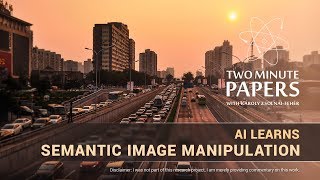
Researchers built an AI that converts semantic maps into photorealistic 2K images using a generative adversarial network. The system uses boundary maps and multiple discriminators at different scales to improve quality. The source code is freely available.
Chapters
Dear fellow scholars, this is two minute papers with this technique is about creating high resolution images from semantic maps. A semantic map is a colorful image where each of the colors denote an object class such as pedestrians, cars, traffic signs and lights, buildings and so on. Normally we use light simulation programs or rasterization to render such an image. But AI researchers ask the question why do we even need a renderer if we can code up a learning algorithm that synthesizes the images by itself? Whoa. This generative adversarial network takes this input semantic map and synthesizes a high resolution photorealistic image from it. Previous techniques were mostly capable of creating coarser lower resolution images, and also they were rarely photorealistic. And get this, this one produces 2k by 1k pixel outputs, which is close to full HD in terms of pixel count. If we wish to change something in a photorealistic image, we'll likely need a graphic designer and lots of expertise in Photoshop and similar tools. In the end, even simpler edits are very laborious to make because the human eye is very difficult to fool. An advantage of working with these semantic maps is that they are super easy to edit without any expertise. For instance, we can exert control on the outputs by choosing from a number of different possible options to fill the labels. These are often not just re skinned versions of the same car or road, but can represent a vastly different solution like changing the material of the road from concrete to dirt. Or it is super easy to replace trees with buildings. All we have to do is rename the labels in the input image. These results are not restricted to outdoors traffic images. Individual parts of human faces are also editable. For instance, adding a mustache has never been easier. The results are compared to a previous technique by the name pix2 pix and against cascaded refinement networks. You can see that the quality of the outputs vastly outperforms both of them, and the images are also of visibly higher resolution. It is quite interesting to say that these are previous work because both of these papers came out this year. For instance, Our episode on PIX2PIX came nine months ago and it has already been improved by a significant margin. The joys of machine learning research. Part of the trick is that the semantic map is not only used by itself, but a boundary map is also created to encourage the algorithm to create outputs with better segmentation. This boundary information turned out to be just as useful as the labels themselves. Another trick is to create multiple discriminator networks and run them on a variety of coarse to fine scale images. There is much, much more in the paper. Make sure to have a look for more details. Since it is difficult to mathematically evaluate the quality of these images, a user study was carried out in the paper. In the end, if we take a practical mindset, these tools are to be used by artists and it is reasonable to say that whichever one is favored by humans should be accepted as a superior method. For now, this tool is going to be a complete powerhouse for artists in the industry. And by this I mean right now. Because the source code of this project is available to everyone free of charge. It's free. In the meantime, we have an opening at our institute at the Vienna University of technology for one PhD student and one postdoc. The link is available in the video description. Read it carefully to make sure you qualify. And if you apply through the email address of Professor Michael Wimmer, make sure to mention two minute papers in your message. This is an excellent opportunity to turn your life around, live in an amazing city, learn a lot and write amazing papers. It doesn't get any better than that. Deadline is end of January. Thanks for watching watching and for your generous support and I'll see you next year.