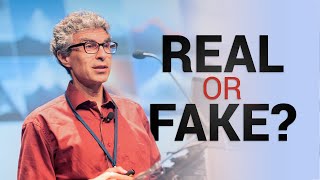
Dr. Zsolnai demonstrates a new deepfake method that generates both audio and video in about 40 seconds using as little as 30 seconds of target footage. A user study with 110 participants found the fakes nearly indistinguishable from real video.
Questions this video answers
May 7, 2021
30 seconds of video footage
2.5 minutes and 10 minutes of video data
40 seconds
110 participants
Chapters
Dear fellow scholars, this is two minute papers with Dr. Zsolnai. Imagine that you are a film critic and you are recording a video review of a movie. But unfortunately, you are not the best kind of movie critic. And you record it before watching the movie. But here is the problem. You don't really know if it's going to be any good. So you record this.
I'm gonna give Hereditary a B minus.
So far so good. Nothing too crazy going on here. However, you go in, watch the movie, and it turns out to be amazing. So what do we do if we don't have time to re record the video? Well, we grab this AI, type in the new text, and it will give us this.
I'm gonna give Hereditary an A. Whoa.
What just happened? What kind of black magic is this? Well, let's look behind the person on the blackboard. You see some delicious partial derivatives. And I am starting to think that this person is not a movie critic. And of course he isn't, because this is Yoshua Bengio, a legendary machine learning researcher. And this was an introduction video where he says this. And what happened is that it has been repurposed by this new Deepfake generator AI where we can type in anything we wish and out comes a near perfect result. It synthesizes both the video and audio content for us. But we are not quite done yet. Something is missing. If the movie gets an A. The gestures of the subject also have to reflect that this is a favorable review. So what do we do? Maybe add a smile there. Is that possible?
I'm gonna give Hereditary an A.
Oh yes, there we go. Amazing. Let's have a closer look at one more example where we can see how easily we can drop in new text with this editor.
Why yao or worry over silly items? Marvel movies are not cinema.
Now, this is not the first method performing this task. Previous techniques typically required hours and hours of video of a target subject. So how much training data does this require to perform all this? Well, let's have a look together. Look. This is not the same footage copy pasted three times. This is a synthesized video output. If we have 10 minutes of video data from the test subject, this looks nearly as good, has fewer sharp details. But in return, this requires only two and a half minutes. And here comes the best part. If you look here, you may be able to see the difference. And if you have been holding onto your paper so far, now squeeze that paper, because synthesizing this only required 30 seconds of video footage of the target subject. My goodness. But we are not Nearly done. Yet it can do more. For instance, it can tone up or down the intensity of gestures to match the tone of what is being said. Look. So how does this wizardry happen? Well, this new technique improves two things really well. One is that it can search for phonemes and other units better. Here is an example. We crossed out the word spider and we wish to use the word fox instead. And it tries to assemble this word from previous occurrences of individual sounds. For instance, the ox part is available when the test subject utters the word box. And two, it can stitch them together better than previous methods. And surely this means that since it needs less data, the synthesis must take a great deal longer, right? No, not at all. The synthesis part only takes 40 seconds. And even if it couldn't do this so quickly, the performance control aspect where we can tone the gestures up or down or add a smile, would still be an amazing selling point in and of itself. But no, it does all of these things quickly and with high quality at the same time. Wow. I now invite you to look at the results carefully and give them a hard time. Did you find anything out of ordinary? Did you find this believable? Let me know in the comments below. The authors of the paper also conducted a user study with with 110 participants who were asked to look at 25 videos and say which one they felt was real. The results showed that the new technique outperforms previous techniques even if they have access to 12 times more training data, which is absolutely amazing. But what is even better, the longer the video clips were, the better this method fared. What a time to be alive. Now, of course, beyond the many amazing use cases of deepfakes in reviving deceased actors, creating beautiful visual art, redubbing movies and more, we have to be vigilant about the fact that they can also be used for nefarious purposes. The goal of this video is to let you and the public know that these deepfakes can now be created quickly and inexpensively and they don't require a trained scientist anymore. If this can be done, it is of utmost importance that we all know about it. And beyond that, whenever they invite me, I inform key political and military decision makers about the existence and details of these techniques to make sure that they also know about these and using that knowledge, they can make better decisions for us. You can see me doing that here. Note that these talks and consultations all happen free of charge and if they keep inviting me, I'll keep showing up to help with this in the future. As a service to the public. Perceptilabs is a Visual API for TensorFlow, carefully designed to make machine learning as intuitive as possible. This gives you a faster way to build out models with more transparency into how your model is architected, how it performs, and how to debug it. Look, it lets you toggle between the visual modeler and and the code editor. It even generates visualizations for all the model variables and gives you recommendations both during modeling and training, and does all this automatically. I only wish I had a tool like this when I was working on my neural networks during my PhD years. Visit perceptilabs.com papers to easily install the free local version of their system today. Our thanks to Perceptilabs for their support and for helping us make better videos for you. Thanks for watching and for your generous support, and I'll see you next time.