AI News: Native Image Generation, Gemini 2.5, and Groundbreaking Medical AI!
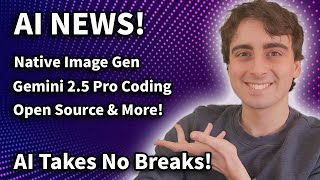
OpenAI added native image generation to GPT-4 Omni, Google released Gemini 2.5 with better coding, and a new AI detects endometrial cancer with very high accuracy. Grok 3 can edit images, and open-source tools now convert images to video and animation.
Chapters
Welcome Back to another AI news roundup here on the Matvid Pro AI YouTube channel. We've got some fun stuff to talk about today for sure, so let's dive right in. First up on today's roster, I just want to do a quick recap of the thing that really stole the show this week in the AI space, and that is the native image generation with GPT4 omni from OpenAI. I just did a full video about it, it's about 20 minutes long, so that's my last video. Check the channel for that. So yeah, this is a model that is not only a large language model, but audio model and an image model as well. It's all wrapped into one. That's why it's called GPT4 omni. Right? It's actually auto regressive and that's how the image generation works, which is pretty crazy because typically it is only diffusion based image generation that we've been dealing with for the past couple of years. But because it's an autoregressive natively embedded image generation model within chat GPT, it can do image to image transformation, allowing GPT4O to take one or multiple images as an input, then produce a related or modified image based on those inputs. Super advanced photorealistic capabilities. I mean, jaw dropping. You really, in a lot of images can't tell that it's AI generated in the first place. And the instruction following is the biggest part. It's the most detailed instruction following I have ever seen from a model. It can combine like 16 elements into one image coherently, which is like orders of magnitude better than anything we have seen prior to. So we've got detailed instructions, rendering text, instructional diagrams, lots of utility and a little bit of extra risk from this. Obviously we know the image generation is good, but it does have some really intriguing extra capabilities. Like for example, you can upload an image of something that appears to be 3D. Obviously it's just like a 2D, PNG or JPEG, but ChatGPT can look at that image and draw lines showing the fact that this model has very good spatial understanding of the images that it sees. You can see in this one, we've got all these lines showing it's in like a box and then all the curvatures for the horns and the eyes and the face of this little dragon character. Pretty darn insane. Not to mention it can also do the same thing and then do a side profile which is perfect. I mean, that is the same exact character. Right? Folks have also come up with some really awesome use cases. People essentially have been converting tons of images from everything around the world into like a studio Ghibli anime style. And some people love it, some people hate it. It's a little bit controversial right now for some reason, but BG Ace here went ahead and remade the entire Lord of the Rings trailer in this studio Ghibli format, which is pretty darn cool. Honestly. I think it looks great. I think it shows how far we've come. You can just do like instant style transfer into a popular anime art style. Granted, though, this whole workflow did take PG Ace here about 9 hours of re editing to get it to look this good. And still it's not as great as a real studio Ghibli film. By no means. I mean those are artistic masterpieces, but we're making leaps, bounds and strides. There is a lot more you could do with AI technology in the art space than you could do just a couple of years ago now. Interestingly enough, a couple of days before OpenAI launched their very own native image generation that has taken the world by storm, Grok 3 actually got its very own native image generation as well. It's not nearly as good in my testing. It's quite blurry. Like when it recreates images, it kind of looks like there's been some sort of like hallucinatory filter applied over it. It's kind of wishy washy, not nearly as good, but it is a capability that's in GROK for free. Like adding a bunch of sunglasses onto these cute little guys, changing hair color, changing a dress that a character is wearing. Lots of really, really great examples here from Poonam, Sony. So yeah, as always, everything's going to be linked down in the description below. But yeah, GROK has its own image editing as well. This kind of flew under the radar just because of the whole OpenAI native image generation explosion. Now next up, this is probably the second biggest announcement that happened this week. Gemini got a 2.5 upgrade. It is their new most intelligent model. Apparently it's state of the art across many benchmarks and it can handle complex problems and give more accurate responses. The main thing that people are noticing in the community about this model is the fact that it has increased code capabilities and and this is even above Claude 3.7 sonnet thinking, which recently was the top charter and considered by the community to be the best coding model. And this is seemingly for a lot of folks, overtaken it. Which is pretty crazy coming from Google, which didn't have the strongest start to large language models, but is really catching up at this point. And by the way, you can actually try this model for completely free in the Google API, which is really awesome. Google's been pretty great with that, just giving us free access to these non open source but closed source AIs. At least we can try them out for free and we don't have to pay for them. Here we could see 2.5 pro experimental developing a quick video game creates a ton of code over here and it essentially one shots this little pixel dinosaur runner game where you simply just have to hop over obstacles. Now honestly the graphics for this game are pretty good considering they're all generated with code. We even have like a kind of a running animation on the main character there. But yeah it one shot this and this is a pretty easy task I think for it. You'll see some other more insane examples in this video. And of course Gemini 2.5 Pro experimental has already been jailbroken by Pliny the Liberator. I don't think there's a single model that this guy can't crack open and get it to reveal all kinds of heinous secrets or things that are against the typical guidelines or rules that Google provides the model. And of course with Pliny everything is always posted to his GitHub. So if you want to jailbreak this for yourself, the link is in the description. It is really crazy to see because a lot of people who use AI for coding every day are claiming that Gemini 2.5 is so much better, that it's fixing Claude 3.7's quote unquote atrocious code with just one prompt. The user claims that it showed them how nonsense Claude's code was to begin with. It felt like I had no chance to make it work or would have spent days fixing it. Apparently it was a lot to actually fix the code that Claude 3.7 actually made, but Gemini was just able to take care of it. You know, this is really intriguing because it does show us how far we really have to go with AI in terms of coding. We need long context length, we need smarter models, and it seems like each new model that releases gets increasingly better and better at actually coding. So let's take a look at some community favorites. The best examples from Gemini 2.5 Pro. And these will be brought to us by Min Choy who has kind of collaborated them together. The first one is a Minecraft clone in a single prompt. And this actually was created by a very popular user on my Discord server, Thacano. And yeah, this is Pretty crazy. There's even shading on some of these blocks. This is just a one shot prompt, start game with settings, voxel world. We enter it and yeah, it loads it in with fog and everything. It really is like a Minecraft clone. The shading looking pretty darn decent, all things considered. Like, I am pretty staggeringly impressed that Gemini 2.5 Pro was able to just spit this out. You can even place blocks and actually build stuff. I mean, it's very rudimentary. There's no textures or anything, but this is a really solid start. And for one shotting, man, I don't know if another AI model would be able to one shot something like this. There are actually quite a few videos on YouTube where people spend quite a lot of time developing their very own voxel Minecraft engines. It's not an easy task. Next up, this is a little bit more creative from Alexander Chen. This is a TV with 10 different channels that you can flip through. And it's all made with code, so there's no, you know, PNGs that are being applied here. Any videos? This is all just coding, raw, creating all of this. We've got the dust trails here. That's really funny with the dust bunny and, you know, the quiz quest. It's pretty rudimentary at the end of the day, but it's really cool that it was able to do all of this visually with just code. Even the classic flight simulator test. This one was by fellow YouTuber Matthew Berman. He makes great videos, so check his channel out if you haven't already. He completes the trifecta of AI matz. This is even crazier. This is a fully working chess game in HTML. This seems like it would be very difficult to code for me because chess has a lot of rules and nuances. I don't know how well this works, but from the little demo video, seems to be pretty darn good. Again, this one coming from Matthew Berman. This is a Rubik's Cube randomizer and solver. So not only can it completely scramble the cube, but it can actually solve any of it, which is pretty awesome. So it's keeping track of all these moves and then reversing them to solve it. And it's all in 3D as well. The cube size is even adjustable, going up to 20 by 20 cubes, which is crazy. So pretty darn incredible. Gemini 2.5 is really darn cool if you're into to AI coding. Got another one. A very simple rudimentary car simulator. We've got a 3D plant simulation as well that can have variants and thickness adjustments essentially like generative plants, which is pretty cool. So it can make all kinds of different ones, even some really weird and unique stuff like this. But yeah, I mean, Gemini 2.5, it's definitely better at coding than I ever could imagine to be. And for those of you who code with AI, I recommend you give this a shot, especially because it is free to test out in the Google API. Next up, guys, we've got a little bit more of a wholesome one from Sean Raulston. Researchers developed an AI that detects endometrial cancer with a stunning 99.26% accuracy, which beats doctors by 20%. Shawn Raulston says here that the same text also nails colorectal, breast and oral cancer diagnoses with jaw dropping. Accuracy at 98%. 97%. That's insane. Faster detection, better outcomes, and brighter futures for people who end up with these terrible, terrible medical issues. Yeah, I thought that this would be great to share with you guys. Thank you, Sean Raulson for pointing this out. AI has massive medical benefit potential. In other news, Dreaming Tulpa has pointed out that the code for this one is finally out. I covered this back in January. It's a new image to video method for animation. It's able to do image to video. The animation looks pretty stellar and simple. Input image with some text and yeah, the output over here on the side looks pretty stellar overall. Regarding animation, specifically, some more image to video examples here. Again, all really anime style animation for the most part, but looking pretty darn awesome. It can even do interpolation as well. I know this is kind of low quality here, but you're able to give it an input frame and an end frame and it's able to interpolate all of the frames that need to exist in between. So as you can see, the bridge is a good example. We've the slightly broken bridge and then the blown up one and you can see that the bridge kind of explodes in epic fashion on the side there. You can see the other examples or the other technologies here don't even come close to this one in terms of its actual ability to create pretty much fully ready animated frames. But yeah, this model is pretty awesome. It's very promising for AI animation or AI assisted animation. And although we covered it earlier, the code is now out and this thing is open source. But that's not all for AI related animation. This is wan image to video with initial frame stylization. And as AI Warper points out, this feels pretty promising for Creating animation style AI movies where, you know, we've got a real video from an actual film, then a generated image, which you could do with any number of AI image generation options. But obviously, as we pointed out earlier in this video, you're probably going to want to use the native image gen from OpenAI to do it. But yeah, the WAN image to video seems to do a pretty great job applying the style to the video and keeping all the motion intact for the most part. So pretty great open source related AI animation options are coming to the forefront right now. Next up, y' all might have missed this one, but this is another fully Apache 2.0 open source model from Sesame AI. They blew up a couple of weeks ago for having very realistic conversational AI that competes even with OpenAI's advanced voice mode. And yeah, I tried it for myself, it was pretty good. But they released a model that's not exactly the model powering the best demos that they had on the website. But it's still fully open source and a lot better than nothing. So in case you guys missed this, they did open source this voice model. Next up, I've got a quick demo I want to show you guys from Sharius Kupar. This is made with Gemini 2.0 image generation. So this demo actually predates a lot of the news from this week, but you can essentially draw on Apple, prompt it, and it will create it as a physics object. And I thought that this was just so cool. It's actually 3D as well. You can see that way that the Apple rolls and turns on the side. I mean, that is just incredible. He literally drew it and it came to life. Next up here, he just draws a quick little banan and he prompts it and it comes to life as a real physics object and kind of rolls around in the background. How awesome and cool is that? He's got some glasses now, so a different sort of object and it appears and then falls to the side. I mean, think about the possibilities in the future. Instant modeling kinds of objects. This has major applications for video games design ideation. So many different fields. Yeah, I thought that this was just a really, really cool demo and I wanted to show it off. I think that you guys appreciate this kind of stuff and like to see it in news roundups for sure. Potato with a smile. Oh, there he is. Little smiley potato man. He's a little bit flat, but the rest of the objects look pretty awesome. Yep. Folks, the future absolutely is here and we're just gonna have to buckle up and hang on as things accelerate and get even crazier with new AI technologies. This week was a pretty big week in the AI space overall, but mainly concentrated on a few big releases rather than a plethora of small ones. I'm wondering what exactly got buried under the rubble of all the big hype from Gemini 2.5 Pro and native image generation? So if there's anything that you think I missed out on, please let me know either in the Discord server or in the comments below, because we always want to hear what else is going on in the AI space. Right? Thanks so much everyone for watching. I'll see you in the next video, and goodbye.










