AI On Fire: A Week of Explosive AI News!
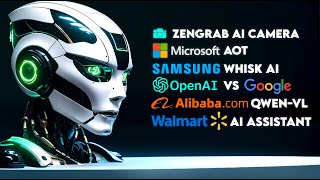
Microsoft's Algorithm of Thoughts improves AI problem-solving, Google launches Synth ID to watermark AI images, and OpenAI releases ChatGPT Enterprise without training on customer data. Cornwall tested LaneWatch AI traffic cameras on 20,000 vehicles daily and recorded over 5,000 violations in six months. Google and OSMO mapped 5,000 chemicals to human odor descriptors.
Questions this video answers
September 4, 2023.
About 20,000 vehicles per day.
Six months.
More than 5,000 violations.
About 5,000 different chemicals.
Chapters
It's been an incredible week for AI with some game changing news and in today's video we'll delve into some of the most intriguing AI stories like Microsoft's new project Algorithm of Thoughts that aims to make AIs like ChatGPT smarter, and Google's feature Synth ID designed to combat misinformation. We'll also discuss the ongoing debate between OpenAI and Google over which has the more powerful AI model. Then the news on OpenAI's ChatGPT enterprise and Alibaba's innovative AI model QENVL. We'll also take a look at Samsung's AI driven food service Whisk, an AI camera in Cornwall aiming to improve road safety, Walmart's internal AI tool My Assistant and finally, a remarkable AI system from Google and OSMO that can smell just like humans. So let's get started with our first topic. My Microsoft is working on a new project called Algorithm of Thoughts. The idea is to make AI like ChatGPT smarter and better at solving problems. AOT uses a set of rules to guide the AI in making decisions. It's like playing a game where the AI has to follow steps to win. For example, if the AI needs to summarize a long article, AOT will direct it to find the main points first, put them in simpler terms and then make sure everything makes sense. Because the AI follows these steps, it doesn't get confused or make errors as easily. This helps it learn and get better over time. Microsoft says this method is so good they used it to design a new computer chip that's specialized for AI tasks. They even made an upgraded version of ChatGPT using AOT that can handle more complex chats with people. The benefits of AOT could be big. It could speed up how computer chips are made and make AI like chatbots and digital assistants interact more naturally with people. It's could also help with creative tasks like writing. I think AOT is a big step forward in AI. What's your take? Is this exciting or does it make you nervous? Alright, moving on to our next topic, Google has introduced a new feature called Synth ID to fight misinformation. This feature places an invisible permanent watermark on images created by Imagen, Google's own text to image generator. The watermark stays even if the image is edited. This this helps identify whether an image is AI generated and there are three levels of detected, not detected, and possibly detected. The feature is currently in beta and available for some users of Vertex AI, Google's platform for generative AI. Google hopes to improve Synth ID and may include it in other products. This move comes as fake and edited images are becoming a big problem online. Google is joining other companies and in the effort to make it easier to tell what's real and what's not. The company has also launched other tools to provide more information about images found online. However, it's still a challenge to keep up with fast advancing AI technology. Okay, now let's talk about something spicy. OpenAI vs Google so the research firm Semianalysis recently published an article claiming that Google's upcoming Gemini AI model will be much more powerful than OpenAI's GPT4. The authors of the report, Dylan Patel and Daniel Nishbal, say that Google has access to much better computer chips and that makes Gemini perform better in terms of computer calculations, also known as flops. In response, OpenAI's CEO Sam Altman questioned the source of the report and hinted that the information was likely flattering because it came from Google Online. Discussions are now focused on whether having better chips advertising actually makes an AI model better. Some people argue that quality isn't just about computational power, but also includes things like training, processes and data quality. Other companies like Meta have also entered the field of large language models, and with Gemini releasing later this year, the competition is heating up. One user pointed out that 2024 will be an interesting year to see which AI model comes out on top. Speaking of OpenAI, they just launched a new version of its chatbot called ChatGPT Enterprise. It's designed for businesses and it's packed with features to keep your data safe. Unlike the regular version, it doesn't use your data for training and is SOC2 compliant, which is a high standard for data security. Managers can also control who has access to it, performance wise. This new version is built on the latest GPT4 technology and can handle a lot of usage. It comes with a special code interpreter feature that helps you understand your data by creating charts or doing complicated analyses. You can even customize it using chat templates or API credits to fit specific tasks like customer service. Big companies like Canva and PWC are already using it, and OpenAI plans to add more features like code writing and image recognition. So honestly, I think this is a game changer for how businesses use AI. Okay, moving on to our next topic, Alibaba has created a new AI model called Quen Vladimir that can understand both pictures and words in English and Chinese. This AI model is really good at tasks like recognizing what's in a photo and answering questions about it. It can even tell you where a picture was taken and can handle multiple questions in a row. Quenvl is useful for many things like answering questions based on images and documents, creating captions for photos, and recognizing small details in pictures. Right now, Anyone can use Quenvl for free or for business on Alibaba's ModelScope platform. Alibaba says this is the first AI model like this in China and one of only a few in the world. I think Alibaba has done something really cool here. This AI could be very helpful in many areas, especially in China where there's a big need for AI technology. Alright, this one is interesting. Samsung has introduced a new service called Whisk that uses AI to help you with everything related to food. Available in over 80 countries, it picks recipes that you'll like, adjusts them for serving size, and even helps you shop for ingredients. Whisk uses AI to personalize personalize your food choices and recipes based on your preferences, dietary needs and available ingredients. For example, Whisk can suggest recipes that match your taste, budget and health goals. It can also adjust the recipes according to the number of servings, the cooking time and the nutritional value. It can work with your online grocery store to make your shopping list and even connect to your smart fridge and oven to keep track of what you have and how your cooking is going. Samsung says Whisk can save you time, reduce waste and help you make tasty and healthy meals. I think Whisk sounds really helpful for making cooking easier and since everyone enjoys food, this app could be a hit. Okay, moving on to our next topic. AI Camera in Cornwall for Road Safety Cornwall is a county in England that has recently installed an AI camera that can detect traffic violations such as mobile phone use and seatbelt offenses. The camera is called LaneWatch AI and it is developed by a company called Zengrab. LaneWatch AI is a smart camera that can capture high quality images of vehicles and drivers in real time. It uses AI to analyze the images and identify any violations or anomalies. For example, it can recognize if a driver is holding a phone, wearing headphones or not wearing a seatbelt. It can also detect if a vehicle is speeding, tailgating or changing lanes without signaling. It then sends the images and the details of the violations to the authorities who can issue fines or warnings to the offenders. Zengrab says that their camera can help improve road safety and reduce accidents by deterring dangerous driving behaviors. It is currently being tested in Cornwall as part of a pilot project and it is located on a busy road near Newquay Airport where it monitors around 20,000 vehicles per day. The project has been running for six months and it has already recorded more than 5,000 violations. Zengrab says that LaneWatch AI has received positive feedback from the local community and the police, and they hope that their camera will be adopted by more regions and countries in the future. But what do you think? Do you support projects like this? Let me know in the comments below. Alright now Walmart is giving its corporate workers an AI tool called My Assistant to help them get work done faster. The tool can quickly summarize documents and help with projects. The aim is to free workers from boring, repetitive tasks so they can focus on making the customer experience better. While other big companies like Amazon and Apple haven't fully adopted this tech in their offices, Walmart is going all in. Walmart is already using AI in other ways too. They have chatbots for customer service and a voice assistant in stores to help employees find items. They also have AI cameras at self checkout to prevent theft. The CEO said they plan to use more AI to understand customers better and improve how they manage stock. The company believes the benefits of using AI like this are greater than any downsides and that both people and technology are needed to achieve their goals. Okay, moving on to our final topic. Scientists from Google Research and a startup called OSMO have made an AI system that can smell like humans do. They used a neural network to teach the AI how to describe the smell of about 5,000 different chemicals. The AI did this by looking at the chemical structures and linking them to smells like fishy or whiny. This AI is really accurate and often even better than people at describing smells. The team made a principal odor map, or pom, which the AI uses to guess the smell of new chemicals. The guesses are usually really close to what people say. This AI could help us understand more about how our brain works with smells. It could also be used to create new scents for products. And that's it for today. If you found this interesting, please like the video and subscribe for more news on AI. Don't forget to hit the bell so you know when new videos are up. Thanks for watching and see you in the next one.










