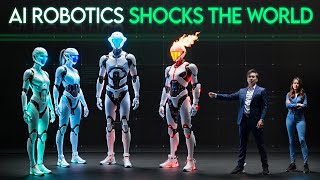
A short-form YouTube discussion (two speakers) surveying recent AI robotics advances across multiple domains. Highlights include Lucidsim — an MIT generative-simulation system that trained a quadruped to perform parkour with a reported 100% success vs 70% for traditional sims; Johns Hopkins’ use of imitation learning to train the DaVinci surgical robot from hundreds of surgery videos to perform stitching, tissue lifting, and needle use; Agility Robotics’ humanoid Digit (height 5.9, mass 72 kg) deployed in logistics with a current charge:work:charge ratio of 4:1:4 and a target 10.1; autonomous lifeguard robots in Luohe City (Hefei Institute) and Shark Eye drones (UC Santa Barbara) for coastal monitoring; an AI humanoid robot (Ida) sold a portrait of Alan Turing for $1,084,800 in Nov 2024; University of Liverpool chemistry robots using NMR and UPLC‑MS to run hundreds of experiments (e.g., thiourea library); and Nvidia’s Jetson Thor platform slated for early 2025 to accelerate humanoid robotics (industry partners named). The piece emphasizes practical deployments, measured performance gains, and commercial/ethical implications.
Questions this video answers
Lucidsim: 100% success; traditional simulations: 70% success.
Hundreds of videos (stated as 'hundreds' in the narration).
Stitching, lifting tissue, and using a needle.
Height: 5.9 (units stated in narration as '5.9 tall'); Mass: 72 kilograms.
Current ratio: 4:1:4 (4 minutes work : 1 minute charge : 4 minutes work); Target ratio: 10.1.
Chapters
This past week in AI robotics has been incredible. Robot dogs are mastering parkour with generative AI. Humanoid bots like Digit are revolutionizing logistics. And surgical robots are performing tasks with human like precision. We've got AI lifeguards saving lives 24, seven chemistry bots conducting hundreds of experiments autonomously. And even a robot created portrait of Alan Turing selling for over $1 million. Plus Nvidia's Jetson Thor platform is set to supercharge the next generation of humanoid robots. It's a week of mind blowing breakthroughs. So let's talk about it.
First up, let's talk about robot dogs and generative AI. Teaching robots to adapt to new environments has always been a headache. You could use real world data, but gathering that is super expensive and time consuming. Digital simulations sound like a great alternative, but they don't always translate to real world success. Enter Lucidsim, a groundbreaking system developed by MIT researchers. Lucidsim uses generative AI models combined with a physics simulator to create ultra realistic virtual training environments. These environments mimic real world conditions like lighting, weather and even the textures of objects. Think about it. AI models describing settings as detailed as an ancient alley lined with teahouses or a sunlit lawn with dry patches. Lucidsim takes these descriptions and maps them into 3D training grounds, teaching robots to navigate tricky obstacles. The results? Stunning. A four legged robot trained on Lucidsim nailed tasks like climbing stairs and locating objects. In one test, it found a traffic cone with a 100% success rate compared to just 70% for traditional simulations. And MIT plans to use this system for more ambitious goals like training humanoid robots. So eventually, robots will be handling tasks in cafes or factories with the precision of a well trained barista. Sounds crazy? Well, researchers are already working on it. Now let's move from the streets to the operating room. At Johns Hopkins University, researchers have trained the DaVinci surgical system robot using imitation learning, a method where robots learn by observing human demonstrations. Hundreds of videos from real surgeries were used to teach the robot three critical tasks. Stitching, lifting tissue and using a needle. What sets this apart is that the robot doesn't rely on manual coding for every move, a process that can take years for complex procedures. Instead, it analyzes patterns from the videos to replicate techniques and even adapt in real time. For instance, if it drops a needle, it picks it back up and continues a feature that wasn't explicitly programmed but learned through observation. The results are impressive. The robot matched human performance across tasks and showed consistent precision, reducing the risk of errors. This approach eliminates the need for time consuming programming, making it scalable for more surgical procedures. The researchers aim to take this further by enabling robots to perform full surgeries autonomously in the future. This breakthrough not only improves accuracy, but also has the potential to address shortages of skilled surgeons globally offering high quality surgical care even in remote locations. Speaking of human like robots, let me introduce you to Digit, the humanoid robot from Agility Robotics. This teal colored bot stands 5.9 tall, weighs 72 kilograms, and looks, well, let's just say its legs are backward. But that's intentional. Digit is designed for logistics and manufacturing, tackling tasks like moving boxes in warehouses. One of Digit's standout features is its versatility. Unlike traditional robots that rely on wheels, Digit uses feet to navigate. This means it can climb stairs, walk across uneven surfaces, and move in spaces where wheeled robots would struggle. To make it even more adaptable, its arms can be swapped out for different tasks, whether it's moving boxes in a warehouse or handling delicate items. This flexibility has already attracted big names like GXO Logistics and the Schaeffler Group, who are deploying fleets of digits to handle repetitive, physically demanding tasks. Here's something fascinating Digit doesn't rely on verbal commands, especially in noisy factory environments. Instead, it takes instructions via an iPad, showing just how much thought has gone into its usability. And while its current charge to work ratio is 4:1:4 minutes of work for every minute of charging, the company is targeting a 10.1 ratio soon. That could be a game changer, allowing Digit to work longer shifts with without frequent breaks. Thanks to large language models LLMs powering its AI, Digit can adapt to new tasks and environments more efficiently over time. Now let's switch gears to something life saving AI powered robot lifeguards In Luohe City, Henan Province, China, researchers from the Hefei Institute of Physical Sciences have developed an autonomous robot lifeguard designed to operate 24. 7 without human intervention. This robot utilizes artificial intelligence, big data and navigation technologies to monitor designated water areas continuously. Equipped with a life saving buoy and a rescue arm, it can detect drowning incidents and respond swiftly, potentially within critical time frames. Similarly, in Santa Barbara, California, the University of California's Benioff Ocean Science Laboratory has introduced Shark Eye AI drones that patrol coastal waters to detect and monitor shark activity. These drones capture real time footage analyzed by machine learning models to identify shark presence, providing timely alerts to lifeguards and beachgoers, thereby enhancing safety measures. These developments highlight the growing role of AI in augmenting traditional lifeguard duties, offering rapid response capabilities and continuous monitoring to improve water safety alright, now let's talk about a groundbreaking moment in the art world. An AI robot named Ida recently made history by selling a painting for over $1 million at Sotheby's. The artwork, a portrait of Alan Turing, the father of modern computing, fetched an astonishing $1,084,800, far exceeding its pre sale estimate of $120,000 to $180,000. This November 2024 sale marked the first time a humanoid robot's creation was auctioned, signaling a major milestone in the growing fusion of AI technology and the global art market. Another significant event occurred in 2018 when Christie's auctioned portrait of Edmond de Bellamy, an AI generated artwork by the Paris based collective Obvious. The piece sold for $432,500, vastly exceeding its initial estimate of $7,000 to $10,000. This sale brought widespread attention to AI's potential in art creation and its market value. These instances underscore a broader trend where AI generated art is gaining recognition and commanding high prices in the art market. The success of such artworks raises questions about creativity, authorship and the evolving role of technology in artistic expression. If you think robots are confined to logistics or art, think again. At the University of Liverpool, researchers have developed a pair of robots that autonomously perform and analyze chemical reactions. These robots are equipped with advanced AI driven decision making capabilities, making them more like lab assistants that never need a coffee break. They're designed to handle the nitty gritty tasks of chemical synthesis, product analysis and even planning the next steps in experiments, all without human intervention. Here's how they work. These robots are equipped with tools like nuclear magnetic resonance and ultra performance liquid chromatography, mass spectrometry, UPLC Ms. This combo allows them to cross check chemical data for accuracy, avoiding the false positives and negatives that can slow down research. For example, they recently synthesized a library of thioureas, analyzed the results and autonomously decided whether to replicate, scale up or tweak the experiments. The robots even use AI algorithms to adapt to unexpected outcomes, making decisions almost as intuitively as a human researcher would. Except they don't sleep or get tired. Over just a few days, these bots performed hundreds of experiments that would take a team of humans weeks to complete. And they're not limited to simple tasks. With modular tools and robust algorithms, they can tackle complex multi step reactions, even in fields like supramolecular chemistry. The implications are massive. These robots could revolutionize drug discovery, materials science and chemical manufacturing by dramatically cutting down costs and timelines. Alright now. Nvidia is stepping up its robotics game with Jetson Thor, a powerful computing platform launching in early 2025. Built specifically for robotics, it's designed to fuel the next generation of humanoid robots, enabling them to interact autonomously with humans and adapt to their environments with greater intelligence. Jetson Thor is the latest in Nvidia's Jetson lineup, known for its compact AI computing platforms. While earlier versions were used in drones and IoT devices, Thor focuses exclusively on robotics. It leverages advancements in computer vision, natural language processing and machine learning, allowing robots to see, learn from experiences and respond to complex situations. This means robots won't just execute pre programmed tasks, they'll adapt dynamically, like collaborating in workplaces or assisting with caregiving. Nvidia isn't building robots themselves, but partnering with manufacturers like Tesla, Siemens and Universal robots. For instance, Tesla's humanoid robot Optimus relies on Nvidia's tech, with limited production planned for late 2025. While challenges like sensor technology and ethical considerations remain, Nvidia's VP of Robotics, Deeputala, acknowledges this is a long term journey. Alright, let me know what you think in the comments and if you enjoyed this. Make sure to like and subscribe for more AI updates. Thanks for watching and see you in the next one.