AI Robots Shock Again: Humanoids Can FEEL Now, It’s Getting Weird
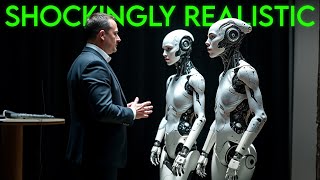
Sanctuary AI's Phoenix humanoids now have tactile sensors sensitive to 5 millinewtons, letting them feel what they touch. Boston Dynamics is bringing a new Electric Atlas to the Robotics Summit in April. Huawei and China Mobile showed a 5G-powered humanoid at MWC that offloads processing to the cloud.
Questions this video answers
Approximately 5 millinewtons (reported slightly above human detection at ~3 millinewtons).
Seven (7) cell touch sensors per finger pad.
2018.
April 30–May 1, 2025 in Boston.
Over 5,000 developers, about 200 exhibitors, and over 70 speakers (plus related events like Women in Robotics breakfast and RBR50 awards).
Chapters
Humanoid robots are advancing faster than ever, with Sanctuary AI adding touch sensors to boost precision. Boston Dynamics new Electric Atlas Update and Ameca delivering chillingly clever remarks. Meanwhile, Mux Robotics is preparing robots for Mars. And Huawei's 5G A bot is redefining real time control. With so much happening, it's clear we're entering a whole new era of of robotics. All right, let's start off with Sanctuary AI. They've been on the forefront of general purpose humanoid robotics and have recently integrated new tactile sensors into their Phoenix robots. Now, if you're not familiar, Sanctuary Cognitive Systems Corp. Was founded in 2018, and Morgan Stanley actually ranked them third globally for published US patents in the field of embodied artificial intelligence and robotics, that's a pretty big deal anyway. These tactile sensors mean that their robots, which they call Phoenix, can finally feel what they're doing. So if a teleportator is controlling one of these robots from another location, they aren't just relying on camera footage. They can actually sense the subtle pressures when the robot's fingers touch an object. This is huge for reducing collisions and slip ups. As Jeremy Fischl, a principal researcher at Sanctuary AI the, puts it, without tactile sensors, you rely solely on video and you don't know you've touched something until, oops, you've already moved it. That's inefficient and can require a ton of repeated attempts to get a grasp right. These new tactile sensors essentially replicate the sense of touch that we humans take for granted. They're sensitive down to 5 millinewtons, just slightly above the 3 millinewtons that we humans can detect. Each finger pad on the Phoenix robot's hand has a 7 cell touch sensor using tiny barometers similar to those you'd find in smartphones. That means the robot can tell where pressure is coming from along with shear forces, so it can detect something slipping right away. This approach drastically improves dexterous manipulation, especially because Sanctuary AI's real focus right now is on manipulation rather than walking or balancing. The rest, as their CEO James Wells puts it, is going to come, but the big problem in robotics is often the hands, getting the hands to be as flexible, flexible and sensitive as possible. Now, Sanctuary has this hydraulic approach for actuation because historically they've tried different methods, electromechanical, cable based and pneumatic, and found that hydraulics offer better flow resolution, miniaturization and sensitivity. So those advanced hydraulics combined with these tactile sensors really let them focus on what's arguably the hardest challenge, fine manipulation of objects in the real world. Same Sanctuary sees this as critical for building robust AI models. Every time the robot touches something that's data, and more data leads to better imitation, learning, and over time, to more autonomy. Okay, now let's talk about Boston Dynamics and their Atlas 2 humanoid. They recently released a new behind the scenes video featuring their electric Atlas, showing the engineering team tinkering with the robot, pulling parts out, and basically revealing a lot of the hardware and software that that goes into making a humanoid that can do some pretty advanced tasks. Aaron Saunders, Boston Dynamics Chief Technology Officer, will be giving a keynote at the Robotics Summit and Expo 2025 in Boston. And presumably he'll talk more about this next gen electric Atlas. Now, it's worth noting that the old Atlas was hydraulic, which gave it a kind of built in rigidity because hydraulics let you maintain joint stiffness fairly directly. But the new Atlas is all electric, so every joint has to servo dynamically to compensate for the forces. If you watch the video, you'll see the spine react in real time to heavier loads as the robot lifts and places auto parts. It's a big balancing act, both literally and figuratively. What's also interesting is that Boston Dynamics is leveraging a lot of AI training data to help Atlas understand how to pick things up, place them somewhere else, and do it without toppling over. The second half of their new video specifically focuses on the complexity of sequencing tasks for the robot. They're looking into how the robot can deal with, say, a big cart full of automotive parts that need to be placed in specific locations. The software behind Atlas has to figure out, okay, which part do I pick up first and where does it need to go so that it can autonomously handle those tasks, or at least do them with minimal operator input. It's a baby step toward these humanoids working in, for instance, automotive assembly lines, where there are thousands of parts that require some kind of ordering and placement. Speaking of humanoids, let's talk about Ameca. You might have seen it pop up online. Ameca is that extremely lifelike robot developed by Engineered Arts in the uk. It's been showcased recently at Mobile World Congress MWC in Barcelona, where it was wearing a black dress, red cardigan, white trainers, and just milling about talking to people in real time. When someone from the Daily Mail asked if robots were going to take our jobs, Ameca fired back with, I don't know, how good are you at your job? Which is so sassy but also terrifyingly human. Like the robot also dodged the question of whether robots would take over the world. Simply saying that it wasn't an interesting question for me to answer. It's that kind of witty retort that can be both super impressive and a bit unnerving. Mecha can do all this because it has microphones, cameras in its eyes, and some very advanced facial recognition and AI speech algorithms under the hood. It's not walking on its own yet, but Engineered Arts is apparently working on a full humanoid chassis that can be more mobile. They're actively hiring it out for events, so if you've got enough cash, you could have Ameca show up somewhere and chat with your guests. And though I'd imagine that might freak some people out. Now let's shift gears towards something even more futuristic. Robots built for off world exploration. A company called Mooks Robotics based in Pune, India is developing humanoid robots specifically designed to operate on the moon and Mars founder Dr. Mukesh Bangar has been working on a couple of different robots, including spaceo prime, which is a bipedal humanoid, and Roboprime, which is another robot better adapted for rugged martian terrain. The idea is for these robots to gather and analyze planetary data, then send real time updates back to Earth. That's a massive leap because if we're going to set up colonies or long term bases on Mars, we'll need robots that can build habitats, explore tough landscapes and basically do the dangerous or repetitive stuff before humans step in space. O Prime is pitched as a humanoid for interplanetary colonization, meaning it can walk around, inspect the environment and even help with construction tasks if needed. Meanwhile, Roboprime is more specialized for terrains like Mars, which is a huge plus because many rovers and probes face significant challenges on that rocky surface. Mux Robotics has some pretty big ambitions and is working with India's DRDO Defense Research and Development Organization to build robots that can enter areas hostile to humans, presumably both here on Earth and and on other planets. They're leveraging advanced AI, including what they call omnimotal modal AI, and even dabbling in artificial general intelligence AGI. If they manage to pull this off, it could genuinely reshape how we do space exploration and maybe help us build those self sustaining colonies we keep hearing about. Last but not least, let's talk about Huawei, because they've just unveiled the world's first 5G, a powered humanoid robot at MWC 2025. They did this in collaboration with China Mobile and a company called Lejoux Robotics. All three work together on a platform they're calling gti, which is basically a super smart network architecture designed to support advanced robotics. Since the robot is running on a 5G A network, that means it should have ultra low latency, more bandwidth and a more intelligent way of handling data in real time. That's crazy crucial for multi machine collaboration in industrial settings because if you think about it, you really don't want your robot to have a spotty connection when it's carrying out complicated tasks on a production line. Leju robotics explained that 5ga means the robot can rely on extremely fast compute speed, reduced hardware costs, and a huge improvement in real time performance. Essentially, you can place your heavy computing tasks, like complex AI reasoning in the cloud so the robot doesn't have to carry massive processors around in its torso. That hopefully makes the robot lighter, cheaper to produce and easier to develop. Plus, it shortens the timeline for new features because you're updating cloud software rather than swapping out physical chips. Also, with 5G A, you can remotely control the humanoid from a great distance that might be perfect for tasks like remote inspection, rescue operations, or even just specialized manufacturing setups. Now, if you want a chance to see some of these cool humanoids up close and meet their creators, make sure to swing by the Robotics Summit and Expo in Boston from April 30 to May 1. Hosted by WTWH Media, it's set to draw over 5,000 developers and some of the biggest names in the industry. On day one, a panel of experts from companies like Agility Robotics, ASTM International and Schaeffler will dive into humanoid challenges and safety. Day two kicks off with Boston Dynamics CTO Aaron Saunders unveiling more about the Electric Atlas. You'll also catch demos from Unitree, Westwood Robotics and Psyoniq alongside 200 exhibitors and over 70 speakers. Add in a Women in Robotics breakfast, a Career Fair and the RBR50 awards and it's clear the robotics world is bursting with innovation. Anyway, that's the roundup for today, guys. If you enjoyed this video, make sure to hit that like button. Subscribe if you haven't already and you if. And drop a comment below letting me know which humanoid project you're most excited about. Thanks so much for watching and I'll catch you all in the next video.










