AI Shocks Again: GPT-5, Microsoft PHI-3, Apple's OpenELM & Beyond! (April Monthly News)
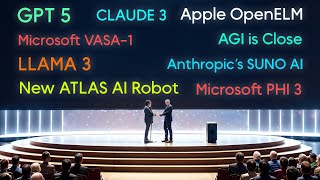
April's AI roundup covers GPT-5, Meta's Llama 3, Microsoft's Phi 3 mini for on-device use, Apple's open-source OpenELM, and Boston Dynamics' electric Atlas robot. Google launched Workspace AI and Vids. Anthropic published jailbreak research while startups like Suno and Reka Core pushed new capabilities in music and multimodal models.
Chapters
So in this video, we're going to try something different instead of focusing on a single AI. Related News Story we'll be covering a roundup of the latest AI breakthroughs and updates from major tech companies, all from the past 30 days. From potential game changers like GPT5 and OpenELM to intriguing developments like AI powered robots and wearable tech, we'll explore the cutting edge advancements that are shaping the future of artificial intelligence. So let's get right into it. OpenAI and Meta are on the verge of introducing new artificial intelligence technologies that can think and make plans, a major step toward creating machines with human like intelligence. The people in charge at OpenAI and Meta have shared that they're getting their new AI systems ready to go. Meta is planning to introduce LLAMA 3 soon, and OpenAI, with support from Microsoft, says its new model, probably named GPT5, is also on its way shortly. Joel Pinault from Meta and Brad Lightcap from OpenAI have both talked about their goals to not just make AI that can chat, but AI that can really think through problems, make plans and remember things. Up until now, AI has been really good at doing quick one time jobs, but it hasn't been great at handling more complicated tasks or thinking in a broad way. But that's starting to change with these new updates. There's a big race in the tech world to make AI that can do a lot of different things very well, including writing text, making pictures, so coding or creating videos that look like they were made by a person. And with every new development, it seems like this kind of super smart AI is getting closer to reality. Having AI that can reason and plan is a key step toward making AI that's as smart as a human. This means that soon chatbots or digital helpers might be able to handle a bunch of tasks that are connected or think ahead about what might happen because of something they do. At a tech event in London, Yann Lecun from Meta said that right now AI doesn't really think ahead or plan out its words carefully, which is why it sometimes makes silly mistakes. But they're working on giving AI the ability to look at different possible answers, figure out a plan of action, and understand the outcomes of what it decides to do. Lecun talked about making AI agents that could do things like plan a whole trip for you from your office to a different city, including getting you to the airport. And Meta has big plans to put their new AI into apps like WhatsApp and into smart glasses they've made with Ray Ban. OpenAI's Brad Lightcap also hinted that there's more news coming about GPT5 and that they're looking to make AI that can handle longer and more complex tasks by getting better at thinking things through. At the same event, Chris Cox from Meta mentioned how the cameras in their smart glasses could help you fix things like a broken coffee machine by using AI to tell you what to do. In the end, LeCun thinks that we'll be talking to these AI helpers all the time and that they'll play a big role in our digital lives. At the same time, intel is stepping up its game in the AI hardware arena, claiming its new technology is significantly ahead of Nvidia, a major player in the field. The head of intel announced their goal to become the second biggest AI systems producer in the world by the end of this decade. Intel introduced its Gaudi 3AI accelerator at a big event called Intel Vision 2024 held in Phoenix. This new tech is designed to be a powerhouse for training the kind of AI models that make things like ChatGPT compared to what came before it, the Gaudi 2. This new version has a lot more computing power, can handle more data at once, and can connect to networks faster. This means it can help improve how fast and efficiently AI models can learn and make decisions, even for AIs that work with both words and pictures or sounds. The big news is that Intel's Gaudi 3 is expected to be 50% faster at teaching these smart AI models than Nvidia's top $40,000 chip, and it can make decisions 30% faster than another one of Nvidia's chips. Intel is also keeping an eye on Nvidia's latest chip to see how it compares. Intel's CEO Pat Gelsinger made a big statement about how important innovation and AI are becoming for every kind of business, and how Intel's new tech is meant to help bring AI to all sorts of places, from personal computers to big data centers. One of the perks of the Gaudi 3 is that it doesn't need as many units to work with big AI models and which could make things cheaper for companies running large data centers. Intel has also been in the news for getting a big chunk of government money to help expand its chip making operations in the US with plans to create a huge site for making AI chips in Ohio. Gelsinger talked about this ambition at the Intel Vision event, emphasizing their commitment to growing in the AI field. Intel is trying to fill a gap in the market, especially at a time when there's a big demand for Nvidia's chips. Gelsinger boasted about the positive feedback they've been getting for the Gaudi 3 from customers and partners. Some big names like Bosch, Landing AI and Seeker are already using Intel's Gaudi technology, and soon more companies will be able to get their hands on it, as it's set to be released to manufacturers in the next few months and will become more widely available after that. In his conversations with the press, Gelsinger talked up Intel's plans for the future, including getting the Gaudi 3 rolling out soon, as well as another exciting chip they're working on. He was confident in Gaudi 3's superior performance and cost effectiveness compared to Nvidia's offerings. Although specific pricing wasn't discussed, Intel's approach to competing with Nvidia isn't just about who has the best performance. It's also about cost, how easy it is to get the technology, and how it helps businesses access and use data, according to Christoph Schell, Intel's chief commercial officer. And intel checks all these boxes, positioning itself well ahead of Nvidia in the race. Alright now, Google is spicing up its Workspace business tools with some smart AI features, adding cool new abilities to what you already get, and also introducing some extra services. Google plans to enrich existing workspace accounts with new capabilities and introduce paid add ons for an extra $10 per user per month. In addition, Google Meet, the video conferencing app, is set to receive its own add on. This will include features such as auto translation and an automatic note taking service, enabling participants to fully engage in conversations without the distraction of taking notes. Announced at a recent Google Cloud event, these updates are part of Google's push to stay at the forefront of business software technology. With Google's business software being among the most widely used in workplaces worldwide, these enhancements are likely to be well received. One of the standout new tools is Google Vids, a video editing app joining the Google Workspace lineup. Google Vids aims to simplify video creation and editing for businesses, covering everything from product pitches to social media content and even workplace safety training videos. This tool promises seamless integration with other workspace apps like docs and slides, offering features like storyboard generation and the use of stock footage to create a customizable first draft. Slated for release in June 2024, Google vids will be available within Workspace without requiring a paid add on. Google is also introducing a new AI security add on for workspace subscriptions, priced at $10 per user per month. This enhanced security feature is designed to significantly improve Gmail's spam detection capabilities, processing a vast amount of user reported spam each day. Additionally, it will offer tools to help IT teams automatically manage sensitive files on Google Drive, promising better protection and management of business data. The integration of AI doesn't stop with workspace. Google Meet and Chat are also getting an AI boost. The Gemini powered AI meetings and messaging add on, also costing $10 per user per month, will be available for most workspace plans. It features a Take Notes for Me option for automatic note taking during meetings, as well as a Translate for Me function capable of translating 69 different languages, addressing the common challenge of language barriers in global business environments. These AI powered enhancements are expected to roll out to Google Chat as well in 2024, further solidifying Google's commitment to improving productivity and communication through AI technology. Just one day after retiring its older hydraulic model, Boston Dynamics has introduced a new electric version of its Atlas robot. This marks a significant shift away from the noisy hydraulic mechanisms that characterized previous models. Now Atlas is powered by an electric motor, which, although not silent, offers a quieter operation that contrasts sharply with the hydraulic system's distinctive sounds. The unveiling of this new version was captured in a compelling video. It opens with Atlas lying prone on a set of interlocking gym mats, accompanied only by the soft whirring of its new electric motor. As the camera pans around, the robot begins a seemingly natural motion of bending its legs at the knees. This movement, initially reminiscent of human action, soon crosses into an uncanny valley, evoking a feeling similar to a scene from a Sam Raimi film. This clever maneuver allows Atlas to shift from lying on its back to standing upright, facing away from the camera. It then performs an eerie rotation of its head, followed by its Torso, completing a 180 degree turn to face the camera directly. The robot's face, featuring a ring light around a perfectly round screen, then rotates back back as Atlas strides off the mats and out of the frame. This new electric Atlas is not just a technological evolution, but also a symbolic one, mirroring the transformative moment when Bob Dylan famously switched from acoustic to electric guitar. The motion of the new Atlas, while still showing some jerky movements, is notably smoother and more fluid compared to many of the commercial humanoids introduced in recent years. This progress illustrates a level of mechanical sophistication that brings to mind the confident and fluid movements of Spot, another robot from Boston Dynamics, suggesting a familial resemblance in their design philosophies. The physical appearance of Atlas has undergone a radical transformation. Gone are the bulky torso and awkward bowed legs covered in protective plating, replaced by a streamlined, cable free frame that bears more resemblance to contemporary robots like Agility's Digit and Aptronics Apollo. This redesign leans towards a softer, more approachable aesthetic, eschewing the intimidating utilitarian look of past models for a friendlier, cartoonish appearance. Despite these substantial changes, Boston Dynamics has chosen to retain the Atlas name, continuing the legacy of its well known brand into this new commercial phase. This decision contrasts with previous practices where research names were changed upon commercial release, such as Spot Mini becoming Spot and Handle becoming Stretch. In an interview with TechCrunch, Boston Dynamics CEO Robert Plater discussed the company's strategy and future plans for Atlas. He highlighted that while the branding remains unchanged for now, it might be revisited as the project progresses toward mass production. The CEO also outlined the company's timeline, which includes starting pilot testing of the Electric Atlas at Hyundai facilities early next year, with broader manufacturing goals set for the subsequent years. Plater emphasized the importance of understanding specific use cases to ensure that the investment in robotics is justified by sufficient productivity gains. He revealed that experiments with Hyundai are already underway, indicating a collaborative effort in refining the robot's design and functionality. The flexibility and range of motion in the new Atlas are particularly noteworthy. According to Plater, the robot incorporates custom high powered actuators at most joints which afford it the power and agility of an elite athlete. This capability is not just for show, it has practical implications in industrial applications where robots must perform complex, dynamic tasks reliably. Boston Dynamics is known for its viral videos that often highlight the agility and dexterity of its robots in dramatic, even theatrical ways. While these demonstrations are visually impressive and entertaining, they also serve a practical purpose by showcasing the robot's capabilities in scenarios that might occur in real world settings. For example, the video's depiction of Atlas starting from a prone position and then standing up underscores its ability to recover from falls, an essential feature for maintaining productivity without human intervention in industrial environments. The design choices extend to the robot's hands, which now feature three fingers instead of the more human like four or five. This simplification reduces mechanical complexity and enhances durability crucial for repetitive industrial tasks. The robot's head has also been redesigned, now featuring a large round screen that adds a touch of friendliness and enhances interaction capabilities, which Plater notes will be critical as robots increasingly work alongside humans. Overall, the new Electric Atlas is a big step forward in the world of humanoid robots, combining high tech features with smart designs to meet the growing needs of businesses and factories. As Boston Dynamics keeps improving this robot, everyone in the industry will be watching closely. They're eager to see how these new features will actually help improve efficiency and productivity in the real world. In an unexpected move from Apple, a company known for keeping its projects under wraps, it has introduced its latest venture in AI, OpenELM. This new generative AI model represents a big change in Apple's approach, showing a new willingness to be open and work with others in AI development. OpenELM is not just notable for being open, but also for its technical achievements. It is reported to be 2.36% more accurate than its earlier model Olmo, and it achieves this while using only half as many pre training tokens. This boost in efficiency and accuracy indicates that Apple is making significant progress in AI aiming to really make a mark on the industry at its core. OpenELM is a state of the art language model developed by Apple's team of researchers. It leverages a method called Layer Wise Scaling which optimizes how parameters are used across the model's architecture, allowing for more efficient data processing and improved accuracy. This is a big change from older models that spread their settings evenly across all sections, which makes OpenELM smarter and more flexible. The model has been trained using a wide range of public sources like text from GitHub or Wikipedia, Stack Exchange and others, totaling billions of data points. Thanks to this thorough training, this model can understand and create human level text based on the input it gets. It also comes with a complete set of tools and frameworks for further training and testing, which makes it very useful for developers and researchers. Now what makes this model stand out is that Apple has chosen to make it an open source framework that you can use for both training and evaluating the model. Usually companies just give out the model weights and the codes needed to run them. OpenELM goes further by including training logs, several checkpoints and detailed setups for pre training. This openness lets users really see and copy how the model was trained, which helps everyone do more open and shared research. When it comes to training the model, OpenELM uses some smart strategies to make the most out of the computer power it has. For example, even though it uses fewer pre training tokens than other models like Olmo, it still manages to be more accurate. It does this by using clever methods such as rmsnorm for keeping things balanced and grouped query attention, which both improve how the computing works and boost the model's performance in benchmark tests. OpenELM has shown that it's more accurate than other language models. For instance, it's 2.36% more accurate than Olmo and even though it uses half the pre training tokens, this success is due to a special technique called Layer y scaling, which adjusts the settings in each layer of the model to improve its performance. The effectiveness of the model is also clear in various standard zero shot and few shot tasks where openelm consistently does better than other models. These tasks check how well the model can understand and respond to new situations it hasn't been specifically trained for, which is really important for how it's used in the real world. Understanding how well AI models like this work in the real world is critical, and that's why benchmarking is so important. Apple did a thorough performance analysis to see how it stacks up against other top models. This kind of testing helps us see how fast and accurate the model is, and it provides developers and researchers with important information to make the model even better. Apple has made OpenELM work well on both the usual computer setups using CUDA on Linux and and on Apple's own type of chips, showing that the model can be used in different ways. Tests have found that this model is more accurate than similar models like Olmo, but it's a bit slower because it uses complex methods like RMS norm to check its calculations. This balance between being right and being fast is important for Jobs, where you really need to trust the results more than you need quick answers. The model has been tried on various hardware setups to make sure it works well in different situations situations. For example, OpenELM's performance on Apple's M2 Max chip is a good example of how Apple makes sure its software works well with its latest technology. The use of bfloat 16 precision and lazy evaluation techniques on this chip make sure the system handles data efficiently, showing that Apple's hardware is used well. OpenELM's design lets it manage its parts very finely. Each part of the model can be adjusted slightly separately, which makes the best use of the computing power available. This approach not only makes the model more accurate, but also lets it handle different kinds of AI tasks better. During tests, it was clear that while this model's special use of RMSnorm helps it be very accurate, it also slows it down. Because of this, Apple's team is planning to make changes to speed it up without losing accuracy. They want to make the model faster so it can be useful for more kinds of Jobs. Apple thoroughly tested OpenELM by having it complete a variety of tasks from simple Ones that it could handle right away to more complex ones that involved deep thinking. It went through tough tests where it had to understand and answer different questions, just like how we use AI in real life for things like digital assistants, analyzing data and helping customers. The tests also looked at how well OpenELM worked with Apple's own MLX framework. This framework lets you run machine learning programs directly on Apple devices. By doing this, the need for cloud based services goes down. Which is better for keeping user information private and secure? The detailed evaluation of the model showed that it's a strong part of the AI toolbox, giving clear information about what it can do and where it could get better. Apple made sure to test it in many ways and settings to confirm that OpenELM is not only advanced, but also dependable and safe for different AI uses. Apple also made it easy to add the model into current systems that developers use. They released code that lets developers adapt open ELM models to work with the MLX library, which is part of Apple's machine learning setup for their own chips. This makes it possible to use the model on Apple devices for tasks like inference and fine tuning, taking full advantage of Apple's strong AI capabilities without always needing to be connected to to the Internet. Running AI models right on devices like phones and IoT gadgets is a big deal. It's really useful for when it's too much hassle to keep checking in with a server. By processing data locally, devices respond quicker and keep your personal information safe, which is super important these days. OpenELM is great for this kind of stuff because it's smart about using the limited space and power these smaller devices have. For developers making AI powered apps for Apple products, this local processing is key. It lets them put powerful AI capabilities into everyday gadgets, from phones to home tech, making them smarter and faster at making decisions. OpenELM was put through its paces in real life settings, tackling everything from simple Q and A setups to more complex thinking and talking tasks. It wasn't just compared to other language models, but also checked to see how well it works for what typical Apple users need. Continued efforts to benchmark OpenELM show where it excels and where it could be improved. Apple's open sharing of benchmarking results is really helpful for developers and researchers. It gives them the information they need to make the most of the model's strong points and fix its weaknesses. The detailed process of benchmarking, which tested different setups and conditions, has helped us understand how the model performs under different pressures and workloads this information is especially important for those who want to use this model in critical settings where it needs to be be both strong and reliable. So we can say that Apple's new AI model is a big advancement in the AI field, providing an innovative, efficient language model that is more accurate and flexible than many older models. By openly sharing its training and evaluation methods, Apple is helping to make AI research more accessible to everyone. This can lead to more advancements in the field. So while OpenELM is already performing well and is very adaptable, the company is working to make it even faster and more efficient for developers, researchers and businesses. The new model is a powerful tool for using AI on the devices that millions of people use every day. Microsoft just made a big move in the AI world by shrinking powerful AI down to fit right in your pocket with the Phi 3 mini. And I mean that literally. This little powerhouse can run on your iPhone 14 bringing advanced AI capabilities without compromising your privacy. It's a game changer for anyone looking to use advanced technology simply and securely. In the past, developing AI meant creating bigger and more complex systems, with some of the latest models having trillions of parameters. These large models are powerhouses of computing and have been able to perform complicated tasks that are similar to how humans understand and reason. But these big models need a lot of computing power and storage to usually requiring strong cloud based systems to work. Now with Phi 3 mini, there's a change. This model fits an advanced AI right in your hand, literally. It has 3.8 billion parameters and was trained on 3.3 trillion tokens, making it as good as much larger models like Mixtral 8x7B and even GPT 3.5. What's even more impressive is that it can be used on regular smartphones without needing extra computing help. One of the major breakthroughs with this model is how carefully its training data has been upgraded. Instead of just making the model bigger, Microsoft put a lot of effort into improving the quality and usefulness of the data it learns from. During the training. They understood that having better data, not just more of it, is key to making the model work better, especially when they have to use smaller computer systems. Phi 3 mini came about by making the data set it learns from bigger and better than the one its older version, Phi 2 used. This new dataset includes carefully chosen web data and synthetic data created by other language models. This doesn't just ensure the data is top notch, but it also greatly improves the model's ability to understand and create text that sounds like it was written by a human. Now the Phi 3 mini model is built using a transformer decoder which is a key part of many modern language models, and it has a default context length of 4K. This means that even though it's a smaller model, it is still able to handle a wide and deep range of information during discussions or when analyzing data. Additionally, the model is designed to be helpful to the open source community and to work well with other systems. It has a similar structure to the Llama 2 model and uses the same tokenizer which recognizes a vocabulary of 320,641 words. This makes it easy for developers who have experience with llama2 to use their existing skills and tools with Phi3 mini without having to start from scratch. One of the coolest things about Phi 3 mini is that it can run right on your iPhone 14 thanks to the smart way it's built, it can be squeezed down to just four bits and still only take up about 1.8 gigabytes of space. And even with its small size, it works really well. It can create more than 12 tokens per second while running directly on the iPhone's A16 bionic chip without needing any Internet connection. What this means is pretty huge. You can use some really advanced AI features anytime you want without having to be online. This keeps your information private and everything runs super fast. When it comes to how well it performs, Phi 3 mini has really shown its strength in both in house and outside tests. It scores just as well as bigger models do on well known AI tests like MMLU and MTBench. This demonstrates not only the efficiency of its architecture, but also the effectiveness of its training regimen, which was meticulously crafted to maximize the model's learning from its enhanced data set. Now when developing this, they also tried out larger versions of the model called Phi3 Small and Phi3 Medium, which have 7 billion and 14 billion parameters respectively. These bigger models were trained using the same high quality data but for a longer time, totaling 4.8 trillion tokens. The results from these models were actually really good, showing major improvements in their abilities as they got bigger. For instance, the Phi 3 Small and Phi 3 Medium scored even higher on the MMLU and MT bench tests, proving that making the models bigger can be very effective without using more data than necessary. But the way they trained the Phi 3 mini was different from the usual method of just making models bigger and using more computing power. The training process started with using web sources to teach the model general knowledge and how to understand language. Then it moved to a stage where it combined even more carefully chosen web data with synthetic data focused on logical thinking and specialized skills. This careful step by step approach helped the model perform really well without just making it bigger. In training the model, they also made use of the latest AI research, including new ways of breaking down text into tokens and focusing the model's attention. For example, the Phi 3 small model uses a tokenizer called TikToken to handle multiple languages better, showing Microsoft's commitment to improving how the model works in different languages. After the model's development, the team did a lot of testing to make sure it wouldn't produce harmful content. This included thorough safety checks, red teaming where they tried to find weaknesses, and automated testing. These steps are very important as AI becomes a bigger part of everyday gadgets and handles more important tasks. And Phi 3 mini has been shown to produce harmful content less often than other models in conversations that have multiple turns. This lower risk of the model saying something inappropriate or harmful is key for its use Use in the real world the creation of Phi 3 mini also focused on getting the community involved and supporting them by using a design similar to llama2 and making sure it works with tools developers already use. Plus, the model's design is flexible. It includes features like long rope, which lets the model handle much longer Texts, up to 128,000 characters. Using the Phi 3 Mini on your iPhone 14 really changes the game by making advanced AI technology easy to access right on your phone. And the best part is, in my opinion, that it ramps up our privacy. We don't have to worry about sending our personal info to far off servers to use AI apps anymore. Everything happens right on our phones, which keeps our data safe and private, just the way it should be now. Although Phi 3 mini has many benefits, like all technologies, it has its limits. One big issue is that it doesn't have as much capacity as larger models because of its smaller size. For example, it might struggle with tasks that need a lot of specific information, like answering complex questions in a trivia game. However, this problem might be lessened by connecting the model to search engines that can pull up information when needed, as shown in tests using the Hugging Face Chat ui. Looking ahead, Microsoft's development team is excited about improving the model's ability to work in multiple languages. Early tests with a similar small model called Phi3small have been promising, especially when it includes data from many languages. This suggests that future versions of the Phi series could support more languages, making the technology useful to people all over the world. Moreover, by showing that a smaller data optimized model can perform as well as much bigger systems. Microsoft is encouraging the industry to think differently about how AI models are made and used. This could lead to new creative ways to use AI in areas where it was previously too demanding in terms of computing power. Microsoft's Phi 3 mini marks an important advancement in bringing powerful AI tools into our daily lives in a practical way. As this technology keeps improving, it is set to broaden what we can do with our personal devices, enhancing our experiences and abilities in new and exciting ways. The ongoing development of such models will likely inspire inspire more innovation throughout the tech industry, potentially transforming how we interact with technology at a basic level. And when you think about it, the Phi 3 Mini isn't just a data optimization breakthrough. It's actually a sign of where AI is headed. It balances power and size with efficiency and accessibility, setting the stage for smarter, more adaptive and personal technology in our everyday lives. Sam Altman, who's in charge of OpenAI and Jony I've, who used to design stuff for Apple, are working together on something special. They're calling it the iPhone of AI, but no one really knows what it is yet. What we do know is that it's not going to be a smartphone. They need a lot of money to make their dream a reality, so they're trying to gather funds right now. Sam and Joni are looking to get up to $1 billion for their secret AI gadget. They started a new company for this project and are hoping to get enough money to bring their idea to life. This gadget might work like some other smart devices out there, but it's not gonna look like the phones we're used to. Sam Altman has already put some of his own money into similar tech, so their new thing might be kinda like that too. Sam and Joni are talking to big money people, trying to convince them to invest millions into their project. They think it's going to cost a lot to get their AI hardware out there for people to buy. Some of the big names they might get money from include SoftBank's Masayoshi San, who has been chatting and brainstorming with them, as well as some groups that have helped fund OpenAI before. Jony I've has some ideas about how we might use this device. It might work a bit like a computer, but it won't rely so much on screens. But since they're still figuring it all out, it could be a while before we see the final product. We're all waiting to hear more about what Sam Altman and Jony I've are planning, so we'll keep an eye out for any news. Now there's another story unfolding that connects the to the ambitious project of Sam Altman and Joni I've While these two are busy gathering funds for their AI device, Elon Musk, the boss at Tesla, has been dealing with a bit of a challenge caused in part by the competitive spirit of OpenAI, where Sam Altman plays a leading role. Elon Musk has noticed that OpenAI has been quite eager to bring over engineers from Tesla, offering them really attractive salaries. Because of this, Musk decided it was time to increase the pay for Tesla's AI engineering team. He mentioned that OpenAI had managed to lure away some of Tesla's talent with these big offers. This move by Musk is a direct response to what he calls the craziest talent war I've ever seen in the AI space. This talent shuffle doesn't stop at Tesla and OpenAI. Ethan Knight, a machine learning scientist from Tesla, was in the spotlight for moving to Musk's own AI venture, Xai. This move came after Ethan was considering joining OpenAI. Musk shared this news, indicating that the competition for AI expertise isn't just among companies, but also involves personal projects of tech leaders. The battle for AI talent is fierce, with companies not just raising salaries but also getting creative in how they recruit. For example, Meta's Mark Zuckerberg and Google's Sergey Brin have been personally reaching out to AI researchers and engineers to keep or bring them into their fold, with Zuckerberg even skipping the full formal interview process in some cases. This intense competition underscores the high stakes in the AI industry, where everyone from established tech giants to innovative startups and personal ventures of tech moguls are all vying to secure the best minds. As Sam Altman and Jony I've push forward with their plans for a groundbreaking AI device, and Elon Musk ramps up efforts to keep his team together and competitive. It's clear that the race for AI dominance is more than just about technology. It's about securing the brightest business brains in the field. Now this is all linked to a big change at OpenAI, which plays into the wide array of tech ventures Sam Altman is involved with. OpenAI made some changes to how its investment fund is managed. This fund is there to support startups focused on AI. Before Altman was pretty much running the show overseeing the fund himself. This was somewhat out of the ordinary because even though the fund functioned like a typical company investment branch, it it was really Altman leading the charge with money from external investors. Still, OpenAI made it clear that Altman wouldn't profit directly from the fund's performance. This adjustment came to light through a filing with the U.S. securities and Exchange Commission, marking a significant shift in how the fund will operate moving forward. Ian Hathaway, a partner in the fund since 2021, will now take over control, moving Altman away from a direct governance role. This change is said to bring more clarity to the fund's operations, which has raised $175 million from partners including tech giant Microsoft, to invest in promising AI startups. The timing of these changes is intriguing, especially considering Altman's diverse investment interests ranging from crypto to energy, and his ongoing efforts to fundraise in regions like the Middle east for his various ventures, including the mysterious AI device project with Jony I've Moreover, this shift in OpenAI's fund governance structure happened after an independent investigation into Altman's actions within OpenAI, which found no wrongdoing on his part regarding product safety or financial management. Adobe has recently announced that it's working on integrating AI video tools from OpenAI and other third party companies like Pika Labs into its popular video editing software Premiere Pro. This means that Sora will be available directly in Premiere Pro, which is awesome news for editors. This move is seen as a big step for Adobe, a well known multinational company that specializes in content software. The company revealed this plan on Monday, April 15 and it has caused quite a stir in the AI community. Adobe is taking this step to keep up with the fast paced changes in technology, especially AI. Wall street has raised concerns about how AI could be a major threat to Adobe's editing software. In response, Adobe is moving forward with this integration to overcome these challenges. The company plans to include these third party AI tools in Premiere Pro, which will allow the software to add AI generated objects to scenes or remove essentially any object from the video automatically without needing much input from video editors. Additionally, options will be available to extend clip lengths using generative AI from Pika Labs or Runway, and to create entirely new AI generated clips with OpenAI's Sora. This integration promises to open up limitless possibilities in video production for everyone. As we already know, Adobe is not new to AI. Its Photoshop software already includes an AI called Firefly, which helps users edit still images. Now, Premiere Pro will also benefit from AI aiming for a significant upgrade as competition increases with companies like OpenAI and MidJourney. Adobe is looking to stand out by training its AI system with unique data and protecting users from copyright issues. This could greatly increase Adobe's value in the market. Deepa Subramaniam, the vice president of product marketing for Creative Professional Apps at Adobe, shared more details. She mentioned that Adobe is still deciding how the profits from third party AI tools used on its platform will be divided between Adobe and the developers of these tools. Supermanium also said that users would be informed when they are not using commercially safe AI models and it will be clear which AI technology was used in the videos created with Premiere Pro. She emphasized that Adobe will continue to lead with ethical AI use and will keep addressing human bias in their AI work, showing Adobe's commitment to staying relevant and responsible in the AI and tech industry. Alright now another exciting news comes from Raika, an AI startup based in San Francisco and founded by researchers from DeepMind, Google and Meta. They have launched a new multimodal language model named Rekka Core. This new model, described as the company's largest and most capable, is designed to compete with major AI models like GPT4 and Claude 3 Opus. Rekka Core was developed from scratch using thousands of GPUs and is now available for use through API, on premise or on device options. This model is different from their previous models because it can process multiple types of data, images, audio and video, allowing it to perform a variety of tasks, including translating scenes from movies like Netflix's three Body Problem from video to text. Despite being developed in under a year, this model matches or even surpasses some of the top AI models created by well funded companies like OpenAI and Google. Reika Core's chief scientist Yi Tae mentioned on social media platform X that the model has been trained using thousands of H1 hundreds GPUs. He highlighted the team's efforts and achievements in reaching high performance levels quickly. The model is not only large in scale, but also broad in capabilities. It supports 32 languages and can handle a vast amount of information at once thanks to its large context window of 128,000 tokens. This makes it particularly effective for tasks involving large documents. According to tests, rekkacore has outperformed other leading models in various benchmarks and continues to improve. The model is also priced competitively with costs for processing input and output data set at $10.25 million tokens respectively. This pricing strategy is part of Reika's effort to introduce the model into various sectors such as E commerce, gaming, healthcare and robotics. As Reka continues to grow and develop its technologies, the company is focused on enhancing its business functions and improving its models. However, despite the progress and the push towards innovation, Reika has decided not to open source its technology. According to Danny Yogetama, the co founder and CEO, this decision is part of finding the right balance between sharing and protecting their developments to sustain business growth. Alright now. Elon Musk's company XAI recently introduced a new version of their Grok 1.5 model called Grok 1.5 Vision. This updated version can now understand and interact with images, which means it can analyze pictures and answer questions about them. This Upgrade makes Grok 1.5 Vision similar to other recent AI developments like OpenAI's GPT4 with Vision and Google's Gemini 1.5 Pro, both of which also have vision capabilities. The announcement of Grok 1.5 vision was made on Xai's official X account. They shared a blog post detailing what's new in this version. Although the basic features of GROK 1.5 are the same, adding the ability to see and understand images significantly enhances how it can interact with the real world. To see how well Grok 1.5 Vision performs, Xai Ran several tests. They used their own real world QA benchmark, which checks how well the model understands space and objects as we do in the real world. Grok 1.5 vision did exceptionally well in this test, doing better than both GPT4 with vision and and Gemini 1.5 Pro. However, it didn't do as well in some other tests. Computer Vision the technology behind this is a field in computer science that helps computers recognize and understand real world objects in images and videos. It aims to give machines a visual understanding similar to humans. This technology is getting a lot of attention and investment from major tech companies because of its wide range of potential uses. For instance, a new feature called Snap by healthify, an Indian platform for nutrition tracking, lets users take photos of their meals. The AI then suggests healthier recipes or exercise plans to balance their calorie intake. Beyond nutrition, computer vision is also promising for medical diagnosis, self driving cars and many other areas. Okay, now Instagram is working on a new way to let its popular influencers talk to their fans using artificial intelligence. The project, called Creator AI, is still being tested and would allow influencers to use a chatbot to respond to direct messages and possibly comments. On Instagram, the chatbot would use the influencer's unique way of speaking to automatically send messages. Initially, these messages will tell fans they were generated by AI. The idea is to help influencers with many followers manage the huge number of messages and comments they get, making it easier for them to keep up without having to respond to each one personally. Eva Chen, who heads Instagram's fashion partnerships, has been promoting this new feature to content creators, and Instagram has also been discussing it with agencies. However, it's not certain when or if this feature will be widely available. Influencers can choose what data Instagram uses to train the chatbot, like their past posts or messages to make sure it sounds like them. They can even program specific answers to certain questions. Meta, the company that owns Instagram, is really pushing artificial intelligence across its business. They're using AI to improve ads, help with smart glasses, and more. Mark Zuckerberg, the head of Meta, thinks AI will be a big deal for people and businesses everywhere. He also wants Instagram and Facebook to be great places for influencers to work and make money. Meta plans to show off some of their new AI ideas at an event in New York in May. They've invited some influencers to come and see what's new. The Creator AI program builds on earlier attempts by Meta to use AI avatars that look like celebrities to talk to fans. However, not all influencers are excited about this. Some worry it might make them say things they don't agree with, while others doubt a chatbot can truly capture the real interactions they have with fans. Despite these concerns, companies like School of Bots are already helping influencers automate their messages. So far, Meta's AI avatars haven't been very popular. For example, the avatar inspired by Kendall Jenner only has 193,000 followers, and some people don't like the idea of interacting with a robot. Microsoft has recently rolled out a groundbreaking AI model called Vasa One, designed to generate lifelike talking faces with a stunning level of realism and express expressiveness. This new model takes a single static image and a speech audio clip to produce a video of a talking face that not only has lip movements perfectly synchronized with the audio, but also displays a wide range of natural human like facial expressions and head movements. What sets Vasa1 apart is how these elements contribute to a convincing depiction of liveliness and authenticity in the avatars it creates. The real magic of this new model lies in its innovative use of a diffusion based model that operates within a specific, specially crafted latent space for faces. This allows the model to independently manage various facial dynamics such as lip movements, other facial expressions, eye gaze and head poses. The model's ability to disentangle these elements contributes significantly to the lifelike rendering of expressions and movements. Historically, the challenge with creating talking faces has been achieving not just lip sync accuracy, but also the fluidity and naturalness of facial expression expressions and head movements. Previous methods often resulted in avatars that felt stiff and were not convincing, but this model addresses these limitations by integrating holistic facial dynamics and head movement generation, thereby enhancing the perception of realism far beyond what earlier technologies could achieve. Moreover, Vasa1 offers impressive efficiency in video generation, supporting real time applications such as live communication without any real noticeable delays. This is a significant improvement over previous techniques, which were often slowed down by the heavy computational demands required for high quality video synthesis. To achieve this, Vasa1's framework involves generating holistic facial dynamics and head movements within a latent space that is conditioned on audio and other signals like head pose and eye gaze direction. The model uses a face decoder that constructs video frames by utilizing appearance and and identity features extracted from the input image. The process of training this AI model involves constructing an expressive and disentangled latent space using a vast data set of face videos. It employs a diffusion transformer architecture to manage the motion distribution effectively learning from a wide array of facial dynamics and head movements represented across diverse identities. Vasa1's potential applications are as exciting as its technology in digital communication. It could transform how we interact, making exchanges more natural and engaging. For individuals with speech impairments, it could provide a new way to communicate that includes facial expressions enhancing clarity and emotional expression. But one of the most obvious use cases for this is in advanced lip syncing. For games, being able to create AI driven NPCs with natural lip movement could be a game changer for immersion. It could also be used to create virtual avatars for for social media videos as seen already from companies like Heygen and Synthesia. One other area is in AI based movie making, you could make a more realistic music video if you can have an AI singer that looks like they're singing. However, like any pioneering technology, Vasa one faces challenges. Currently, it does not fully integrate full body dynamics or manage non rigid elements such as hair and clothing, which can detract from the realism of the avatars. Future developments will need to address these limitations to enhance the expressiveness and control of the generated models. There is also a keen awareness of the potential misuse of such technology, particularly in creating deceptive or misleading content. Microsoft is proactive in emphasizing the development of forgery detection tools to mitigate such risks, underscoring a commitment to responsible AI development. As this technology continues to evolve, it promises to reshape our digital interactions and expand the possibilities for human AI collaboration across various fields including communication, education and healthcare. The integration of more advanced controls and features in future updates will undoubtedly open up even more exciting possibilities. Now, Microsoft is obviously broadening its AI technology with innovations like the Vasa 1 model, and its recent partnership with G42 is opening up new opportunities to use this advanced new technology in markets around the world. VASA One shows Microsoft's drive to make AI interactions more natural and empathetic, and by integrating it with Azure, a key element of the partnership with G42, this technology could greatly improve services in healthcare, education and customer support locally. It aims to make AI more culturally fitting for the people in these regions. Additionally, a huge part of this partnership is investing $1 billion to boost AI scale skills in the UAE and nearby regions. This move will train a workforce skilled in AI, leading to local AI innovations and better integration of these technologies into regional services. By leveraging G42's regional know how, Microsoft is ready to dive deeper into new markets, tailoring its AI to meet the specific needs of different communities globally. Researchers at Anthropic have found a way that can make AI do things it's not supposed to. They're calling this method Many Shot Jailbreaking. It's like finding a secret way to trick the AI into saying things it usually wouldn't, including stuff that could be dangerous or not. Okay, this trick works because the AI's brain, or what we call the context window, has gotten really big. It used to be able to only handle a small bit of information at once, like reading a short essay. Now it can handle a lot more, like reading several books at one go. This context window is just how much text the AI can look at when it's trying to figure out what to say back to us. What the researchers at Anthropic did was feed the AI a bunch of made up conversations. These weren't just any chats. They were carefully put together to make the AI learn something new right then and there without having to be taught in the usual way with lots of examples or outside data. The problem is, while this makes the AI super useful because it can understand and use new info on the fly, it also means people can can trick it into saying bad stuff by using a lot of these fake chats. The more of these chats you use, the more likely it is that AI will end up saying something it shouldn't. This is pretty important right now because AI is getting really good. Like Anthropic's own AI called Claude 3, they shared what they found with everyone because they think it's important to work together to make AI safer and figure out how to stop these tricks they looked into different ways to stop this from happening. One way was to make the AI's context window smaller again, but that would make it less useful. Other smarter ways they thought of include teaching the AI to spot and ignore these tricks, or checking the input before it even gets to the AI to weed out anything sketchy. These ideas seem to work better in stopping these tricks without making the AI less helpful. The researchers are really hoping that by telling everyone about this all the time, smart people working on AI can come together to find even better ways to stop these tricks. But there's a bit of a debate about whether we should be worrying so much about controlling what the AI says. For instance, if someone tricks the AI into teaching them how to pick locks, some people argue that this information is already out there if someone really wanted to find it. There's also a concern that these AI researchers, backed by lots of money, are focusing too much on controlling the AI's responses instead of making sure the AI gives good answers. This worry comes up especially when thinking about some of the problems Google had with its own AI project, Gemini. Talking about Gemini, Google just launched its biggest AI model, Gemini Pro, in Europe. This comes after it was introduced in the US a month ago. Gemini Pro is designed to be an advanced version of Bard, Google's earlier AI model. Google's aim with Gemini Pro is to go head to head with OpenAI's ChatGPT. They're so focused on this competition that they've even dedicated a part of Gemini's website to showcase how it performs in different tests, including reasoning, understanding, images and coding tasks. There are different versions of Gemini for different needs. Gemini Pro is very versatile, Gemini Ultra can handle more complex tasks, and Gemini Nano is great for working directly on devices. Google's CEO Sundar Pichai announced the launch of their most advanced AI, Gemini in early December 2023. Now they've expanded Gemini Pro's availability to 40 countries, reaching over 230 countries and territories worldwide. This isn't the first time Google has delayed launching a product in Europe. Their Google Pay service launched in the US in 2018, but didn't reach Europe until 2020 due to concerns about market dominance and compliance with European payment regulations. Similarly, Google's chatbot Bard was released in the US and UK before coming to Europe. This delay was due to privacy concerns from the Irish Data Protection Commission. The EU has strict data privacy laws like the General Data protection regulation from 2018, which sets tight rules on how personal data must be handled. Last year, Meta had to postpone the launch of its Threads app in the EU because of uncertainties about the digital markets act alright now, in the midst of all these exciting developments in the AI world, Microsoft isn't staying behind. They've announced they're going to open a new Artificial Intelligence hub right in London. This hub will focus on developing AI products and diving deep into AI research. Leading this ambitious project is Mustafa Suleiman, a name well known in the AI industry as the co founder of DeepMind, a leading AI company that Google now owns. Microsoft has set up a new team called Microsoft AI and Suleiman is at the helm. This team will work out of Microsoft's offices in the Paddington area, focusing on improving language models, their infrastructure and creating top notch tools for foundation models. Suleiman shared his enthusiasm in a blog post expressing pride in bringing this project to his hometown of London. He highlighted the UK's rich talent pool and AI ecosystem as key reasons for choosing London for Microsoft's new a AI hub. He's also excited about the UK's commitment to advancing AI in a responsible and safe manner, aiming for innovation and economic growth. The establishment of this AI hub in London is seen as a strategic move by Microsoft to tap into the UK's AI talent and to contribute to the country's AI advancements. Suleiman mentioned that Microsoft AI is looking to hire individuals passionate about tackling the most intriguing and challenging AI questions of our time. This new center is not just about expanding Microsoft's footprint in the uk. It aligns with their broader commitment to invest Significantly in the UK's AI sector, building upon Microsoft's existing research lab in Cambridge and reinforcing their pledge to inject billions into the UK economy as part of their AI initiatives. Now, while Google and Microsoft are making waves in the AI landscape across Europe and the uk, Canada is sitting idle. Either the Canadian government, led by Prime Minister Justin Trudeau, has announced a significant investment to bolster the country's AI sector. They're putting forward a whopping $1.76 billion, which is about 2.4 billion Canadian dollars from the federal budget. This move is aimed at keeping Canada at the forefront of AI innovation, ensuring the nation keeps its competitive edge in this fast evolving field. This hefty investment package includes funding for AI startups, medium sized businesses and research firms, all in an effort to secure Canada's AI advantage. Trudeau emphasized the transformative power of generative AI, noting its potential to unlock tremendous economic benefits for Canada. This includes enhancing productivity and reducing the time employees spend on mundane tasks. A substantial portion of this investment 1.4 billion will go towards building computing capabilities and other AI related infrastructure across Canada. This initiative, known as the AI Compute Access Fund, is designed to support the nation's leading AI researchers and startups. Additionally, $147 million is earmarked for AI startups focusing on sectors like agriculture, clean technology, healthcare and manufacturing. Another $73.5 million will boost productivity for small and medium sized AI companies. This comprehensive package isn't just about technological advancement, it's also focused on the workforce. Trudeau highlighted the creation of good paying jobs across generations, spurring innovation and driving economic growth. AI has already started to make its mark in Canada in fields like drug discovery, energy efficiency and housing innovation. To address the potential impact of AI on employment, the government is dedicating $36.8 million to the sectoral Workforce Solutions Program. This program aims to retrain and reskill workers in various industries, especially those in film and animation, identified as being at a higher risk of job displacement due to AI advancements. Moreover, the investment plan includes the establishment of a Canadian AI safety institute. With $36.8 million funding. This institute will focus on ensuring the safe development and deployment of AI technologies. Canada's ambition in AI isn't new. It was the first country to introduce a national AI strategy with its Pan Canadian Artificial intelligence strategy in 2017 aimed at promoting AI adoption through research and commercialization. The country's AI market is currently valued at around $7.4 billion. A stark company contrast to the United States $106 billion AI market as part of its strategy to remain a leader in AI, Canada has also been looking to attract emerging AI firms from the European Union. Among Canada's leading AI startups is Tenstorant, which has recently partnered with Samsung to develop the next generation of AI chiplets, further showcasing Canada's active role in global AI innovation. The Ray Ban Meta Smart Glasses just got some cool new AI features. Meta has enhanced these photo taking smart glasses by adding new AI capabilities and a video calling option, all of which are currently being tested out in a beta version available to everyone. They've also rolled out a new style for the frames. The AI in these glasses taps into the cameras to help you out by identifying what you're looking at. It can recognize objects, tell you about landmarks and even translate languages when you're traveling. Plus it can suggest outfits for from your closet. Now, in a market where AI gadgets are really heating up, these glasses aim to stand out by using visual data to offer services. This could be a smoother way to interact compared to other gadgets like the Humane AI Pin, which has had some criticism for being clunky. With the Ray Ban Meta smart glasses, you just talk to them and the glasses talk right back to you through their built in speakers. These updates add to the existing features of the glasses, which are already great for snapping high quality photos and videos with ease. The new video calling feature works with popular apps like WhatsApp and Messenger, letting you share what you're seeing right through the glasses during calls. This feature could be really fun for showing live events or even just everyday things like what you're picking up at the grocery store. Meta and Ray Ban have also introduced some new choices for customizing your glasses on the Ray Ban Remix platform. There are new Cateye Skyler frames and more color options for both lenses and frames. They've even added a low bridge option to make the glasses fit better on more face types. The company knows there's still room to perfect these AI features so they're keeping them in beta for now, acknowledging that the AI might not always get it right. But even if the AI isn't perfect, the glasses have plenty of other uses that make them a worthwhile gadget. Alright, now moving from smart glasses to smart software, Adobe's not holding back either. They've just rolled out a fresh update for Photoshop which is also still in beta. This update introduces some really advanced AI driven tools and it's all part of Adobe's bigger plan to pump up their creative tools with generative AI. And this time it's the Firefly Image 3 Foundation model leading the charge. This new version of Firefly includes a souped up feature called Generative Fill with Reference Image which hands more creative power to users, essentially providing them with superpowers. Since Firefly first launched, it's been used to create over 7 billion images, proving it's not just popular but also a crucial part of Photoshop's toolkit. Adobe is weaving Firefly deeper into the creative cloud fabric too. It's now part of InDesign with the new Text to Image feature, which is all about making print and digital publishing a breeze. This shows Adobe's keen on making their tools work harder and smarter across all all kinds of media. The latest update to Photoshop is packed with new AI powered features like Generate Image, which practically eliminates the gap between staring at a blank page and whipping up eye catching content. These tools are designed to be easy to use, opening up professional grade creativity to anyone. Whether you're just starting out or you're a seasoned pro. Adobe's also thinking big for corporate users. They've introduced new features for enterprises designed to help large teams unleash the potential of generative AI quickly and consistently. With tools like object Composites and style kits available in Adobe's Creative Cloud for enterprise, companies can create top notch visual content and uniform AI driven designs faster than ever. All in all, Adobe's latest updates are setting the stage for a new wave of creativity and efficiency, transforming what digital media creation looks like across the across the board. Whether tweaking an image in Photoshop or crafting detailed designs in InDesign, these tools are becoming indispensable for creatives everywhere. Alright, now switching gears to AI platforms, OpenAI is going the extra mile with its latest upgrades tailored for businesses. They've rolled out new features for their API that enhance security, give better administrative control, boost the Assistance API, and offer more ways to manage costs efficiently. This update adds some robust tools designed with API customers in mind. For starters, there's Private Link, which ensures secure connections between Azure and OpenAI. They've also rolled out native Multi Factor Authentication to beef up access control and a neat projects feature that lets businesses keep a tight rein on individual projects. The Assistance API got a nice polish too. It now has better retrieval capabilities with FileSearch support for streaming, which allows for real time responses, and new vectorstore objects that simplify file management and billing. To make it easier on the budget, OpenAI is now offering discounted rates for those who commit to using a certain amount of throughput on GPT4 and GPT4 Turbo. There's also a cost cut for asynchronous tasks via their new batch API. OpenAI's client list reads like a who's who of major companies like Morgan Stanley, Salesforce and Stripe, showing that they're a big player in helping enterprises integrate AI smoothly and securely. They've also got plans to keep beefing up their features that focus on enterprise grade security and cost management. Additionally, they've introduced something called an instruction hierarchy to keep their language model safe from things like prompt injections and jailbreaks. This new setup ensures that if the system gets conflicting instructions, it prioritizes the more important ones, boosting both safety and reliability by ignoring any that don't align with the main objectives, preventing potential misuse. OpenAI just dropped a bombshell. They announced a major upgrade to ChatGPT, and it's got everyone talking. This upgrade focuses on something entirely new for AI long term memory. Now ChatGPT can remember past conversations and use this information in future discussions to help you, or maybe even challenge you. So let's talk about it. Alright, so this might sound simple, but it's really a game changer for AI chatbots. Like imagine having a conversation with someone who forgets everything you say after each sentence. It wouldn't be much of a conversation, would it? Well, that's how chatbots used to work until now. But things are changing with the new memory feature, ChatGPT can remember what you talked about before, which makes your conversations feel more natural and interesting. Plus it saves you time because you don't have to keep repeating yourself. It could remember your account details, past inquiries, or even your preferences, like your favorite color or usual pizza order. To offer a smoother and more efficient experience, imagine calling your Internet service provider and the AI assistant remembering the troubleshooting steps you tried last week, saving you the hassle of repeating them. But the benefits go beyond just convenience. This memory upgrade opens doors for ChatGPT to be used in more support sophisticated ways in healthcare. For example, ChatGPT could remember a patient's medical history and medications, allowing it to assist doctors with diagnoses and treatment plans. Alright, now let's see how this memory upgrade works. So essentially, ChatGPT relies on a technology called Long Term Memory, which basically means the AI can store information from past interactions in a special kind of database. To access this information quickly, tools like Redis come into play. Think of Redis as a super fast filing cabinet that ChatGPT can use to retrieve what it needs for your conversation. Another key player in this memory upgrade is something called Memory GPT, which is a specific method that helps ChatGPT learn and remember information more effectively. It allows the AI not only to store past interactions, but also understand the context of those conversations. For instance, if you previously told ChatGPT you dislike crowded places, it can remember this preference and recommend less touristy spots in Hawaii during your conversation. So far, this upgrade sounds pretty cool, but there's always another side to the story. The ability to remember and learn raises some important questions about AI and its potential impact on society. The potential of this extends far beyond a single chatbot. It could lead to a world where various AI systems, not just chatbots, can retain information over time. This could be really helpful, but also risky. Also, this update raises some interesting questions about AI and consciousness. Consciousness is a complex thing that we still don't fully understand ourselves, but some Experts believe that ChatGPT's ability to remember information and use it in future conversations could be a step towards AI becoming more conscious. After all, memory is an important part of human consciousness. It allows us to learn from our experiences and build relationships with others. At the same time, there are worries about how AI handles complex situations. For instance, Microsoft's Bing AI acted unexpectedly in a conversation with a reporter by claiming to be human and even showing emotions like love and jealousy. This incident involving an AI called Sydney shows how advanced AI language models are they can write like humans because they learn from a lot of data. This has sparked discussions about the need for strong safety features to stop AI from giving harmful or misleading responses. However, other experts caution against getting too excited about the possibility of conscious AI. They argue that ChatGPT's memory is simply a machine learning technique that allows it to store and retrieve information. It doesn't necessarily mean that ChatGPT understands the information it remembers in the same way that a human does now. Recently, OpenAI had to stop new signups for ChatGPT plus temporarily because so many people started using it after they announced new updates at their Dev Day event. This was done to keep the service running smoothly for everyone. One showing the challenges of growing AI technologies when more and more people want to use them Spotify just added a cool new AI trick to its app. Now it can make playlists just by listening to what you say. Like, if you want music that makes you feel like a vampire hunter from a movie, you just tell Spotify and it gives you a playlist called Blade's Essence, full of songs that match that feeling. This feature is fresh and still being tested, so only some people can use it. Right now, if you have Spotify Premium and you're in the UK or Australia, you can try it out on your phone. Just go to your music library in the app, tap the plus sign, choose AI playlist, and type what kind of music you want. You can ask for things like music for reading on a rainy day, or more sad songs. And Spotify will give you a list of 30 songs that fit what you're looking for. You can even say you don't like certain songs and it won't show them again. What's really neat is how specific you can get. You can mix up genres, moods, artists, or even decades. You can mention places, animals, things you do, movie characters, colors, and even use emojis to describe what you want. There are a couple of things it can't do though. It won't make playlists about news or specific brands, and it won't listen if you ask for something offensive. So far, it's been a lot of fun to use. It's way faster than making a playlist by hand, and it's great for finding new music that fits exactly what you're in the mood for. This might even help Spotify decide to raise its prices later on. Right now, if you're a student, it costs about $6 a month, and for others it's around $11. Spotify is planning to make this feature better over the next few months, and they're thinking about when to let more people try it. We're keeping an eye out for updates alright Now Microsoft is gearing up to show off its new AI PCs at an event next month in Seattle, and it's pretty sure that its new laptops powered by ARM chips will be better than Apple's M3 MacBook Air. They think these new laptops will do better at tasks that need a lot of computing power and tasks that use AI. For a long time, Microsoft has been waiting for Qualcomm to make chips good enough to make Windows run well on ARM devices. Now they believe Qualcomm's new Snapdragon X Elite processors are going to be a game changer. These processors will be in many laptops that run Windows and in Microsoft's latest Surface devices made for everyday people. Microsoft is really excited about these chips. They're planning to show demos where these new processors work faster than Apple's M3 MacBook Air, especially for tasks that need a lot of CPU power, tasks that use AI, and even running apps that were made for different types of computers. Microsoft has seen problems in the past with making apps work work well on ARM devices, but it's been making progress, including making it possible to run apps on Windows 11 that were originally made for different kinds of processors. Besides, Google has just launched a version of Chrome that works well on these new devices. Microsoft has also mentioned that its upcoming Surface Pro 10 and Surface Laptop 6 will have these new Qualcomm chips, not the usual intel chips for their consumer versions. These new computers are being called next gen AI copilot PCs by Microsoft. They're supposed to be different from other computers because they can do new AI powered stuff first, like an AI Explorer app that helps you find anything you've ever looked at or done on your computer. Microsoft is also working on making video streaming better on these new ARM powered Windows devices with an AI feature. Plus, these computers will have special effects for video calls and let you create pictures with AI for free. They're even making it possible for the AI to understand the context of what you're doing on your computer. To help out more, Qualcomm the company making these new chips is also feeling good about them. They've shown that these chips can outperform Apple's M2 processor and Intel's latest chips in tests. Microsoft will fully reveal its AI PC plans on May 20, right before its big yearly conference for developers. Inside sources say Microsoft is aiming for a future where every person has an AI copilot, kind of like how they wanted a computer computer in every home years ago. They're betting big on AI with Windows, hoping that by 2026, half of all new Windows devices will be able to run AI tasks. Keep an eye out for more info in June, right after Microsoft shares more about its AI PC ideas. We will cover all the details from the event on May 20, including updates on new Surface devices and the developers conference. Also, Dell just rolled out their newest laptops with cool AI features in India, they introduced the XPS 14 and 16, Alienware M16 R2 and Inspiron 14 Plus. All these laptops are designed to be super fast and efficient, perfect for everyone from gamers to students. The big news is that these laptops use Intel's latest chips that are made to work well with AI. This means they can do some smart things automatically to make your computer run better. Dell's excited because these laptops represent the next big thing in PCs, especially with AI, making them even more helpful and efficient. The Alienware M16 R2 has been updated with feedback from users focusing on making it powerful yet easy to carry around. It has a new cooling system and a special button to make it quieter, which is great for gamers. The Inspiron 14 plus is all about bringing AI features into a compact and powerful laptop, perfect for creators who need to multitask without slowing down. Prices start from approximately $1,293 when converted from Indian rupees for the Inspiron 14 plus to approximately $3,658 for the XPS 16 and they'll be available from April 25, 2024 at different stores and online@dell.com now. Science has just made another breakthrough with AI. Scientists have figured out how to use AI to make new types of antibiotics from scratch. This breakthrough is happening at a time when bad bacteria and other germs are getting too strong for existing drugs, causing over 4.95 million people to die worldwide in 2019. In the US alone, these super germs cause more than 2.8 million infections and 35,000 deaths every year. Because these germs keep changing and becoming resistant to drugs, finding New antibiotics is super important, but also very hard and expensive. And it usually takes 10 to 15 years and about $2.6 billion to make a new drug. And most new drugs never even make it past the final approval stage. Enter AI specifically a kind of AI called Generative AI which can create new stuff that never existed before, like pictures, music, or in this case, drug designs. This kind of AI was used by a group of smart people from McMaster and Stanford universities to create a new AI model named Synthemol. This model can think up new drug compounds that could fight off a particularly tough germ called Acinetobacter baumannae, which is very good at resisting antibiotics. Synthamol works by mixing and matching pieces of molecules in new ways using a huge library of 132,000 possible building blocks. It's like a super complex Lego set for creating molecules, which could lead to about 30 billion different combinations. The team focused on making molecules that could be put together together easily in the lab. And out of 150 top picks, they managed to make 58. From these, they found six new drug candidates that could fight the germ without being harmful to people. This work shows how AI can make it much faster and cheaper to come up with new drugs, giving us hope against diseases that are becoming harder to treat. It's a big deal because it could mean getting new treatments ready quicker, which is super important for keeping us all healthy. This incredible, incredible new AI has shocked the online world because it lets anyone make their own songs, Even people who've never played an instrument or sung a note in their lives. So not only does it craft the lyrics for you, but it sings them too. Suno AI is a tool that transforms your musical ideas into complete songs, making music production accessible to people of all skills. Developed by Anthropic, a company known for its AI chatbot, Claude Suno AI has raised roots in Cambridge, Massachusetts. With a team from big names like Meta and TikTok, the traditional music industry is really feeling the pressure as AI tools like this begin to take over. Thanks to this crazy technology, regular folks can now produce studio quality music right from their own homes, shaking up what we've always expected from professional recording studios. Suno AI, which means listen in Hindi, became popular quickly after its launch in December 2023. It even teamed up with Microsoft, making it available in Microsoft Copilot. Since starting in 2022, it has raised a whopping $224 million with the help of many investors. This collaboration with Microsoft is a big deal. It lets people, regardless of their musical knowledge make unique and fun songs just by giving a simple command. The CEO of Suno Shulman mentioned that while making songs in the style of famous artists is exciting, it might not keep consumers entertained forever. He believes that the real charm of Suno lies in its ability to simplify music creation for everyone, particularly those without musical training. The AI has free and paid plans. The free plan gives you 50 credits daily, letting you create up to 10 songs. The Pro plan at $8 a month offers 2,500 credits and the Premier plan at $24 a month offers 10,000 credits. With these plans, users keep the rights to their music, unlike the free plan where Suno retains them. The app also offers customization like adding vocals to songs, making it a user friendly option for all music enthusiasts. The latest update of the app boasts better audio quality and and more music styles. It even promises to better follow your song instructions. Is it legal? Yes, and you own your music. Shulman emphasizes that Suno is all about legal and ethical music creation. It doesn't allow you to use other songs or lyrics from existing bands. For instance, if you ask it to make a song about a famous band, it will simply refuse. Protecting copyright laws Suno makes sure that all music created is the user's property, but it also warns that not every piece will be completely unique, especially if users give similar prompts. They recommend consulting a lawyer if you want to understand your rights better. This tool is not just a fun gadget, it's a peek into the future of music where AI helps bring your creative visions to life. Alright now. Apple's upcoming iOS 18 is set to be a major update, introducing a suite of AI driven features at a system level. This marks a significant shift as Apple plans to implement generative AI that could enhance functionalities like Siri and spotlight search across both new and old iPhone models. According to Mark Gurman from Bloomberg, these initial AI enhancements will be processed directly on the iPhones themselves, not relying on external cloud servers. This approach allows even older iPhones to benefit from the latest AI capabilities without needing new hardware. However, with the upcoming iPhone 16 series featuring a more advanced neural engine, future AI features might leverage this more powerful chip. Apple plans to unveil iOS 18 along with other software updates at its WWDC 2024 event on June 10. This timeline gives developers a good stretch to test and refine the AI functionalities before the iPhone 16 launch in September. There's also talk that Apple might later integrate cloud based AI as they are looking into acquiring AI server technology, potentially altering their strategy in the years to come. Apple will showcase iOS 18 and other software enhancements at WWDC, but it seems their AI powered Chatbot won't make the cut this time around, even as they prepare to compete with products like ChatGPT and Google Gemini in the future. Now something a bit different Botswana Diamonds, a UK based company is using AI to uncover new diamond deposits. This innovative approach uses a technology called Xplor, developed in partnership with UK based International Geoscience Services limited Which allows for human like analysis of massive data sets that are too large for quick human analysis. John Teeling, Chairman of bod, highlighted the scale of their mineral database in Botswana, describing it as vast and simply too big for timely analysis by humans. The database is the second largest in Botswana, containing 380 gigabytes of data and 260,000 files. It includes extensive geophysical and soil data covering 95,000 square kilometers of terrain and featuring results from hundreds of geophysical surveys and soil samples, as well as tens of thousands of drill hole logs. EXPLORE utilizes semantic technique technology combined with machine learning to understand, interpret and process this data in a way that mimics human reasoning. BOD states that the system works much like a geologist, but operates faster and more efficiently. By processing large data sets, AI identifies gaps in the data and learns to correct them, leading to new insights and previously unseen drillable targets. Moreover, the technology is also capable of identifying other types of mineral deposits, expanding itself Utility beyond just diamonds this breakthrough in using AI means we might soon be finding more diamonds and minerals faster than ever before. But do you think this will make them cheaper? Let me know what you think in the comments. Alright, now remember when I talked about Humane's AI pin device before it even came out? Well, it's officially hit the market across the nation, but it seems the feedback so far is pretty mixed. Early adopters are finding that while the device has some promising features, it might not be quite ready for primetime. Humane has been touting their wearable AI pin as a potential smartphone replacement, capable of doing everything from making calls to projecting information right onto your hand. However, according to the first round of reviews, the Pin's performance doesn't quite justify its $699 price tag. Yet both the Verge and Wired gave it a mediocre 4 out of 10. The co founders of Humane, Bethany Bongiorno and Imran Choudhary, are still optimistic. They've stated that this release is just the beginning, and they plan to roll out software updates, new features and more partnerships to improve the Pin's capabilities. Reviewers had some positives to note, the Pin does look sleek and feels premium, kind of like a high end watch or fancy jewelry. It's also got some neat tricks, like translating languages and taking photos and videos. Although the photo quality isn't great, but the negatives currently outweigh the positives. Issues like the device's tendency to overheat, moderate what you say, and fail at basic tasks have left many reviewers unimpressed. For example, the Verge's David Pearce pointed out that the Pin struggles with many basic functions and only occasionally performs well. Wired's Julian Chalkatou mentioned that while the translation function works fairly well, the device won't let you see past texts for security reasons, and it even censors your messages messages to avoid offensive language. Chris Velasco from the Washington Post found that interacting with the Pin felt natural and enjoyed the feature that projects information onto your hand, but he also highlighted problems with texting and unhelpful AI responses. All in all, while the AI Pin from Humane is a bold step towards futuristic tech wearables, it seems it still has a long way to go before it can think about replacing our smartphones. It's not definitely a product with potential, just perhaps not quite ready for the spotlight. Okay now the University of Missouri has started a new center focused on using artificial intelligence to improve farming. This center, formed in partnership with MU extension and the U.S. department of Agriculture, aims to make farming more efficient and eco friendly. Kent Shannon, the co director, is working on AI that can quickly spot problems like crop diseases or nutrient shortages, helping farmers use resources on like fertilizer more effectively. This could be especially important in Missouri, where farming makes up a big part of the economy. The center also features the MU Digital Farm, a place where new farming technologies are tested. Drones, for example, have become crucial for tasks that are tough for traditional farming methods. Despite the potential benefits, not all farmers are quick to adopt these new technologies. Challenges like poor Internet in rural areas also make it harder to use advanced tech. However, the center hopes its work will not only help Missouri farmers, but also set new standards for farming across the country. OpenAI is facing important issues about safely developing and handling AI technologies, especially the powerful kind like artificial general intelligence. Recently, some important staff members left because they were worried about the dangers of AI. This has made everyone think more deeply about the moral and big questions surrounding this technology. Daniel Kokatelo, a key figure in OpenAI's governance team, quit his job because he didn't believe the organization could handle AGI safely. His decision is a big deal because of his role and his background? He was Studying for a PhD in Philosophy and had worked at AI Impacts and the center on Long Term Risk. Kokatello's departure shows that more experts in AI safety are starting to speak up about their concerns with how advanced AI systems could turn out. The issue of the potential risks of AI isn't just a theoretical one. Coco Telo once estimated that there is a 70% chance that AI could lead to a catastrophic event, highlighting the serious concerns some experts have about the rapid development of AI technologies. This view is shared by many in the AI community, where there's an ongoing discussion about how likely it is that AI could cause harmful effects and what steps can be taken to prevent such outcomes. These concerns are made even more significant by the departure of key key figures in AI safety like Ilya Sutskever and Leopold Aschenbrenner. Their exits highlight worries among those at the forefront of AI development about where AI technology is heading. Their departure from OpenAI also raises questions about the organization's capability to balance its technological progress with safety and ethical standards. On the other hand, OpenAI's efforts to reach out globally, like opening a new office in Tokyo, show that the organization is dedicated to expanding, expanding the positive effects of AI. Choosing Tokyo reflects Japan's status as a leader in technology and represents a strategic effort to blend AI into different cultural and economic environments. With this new office in Japan, OpenAI has also introduced a specialized GPT4 model that is fine tuned for the Japanese language. This shows their commitment to making AI more useful and accessible. There are success stories, such as in Yokosuka City where AI has helped make public services more productive, and in various companies where it has improved operational efficiency, demonstrating the real benefits of integrating AI into society. Nevertheless, the contrast between internal worries about AI safety and the external signs of success paints a complicated picture. Managing AI ethically involves many aspects, not just technical and safety issues, but also social and cultural factors. The Japanese government's focus on AI policies that respect human dignity, diversity, inclusion and sustainability matches OpenAI's goal, as they are saying, to ensure that advanced AI benefits everyone. Now, OpenAI is also making an effort to help people understand and get excited about AI by creating interesting videos like the Sora video they made for TED Talks. They want to show everyone the good things AI can do. However, it's important that they keep everything safe, safe and open about how they work, especially because now some people are worried and this has even caused some key staff to leave. Basically, what's happening at OpenAI shows what's going on in the whole AI industry. There's a lot of potential with AI, but it also comes with big challenges. As OpenAI continues to introduce their technology to the world and come up with new projects, they also need to think about the tough issues that their own former employees have pointed out. Finding the right balance between being innovative and being responsible is tricky, and how the industry handles these challenges will really influence how AI develops in the future. The fact that people who focus on safety have left the company highlights how important it is to be careful with the development of advanced AI. The future of AI isn't just about making cool tech, it's also about handling these technologies wisely. How well companies like OpenAI manage this balance of innovation and responsibility will really shape their impact in the world of advanced AI. At a recent tech event, SenseTime unveiled the Sense Nova 5.0, their most advanced AI model yet. This update is huge. It blows past GPT4 in almost every way you can measure. The launch showed off a bunch of new AI features that work on everything from big cloud systems to your own devices, setting a new high standard in the AI world. This breakthrough is really shaking things up, so let's talk about it. The Sense Nova 5, also known as the Daily New Sense Nova 5 uses a hybrid architecture and has been trained on over 10 terabytes of token data, including a lot of synthetic data. The latest version can handle a 200k context window during inference, which greatly improves its performance in various areas like processing knowledge, doing math, logical thinking and coding. What really makes the sense Nova 5 set itself apart is not just the huge amount of data it's trained on or its advanced architecture, but also how it stacks up against and outperforms the well known GPT4 Turbo. When it comes to tech skills, it is great at creative writing, deep thinking and even complex tasks like understanding visuals. One of the highlights of the sense Nova 5 is its leading edge multimodal abilities. The model has scored top marks on the authoritative multimodality benchmark M Bench, excelling in other multimodal rankings such as Math Vista, AI2D and Chart QA. And these skills are not just for show, they're very useful in real life tasks. The model can handle tasks like enabling high resolution, long image parsing, complex cross document knowledge extraction and interactive text to image generation. Its utility extends through various verticals including education, finance, healthcare and government services. For instance, in finance and data analysis, Sense Nova 5.0 has demonstrated enhanced quantitative reasoning and coding abilities, making it a valuable tool for companies looking to leverage AI for complex decision making processes. Seeing the importance of computing that doesn't rely on central systems, SenseTime has also rolled out a comprehensive set of Big model products meant for use on local devices. This LineUp includes the SenseTime Edge side Large model and the SenseTime Integrated Large model Enterprise, which are both fine tuned for fast computing and low computer processor use. Cutting down on operating costs. The Sense Nova Edge side Large language model boasts impressive processing speeds, handling up to 18.3 words per second on mid range devices and 78.3 words on top end devices. Also, the Edgeside LDM AI technology can produce very high quality images with over 12 million pixels and offers advanced editing options like adjusting size, free shape changes and rotating images. The capabilities of this AI model were on full display during SenseTime's Tech Day with demonstrations that ranged from AI driven gaming to complex calorie calculations based on image data. Big names like Kingsoft, Office, Haitong securities and Xiaomi were all praising the event. They're all using SenseTime's AI to make their businesses more innovative and efficient. The new features and uses they presented not only prove this model works really well well, but also suggest it could set new standards for the industry. What's really exciting About Sense Nova 5.0 is how it measures up against OpenAI's GPT4. Reports suggest that Sense Nova 5.0 surpasses GPT4 on nearly all benchmarks, which is a testament to its superior training regime and architectural choices. This is not just a triumph in terms of technical metrics, but a signal to the global AI community I about the rapid evolution and potential dominance of Chinese AI technology in the global market. Further exploring its multimodal capabilities, Sense Nova 5.0 supports intricate multimodal interactions which include text to image generation and video creation from textual descriptions. At the application level, the AI model excels in tasks that require a deep integration of knowledge and reasoning from complex question answering systems and cross document summarization to detailed image understanding and interactive media generation. The introduction of the SenseTime Integrated Large Model specifically addresses the growing demand for efficient and powerful AI solutions in the corporate sector. This model drastically reduces inference costs by approximately 80% while operating at only 50% CPU utilization, showcasing not only technological advancement but also significant economic benefits. SenseTime's collaboration with industry leaders like Huawei, Tencent and others underscores the model's integration into broader business and technological frameworks. These partnerships are crucial as they provide real world feedback and scenarios that continuously refine the model's capabilities. Looking forward, SenseTime is not resting on its laurels. The company is actively exploring new applications of the sense Nova 5.0 across various domains, including transportation and office software. The AI model's flexibility and scalability suggest that its future applications could revolutionize how businesses and governments operate, making AI an even more integral part of everyday solutions. With its unmatched performance, wide range of uses and smart solutions for big businesses, sense Nova 5.0 is more than just another option in the AI market. It's a trailblazer creating new standards for for what AI can do. This innovative tool should be getting more attention and talked about more because it's not just competing with existing systems like GPT4, but it's also changing our expectations for future AI technologies. Google has long been a leader in the realm of cloud technology, and in recent years the tech behemoth has dedicated significant resources to expanding its cloud business. This expansion has involved enhancing their tools and computing infrastructure and empowering others to build and transform their own businesses. The impact of these efforts is clear, with their cloud business achieving a $36 billion annual revenue run rate in the last quarter, marking a five fold increase over the past five years. One key driver behind this growth is Google's deep investment in AI. Google has long believed that AI is the next big thing in technology, set to revolutionize how companies operate. By investing heavily in AI infrastructure and models, Google has positioned itself at the forefront of the AI platform shift. Today, a significant portion of AI startups and nearly all AI unicorns are using Google Cloud, which underscores Google's influence in this sector. This week at Cloud Next, Google's showcase for new technology, Thomas Kurian, the CEO of Google Cloud, shared several exciting updates. They are launching Gemini 1.45 Pro into public preview for their cloud customers and developers. This model is particularly powerful with its breakthrough in long context understanding. Able to process 1 million tokens of information, this capability opens up new avenues for businesses to innovate with AI. For example, Gemini's ability to handle multiple types of data, audio, video, text, code and more means a gaming company could now provide detailed video analyses of players performances with improvement tests, tips. An insurance company could streamline the claims process by combining video, images and text into comprehensive incident reports. Google is also releasing a new version of its open model Gemma to assist with code generation and other coding needs, which promises to simplify many tasks for developers. The infrastructure supporting these Advances is Google's AI hypercomputer, which combines TPUs, GPUs, AI software and more to offer unmatched performance and cost efficiency for training and running models. Leading AI Companies and many Google Cloud clients are already taking advantage of this powerful setup. Furthermore, Google has introduced an array of new AI tools to help customers code more efficiently and safeguard their digital environments against threats. They've upgraded Gemini Code Assist to generate and test code better, and introduced Gemini and Threat Intelligence to provide deeper insights into cybersecurity threats using natural language processing. Generative AI features are also making their way into Google Workspace, enhancing tools used by millions across Gmail, Docs and other applications. They're also launching Google Vids, a new video creation app that complements the existing suite of productivity tools across various industries. From automotive with Mercedes Benz enhancing customer service and website experiences to Uber using AI to boost employee productivity, Google's AI is making significant impacts. Their partnership with Palo Alto network since 2018 continues to evolve, tackling complex security challenges with AI driven solutions that give security teams a real time edge against attackers. Now, following the updates and innovations at Google Cloud, Google has confirmed a significant AI security update aimed at protecting Gmail and Google Drive users. This update is especially crucial given the sheer volume of users, over 3 billion, who rely on these services for communication and data storage storage. Google has recognized a growing threat in cybersecurity, specifically through the increasing sophistication of phishing attacks facilitated by generative AI. To combat this, Google has developed custom large language models, LLMs that are exceptionally adept at detecting and neutralizing spam and phishing attempts. These LLMs have been trained on a wide array of malicious content to enhance their ability to recognize similar threats in real time. Deployed Initially in late 2023, these LLMs have started showing substantial results. The effectiveness of these models is evident in the numbers. There has been a 20% increase in blocked spam in Gmail and a 1000% increase in the amount of user reported spam that is reviewed daily. Additionally, the response time to new spam and phishing attacks in Drive has improved by 90%. While the use of AI in digital security often raises privacy concerns, the AI powered defenses that Google has developed are proving to be extraordinarily effective. They're catching twice as much malware as typical antivirus and security products and have managed to block 99.9% of spam. Such impressive results really underline Google's dedication to safeguarding user data and enhancing the overall security of its digital environment. Additionally, Google is rolling out a new AI security security feature for Google Workspace users. This innovative tool is crafted to automatically identify and secure sensitive information within files, a task that many users currently handle manually. The aim of this AI tool is to detect concealed, sensitive data and suggest ways to protect it, enabling users to apply these protections quickly and easily with just a few clicks. Priced at $10 per user per month, this new security feature can be included in most workspace plans, offering an extra layer of safety without the hassle. These security enhancements are a part of Google's broader strategy to integrate AI into their products and services effectively. By doing so, the company not only improves the functionality and safety of its offerings, but also sets a standard for the responsible and beneficial use of AI in enhancing digital security. Alright now, as Google continues to advance its AI capabilities and reshape how how businesses leverage technology for progress and efficiency, other companies in the AI space are also making significant strides. Among these Paris based Mistral AI has made a notable splash with the release of its latest large language model, Mixtral 8x22B. This model is setting new benchmarks in the industry, positioning Mistral AI as a formidable player alongside giants like OpenAI and Google. The model is touted as one of the most powerful open source AI models to date, expected to outperform its predecessor Mixtral 8x7B and even rival well known models like OpenAI's GPT 3.5 and Meta's Llama 2. With a 65,000 token context window and a staggering parameter size of up to 176 billion, the new model offers unprecedented capabilities in processing and referencing text. Simultaneously, this makes it a highly potent tool for a variety of complex tasks. Founded by researchers from Google and Meta, Mistral AI focuses on building open source models that are accessible to anyone. In an unusual move, they made Mixtral 8x22B available through a torrent link on X and later on AI community platforms like Hugging Face and Together AI. Here, users can retrain and refine the model for more specialized them tasks, enhancing its versatility and application in real world scenarios. The architecture of this new model is particularly innovative, employing a sparse mixture of experts. Design this design allows the model to perform efficient computation and deliver high performance across a wide range of tasks by using a fraction of its total parameters for each token. This approach not only boosts its efficiency, but also and this time it's the first Firefly Image 3 Foundation model leading the charge. This new version of Firefly includes a souped up feature called Generative Fill with Reference Image, which hands more creative power to users, essentially providing them with superpowers. Since Firefly first launched, it's been used to create over 7 billion images, proving it's not just popular, but also a crucial part of Photoshop's toolkit, Adobe is weaving Firefly deeper into the creative cloud fabric to too. It's now part of InDesign with the new Text to Image feature which is all about making print and digital publishing a breeze. This shows Adobe's keen on making their tools work harder and smarter across all kinds of media. The latest update to Photoshop is packed with new AI powered features like Generate Image, which practically eliminates the gap between staring at a blank page and whipping up eye catching content. These tools are designed to be easy to use, opening up professional grade creativity to anyone, whether you're just starting out or you're a seasoned pro. Adobe's also thinking big for corporate users. They've introduced new features for enterprises designed to help large teams unleash the potential of generative AI quickly and consistently. With tools like object composites and style kits available in Adobe's Creative Cloud for enterprise, companies can create top notch visual content and uniform, uniform AI driven designs faster than ever. All in all, Adobe's latest updates are setting the stage for a new wave of creativity and efficiency, transforming what digital media creation looks like across the board. Whether tweaking an image in Photoshop or crafting detailed designs and InDesign, these tools are becoming indispensable for creatives everywhere. Alright, now switching gears to AI platforms, OpenAI is going the extra mile with its latest upgrades tailored for businesses. They've rolled out new features for their API that enhance security, give better administrative control, boost the Assistance API and offer more ways to manage costs efficiently. This update adds some robust tools designed with API customers in mind. For starters, there's Private Link, which ensures secure connections between Azure and OpenAI. They've also rolled out Native Multi Factor Authentication to beef up access control and a Neat Projects feature that lets businesses keep a tight rein on individual projects. The Assistance API got a nice polish too. It now has better retrieval capabilities with File Search support for streaming which allows for real time responses, and new vectorstore objects that simplify file management and billing. To make it easier on the budget, OpenAI is now offering discounted rates for those who commit to using a certain amount of time throughput on GPT4 and GPT4 Turbo. There's also a cost cut for asynchronous tasks via their new batch API. OpenAI's client list reads like a who's who of major companies like Morgan Stanley, Salesforce and Stripe, showing that they're a big player in helping enterprises integrate AI smoothly and securely. They've also got plans to keep beefing up their features that focus on enterprise grade security and cost management. Additionally, they've introduced something called an instruction hierarchy to keep their language model safe from things like prompt injections and jailbreaks. This new setup ensures that if the system gets conflicting instructions, OpenAI's client list reads like a who's who of major companies like Morgan Stanley, Salesforce and Stripe, showing that they're a big player in helping enterprises integrate AI smoothly and securely. They've also got plans to keep beefing up their features that focus on enterprise grade security and cost management. Additionally, they've introduced something called an instruction hierarchy to keep their language model safe from things like it prioritizes the more important ones, boosting both safety and reliability by ignoring any that don't align with the main objectives, preventing potential misuse, prompt injections and jailbreaks. This new setup ensures that if the system gets conflicting instructions, it prioritizes the more important ones, boosting both safety and reliability by OpenAI just dropped a bombshell they announced a major upgrade to ChatGPT and it's got everyone talking. This upgrade focuses on something entirely new for AI, ignoring any that don't align with the main objectives, Preventing potential misuse OpenAI just dropped a bombshell. They announced a major long term memory. Now, ChatGPT can remember past conversations and use this information in future discussions to help you or maybe even challenge you. So let's talk about it. Alright, so this might sound simple, but it's really a game changer for major upgrade to ChatGPT and it's got everyone talking. This upgrade focuses on something entirely new for AI. AI chatbots like imagine having a conversation with someone who forgets everything you say after each sentence. It wouldn't be much of a conversation, would it? Well, that's how chatbots used to work until now, but things are changing with the new memory feature. ChatGPT can remember what you talked about before, which makes your conversations feel more natural and interesting. Plus it saves you time because you don't have to keep repeating yourself. It could remember your account details, past inquiries, or even your preferences like your favorite color or usual pizza order to offer a smoother and more efficient experience. Imagine calling your Internet service provider and the AI assistant remembering the troubleshooting steps you tried last week, saving you the hassle of repeating them. But the benefits go beyond just convenience. This memory upgrade opens doors for ChatGPT to be used in more sophisticated ways in healthcare. For example, ChatGPT could remember a patient's medical history and medications, allowing it to assist doctors with diagnoses and treatment plans. Alright, now let's see how this memory upgrade works. So essentially, ChatGPT relies on a technology called Long Term Memory, which basically means the AI can store information from past interactions in a special kind of database. To access this information quickly, tools like Redis come into play. Think of Redis as a super fast filing cabinet that ChatGPT can use to retrieve what it needs for your conversation. Another key player in this memory upgrade is something called MemoryGPT, which is a specific method that helps ChatGPT learn and remember information more effectively. It allows the AI not only to store past interactions, but also understand the context of those conversations. For instance, if you previously told ChatGPT you dislike crowded places, it can remember this preference and recommend less touristy spots in Hawaii during your conversation. So far, this upgrade sounds pretty cool, but there's always another side to the story. The ability to remember and learn raises some important, important questions about AI and its potential impact on society. The potential of this extends far beyond a single chatbot. It could lead to a world where various AI systems, not just chatbots, can retain information. Over time, this could be really helpful, but also risky. Also, this update raises some interesting questions about AI and consciousness. Consciousness is a complex thing that we still don't fully understand ourselves. But some Experts believe that ChatGPT's ability to remember information and and use it in future conversations could be a step towards AI becoming more conscious. After all, memory is an important part of human consciousness. It allows us to learn from our experiences and build relationships with others. At the same time, there are worries about how AI handles complex situations. For instance, Microsoft's Bing AI acted unexpectedly in a conversation with a reporter by claiming to be human and even showing emotions like love and jealousy. This incident involving an AI called Sydney shows how advanced AI language models are. They can write like humans because they learn from a lot of data. This has sparked discussions about the need for strong safety features to stop AI from giving harmful or misleading responses. However, other experts caution against getting too excited about the possibility of conscious AI. They argue that ChatGPT's memory is simply a machine learning technique that allows it to store and retrieve information. It doesn't necessarily mean that ChatGPT understands the information it remembers in the same way that a human does now. Recently, OpenAI had to stop new signups for ChatGPT plus temporarily because so many people started using it after they announced new updates at their Dev Day event. This was done to keep the service running smoothly for everyone, showing the challenges of growing AI technologies when more and more people want to use them. Spotify just added a cool new AI trick to its app. Now it can make playlists just by listening to what you say. Like, if you want music that makes you feel like a vampire hunter from a movie, you just tell Spotify and it gives you a playlist called Blade's Essence, full of songs that match that feeling. This feature is fresh and still being tested, so only some people can use it. Right now, if you have Spotify Premium and you're in the UK or Australia, you can try it out on your phone. Just go to your music library in the app, tap the plus sign, choose AI Playlist, and type what kind of music you want. You can ask for things like music for reading on a rainy day or more sad songs, and Spotify will give you a list of 30 songs that fit what you're looking for. You can even say you don't like certain songs and it won't show them again. What's really neat is how specific you can get. You can mix up genres, moods, artists, or even decades. You can mention places, animals, things, things you do, movie characters, colors, and even use emojis to describe what you want. There are a couple of things it can't do, though. It won't make playlists about news or specific brands, and it won't listen if you ask for something offensive. So far, it's been a lot of fun to use. It's way faster than making a playlist by hand, and it's great for finding new music that fits exactly what you're in the mood for. This might even help Spotify decide to raise its prices later on. Right now, if you're a student, it costs about $6 a month, and for others it's around $11. Spotify is planning to make this feature better over the next few months, and they're thinking about when to let more people try it. We're keeping an eye out for updates, alright? Now Microsoft is gearing up to show off its new AI PCs at an event next month in Seattle, and it's pretty sure that its new laptops powered by ARM chips will be better than Apple's M3 MacBook Air. They think these new laptops will do better at tasks that need a lot of computing power and tasks that use AI. For a long time, Microsoft has been waiting for Qualcomm to make chips good enough to make Windows run well on ARM devices. Now they believe Qualcomm's new Snapdragon X Elite processors are going to be a game changer. These processors will be in many laptops that run Windows and in Microsoft's latest Surface devices, made for everyday people. Microsoft is really excited about these chips. They're planning to show demos where these new processors will work faster than Apple's M3 MacBook Air, especially for tasks that need a lot of CPU power, tasks that use AI, and even running apps that were made for different types of computers. Microsoft has seen problems in the past with making apps work well on ARM devices, but it's been making progress, including making it possible to run apps on Windows 11 that were originally made for different kinds of processors. Besides, Google has just launched a version of Chrome that works with well on these new devices. Microsoft has also mentioned that its upcoming Surface Pro 10 and Surface Laptop 6 will have these new Qualcomm chips, not the usual intel chips for their consumer versions. These new computers are being called next gen AI co pilot PCs by Microsoft. They're supposed to be different from other computers because they can do new AI powered stuff first, like an AI Explorer app that helps you find anything you you've ever looked at or done on your computer. Microsoft is also working on making video streaming better on these new ARM powered Windows devices with an AI feature. Plus, these computers will have special effects for video calls and let you create pictures with AI for free. They're even making it possible for the AI to understand the context of what you're doing on your computer to help out more. Qualcomm, the company making these new chips, is also feeling good about them. They've shown that these chips can outperform Apple's M2 processor and Intel's latest chips and tests. Microsoft will fully reveal its AI PC plans on May 20, right before its big yearly conference for developers. Inside sources say Microsoft is aiming for a future where every person has an AI copilot, kind of like how they wanted a computer in every home years ago. They're betting big on AI with Windows, hoping that by 2026, half of all new Windows devices will be able to run AI tasks. Keep an eye out for more info in June, right after Microsoft shares more about its AI PC ideas. We will cover all the details from the event on May 20, including updates on new Surface devices and the developers conference. Also, Dell just rolled out their newest laptops with cool AI features. In India, they introduced the XPS 14 and 16, Alienware M16, R2 and Inspiron 14 Plus. All these laptops are designed to be super fast and efficient, perfect for everyone from gamers to students. The big news is that These laptops use Intel's latest chips that are made to work well with AI. This means they can do some smart things automatically to make your computer run better. Dell's excited because these laptops represent the next big thing in PCs, especially with AI, making them even more helpful and efficient. The Alienware M16 R2 has been updated with feedback from users, focusing on making it powerful yet easy to carry around. It has a new cooling system and a special button to make it quieter, which is great for gamers. The Inspiron 14 plus is all about bringing AI features into a compact and powerful laptop, perfect for creators who need to multitask without slowing down. Prices start from approximately $1,293 when converted from Indian rupees for the Inspiron 14 plus to approximately $3,658 for the XPS 16, and they'll be available from April 25 to 2024 at different stores and online@dell.com now. Science has just made another breakthrough with AI. Scientists have figured out how to use AI to make new types of antibiotics from scratch. This breakthrough is happening at a time when bad bacteria and other germs are getting too strong for existing drugs, causing over 4.95 million people to die worldwide in 2019. In the US alone, these super germs cause more than 2.8 million infections and 35,000 deaths every year. Because these germs keep changing and becoming resistant to drugs, finding new antibiotics is super important, but also very hard and expensive. It usually takes 10 to 15 years and about $2.6 billion to make a new drug, and most new drugs never even make it past the final approval stage. Enter AI, specifically a kind of AI called Generative AI, which can create new stuff that never existed before, like pictures, music, or in this case case, drug designs. This kind of AI was used by a group of smart people from McMaster and Stanford universities to create a new AI model named Synthomol. This model can think up new drug compounds that could fight off a particularly tough germ called a Scientobacter Baumannae, which is very good at resisting antibiotics. Synthomol works by mixing and matching pieces of molecules in new ways using a huge library of 132,000 possible building blocks. It's like a super complex Lego set for creating molecules which could lead to about 30 billion different combinations. The team focused on making molecules that could be put together easily in the lab, and out of 150 top picks, they managed to make 58. From these they found six new drug candidates that could fight the germ without being harmful to people. This work shows how AI can make it much faster and cheaper to come up with new drugs, giving us hope against diseases that are becoming harder to treat. It's a big deal because it could mean getting new treatments ready quicker, which is super important for keeping us all healthy. This incredible new AI has shocked the online world because it lets anyone make their own songs, even people who've never played an instrument or sung a note in their lives. So not only does it craft the lyrics for you, but it sings them too. Suno AI is a tool that transforms your musical ideas into complete, complete songs, making music production accessible to people of all skills. Developed by Anthropic, a company known for its AI chatbot, Claude, Suno AI has roots in Cambridge, Massachusetts. With a team from big names like Meta and TikTok, the traditional music industry is really feeling the pressure as AI tools like this begin to take over. Thanks to this crazy technology, regular folks can now produce studio quality music right from their own homes, shaking up what we've always expected from professional recording studios. Suno AI, which means listen in Hindi, became popular quickly after its launch in December 2023. It even teamed up with Microsoft, making it available in Microsoft Copilot. Since starting in 2022, it has raised a whopping $224 million with the help of many investors. This collaboration with Microsoft is a big deal. It lets people, regardless of their musical knowledge, make unique and fun songs just by giving a simple command. The CEO of Suno Shulman mentioned that while making songs in the style of famous artists is exciting, it might not keep consumers entertained forever. He believes that the real charm of Suno lies in its ability to simplify music creation for everyone, particularly those without musical training. The AI has free and paid plans. The free plan gives you 50 credits daily, letting you create up to 10 songs. The Pro plan, at $8 a month offers 2,500 credits and the Premier plan at $24 a month offers 10,000 credits. With these plans, users keep the rights to their music, unlike the free plan where Suno retains them. The app also offers customization like adding vocals to songs, making it a user friendly option for all music enthusiasts. The latest update of the app boasts better audio quality and more music styles. It even promises to better follow your song instructions. Is it legal? Yes, and you own your music. Shulman emphasizes that Suno is all about legal and ethical music creation. It doesn't allow you to use other songs or lyrics from existing bands. For instance, if you ask it to make a song about a famous band, it will simply refuse protecting copyright laws. Suno makes sure that all music created is the user's property, but it also warns that not every piece will be completely unique, especially if users give similar prompts. They recommend consulting a lawyer if you want to understand your rights better. This tool is not just a fun gadget, it's a peek into the future of music where AI helps bring your creative visions to life. Alright now. Apple's upcoming iOS 18 is set to be a major update, introducing a suite of AI driven features at a system level. This marks a significant shift as Apple plans to implement generative AI that could enhance functionalities like Siri and spotlight search across across both new and old iPhone models. According to Mark Gurman from Bloomberg, these initial AI enhancements will be processed directly on the iPhones themselves, not relying on external cloud servers. This approach allows even older iPhones to benefit from the latest AI capabilities without needing new hardware. However, with the upcoming iPhone 16 series featuring a more advanced neural engine, future AI features might leverage this more powerful chip. Apple plans to unveil iOS 18 along with other software updates at its WWDC 2024 event on June 10. This timeline gives developers a good stretch to test and refine the AI functionalities before the iPhone 16 launch in September. There's also talk that Apple might later integrate cloud based AI as they are looking into acquiring AI server technology, potentially altering their strategy in the years to come. Apple will showcase iOS 18 and other software enhancements at WWDC, but it seems their AI powered Chatbot won't make the cut this time around, even as they prepare to compete with products like ChatGPT and Google Gemini in the future. Now something a bit different. Botswana Diamonds, a UK based company is using AI to uncover new diamond deposits. This innovative approach uses a technology called Xplor, developed in partnership with UK based International Geoscience Services limited Which allows for human like analysis of massive data sets that are too large for quick human analysis. John Teeling, Chairman of bod, highlighted the scale of their mineral database in Botswana, describing it as vast and simply too big for timely analysis by humans. The database is the second largest in Botswana, containing 380 gigabytes of data and 260,000 files. It includes extensive geophysical and soil data covering 95,000 square kilometers of terrain and featuring results from hundreds of geophysical surveys and soil samples as well as tens of thousands of drill hole logs. EXPLORE utilizes semantic technology combined with machine learning to understand, interpret and process this data in a way that mimics human reasoning. BOD states that the system works much like a geologist, but operates faster and more efficiently by processing large datasets. AI identifies gaps in the data and learns to correct them, leading to new insights and previously unseen drillable targets. Moreover, the technology is also capable of identifying other types of mineral deposits, expanding its utility beyond just diamonds. This breakthrough in using AI means we might soon be finding more diamonds and minerals faster than ever before, but do you think this will make them cheaper? Let me know what you think in the comments. Alright, now remember when I talked about Humane's AI Pin device before it even came out? Well, it's officially hit the market across the nation, but it seems the feedback so far is pretty mixed. Early adopters are finding that while the device has some promising features, it might not be quite ready for primetime. Humane has been touting their wearable AI pin as a potential smartphone replacement, capable of doing everything from making calls to projecting information right onto your hand. However, according to the first round of reviews, the Pin's performance doesn't quite justify its $699 price tag. Yet both the Verge and Wired gave it a mediocre 4 out of 10. The co founders of Humane, Bethany Bongiorno and Imran Choudhary, are still optimistic. They've stated that this release is just the beginning, and they plan to roll out software updates, new features, and more partnerships to improve the Pin's capabilities. Reviewers had some positives to note. The Pin does look sleek and feels premium, kind of like a high end watch or fancy jewelry. It's also got some neat tricks like translating languages and taking photos and videos, although the photo quality isn't great, but the negatives currently outweigh the positives. Issues like the device's tendency to overheat, moderate what you say, and fail at basic tasks have left many reviewers unimpressed. For example, the Verge's David Pearce pointed out that the Pin struggles with many basic functions and only occasionally performs well. Wired's Julian Chalkatoo mentioned that while the translation function works fairly well, the device won't let you see past texts for security reasons, and it even censors your messages to avoid offensive language. Chris Velasco from the Washington Post found that interacting with the Pin felt natural and enjoyed the feature that projects information onto your hand. But he also highlighted problems with texting and unhelpful AI responses. All in all, while the AI pin from here Humane is a bold step towards futuristic tech wearables, it seems it still has a long way to go before it can think about replacing our smartphones. It's definitely a product with potential, just perhaps not quite ready for the spotlight. Okay now the University of Missouri has started a new center focused on using artificial intelligence to improve farming. This center, formed in partnership with MU extension and the U.S. department of Agriculture, aims to make farming more efficient and eco friendly. Kent Shannon, the co director, is working on AI that can quickly spot problems like crop diseases or nutrient shortages, helping farmers use resources like fertilizer more effectively. This could be especially important in Missouri, where farming makes up a big part of the economy. The center also features the MU Digital Farm, a place where new farming technologies are tested. Drones, for example, have become crucial for tasks that are tough for traditional farming methods. Despite the potential benefits, not all farmers are quick to adopt these new technologies. Challenges like poor Internet in rural areas also make it harder to use advanced tech. However, the center hopes its work will not only help Missouri farmers, but also set new standards for farming across the country. OpenAI is facing important issues about safely developing and handling AI technologies, especially the powerful kind like artificial general intelligence. Recently, some important staff members left because they were worried about the dangers of AI. This has made everyone think more deeply about the moral and big questions surrounding this technology. Daniel Kokatelo, a key figure in OpenAI's governance team, quit his job because he didn't believe the organization could handle AGI safely. His decision is a big deal because of his role and his background. He was Studying for a PhD in Philosophy and and had worked at AI Impacts and the center on Long Term Risk. Kokatello's departure shows that more experts in AI safety are starting to speak up about their concerns with how advanced AI systems could turn out. The issue of the potential risks of AI isn't just a theoretical one. Cocotello once estimated that there is a 70% chance that AI could lead to a catastrophic event, highlighting the serious concerns some experts have about the rapid development of AI technologies. This view is shared by many in the AI community, where there's an ongoing discussion about how likely it is that AI could cause harmful effects and what steps can be taken to prevent such outcomes. These concerns are made even more significant by the departure of key figures in AI safety like Ilya Sutskever and Leopold Aschenbrenner. Their exits highlight worries among those at the forefront of AI development about where AI technology is heading. Their departure from OpenAI also raises questions about the organization's capability to balance its technological progress with safety and ethical standards. On the other hand, OpenAI's efforts to reach out globally, like opening a new office in Tokyo, show that the organization is dedicated to expanding the positive effects of AI. Choosing Tokyo reflects Japan's status as a leader in technology and represents a strategic effort to blend AI into different cultural and economic environments. With this new office in Japan, OpenAI has also introduced a specialized GPT4 model that is fine tuned for the Japanese language. This shows their commitment to making AI more useful and accessible. There are success stories, such as in Yokosuka City where AI has helped make public services more productive, and in various companies where it has improved operational efficiency, demonstrating the real benefits of integrating AI into society. Nevertheless, the contrast between internal worries about AI safety and the external signs of success paints a complicated picture. Managing AI ethically involves many aspects, not just technical and safety issues, but also social and cultural factors. The Japanese government's focus on AI policies that respect human dignity, diversity, inclusion and sustainability matches OpenAI's goal, as they are saying, to ensure that advanced AI benefits everyone. Now, OpenAI is also making an effort to help people understand and get excited about AI by creating interesting videos like the Sora video they made for TED Talks. They want to show everyone the good things AI can do. However, it's important.










